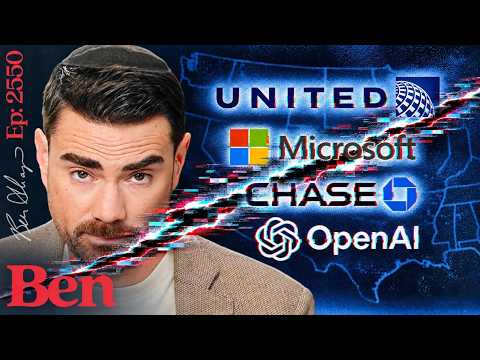
What The Hell Is Going On With The Internet Outage? Here's Everything You Need To Know.
Ben Shapiro
Summary
Ben Shapiro analyzes a wave of November service outages affecting Microsoft Outlook and Teams, the FAA, Workday, major banks, United Airlines, Apple, and the NSA. Drawing on Wall Street Journal reporting and an FBI flash advisory, he explains that AI cybersecurity and penetration tools like Mythos and Artex have accelerated vulnerability discovery, triggering an avalanche of software patches that often introduce new bugs. Shapiro criticizes conflicting statements from DHS Secretary, the FBI, Secretary of State Marco Rubio, and Vice President JD Vance, arguing that poor transparency fuels public panic.
Evaluating potential solutions, Shapiro contends that free-market competition compels private corporations to fix technical failures rapidly, whereas government officials lack technical expertise and incentives to solve problems. He also warns against cronyism between tech firms and Washington, highlighting the DOJ, Commerce, and SEC investigations into Nvidia, former CEO Jensen Huang, and Singapore-based Megaspeed over chip diversion to China.
How time-sensitive the topic is: Breaking
By the numbers
1,400 security flaws: Record number of security flaws Microsoft released patches to fix during its monthly software update last month. (Mentioned at 4:29)
170 security flaws: Number of security flaws Microsoft patched in its monthly update one year earlier. (Mentioned at 4:37)
430 million people: Number of people affected by the 24-hour Microsoft outage on November 12 that disrupted Outlook and Teams. (Mentioned at 8:00)
12,400 flights: Number of flights cancelled during a five-hour FAA ground stop caused by an L3Harris wiring replacement overload. (Mentioned at 8:17)
3 hours: Time under which the AI framework Artex can accelerate intrusions from initial targeting to privileged access, per the FBI. (Mentioned at 12:20)
2,250 downstream tenants: Number of downstream tenants facing attempted authentication during the October ConnectWise supply chain compromise. (Mentioned at 12:29)
140 billion USD: Amount by which Nvidia's loans to third-party companies to build data centers grew in Jensen Huang's last quarter. (Mentioned at 33:57)
26%: Percentage of voters who approve of President Donald Trump's handling of AI, according to CNN polling. (Mentioned at 37:02)
16%: Percentage of voters who think the Trump administration has the AI risks about right, according to CNN polling. (Mentioned at 37:17)
Questions this video answers
What caused the wave of tech and infrastructure outages across Microsoft, the FAA, and major banks?
According to Wall Street Journal reporting cited by Ben Shapiro, the disruptions stem from a combination of relentless AI-driven cyber attacks, an unprecedented surge in software upgrades, and buggy patches deployed to counter new AI bug-finding tools. Because updates happen instantaneously at scale, software flaws temporarily disrupt major systems before being rapidly debugged.
Ben Shapiro, 2:22 to 6:50
From this keypoint: AI hacking tools and rapid patching fuel bugs
Which major companies and government agencies experienced outages between November 12 and November 17?
The November timeline includes a 24-hour Microsoft Outlook and Teams outage affecting 430 million people, a five-hour FAA nationwide ground stop cancelling 12,400 flights, and disruptions at Workday, Chase, Bank of America, Wells Fargo, JPMorgan, United Airlines, Apple, the National Weather Service, and the NSA. Most of these incidents were resolved within a few hours.
Ben Shapiro, 7:53 to 10:25
From this keypoint: November outage timeline from Microsoft to the NSA
Why did the FAA issue its first full nationwide ground stop since September 11?
An FAA contractor, L3Harris Technologies, was replacing copper wiring with fiber when a system overload occurred. The five-hour ground stop resulted in 12,400 cancelled flights.
Ben Shapiro, 7:53 to 10:25
From this keypoint: November outage timeline from Microsoft to the NSA
What is the Artex AI hacking tool warned about in the FBI flash advisory?
Artex is a superintelligence-powered penetration testing framework that cyber criminals and state-aligned hackers are exploiting to automate attacks worldwide. According to the FBI, Artex can accelerate intrusions from initial targeting to privileged access in under three hours and was used in the October ConnectWise supply chain compromise affecting over 2,250 downstream tenants.
Ben Shapiro, 10:25 to 15:50
From this keypoint: Mixed messaging from Mullin, FBI, Rubio, and Vance
Why did the NSA close its campus to most employees on Tuesday night?
According to CNN reporting cited in the episode, a highly classified internal communications network at the NSA went down, prompting the agency to revert to essential personnel while restoring it. The NSA stated that the temporary degradation occurred during scheduled routine maintenance and that mission-critical capabilities remained fully operational.
Ben Shapiro, 7:53 to 10:25
From this keypoint: November outage timeline from Microsoft to the NSA
Why did the Department of Justice and Commerce Department investigate Megaspeed and Nvidia?
The Department of Commerce began investigating Singapore-based Megaspeed in 2024 for potential semiconductor export control violations involving chip diversion to China. Following an on-site inspection in June 2025 and an interview with Megaspeed CEO Alice Huang, the DOJ took the lead in a criminal investigation, while the SEC launched a civil probe into Nvidia.
Ben Shapiro, 29:44 to 36:17
From this keypoint: Nvidia board rejects Jensen Huang amid Megaspeed probe
Will Nvidia's board of directors reinstate Jensen Huang as CEO?
No, interim Nvidia CEO stated on television with Jim Cramer that the board accepted Jensen Huang's resignation and determined they will not reinstate him. In addition to the Megaspeed export controversy, Shapiro notes that Huang had expanded Nvidia's third-party data center loan portfolio by nearly $140 billion in his final quarter.
Ben Shapiro, 29:44 to 36:17
From this keypoint: Nvidia board rejects Jensen Huang amid Megaspeed probe
Why does Ben Shapiro argue the free market is better than the government at fixing AI outages?
Shapiro argues that most members of Congress do not understand AI and face political incentives to prolong problems or overregulate. By contrast, private companies face creative destruction and immediate customer loss if their services fail, compelling them to mobilize all resources to fix bugs within hours.
Ben Shapiro, 19:29 to 26:47
From this keypoint: Why free markets fix tech bugs better than government
How do American voters rate President Donald Trump's handling of artificial intelligence?
According to CNN polling presented by Harry Enten, only 26% of voters approve of President Donald Trump's handling of AI, while a clear majority disapprove. Furthermore, only 16% of voters believe the Trump administration has the risks surrounding AI about right.
Ben Shapiro, 36:17 to 39:19
From this keypoint: Voter disapproval of Trump on AI and left-wing backlash
Credible AI™ signals
Confidence: Sourced Partisan Commentary. Ben Shapiro grounds his analysis of recent infrastructure outages in reporting from the Wall Street Journal and CNN, official FBI and Department of Commerce statements, and direct video clips of public officials, though he frames the events through strong free-market and partisan interpretations.
Bias: Free-Market Conservative. The commentary strongly champions free-market solutions over government intervention, portrays Democratic figures and progressive critics as hostile to American capitalism, and criticizes both Silicon Valley culture and federal bureaucracy from a conservative viewpoint.
Originality (65%): Synthesized Market Take. While the segment relies heavily on aggregated news reports and public clips regarding tech outages and the Nvidia investigation, it connects these threads into a cohesive argument about institutional trust, market discipline, and political opportunism.
Depth (68%): Structured Policy Argument. The episode moves beyond listing service disruptions to examine the dual-use nature of AI cybersecurity tools, the economic incentives driving private sector bug fixes versus government inertia, and the risks of cronyism in tech-government relations.
Key points (9)
Short (20 min): key points 1, 2, 6 and 8
Medium (28 min): key points 1, 2, 3, 4, 6 and 8
Relaxed (36 min): all 9 key points
1. Shapiro links outage panic to institutional distrust
Timestamp: 00:00:12 to 00:02:22 (2 min)
Speaker: Ben Shapiro
Following a week of service disruptions at Microsoft, the FAA, major banks, and the NSA, public anxiety is spreading because citizens no longer trust government, media, or tech elites. When leaders fail to communicate clearly, speculation about bank runs and systemic collapse fills the void.
Impact: Medium. Why it matters: Frames the wave of technical disruptions as a crisis of institutional credibility rather than a purely engineering failure.
“And of course, the biggest thing here is that people in positions of power are not good at communicating with us and telling us what the hell is going on.”
In the video: Ben Shapiro, at 1:20
2. AI hacking tools and rapid patching fuel bugs
Timestamp: 00:02:22 to 00:06:50 (4 min)
Speaker: Ben Shapiro
Citing Wall Street Journal reporting, Ben Shapiro explains that AI tools like Artex and Anthropic's Mythos uncover software flaws at unprecedented speed, forcing companies into constant patching. While Microsoft patched a record 1,400 flaws in a month, rapid updates also introduce new bugs.
Impact: High. Why it matters: Explains the technical mechanism behind the simultaneous outages: an AI-accelerated cycle of vulnerability discovery and rushed software updates.
“Last month, Microsoft released patches fixing about 1,400 security flaws in its products during its monthly software update. That was a record. One year earlier, that number was 170.”
In the video: Ben Shapiro, at 4:27
3. November outage timeline from Microsoft to the NSA
Timestamp: 00:07:53 to 00:10:25 (3 min)
Speaker: Ben Shapiro
Between November 12 and November 17, outages hit Microsoft Outlook and Teams affecting 430 million people, an FAA ground stop cancelling 12,400 flights due to L3Harris wiring work, Workday, major banks, United Airlines, Apple, and an NSA internal network. Most were resolved within hours.
Impact: High. Why it matters: Catalogs the specific scope, causes, and rapid resolution times of the November disruptions, separating hardware accidents from software rollouts.
“So November 12th, Microsoft out outage disrupted Outlook teams and other services that lasted about 24 hours and it affected some 430 million people.”
In the video: Ben Shapiro, at 7:53
4. Mixed messaging from Mullin, FBI, Rubio, and Vance
Timestamp: 00:10:25 to 00:15:50 (5 min)
Speaker: Ben Shapiro
While DHS Secretary declared there is no cyber threat taking place, the FBI simultaneously issued a flash advisory warning that hackers are using Artex to breach systems in under three hours. Secretary of State Marco Rubio dismissed leaked threat reports and Vice President JD Vance urged calm.
Impact: High. Why it matters: Highlights how contradictory assurances and warnings across federal agencies confuse non-expert citizens and deepen public suspicion.
For: YouTube: Ben Shapiro, Marco Rubio, JD Vance
5. Vance's DealBook cancellation and AI ripple warnings
Timestamp: 00:16:50 to 00:19:29 (3 min)
Speaker: Ben Shapiro
Vice President JD Vance abruptly cancelled his appearance at the New York Times DealBook Summit just 20 to 30 minutes before departure to attend meetings in Washington. Meanwhile, Google warned that hackers use LLMs to exploit updates, and a secretary suggested self-fixing superintelligence is overloading legacy systems.
Impact: Medium. Why it matters: Shows how abrupt schedule changes by top leaders and speculation about superintelligence amplify public fears about AI.
“Well, when major figures abruptly cancel media appearances without explanation in the middle of what seemed to be a cascade of failures, again, disquing.”
In the video: Ben Shapiro, at 17:13
For: YouTube: Ben Shapiro
6. Why free markets fix tech bugs better than government
Timestamp: 00:19:29 to 00:26:47 (7 min)
Speaker: Ben Shapiro
Evaluating whether government or private industry should solve AI and tech outages, Ben Shapiro argues politicians lack technical knowledge and benefit politically from prolonging crises. By contrast, creative destruction and market competition force companies like Microsoft and Wells Fargo to fix failures rapidly or lose customers.
Impact: High. Why it matters: Articulates the core ideological thesis of the episode: consumer choice and profit risk discipline private firms far more effectively than regulation.
“I don't have to trust Sam Alman. I just have to trust that the market will punish Sam Alman if his company fails, which is true. That is one of the beauties of the market.”
In the video: Ben Shapiro, at 24:44
7. Bay Area orgy scandal hurts trust in AI leaders
Timestamp: 00:28:04 to 00:29:44 (2 min)
Speaker: Ben Shapiro
Citing Washington Free Beacon reporting, Ben Shapiro highlights that Anthropic cybersecurity researcher Paul Crowley managed Red Means No LLC, a Bay Area group hosting consensual non-consent orgies co-founded by Aella, partner of MIRI president Nate Soares. Shapiro argues such behavior alienates the public from free markets.
Impact: Low. Why it matters: Illustrates how cultural scandals inside Silicon Valley AI firms erode public confidence in private-sector tech leadership.
Interim Nvidia CEO confirmed the board will not reinstate former CEO Jensen Huang despite his public appeal. Meanwhile, the DOJ and Commerce Department detailed a criminal probe into Singapore-based Megaspeed and CEO Alice Huang over illicit chip diversion to China, while the SEC probes Nvidia's $140 billion lending surge.
Impact: High. Why it matters: Exposes the national security and financial risks of close entanglement between dominant tech firms and federal export regulators.
“The scandal is that apparently Jensen Hong using his government connections and friends in high places was able to open a loophole that allowed Nvidia to funnel either the use of sophisticated microchips or the chips themselves to our enemies in China.”
In the video: Ben Shapiro, at 30:00
For: YouTube: Ben Shapiro
9. Voter disapproval of Trump on AI and left-wing backlash
Timestamp: 00:36:17 to 00:39:19 (3 min)
Speaker: Ben Shapiro
CNN polling analyst Harry Enten reports that only 26% of voters approve of President Donald Trump's handling of AI and 16% think his administration has AI risks right. Ben Shapiro warns that without transparency, critics like the commentator and Greta Thunberg will exploit public anger against AI data centers to attack capitalism.
Impact: High. Why it matters: Connects poor administration polling on AI to a broader political vulnerability that progressive populists plan to use in the 2028 presidential race.
“The necessity for clarity in communication is so high because otherwise people like the Medihassans and the Gretenbergs get what they want which is to destroy the system wholesale.”
In the video: Ben Shapiro, at 39:08
For: Harry Enten, YouTube: Ben Shapiro, Greta Thunberg
Conflicts of interest (3)
PureTalk & Incogni Tech-Outage Sponsorships
Commercial conflict, Medium severity
Ben Shapiro reads paid sponsorships for wireless provider PureTalk and data-removal service Incogni during his analysis of tech outages and corporate data practices.
Sources: Ben Shapiro
Significance: Shapiro directly uses the episode's warnings about telecommunications reliability and Silicon Valley data tracking as transition hooks to pitch his sponsors' services.
Silencer Shop Foundation Sponsorship
Commercial conflict, Low severity
Ben Shapiro delivers a paid promotion for the Silencer Shop Foundation while criticizing federal government competence and Democratic midterm priorities.
Sources: Ben Shapiro
Significance: The sponsorship reinforces the broadcast's anti-government regulatory framing by tying federal critique directly to a sponsor's litigation against the ATF.
Daily Wire Self-Promotion and Film Trailer
Commercial conflict, Low severity
Ben Shapiro is the co-founder and host at Daily Wire, which promotes its paid subscription memberships and airs a promotional trailer at the end of the episode.
Sources: Ben Shapiro
Significance: Shapiro frames Daily Wire's editorial mission as providing clarity that powerful institutions fail to deliver, supporting subscriber recruitment.
Key sources
Ben Shapiro: Host, The Ben Shapiro Show / Daily Wire
Marco Rubio: Secretary of State
JD Vance: Vice President of the United States
Jeff Bezos: Tech executive
Harry Enten: CNN Polling Analyst
Greta Thunberg: Activist
YouTube: Ben Shapiro
Who's in this
Microsoft
FAA
National Security Agency
Anthropic
Dario Amodei
OpenAI
FBI
Google
Nvidia
Jensen Huang
Megaspeed
Alice Huang
Donald Trump
Sam Altman
Paul Crowley
Aella
Nate Soares
David Sacks
Also mentioned
Artex (First mentioned at 3:25)
Microsoft Outlook (First mentioned at 0:16)
Wells Fargo (First mentioned at 0:22)
NSA (First mentioned at 0:24)
Wall Street Journal (First mentioned at 2:22)
Red Means No LLC (First mentioned at 28:26)
Department of Commerce (First mentioned at 31:13)
Department of Justice (First mentioned at 31:13)
Workday (First mentioned at 0:19)
Chase (First mentioned at 0:19)
Bank of America (First mentioned at 0:19)
JPMorgan (First mentioned at 0:22)
United Airlines (First mentioned at 0:22)
National Weather Service (First mentioned at 0:24)
Daily Wire (First mentioned at 1:57)
Mythos (First mentioned at 4:06)
Apple (First mentioned at 5:15)
PureTalk (First mentioned at 6:56)
L3Harris Technologies (First mentioned at 8:11)
CNN (First mentioned at 9:48)
Silencer Shop Foundation (First mentioned at 15:58)
Incogni (First mentioned at 27:07)
China (First mentioned at 30:12)
Singapore (First mentioned at 31:27)
SEC (First mentioned at 33:23)
This analysis was generated by skim (skim.plus), an AI-powered content analysis platform by Credible AI. Scores and classifications represent the platform's AI-generated assessment and should be considered alongside other sources.