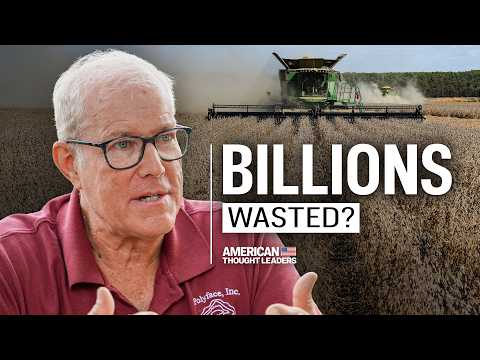
American Thought Leaders - The Epoch Times's Why Do We Pay Farmers to Grow Food Nobody Eats? | Joel Salatin: skim's analysis identifies 12 key moments, with 1 potential conflict of interest flagged. Polyface Farms co-owner Joel Salatin argues that high US beef prices stem from 2020-2021 southern droughts, aging farmers, Mexican border closures over screwworm, and federal subsidies that lock land into corn and soybeans.
Category: Politics. Format: Interview. YouTube video analyzed by skim.
skim AI Analysis
Credibility assessment: Experienced Practitioner View. Joel Salatin draws on decades of direct farm and slaughterhouse management experience, offering concrete operational cost figures and citing specific legislation like the Prime Act. However, several broad macro-agricultural statistics and FOIA claims are presented conversationally without independent documentation.
Bias assessment: Free-Market Agrarian. The conversation strongly favors deregulation, regenerative grazing, and local food networks while criticizing federal grain subsidies and USDA inspection mandates. The host openly shares his preference for Polyface Farms beef and offers minimal pushback against Salatin's libertarian economic framing.
Originality: 78% — Distinctive Farm Economics. Rather than repeating standard inflation talking points on beef prices, Salatin connects row-crop subsidies, slaughterhouse HACCP compliance costs, farm land-leasing demographics, and plant biodiversity into a cohesive critique of centralized agriculture.
Depth: 76% — Detailed Operational Breakdown. Salatin breaks down multi-year cattle breeding cycles, per-acre conversion economics from soybeans to perennial pasture, custom slaughter exemptions, and diesel versus labor cost ratios, grounding high-level policy arguments in farm-level math.
Key Points (12)
1. Salatin Explains Why US Beef Supply Shrunk
Timestamp: 00:02:43 to 00:07:09
Joel Salatin attributes soaring beef prices to a multi-year supply crunch triggered by 2020-2021 southern US droughts that forced ranchers to liquidate herds, alongside aging livestock farmers averaging 65 years old. Rising demand from keto and carnivore diets and a Mexican border closure blocking one million cattle over screwworm compounded the shortage. Because expanding a cattle herd takes roughly four years, farmers cannot quickly rebuild supply while input costs outpace beef prices.
Significance (High): Frames current beef inflation not as sudden price gouging, but as a structural collision between biological breeding lags, demographic exit, and regional supply shocks.
Sources in support: Joel Salatin (Co-owner of Polyface Farms and author)
Neutral sources: YouTube: American Thought Leaders - The Epoch Times
2. Corn and Soybean Subsidies Distort Farming
Timestamp: 00:07:12 to 00:11:30
Raising herbivores on perennial grass avoids annual tillage, whereas omnivores like chickens and pigs require annual grain crops. Salatin argues that federal subsidies for corn and soybeans are the core driver of beef problems, noting that half of US soybeans are exported and almost half of corn goes to ethanol. Despite a recent $12 billion bailout after soybean farmers reportedly lost $100 an acre in 2025, subsidies insulate growers from global oversupply and China's 2030 import-reduction goals.
Significance (High): Challenges the assumption that US farm subsidies secure domestic food supply, showing how taxpayer bailouts lock acreage into non-food and export commodities.
Sources in support: Joel Salatin (Co-owner of Polyface Farms and author)
Neutral sources: YouTube: American Thought Leaders - The Epoch Times
3. Converting Soybean Land to Pasture Pays Off
Timestamp: 00:11:30 to 00:14:26
Salatin presents an economic analysis showing that converting 1,000 acres of Nebraska soybeans into perennial pasture for cattle costs $300,000 in fencing, water lines, and grass seed, which equals a single year's operating expense for growing soybeans. Under intensive grazing management, he estimates the land could earn $1,000 an acre instead of losing $100 an acre on soybeans. Farmers resist switching because cattle require daily on-site presence and receive no government crop insurance or subsidy checks.
Significance (High): Demonstrates how federal risk-shielding for row crops actively discourages profitable, ecologically restorative transitions to domestic beef production.
Sources in support: Joel Salatin (Co-owner of Polyface Farms and author)
Neutral sources: YouTube: American Thought Leaders - The Epoch Times
4. Salatin Calls for Free Markets Without Bailouts
Timestamp: 00:14:26 to 00:17:55
Using an analogy of demanding 30 electricians for a 20-electrician construction project, Salatin criticizes the mindset that taxpayers must fund surplus soybean farming out of respect for farmers. He notes that beef farmers receive zero subsidies or insurance and insists he does not want government aid. Instead, he urges policymakers to let Adam Smith's invisible hand move producers out of surpluses and adjust the 10-to-12-year cattle cycle naturally.
Significance (Medium): Distinguishes Salatin's position from typical agricultural lobbying by rejecting protective subsidies for his own sector in favor of unmanipulated price signals.
Sources in support: Joel Salatin (Co-owner of Polyface Farms and author)
Neutral sources: YouTube: American Thought Leaders - The Epoch Times
5. Young Farmers Can Bootstrap by Leasing Land
Timestamp: 00:17:55 to 00:20:20
Because older farmers cannot exit when young people cannot afford land and startup costs, 47% of American farmland is currently leased rather than owned by its operator. Salatin highlights a recent Polyface Farms conference featuring eight farmers who started at age 20 with no land or money and reached full-time farming by 40 without government help. He frames land ownership as an economic defense for the wealthy, while leasing and land management offer an accessible economic offense for young farmers.
Significance (Medium): Reframes the high price of farmland from an insurmountable barrier into a leasing opportunity for new entrants focused on operational management.
Sources in support: Joel Salatin (Co-owner of Polyface Farms and author)
Neutral sources: YouTube: American Thought Leaders - The Epoch Times
6. Federal Inspection Laws Block Local Meat Sales
Timestamp: 00:20:20 to 00:25:30
Tracing federal meat regulation from Upton Sinclair's 1906 book The Jungle to the 1967-1968 Wholesome Foods Act, Salatin explains how laws wiped out community on-farm slaughterhouses. While farmers can sell live animals or use a custom-processing exemption by pre-selling shares of a live steer to up to eight buyers, they cannot legally sell individual cuts of meat without federal inspection. A August 2026 New Hampshire bill to legalize neighbor-to-neighbor meat sales and test intrastate commerce at the Supreme Court was vetoed by the governor.
Significance (High): Exposes why local ranchers struggle to reach everyday grocery shoppers: federal rules force consumers to buy $1,000 bulk animal shares or nothing.
Sources in support: Joel Salatin (Co-owner of Polyface Farms and author), YouTube: American Thought Leaders - The Epoch Times
7. Salatin Backs Prime Act as Packers Hold 85%
Timestamp: 00:25:30 to 00:29:48
Congressman Thomas Massie's Prime Act would allow states to permit intrastate retail sales of custom-processed meat cuts without federal inspection. Salatin explains that farmers today capture only 5.8 cents of the retail food dollar, down from 40 cents 80 years ago, because 75% of American food is convenience food where profits go to value-adding processors. Meanwhile, packer consolidation has grown from seven companies controlling 50% of meat in 1906 to four companies controlling 85% today through regulatory cronyism.
Significance (High): Connects farm-gate income collapse directly to regulatory barriers that prevent small producers from capturing value-added processing margins.
Sources in support: Joel Salatin (Co-owner of Polyface Farms and author)
Neutral sources: YouTube: American Thought Leaders - The Epoch Times
8. HACCP Costs and Custom Beef's Safety Record
Timestamp: 00:29:48 to 00:35:07
As co-owner of a small federally inspected slaughterhouse in Harrisonburg processing 50 cattle a week, Salatin says federal HACCP compliance adds 30% to processing costs, making it cost $600 per head versus $150 at a 5,000-head-per-day Tyson plant. Responding to food safety objections, Salatin claims Freedom of Information Act requests to the Food Safety Inspection Service revealed zero pathogen or sickness incidents from uninspected custom-processed beef since 1968. Direct relational accountability keeps small custom butchers clean without hiding behind government compliance shields.
Significance (High): Undermines the core regulatory justification for uniform federal inspection by contrasting small-scale reputational accountability with industrial recalls.
Sources in support: Joel Salatin (Co-owner of Polyface Farms and author), YouTube: American Thought Leaders - The Epoch Times
9. Scaling by Duplication Could Add 1,000 Plants
Timestamp: 00:35:07 to 00:37:39
Salatin relays Congressman Thomas Massie's estimate that passing the Prime Act would prompt 1,000 community abattoirs to open or reopen within weeks, which at 20 cattle a week for 50 weeks would process one million beef cattle annually. While industrial agriculture defines scale through centralization and giant facilities, Salatin argues that nature scales through duplication, making more acorns, calves, and seeds rather than giant trees or cows. Decentralizing slaughterhouses follows this natural model of resilience.
Significance (Medium): Quantifies how quickly small-scale processing capacity could rebound if legal barriers to retail custom cuts were lifted.
Sources in support: Joel Salatin (Co-owner of Polyface Farms and author)
Neutral sources: YouTube: American Thought Leaders - The Epoch Times
10. Polyface Farms Trades Chemicals for Labor
Timestamp: 00:37:39 to 00:40:58
Comparing Polyface Farms to factory feedlots, Salatin explains that his farm replaces subsidized grain, pharmaceuticals, chemical fertilizers, and heavy equipment with well-paid domestic labor and intensive management. When Russia's invasion of Ukraine drove fertilizer prices up 400%, Polyface Farms was unaffected and sold steaks and pork chops for less than Costco. While diesel fuel accounts for 50% of the average US farmer's expenses, it represents only 5% of Polyface's costs, trading short-term industrial efficiency for long-term durability.
Significance (High): Provides a concrete case study of how low-input regenerative farming insulates food prices from geopolitical energy and fertilizer shocks.
Sources in support: Joel Salatin (Co-owner of Polyface Farms and author), YouTube: American Thought Leaders - The Epoch Times
11. Why Antiquity Diets Favored Herbivore Meat
Timestamp: 00:40:58 to 00:45:35
Addressing why carnivore diet followers prioritize beef over poultry or pork, Salatin notes that pre-industrial human diets relied on seafood or grazing herbivores because grain was historically scarce and expensive. Citing Thomas Jefferson's Farm Book, he says corn and wheat would cost $30 a bushel in today's spread, making grain-fed omnivores like chickens and pigs a luxury. Cheap grain over the last century is a historical blip enabled by cheap fossil energy, mechanization, and depleting legacy prairie soils.
Significance (Medium): Places the modern abundance of cheap chicken and pork in historical perspective as a temporary byproduct of fossil-fuel grain farming.
Sources in support: Joel Salatin (Co-owner of Polyface Farms and author)
Neutral sources: YouTube: American Thought Leaders - The Epoch Times
12. Plant Diversity Drives Steak Nutrient Density
Timestamp: 00:45:35 to 00:49:23
Salatin cites research by Dan Kittredge's Bionutrient Food Association, which found up to a 50-fold nutrient variation between the best and poorest carrots and broccoli and analyzed roughly 500 beef samples. Regardless of cattle breed, climate, or age, the single consistent predictor of higher nutritional density in steak was the number of different plants the animal ate. Polyface Farms has not planted a seed in 65 years, moving cattle daily to fresh, diverse pasture 'salad bars' and relying on free-market innovation over government control.
Significance (High): Links rotational grazing on diverse, unseeded pastures directly to measurable nutritional superiority in finished beef.
Sources in support: Joel Salatin (Co-owner of Polyface Farms and author)
Neutral sources: YouTube: American Thought Leaders - The Epoch Times
This analysis was generated by skim (skim.plus), an AI-powered content analysis platform by Credible AI. Scores and classifications represent the platform's AI-generated assessment and should be considered alongside other sources.