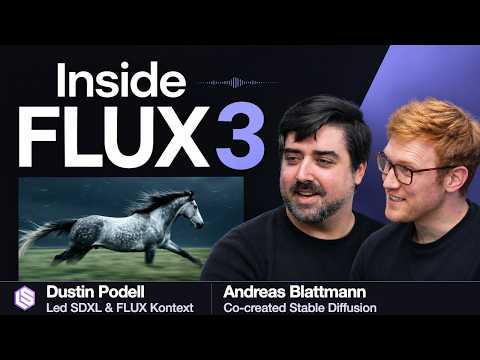
Why FLUX 3 Trains on Images, Video and Sound — Andreas Blattmann & Dustin Podell, Black Forest Labs
Latent Space
Summary
Black Forest Labs co-founder Andreas Blattmann and founding researcher Dustin Podell trace the evolution of generative media from Latent Diffusion and Stable Diffusion XL to FLUX 3. They share candid stories behind their models, including how an unreleased architecture became SDXL's refiner, how 1,000 steps of 3D fine-tuning proved 2D video models learn implicit 3D geometry, and how a four-to-six-hour experiment on relational photography data birthed FLUX Kontext. They also break down why rectified flow matching simplified diffusion math and how autoregressive training efficiency compares with distilled diffusion inference speed.
Backed by $450 million in funding and over $100 million in revenue, Black Forest Labs is now extending its unified multimodal backbone into physical AI with the 7-billion-parameter FLUX 3 Action model. Requiring only four hours of fine-tuning data for industrial tasks, the model predicts video frames alongside robot joint states, setting the stage for single-shot robotic learning and commercial manufacturing deployments in 2027.
How time-sensitive the topic is: Developing story
By the numbers
450 million USD: Total funding raised by Black Forest Labs so far, as stated by Andreas Blattmann. (Mentioned at 19:50)
100 million USD: Annualized revenue milestone crossed by Black Forest Labs as published in December, according to Andreas Blattmann. (Mentioned at 20:02)
1,000 fine-tuning steps: Number of 3D fine-tuning steps needed to turn Stable Video Diffusion's 2D pre-trained video model into an explicit 3D model. (Mentioned at 37:50)
13 people: Size of Black Forest Labs' founding team when they met at a French chalet to begin training FLUX 1. (Mentioned at 47:20)
3 months: Time elapsed from incorporating Black Forest Labs and starting training to launching FLUX 1. (Mentioned at 47:45)
4 to 6 hours: Duration of Dustin Podell's initial test training run on relational photography data that proved the generality of FLUX Kontext. (Mentioned at 59:33)
10 reference images: Number of reference images supported for multi-image contextual editing in FLUX 2. (Mentioned at 1:06:17)
4 hours of data: Amount of robotics fine-tuning data required by FLUX 3 Action for an industrial task, eight times less than Pi0.5. (Mentioned at 1:25:06)
7 billion parameters: Model size of FLUX 3 Action designed to run on-device in real time for robotics. (Mentioned at 1:27:10)
Questions this video answers
Why did Black Forest Labs train FLUX 3 on images, video, audio, and robotic actions together?
Andreas Blattmann explains that Black Forest Labs built FLUX 3 as a unified multimodal backbone to capture intuitive System 1 visual intelligence from natural signals. Training a single model across images, video, and audio builds an implicit understanding of physics and 3D space that compounds when derived into specialized models for video editing, 4K upscaling, and robotic action prediction.
Andreas Blattmann, 17:04 to 25:35
From this keypoint: Visual Intelligence and $450M Funding
Can a generative model learn 3D understanding just by watching 2D videos?
Yes, Andreas Blattmann argues that predicting camera pans and object motion in 2D videos forces a model to learn implicit 3D representations without explicit 3D meshes. In their Stable Video Diffusion research, a model pre-trained solely on 2D videos was fine-tuned into an explicit 3D view generator in just 1,000 steps.
Andreas Blattmann, 33:59 to 39:57
From this keypoint: 2D Video Pre-Training Unlocks 3D in 1,000 Steps
What are the trade-offs between autoregressive image generation and diffusion models?
Andreas Blattmann explains that autoregressive models are more data-efficient during training because they compute gradients across all tokens in parallel, whereas diffusion models sample points along a continuous noise trajectory. However, diffusion models are much faster at inference because 50 denoising steps can be distilled down to four, while autoregressive models must generate tokens one after another.
Andreas Blattmann, 1:13:12 to 1:20:50
From this keypoint: Autoregressive Data Efficiency vs Diffusion Speed
How does flow matching improve upon classic diffusion in Stable Diffusion 3 and FLUX?
Flow matching replaces the stochastic differential equations of classic diffusion with ordinary differential equations that draw a direct path between any two probability distributions without requiring a standard normal prior. This mathematical simplification makes training more scalable, enables faster few-step sampling, and allows researchers to oversample compute on the middle denoising steps that carry the most information.
Andreas Blattmann, 39:57 to 46:57
From this keypoint: Why SD3 Switched to Rectified Flow Matching
How did Dustin Podell create FLUX Kontext for character-consistent image editing?
Dustin Podell pitched an editing model at a French offsite based on the hypothesis that pre-trained diffusion models already understand spatial relationships between objects. Working with one data colleague in San Francisco, he trained a model for just four to six hours on a small photography dataset describing object relationships, immediately unlocking general editing capabilities that eliminated slot-machine prompting.
Dustin Podell, 54:58 to 1:03:15
From this keypoint: Dustin Podell's Six-Hour Experiment for Kontext
Why did Stable Diffusion XL (SDXL) need a separate refiner model?
Dustin Podell reveals that while the SDXL base model handled image composition and multi-aspect resolutions well, it struggled with high-frequency textures like skin and grass. The team took a separate, unreleased diffusion architecture that had poor structural generation but strong texture detail and repurposed it as a second-stage refiner at the end of the denoising trajectory.
Dustin Podell, 27:38 to 33:59
From this keypoint: How a Failed Architecture Became SDXL's Refiner
How does FLUX 3 Action control robots and how much training data does it need?
FLUX 3 Action is a 7-billion-parameter world action model that takes camera video and instructions to predict chunks of 9 to 21 video frames alongside six-degree-of-freedom robot joint states at roughly 10 FPS. Because it leverages a general multimodal video backbone, it needed only four hours of fine-tuning data for an industrial robotics task, eight times less than Pi0.5.
Andreas Blattmann, 1:20:50 to 1:32:16
From this keypoint: FLUX 3 Action and Single-Shot Robotics by 2027
How much funding and revenue has Black Forest Labs achieved?
Andreas Blattmann states that Black Forest Labs has raised $450 million in total funding so far. He also notes that the company crossed $100 million in published revenue as of December, giving them the capital to expand from image generation into video and robotics.
Andreas Blattmann, 17:04 to 25:35
From this keypoint: Visual Intelligence and $450M Funding
How did Dustin Podell transition from web development to frontier AI research?
After working as a software developer for 10 years, Dustin Podell resigned from his Los Angeles studio the day Stable Diffusion launched to experiment with open-source models full-time. He joined Stability AI as an engineer, learned from researchers like Dr. Scott Hawley, and used idle cluster compute to run his own training experiments until he became research lead on SDXL.
Dustin Podell, 9:23 to 17:04
From this keypoint: Dustin Podell's Open-Source Path Into AI Research
Credible AI™ signals
Confidence: Firsthand Researcher Insights. Andreas Blattmann and Dustin Podell speak directly from their firsthand experience building Latent Diffusion, Stable Diffusion XL, Stable Diffusion 3, and the FLUX model family at Black Forest Labs. Claims about internal training runs and company metrics are self-reported, while technical explanations align with published research.
Bias: Founder-Friendly Tech Optimism. The hosts openly celebrate their personal history with the guests and credit Stable Diffusion for their own career pivots. While technical trade-offs like SDXL's refiner and diffusion's data inefficiency are discussed candidly, the conversation naturally favors Black Forest Labs' architectural bets and commercial outlook.
Originality (88%): Candid Lab Origin Lore. The interview surfaces behind-the-scenes details rarely found in technical papers, including how a failed SDXL architecture was repurposed into its refiner, how FLUX Kontext started as a six-hour side experiment on relational photography data, and how Black Forest Labs' founding team built FLUX 1 from a French chalet.
Depth (85%): Deep Architecture Breakdown. The discussion moves past surface hype to examine why low- and high-frequency details emerge at different noise steps, why ordinary differential equations in flow matching simplify sampling compared to stochastic diffusion, and how autoregressive token generation trades off against distilled diffusion steps.
Key points (13)
Short (24 min): key points 1, 4 and 12
Medium (39 min): key points 1, 4, 7, 9 and 12
Relaxed (1h 35min): all 13 key points
1. swyx on FLUX Kontext and the Pivot to Robotics
Timestamp: 00:00:00 to 00:03:39 (4 min)
Speaker: swyx
swyx introduces Andreas Blattmann and Dustin Podell, noting that the original Stable Diffusion release inspired him, Dustin, and his co-host to quit their jobs and work full-time in AI. He argues that image editing models like FLUX Kontext will replace everyday workflows in tools like Canva and Photoshop, while frontier generative media labs are now converging on world models and robotics. He concludes that when top frontier researchers lean in one direction, a major breakthrough is likely 6 to 12 months away.
Impact: Medium. Why it matters: Frames the episode's central arc: generative image and video labs are no longer just building creative tools, but laying the perceptual foundation for robotics.
2. Black Forest Roots and Latent Diffusion Origins
Timestamp: 00:04:23 to 00:09:23 (5 min)
Speaker: Andreas Blattmann
Andreas Blattmann explains that he has developed diffusion models for seven years after meeting his co-founders in Heidelberg, where their shared physics background drew them to mapping physical diffusion onto generative modeling. When founding Black Forest Labs, they chose to base the lab in their hometown of Freiburg at the foot of Germany's Black Forest rather than relocating exclusively to San Francisco. That university research in Heidelberg and Munich produced the latent diffusion algorithm that scaled into Stable Diffusion.
Impact: Low. Why it matters: Shows how academic physics intuition in German universities produced the core latent compression technique powering modern generative media.
“we're all having a kind of a physics background um in some sense and this this paradigm of just like mapping this general physical phenomena of diffusion to machine learning and generative modeling had a a kind of a philosophical kind of beauty to us”
In the video: Andreas Blattmann, at 5:32
For: swyx
3. Dustin Podell's Open-Source Path Into AI Research
Timestamp: 00:09:23 to 00:17:04 (8 min)
Speaker: Dustin Podell
Dustin Podell recounts how he worked as a software developer in Los Angeles for about 10 years before turning in his resignation the day Stable Diffusion was released. Fascinated by running open-source models at home and collaborating on Discord, he joined Stability AI as an engineer, was mentored by Dr. Scott Hawley, and used idle cluster compute to teach himself model training. His obsession with tearing models apart and running experiments propelled him from web development into leading frontier diffusion research.
Impact: Medium. Why it matters: Demonstrates how open-source model weights and community Discord servers enabled self-taught engineers to transition into frontier AI research.
“at the time I was working at a software studio down in Los Angeles stable diffusion came out and basically that day I turn in my resignation”
In the video: Dustin Podell, at 11:45
For: Andreas Blattmann
4. Visual Intelligence and $450M Funding
Timestamp: 00:17:04 to 00:25:35 (9 min)
Speaker: Andreas Blattmann
Andreas Blattmann explains that Black Forest Labs is extending beyond image generation into System 1 visual intelligence by training FLUX 3 across images, video, audio, and actions. He notes the company has raised $450 million in funding and crossed $100 million in revenue as of December, using that foundation to model physical intuition directly from 2D natural signals without explicit 3D meshes. Both Blattmann and Podell argue that observing 2D videos teaches models implicit 3D world structure just as human infants learn by observing before interacting.
Impact: High. Why it matters: Establishes Black Forest Labs' core technical thesis: training on 2D video and natural signals is sufficient to build implicit 3D world models without explicit 3D geometry.
“no 3D model at all just learning on based on natural data.”
In the video: Andreas Blattmann, at 21:12
For: Dustin Podell
Neutral: swyx
5. How a Failed Architecture Became SDXL's Refiner
Timestamp: 00:27:38 to 00:33:59 (6 min)
Speaker: Dustin Podell
Dustin Podell reveals that Stable Diffusion XL introduced multi-aspect bucket training and multi-stage post-training, but the base model struggled with high-frequency details like skin texture. Rather than letting an unreleased, structurally weak alternative SDXL architecture go to waste, the team repurposed that separate diffusion model into SDXL's second-stage refiner. Andreas Blattmann adds that this two-model pipeline was one of the earliest works to exploit how diffusion trajectories learn structure near noise and fine texture near the clean image.
Impact: High. Why it matters: Uncovers how an engineering workaround for high-frequency textures revealed a fundamental property of where structure versus detail lives along the denoising trajectory.
“there was a version of SDXL that was never released uh it was a different architecture that didn't quite work as well but it was trained pretty far along even to like the post- training stages uh the refiner was that model”
In the video: Dustin Podell, at 30:31
For: Andreas Blattmann
6. 2D Video Pre-Training Unlocks 3D in 1,000 Steps
Timestamp: 00:33:59 to 00:39:57 (6 min)
Speaker: Andreas Blattmann
Andreas Blattmann discusses his work on Align Your Latents at Nvidia and Stable Video Diffusion at Stability AI, emphasizing that dataset filtering between quantity and quality is the most underappreciated lever in generative modeling. Because a model estimates the probability distribution of its training data, blurry or low-motion clips will degrade even a perfect algorithm. Most importantly, the team demonstrated that a model pre-trained purely on 2D videos could be fine-tuned into an explicit 3D view generator in just 1,000 steps.
Impact: High. Why it matters: Provides empirical evidence that temporal attention over 2D video forces a model to learn deep 3D spatial representations.
“what we actually did is we took this video model that we trained and then we had I think 1k fine-tuning steps on 3D data and we got a 3D model out of it.”
In the video: Andreas Blattmann, at 36:52
Neutral: swyx
7. Why SD3 Switched to Rectified Flow Matching
Timestamp: 00:39:57 to 00:46:57 (7 min)
Speaker: Andreas Blattmann
Andreas Blattmann and Dustin Podell explain how Stable Diffusion 3 transitioned from convolutional architectures and stochastic differential equations to Diffusion Transformers and rectified flow matching. Flow matching formulates distribution translation as an ordinary differential equation between any two distributions without requiring a standard normal prior, making fast few-step sampling much easier. Crucially, the SD3 research identified which intermediate steps along the noise-to-data trajectory carry the most information so training compute could be oversampled where it matters most.
Impact: High. Why it matters: Explains the mathematical shift from classic diffusion to flow matching and non-uniform timestep sampling that underpins modern frontier image and video generators.
For: Dustin Podell
Neutral: swyx
8. Launching Black Forest Labs From a French Chalet
Timestamp: 00:46:57 to 00:54:58 (8 min)
Speaker: Andreas Blattmann
Andreas Blattmann and Dustin Podell describe leaving Stability AI with a founding team of 13 people to start Black Forest Labs from scratch, kicking off the training of FLUX 1 during a week-long offsite in a French mountain chalet. Podell notes they were frustrated that Stability AI failed to capture the commercial value of models that were powering successful businesses worldwide. While FLUX 1's launch three months later gave them an immediate commercial kickstart in image generation, Blattmann emphasizes their seed pitch always centered on video modeling as the core path to world understanding.
Impact: Medium. Why it matters: Clarifies that Black Forest Labs was founded to capture the commercial value Stability AI missed while using image revenue to fund multimodal video and world modeling.
“BFL was not found to be an image generation lab it was more of a kind of a matter of the the the flux model being so good that we then capitalized on it as well because it gave us a kickstart”
In the video: Andreas Blattmann, at 52:52
For: Dustin Podell
9. Dustin Podell's Six-Hour Experiment for Kontext
Timestamp: 00:54:58 to 01:03:15 (8 min)
Speaker: Dustin Podell
Dustin Podell explains that FLUX Kontext began as a pitch at a French cabin offsite and a two-person side project in San Francisco aimed at eliminating the slot-machine randomness of text prompting. He hypothesized that because pre-trained models already encode spatial relationships between objects, a small, high-quality dataset describing relational photography could unlock general image editing. After just four to six hours of training on that tiny dataset, the model began generalizing to tasks like placing logos on shirts, leading to a company-wide push and distillation by Axel.
Impact: High. Why it matters: Shows that in-context character-consistent image editing emerged primarily from targeted relational data curation rather than massive new pre-training runs.
“I trained the model for like I mean it was maybe like six hours of training, four hours of training. It was it was very very short training run. And all of a sudden like I saw what felt like a clear generality coming out of it”
In the video: Dustin Podell, at 59:33
For: Andreas Blattmann
Neutral: swyx
10. Scaling to 10 References and Building KontextBench
Timestamp: 01:03:15 to 01:13:12 (10 min)
Speaker: Dustin Podell
Andreas Blattmann and Dustin Podell discuss data scaling ladders, explaining that FLUX 2 expanded FLUX Kontext's single-image limitation to handle up to 10 reference images, which matches the cognitive limit of central characters in a film. To evaluate contextual editing, Podell and Tim Dockhorn built KontextBench by combining real production workflows with playful, hand-crafted prompts in their San Francisco office. They argue that once a base model reaches high strength, noisy public Discord preference loops become less useful than targeted task adherence.
Impact: Medium. Why it matters: Highlights how evaluation shifts from subjective aesthetic preference voting to concrete task completion once generative models mature.
“with Flux 2, we finally were able to like spend the time to to to kind of build out the data and actually do this larger scale training for handling I think it was 10 reference images at the time.”
In the video: Dustin Podell, at 1:06:11
For: Andreas Blattmann
Neutral: swyx
11. Autoregressive Data Efficiency vs Diffusion Speed
Timestamp: 01:13:12 to 01:20:50 (8 min)
Speaker: Andreas Blattmann
Andreas Blattmann and Dustin Podell compare autoregressive and diffusion paradigms, noting that conversational editing is not exclusive to autoregressive models because language capabilities and reinforcement learning can be integrated into diffusion backbones. Blattmann explains that autoregressive models are more data-efficient during training because they compute gradients across all tokens in parallel, whereas diffusion samples single points along an infinite noise trajectory. However, diffusion wins at inference speed because 50 denoising steps can be distilled down to four, while autoregressive models must generate tokens sequentially.
Impact: High. Why it matters: Provides a clear technical trade-off between autoregressive and diffusion models: autoregression maximizes training gradient efficiency, while distilled diffusion dominates parallel inference speed.
“There's no inherent limitation to that you couldn't have a model that is diffusion based do the exact same process that can do all of these aspects”
In the video: Dustin Podell, at 1:16:41
For: Dustin Podell
Neutral: swyx
12. FLUX 3 Action and Single-Shot Robotics by 2027
Timestamp: 01:20:50 to 01:32:16 (11 min)
Speaker: Andreas Blattmann
Andreas Blattmann explains how FLUX 3 Action adapts their 7-billion-parameter multimodal backbone into a world action model that predicts six-degree-of-freedom robot joint states alongside 9 to 21 future video frames at roughly 10 FPS. Because the backbone is pre-trained across video, audio, and images, fine-tuning it for industrial robotics required only about four hours of data, eight times less than Pi0.5. Blattmann and Podell predict that 2027 will be the breakout year for manufacturing robotics as they work toward in-context learning where a robot performs a task after observing it just once.
Impact: High. Why it matters: Details how a single multimodal video backbone transfers directly into on-device robotic control with 8x greater data efficiency than prior open models.
“Our vision is that robotic like an autonomous robot should be able to observe any action once and then be able to do it.”
In the video: Andreas Blattmann, at 1:25:56
For: Dustin Podell
Neutral: swyx
13. Restoring Family Photos and Overcoming AI Backlash
Timestamp: 01:32:16 to 01:38:14 (6 min)
Speaker: Dustin Podell
Addressing public hostility toward generative AI on social media, Andreas Blattmann emphasizes that Black Forest Labs focuses on professional productivity tools rather than generating low-quality slop or replacing workers. Dustin Podell shares that one of the most unexpected and rewarding viral use cases for FLUX Kontext was families restoring and colorizing degraded vintage photographs while preserving facial identity. Both researchers conclude that while viral consumer moments cannot be planned, building novel capabilities into general models consistently unlocks unexpected value.
Impact: Low. Why it matters: Illustrates how high-fidelity identity preservation in editing models turns abstract AI research into emotionally resonant consumer applications like photo restoration.
“Actually, the one big use case that we saw a ton of usage on that like, you know, we didn't necessarily expect was image restoration as well.”
In the video: Dustin Podell, at 1:35:47
For: Andreas Blattmann, swyx
Conflicts of interest (2)
Black Forest Labs Leadership Stake
Commercial conflict, Medium severity
Andreas Blattmann is a co-founder and Dustin Podell is a founding researcher at Black Forest Labs, the company whose FLUX models and commercial products are the central subject of the interview.
Sources: Andreas Blattmann, Dustin Podell, Black Forest Labs
Significance: The guests have a direct commercial incentive to highlight the technical superiority of flow matching, FLUX 3, and their upcoming 2027 robotics partnerships over competing architectures.
Paid Episode Sponsorship by Deepgram
Commercial conflict, Low severity
Deepgram is a paid sponsor of this Latent Space episode and works with the hosts on AI Engineer events.
Sources: swyx, YouTube: Latent Space, Deepgram
Significance: The host delivers a promotional read endorsing Deepgram's speech models, voice agent APIs, and Flux text-to-speech credit offer midway through the show.
Key sources
swyx: Host, Latent Space
Andreas Blattmann: Co-founder, Black Forest Labs
Dustin Podell: Founding Researcher, Black Forest Labs
YouTube: Latent Space: Podcast Channel and Co-hosts
Who's in this
Black Forest Labs
Stability AI
FLUX 3
FLUX Kontext
Stable Diffusion XL
Stable Diffusion 3
Deepgram
Midjourney
Also mentioned
Stable Diffusion (First mentioned at 0:09)
SDXL (First mentioned at 0:34)
FLUX 1 (First mentioned at 0:39)
FLUX 3 Action (First mentioned at 17:15)
Latent Space (First mentioned at 1:08)
Germany (First mentioned at 5:27)
San Francisco (First mentioned at 6:57)
Stable Video Diffusion (First mentioned at 34:50)
FLUX 2 (First mentioned at 1:04:59)
Photoshop (First mentioned at 1:52)
Runway (First mentioned at 2:25)
Robin (First mentioned at 5:19)
Heidelberg (First mentioned at 5:25)
Freiburg (First mentioned at 7:03)
Discord (First mentioned at 12:22)
ComfyUI (First mentioned at 14:52)
Daniel Kahneman (First mentioned at 18:53)
Lucas Beyer (First mentioned at 23:40)
Meta (First mentioned at 23:44)
Nvidia (First mentioned at 34:08)
Align Your Latents (First mentioned at 34:09)
France (First mentioned at 47:23)
xAI (First mentioned at 54:35)
Qwen (First mentioned at 1:01:49)
Gemini (First mentioned at 1:02:34)
KontextBench (First mentioned at 1:07:49)
ChatGPT (First mentioned at 1:13:20)
Dyna Robotics (First mentioned at 1:24:24)
Canva (First mentioned at 1:50)
Vienna (First mentioned at 4:39)
Patrick (First mentioned at 5:20)
Munich (First mentioned at 7:19)
Terry Pratchett (First mentioned at 8:53)
Los Angeles (First mentioned at 11:47)
Scott Hawley (First mentioned at 15:54)
Thinking, Fast and Slow (First mentioned at 18:55)
Gary Marcus (First mentioned at 22:01)
Google (First mentioned at 23:45)
OpenAI (First mentioned at 23:48)
Axel (First mentioned at 1:00:22)
Tim Dockhorn (First mentioned at 1:08:10)
This analysis was generated by skim (skim.plus), an AI-powered content analysis platform by Credible AI. Scores and classifications represent the platform's AI-generated assessment and should be considered alongside other sources.