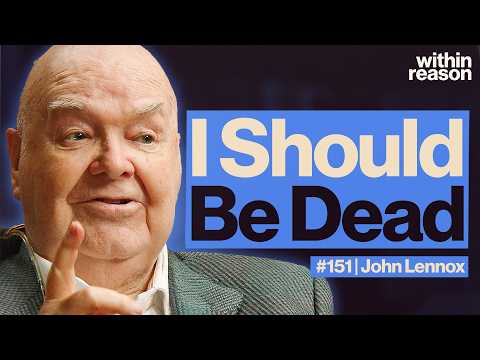
Northern Irish mathematician and Christian apologist John Lennox joins Alex O'Connor to reflect on his newly printed biography, his famous debates with Richard Dawkins and Christopher Hitchens, and the philosophical challenges of suffering and divine hiddenness. Both speakers critique scientism, agreeing through David Hume's problem of induction and an analogy of Shakespearean sonnets that scientific laws merely describe regularities in the universe rather than causing them. Lennox argues that the New Atheists mistakenly defined God as a placeholder for scientific ignorance and redefined faith as belief without evidence, though he credits them with inspiring wonder in nature and forcing Christians to abandon sloppy arguments.
When pressed by O'Connor on why an all-loving God remains hidden from sincere seekers and permits gratuitous suffering, Lennox acknowledges a residual mystery that cannot be solved like an equation. Instead, he reframes the issue around whether the life and suffering of Jesus provide enough cumulative evidence to trust God through tragedy, sharing personal accounts of a Christchurch earthquake widow, a Siberian gulag survivor, and the death of his 22-year-old niece alongside his own near-fatal heart surgery. They conclude by examining how violent extremism distorts Christ's non-violent message before Pontius Pilate.
How time-sensitive the topic is: Evergreen
By the numbers
500 physicists and experts: Audience size John Lennox says he addressed at a laboratory just south of Oxford. (Mentioned at 3:37)
82 years of age: John Lennox's stated age at the time of the interview. (Mentioned at 6:04)
3 academic chairs: Number of professorships held simultaneously by James Tour at Rice University. (Mentioned at 39:52)
7 years: Time spent in a Siberian gulag by a Christian man John Lennox met. (Mentioned at 52:28)
22 years old: Age of John Lennox's niece when she died of a brain tumor the same year he survived a blocked coronary artery. (Mentioned at 1:05:52)
40 minutes: Duration of silence during surgery while a surgeon worked to clear John Lennox's blocked right coronary artery. (Mentioned at 1:07:44)
100 million compatriots: Figure John Lennox quotes from Aleksandr Solzhenitsyn's speech regarding those who perished in the Soviet Union. (Mentioned at 1:10:47)
Questions this video answers
How does John Lennox respond to the problem of arbitrary suffering and evil?
John Lennox admits there is no simple formula to solve arbitrary suffering and instead changes the question to whether there is enough evidence, particularly in the suffering and resurrection of Jesus, to trust God with the mystery. He emphasizes that people experiencing tragedy need pastoral empathy rather than generic intellectual answers.
John Lennox, 44:36 to 54:17
From this keypoint: Reframing arbitrary suffering as a question of trust
What did the New Atheists get wrong about God according to John Lennox?
Lennox argues that the New Atheists falsely defined the biblical God as a 'God of the gaps'—a temporary placeholder for things science cannot yet explain. By contrast, he argues that the Bible presents God as the creator of both what we understand and what we do not, meaning deeper scientific understanding points toward a creator rather than replacing one.
John Lennox, 14:59 to 22:12
From this keypoint: Why New Atheists misread God and scientific faith
Why does Alex O'Connor say scientific laws cannot explain the origin of the universe?
Alex O'Connor explains that scientific laws only describe regular occurrences in nature rather than causing them. Using an analogy of researchers discovering the laws of capitalization and grammar in a book of Shakespearean sonnets, he shows it is a category error to expect descriptive laws to explain what caused the book—or the universe—to exist.
Alex O'Connor, 26:21 to 31:22
From this keypoint: Scientific laws describe nature rather than cause it
How does John Lennox justify believing in the incarnation of Jesus if he cannot explain how it works?
Lennox recounts asking an Oxford physics professor to define consciousness and energy, both of which the physicist believed in without knowing what they fundamentally are because of their explanatory power. Lennox argues that he similarly believes God became human not because he can explain the mechanism, but because it makes sense of the wider evidence.
John Lennox, 2:29 to 6:14
From this keypoint: John Lennox defends the incarnation's explanatory power
Why is scientism or logical positivism considered self-defeating?
Alex O'Connor notes that logical positivism claimed a statement is meaningful only if it is empirically verifiable or mathematically true by definition, a standard that fails because that very claim is neither. John Lennox points out that scientism—claiming science is the only way to truth—commits the same error because it is a meta-scientific claim rather than a scientific finding.
Alex O'Connor, 22:12 to 26:21
From this keypoint: Alex O'Connor on Hume's induction and scientism
How does John Lennox respond to the problem of divine hiddenness and sincere non-believers?
Lennox acknowledges that divine hiddenness leaves a genuine residual mystery and sympathizes with those who want to believe but cannot. He notes that worldviews can change when people examine counterarguments openly and observes that intense hostility toward faith often masks deep personal wounds from clerical abuse.
John Lennox, 35:17 to 44:36
From this keypoint: Divine hiddenness and the trauma of religious abuse
Is religious faith just belief without evidence or an evolutionary psychological cope?
While Alex O'Connor notes that a cynic could view religious comfort as an evolutionary mechanism to prevent despair, both he and Lennox argue that legitimate faith relies on cumulative background evidence. Just as one trusts a table not to collapse or trusts a spouse in a new situation based on past reliability, Christian faith combines rational evidence with personal commitment.
John Lennox, 54:17 to 1:00:33
From this keypoint: Faith as cumulative trust rather than psychological cope
Why does John Lennox warn Christians against claiming that enough faith guarantees physical healing?
Lennox argues that promising people they will be cured of illnesses like cancer if they have enough faith is unbiblical and devastates believers when healing does not happen. Sharing that his 22-year-old niece died of a brain tumor the same year he miraculously survived a blocked coronary artery, he stresses that Christians must avoid selfishly framing God's goodness around their own survival.
John Lennox, 1:00:33 to 1:08:13
From this keypoint: The danger of claiming faith guarantees healing
How were John Lennox's debates with Richard Dawkins and Christopher Hitchens organized?
Lennox reveals that neither he nor Richard Dawkins actively sought to debate each other; instead, Alabama historian Larry Taunton persuaded both of them in order to bring an Oxford God debate to the American South. Lennox also explains that after he won an audience vote against Christopher Hitchens at the Edinburgh Festival, Hitchens immediately asked for a rematch without voting.
John Lennox, 7:48 to 13:25
From this keypoint: How the Dawkins and Hitchens debates came together
What did the New Atheists get right in their critiques of religion and science?
John Lennox credits writers like Richard Dawkins and Peter Atkins with inspiring deep wonder about the natural world through brilliant scientific descriptions. He also acknowledges that their critiques exposed sloppy 'God of the gaps' arguments and anti-scientific attitudes among Christians, forcing apologists and Christian philosophers to sharpen their reasoning.
John Lennox, 31:22 to 35:17
From this keypoint: What New Atheists got right on wonder and sloppy faith
Were Soviet atrocities motivated by atheism, and are religious wars primarily about theology?
Citing Aleksandr Solzhenitsyn, John Gray, and Russian intellectuals, Lennox argues that Soviet pogroms and persecutions under Stalin were actively carried out in the name of atheism. Conversely, both Lennox and O'Connor contend that many so-called religious conflicts, such as the Troubles in Northern Ireland, were political struggles rather than theological disputes.
John Lennox, 1:08:13 to 1:14:44
From this keypoint: Religious violence, Soviet atheism, and the Troubles
Why does John Lennox say that committing violence in the name of Christianity disobeys Jesus?
Pointing to Jesus's trial before Pontius Pilate, Lennox highlights Jesus's declaration that his kingdom is not of this world and that he came to bear witness to the truth. Because truth about forgiveness and peace with God cannot be imposed by force, anyone who uses weapons or bombs to advance Christianity is directly disobeying Christ.
John Lennox, 1:14:44 to 1:18:35
From this keypoint: Why violence in Christ's name disobeys Jesus
Credible AI™ signals
Confidence: Charitable Philosophical Probe. John Lennox and Alex O'Connor ground their arguments in named philosophical frameworks, historical works by Isaac Newton and David Hume, and first-hand accounts of past debates. Personal anecdotes and theological claims remain subjective, fitting a reflective dialogue rather than empirical reporting.
Bias: Sympathetic Theistic Inquiry. John Lennox openly advocates for Christian apologetics while Alex O'Connor adopts an explicitly charitable posture toward theism, even supplying analogies that critique scientism. However, O'Connor still presses sharp objections on divine hiddenness and gratuitous suffering, preventing a one-sided promotional piece.
Originality (75%): Fresh Angles on Classic Debate. While the debate over New Atheism and the problem of evil is well-trodden territory, the conversation offers fresh personal behind-the-scenes history from Lennox's debates with Dawkins and Hitchens, alongside O'Connor's original Shakespearean sonnet analogy for scientific laws.
Depth (84%): Nuanced Epistemological Rigor. Both speakers move past surface-level slogans to examine the epistemological foundations of faith, the problem of induction, logical positivism's self-defeat, and the distinction between descriptive scientific laws and causal explanations, while separating intellectual from pastoral responses to suffering.
Key points (12)
Short (27 min): key points 1, 3, 8 and 9
Medium (45 min): key points 1, 3, 4, 5, 7, 8 and 9
Relaxed (1h 13min): all 12 key points
1. John Lennox defends the incarnation's explanatory power
Timestamp: 00:02:29 to 00:06:14 (4 min)
Speaker: John Lennox
Prompted by Alex O'Connor on why non-Christians find the incarnation strange, John Lennox recounts asking an Oxford physics professor to define consciousness and energy. Because the physicist believed in both without knowing what they are due to their explanatory power, Lennox argues he similarly believes God became human because it makes sense of the evidence.
Impact: Medium. Why it matters: Frames core Christian dogma not as an irrational leap, but as an inference to the best explanation comparable to foundational concepts in physics.
“And if you can't explain energy and consciousness, do you think I'm going to be able to explain to you how God can become human? Of course, I can't. However, I believe in it because as I consider all the evidence I face, it's the only explanation that makes sense of all the rest.”
In the video: John Lennox, at 5:26
Neutral: Alex O'Connor
2. How the Dawkins and Hitchens debates came together
Timestamp: 00:07:48 to 00:13:25 (6 min)
Speaker: John Lennox
Reflecting on his new biography, My Story, John Lennox explains that his high-profile debates with Richard Dawkins and Christopher Hitchens were organized by historian Larry Taunton rather than sought out by the speakers. He recounts winning an audience vote against Hitchens at the Edinburgh Festival on whether the new Europe should prefer New Atheism, prompting Hitchens to demand a no-vote rematch in Alabama.
Impact: Low. Why it matters: Demystifies the era of major New Atheist debates by showing they were driven by third-party organizers and featured cordial backstage rapport.
“And the moderator said, "Christopher, shall we have a a recount?" And I could hear him say it, because he was just beside me. "No, I think Lennox has it." And I got up and shook hands with Christopher, passing by him”
In the video: John Lennox, at 12:56
For: Alex O'Connor
3. Why New Atheists misread God and scientific faith
Timestamp: 00:14:59 to 00:22:12 (7 min)
Speaker: John Lennox
Asked what New Atheists got wrong, John Lennox argues they relied on mockery and falsely reduced the biblical God to a 'God of the gaps' who disappears as science advances. Pointing to Isaac Newton, Albert Einstein, and John Polkinghorne, he contends that biblical creation encompasses what we do understand and that science itself requires faith in the rational intelligibility of the universe.
Impact: High. Why it matters: Challenges the conflict thesis between religion and science by arguing that scientific inquiry depends on an unprovable trust in cosmic rationality.
“And that is if you define God to be a God of the gaps, that is a placeholder for the things you don't yet understand. If that's your definition of God, then you have to choose between God and science by definition.”
In the video: John Lennox, at 18:06
Neutral: Alex O'Connor
4. Alex O'Connor on Hume's induction and scientism
Timestamp: 00:22:12 to 00:26:21 (4 min)
Speaker: Alex O'Connor
Alex O'Connor explains that studying David Hume's problem of induction showed him that everyone holds foundational beliefs without empirical proof, comparing New Atheists' evidential standards to the self-defeating criteria of logical positivism. John Lennox agrees, noting that scientism is logically incoherent and citing Nobel laureate Peter Medawar on why science is not coextensive with rationality.
Impact: High. Why it matters: Exposes the self-referential inconsistency of demanding empirical verification for all truth claims, undercutting strict scientism from an agnostic perspective.
“And I think what the new atheists did was they said we won't believe anything without sufficient scientific evidence. And they just set the bar too high and left themselves open to attacks from people who said well go on then prove the existence of the external world”
In the video: Alex O'Connor, at 23:55
For: John Lennox
5. Scientific laws describe nature rather than cause it
Timestamp: 00:26:21 to 00:31:22 (5 min)
Speaker: Alex O'Connor
Alex O'Connor argues that scientific laws merely describe regularities rather than explain or cause them, illustrating his point with investigators who discover the grammatical laws of a Shakespearean sonnet book and mistakenly expect those rules to explain the book's origin. John Lennox praises the analogy, adding that Ludwig Wittgenstein noted natural laws only describe and that Newton's laws never cause billiard balls to move.
Impact: High. Why it matters: Clarifies a widespread category error in popular science by distinguishing mathematical descriptions of physical behavior from causal agency.
“It would be more than just optimism. It would be an actual category error to think that the laws of literacy will one day describe even describe, let alone explain the origin of the book.”
In the video: Alex O'Connor, at 29:59
For: John Lennox
6. What New Atheists got right on wonder and sloppy faith
Timestamp: 00:31:22 to 00:35:17 (4 min)
Speaker: John Lennox
When asked what the New Atheists got right, John Lennox credits Richard Dawkins and Peter Atkins with inspiring wonder about nature and forcing Christians to abandon sloppy 'God of the gaps' thinking. While faulting Stephen Hawking's claim in The Grand Design that the universe can create itself from nothing because of gravity, Lennox emphasizes that atheistic and Christian scientists share the same science while differing on its overarching interpretation.
Impact: Medium. Why it matters: Demonstrates intellectual charity by crediting ideological opponents with sharpening Christian philosophical rigor and celebrating the natural world.
“Because it's an analysis of their arguments that has helped me over many years to think much more clearly about these things and to recognize that often in the past Christians like me were sloppy in thinking.”
In the video: John Lennox, at 33:59
For: Alex O'Connor
7. Divine hiddenness and the trauma of religious abuse
Timestamp: 00:35:17 to 00:44:36 (9 min)
Speaker: John Lennox
Alex O'Connor raises the problem of divine hiddenness, arguing it seems arbitrary and cruel that some people sincerely cry out for a sign from God and cannot believe. John Lennox acknowledges a real residual mystery, points to Rice University professor James Tour's open discussions on the resurrection, and recounts how a furious South American politician at a Club of Rome conference in Siberia softened after Lennox recognized his rage stemmed from clerical abuse.
Impact: High. Why it matters: Validates the emotional and intellectual weight of non-belief, separating genuine philosophical resistance from trauma caused by religious abuse.
“And I think some people have a genuine objection. We started this conversation with it. That I meet people all through my life who say, "Look, I'd love to be able to believe like you do, but I can't. My family were murdered in the Holocaust or something like this."”
In the video: John Lennox, at 43:57
For: Alex O'Connor
8. Reframing arbitrary suffering as a question of trust
Timestamp: 00:44:36 to 00:54:17 (10 min)
Speaker: John Lennox
Alex O'Connor argues that the existence of even one sincere non-believer or one case of gratuitous suffering is hard to square with an all-loving God. Rather than offering a formulaic solution, John Lennox changes the question to whether there is sufficient evidence to trust God in the dark, sharing accounts of a widow after the Christchurch earthquake and a Christian who endured seven years in a Siberian gulag.
Impact: High. Why it matters: Moves the problem of evil from an unresolvable logical deadlock to an existential test of whether Christianity offers pastoral resilience inside tragedy.
“And so I'm a mathematician, and when mathematicians have tried for a few hundred years to answer a question, they can't they very sensibly try to change the question. And so I changed the question to that equally difficult one. Is there any evidence that we can trust God with it?”
In the video: John Lennox, at 47:18
Neutral: Alex O'Connor
9. Faith as cumulative trust rather than psychological cope
Timestamp: 00:54:17 to 01:00:33 (6 min)
Speaker: John Lennox
Alex O'Connor suggests a cynic would view religious comfort during suffering as an evolutionary psychological cope, though he also defines legitimate faith as relying on background evidence, like trusting a table at Magdalen College not to collapse. John Lennox agrees that both rational and subjective dimensions are needed, comparing religious faith to cumulative personal trust in a spouse rather than mere propositional assent.
Impact: Medium. Why it matters: Distinguishes mature religious faith from blind credulity by grounding it in cumulative relational experience alongside rational inquiry.
“You can face a new situation because although you've no specific evidence for this situation, you've had a lifetime of it before other situations. In other words, you know you would say, "I trust that person."”
In the video: John Lennox, at 57:49
For: Alex O'Connor
10. The danger of claiming faith guarantees healing
Timestamp: 01:00:33 to 01:08:13 (8 min)
Speaker: John Lennox
Alex O'Connor questions why Jesus in the Gospels seems to reward faith with physical healing when people cannot simply muster belief on command, and notes that crediting God for survival implies God chose not to save others. John Lennox warns against 'putting God to the test' or promising cancer cures through faith, recounting how he nearly died from a blocked coronary artery the same year his 22-year-old niece died of a brain tumor.
Impact: Medium. Why it matters: Critiques prosperity-style healing claims from within Christianity, highlighting the pastoral harm of telling sufferers their recovery depends on their faith.
“In that what I usually say is people say, "Well, are you grateful to God for that?" I say I am. But I realized that that very same year, my sister lost her 22-year-old daughter to a brain tumor. Now, I need to be very careful how I describe my own reaction because I need to be able to say that to her as well.”
In the video: John Lennox, at 1:05:43
For: Alex O'Connor
11. Religious violence, Soviet atheism, and the Troubles
Timestamp: 01:08:13 to 01:14:44 (7 min)
Speaker: John Lennox
Alex O'Connor and John Lennox discuss how Jesus criticized clerical abuse just as Christopher Hitchens did, before debating whether atheism itself motivates atrocities. Lennox cites John Gray and Aleksandr Solzhenitsyn to argue that Soviet persecutions under Stalin were perpetrated because of atheism, while O'Connor notes that conflicts like the Northern Ireland Troubles were political rather than theological disputes.
Impact: Medium. Why it matters: Complicates the narrative that religion uniquely causes war by contrasting 20th-century state atheism with the political roots of sectarian conflicts.
“And in my travels in Russia, I asked a lot of Russian intellectuals and others about that question. And they said, "No, no, no. This destruction was done in the name of atheism. A lot of it.”
In the video: John Lennox, at 1:10:24
Neutral: Alex O'Connor
12. Why violence in Christ's name disobeys Jesus
Timestamp: 01:14:44 to 01:18:35 (4 min)
Speaker: John Lennox
Alex O'Connor suggests that when people commit evil believing God is on their side, they are exploiting the assumption that God is good. John Lennox concludes by pointing to Jesus's trial before Pontius Pilate, arguing that because Jesus stated his kingdom is not of this world and came to bear witness to truth, anyone using bombs or weapons to defend his message is disobeying Christ.
Impact: Medium. Why it matters: Provides a direct theological standard from the Gospels to judge and condemn religious violence committed by professing Christians.
“In other words, people that take up AK-47s, swords, bombs, anything to defend and his message are not following him, they're disobeying him.”
In the video: John Lennox, at 1:18:04
For: Alex O'Connor
Conflicts of interest (2)
Promotion of John Lennox's New Biography
Commercial conflict, Medium severity
John Lennox is promoting his newly printed biography, My Story, and Alex O'Connor's show description includes an exclusive 30% publisher discount code for listeners.
Sources: Alex O'Connor, John Lennox
Significance: The promotional tie-in incentivizes a cordial, retrospective interview format that highlights Lennox's career milestones and debate victories rather than aggressively challenging his biographical accounts.
Ground News Paid Sponsorship Read
Commercial conflict, Low severity
Alex O'Connor delivers a paid mid-roll advertisement for Ground News offering a 40% discount via his custom referral link.
Sources: Alex O'Connor, Ground News
Significance: The sponsorship is a standard commercial read on media bias and AI regulation that does not intersect with the theological or philosophical arguments of the interview.
Key sources
Alex O'Connor: Host of The Within Reason Podcast
John Lennox: Northern Irish mathematician, bioethicist, and Christian apologist
Who's in this
Richard Dawkins
Christopher Hitchens
Stephen Hawking
Isaac Newton
David Hume
C. S. Lewis
Larry Taunton
Peter Medawar
James Tour
John Gray
Aleksandr Solzhenitsyn
Tony Blair
Ground News
Also mentioned
Jesus (First mentioned at 1:47)
Oxford (First mentioned at 3:44)
My Story: An Intellectual and Spiritual Biography (First mentioned at 7:34)
Northern Ireland (First mentioned at 36:53)
Siberia (First mentioned at 40:56)
Russia (First mentioned at 6:45)
Book of Acts (First mentioned at 6:52)
University of Cambridge (First mentioned at 8:33)
Alabama (First mentioned at 9:00)
Birmingham (First mentioned at 10:39)
Edinburgh Festival (First mentioned at 10:47)
Principia Mathematica (First mentioned at 17:25)
Albert Einstein (First mentioned at 20:57)
John Polkinghorne (First mentioned at 21:25)
Magdalen College (First mentioned at 25:56)
Ludwig Wittgenstein (First mentioned at 27:15)
A Brief History of Time (First mentioned at 31:05)
Peter Atkins (First mentioned at 31:58)
The Grand Design (First mentioned at 33:08)
Why I Am Not a Christian (First mentioned at 38:27)
Bertrand Russell (First mentioned at 38:31)
Thomas Nagel (First mentioned at 39:15)
Christchurch (First mentioned at 51:04)
Richard Feynman (First mentioned at 4:44)
Ukraine (First mentioned at 6:46)
Luke (First mentioned at 6:54)
Paul (First mentioned at 6:54)
Dinesh D'Souza (First mentioned at 10:30)
Tom Paine (First mentioned at 11:35)
BBC Radio 4 (First mentioned at 11:50)
Berlin Wall (First mentioned at 12:24)
Sam Altman (First mentioned at 13:26)
Alfred North Whitehead (First mentioned at 17:00)
David Hockney (First mentioned at 18:56)
Science and God: Do You Have to Choose? (First mentioned at 22:07)
God and Stephen Hawking (First mentioned at 27:31)
This analysis was generated by skim (skim.plus), an AI-powered content analysis platform by Credible AI. Scores and classifications represent the platform's AI-generated assessment and should be considered alongside other sources.