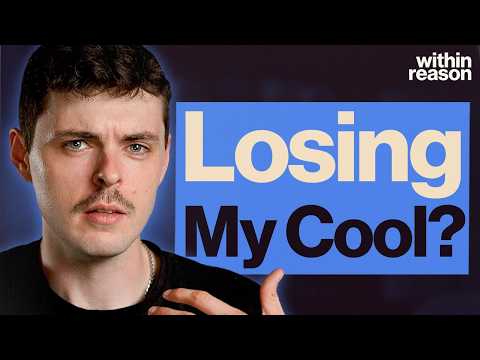
Why I Got Angry in a Recent Debate - 2 Million QnA
Alex O'Connor
Summary
To celebrate nearing two million subscribers, Alex O'Connor answers audience questions ranging from his academic ambitions and daily habits to his favorite philosophical thought experiments. He explains why he hopes to pursue a PhD developing global emotivism, a framework arguing that even basic empirical claims rely on an emotional intuition rejecting Cartesian skepticism. He also shares his weeks-long immersion process for Within Reason interviews, explains why he would introduce Aristotle to Charles Darwin's evolutionary biology, and uses a halftime swap between Manchester United and Manchester City to argue that a football club consists solely of its supporters.
In the final segment, O'Connor addresses his biggest recent regret: his Royal Institution dialogue with William Lane Craig. Although Craig opened the evening by declaring it a friendly conversation rather than a debate, Craig later wrote in a newsletter that O'Connor made a strategic mistake by focusing on the Kalam cosmological argument and claimed O'Connor's heated exchange with a heckling audience member proved he is mightily resisting God.
How time-sensitive the topic is: Evergreen
By the numbers
1.98 million subscribers: Alex O'Connor's approximate YouTube subscriber count at the time of recording the Q&A. (Mentioned at 0:13)
400 calories: Caloric content of a single bottle of Huel ready-to-drink meal replacement, alongside 35g of protein and 26 vitamins and minerals. (Mentioned at 16:31)
25 Christians: Number of Christian opponents Alex O'Connor debated sequentially in his Jubilee video. (Mentioned at 23:34)
0.25 proportion of surviving works: Alex O'Connor estimates that about a quarter of all of Aristotle's surviving works are about biology. (Mentioned at 29:03)
340 million people: Population of the United States, cited by O'Connor as the largest population among countries competing in the World Cup. (Mentioned at 37:45)
Questions this video answers
Why did Alex O'Connor get angry during his event with William Lane Craig?
During the audience Q&A at the Royal Institution, an audience member shouted out a response without a microphone and then tried to wave the moderator on to the next question while O'Connor was replying. O'Connor got frustrated and told the man he could not shout responses and then cut off the reply. He later objected when William Lane Craig cited this frustration in a newsletter as proof that O'Connor is resisting God.
Alex O'Connor, 45:01 to 51:05
From this keypoint: Audience Clash Doesn't Disprove Non-Resistant Unbelief
What did William Lane Craig write about Alex O'Connor in his newsletter?
Craig wrote that O'Connor made a strategic mistake by focusing exclusively on the Kalam cosmological argument—Craig's area of expertise—and made little progress refuting it. Craig also claimed that O'Connor's shouting match with an audience member exploded the myth that O'Connor is a non-resistant unbeliever. O'Connor countered that Craig had explicitly framed the evening as a friendly conversation rather than a debate.
Alex O'Connor, 40:23 to 45:01
From this keypoint: Regretting the William Lane Craig Dialogue Format
What is Alex O'Connor's theory of global emotivism?
Global emotivism extends ethical emotivism—the view that moral claims like 'murder is wrong' merely express emotional attitudes—to all factual propositions about the world. O'Connor argues that believing any empirical claim requires trusting our sense data over Cartesian skepticism, which ultimately rests on an unprovable emotional intuition. Consequently, asserting any truth is fundamentally expressing emotional discontent with radical skepticism.
Alex O'Connor, 4:43 to 10:13
From this keypoint: Factual Assertions Express Emotional Intuitions
Does Alex O'Connor plan to get a PhD in philosophy?
Yes, O'Connor says he would love to pursue a master's degree and a PhD in philosophy to contribute original research rather than just communicating others' ideas on YouTube. He hopes to research either the interplay between consciousness-first metaphysics and religious traditions or his theory of global emotivism. He believes working privately on a dissertation for several years would prevent audience expectations from biasing his philosophical thinking.
Alex O'Connor, 1:33 to 4:42
From this keypoint: Alex O'Connor Wants a PhD on Global Emotivism
How does Alex O'Connor prepare for Within Reason podcast interviews?
O'Connor immerses himself in an upcoming guest's work for weeks, reading their books and listening to every available interview while cooking, cleaning, or traveling. This allows him to learn how they speak, prompt them on forgotten anecdotes, and avoid repetitive questions that bore them. He states he would rather postpone or cancel an interview than show up underprepared.
Alex O'Connor, 19:20 to 23:09
From this keypoint: Immersive Podcast Prep and Night-Owl Routine
What is Alex O'Connor's favorite debate he has participated in?
Among his public debates, O'Connor highlights his Jubilee episode with 25 Christians—after which he took everyone to a bar in Los Angeles—and his debate with the speaker on whether Christianity produced Western values. However, he says his favorite debates are private arguments with close friends at the dinner table because no one is performing for an audience.
Alex O'Connor, 23:09 to 27:17
From this keypoint: Debating 25 Christians and the Speaker
Which historical figure would Alex O'Connor most want to talk to?
Outside of biblical figures like Jesus of Nazareth and John the Baptist, O'Connor would choose to speak with Aristotle. Because roughly a quarter of Aristotle's surviving works examine biology and briefly touch on natural selection, O'Connor wants to show him Darwin's Origin of Species and modern genetics. He would also ask whether Thomas Aquinas accurately adapted Aristotelian metaphysics into Christian theology.
Alex O'Connor, 28:09 to 31:47
From this keypoint: Why O'Connor Would Introduce Aristotle to Darwin
Why doesn't Alex O'Connor support a football club?
O'Connor explains that he has a philosophical problem with what defines a football club, since players rarely come from the local area. Using a thought experiment where Manchester United and Manchester City swap players, managers, kits, and names at halftime, he concludes a club is defined solely by its community of supporters. For the World Cup, he jokes about using utilitarian hedonic calculus to back the country where a win produces the most happiness.
Alex O'Connor, 32:18 to 39:25
From this keypoint: Football Club Identity and Utilitarian Fandom
What career would Alex O'Connor have chosen if he hadn't started YouTube?
O'Connor believes he would have tried to become a classroom teacher. Having spoken to small groups of students at schools, he finds it deeply rewarding to watch young people ask sharp questions and grasp difficult philosophical concepts in real time.
Alex O'Connor, 14:14 to 15:49
From this keypoint: O'Connor Would Have Pursued Classroom Teaching
What is Alex O'Connor's favorite Beatles song?
O'Connor names 'What Goes On' from Rubber Soul as the Beatles track he would choose to listen to right now, while also praising 'Mean Mr. Mustard', 'She Came in Through the Bathroom Window', and their cover of 'Till There Was You'. He argues that The Beatles are so extraordinary they might paradoxically be the most underrated band in history despite their fame.
Alex O'Connor, 17:58 to 19:20
From this keypoint: Why O'Connor Calls the Beatles Underrated
Credible AI™ signals
Confidence: Candid Personal Reflections. Alex O'Connor speaks primarily about his own life, philosophical theories, and personal experiences. When critiquing William Lane Craig and the speaker, he backs up his claims by quoting Craig's newsletter directly and playing archival footage from both events.
Bias: Secular Philosophical Lens. O'Connor approaches every topic from a secular, utilitarian, and skeptical philosophical standpoint. While he remains respectful of religious interlocutors and open to friendly dialogue, his critiques of Christian apologetics and defending his own debate conduct naturally favor his own perspective.
Originality (84%): Novel Philosophical Musings. Beyond standard Q&A fare, O'Connor outlines an original philosophical framework he calls global emotivism, attempting to extend ethical emotivism to all propositional truths. He also constructs a creative Ship-of-Theseus thought experiment using Manchester football clubs.
Depth (76%): Informal Yet Rigorous. Despite the casual Q&A format, O'Connor unpacks complex epistemological problems, including the deflationary theory of truth, the Frege-Geach problem, Aristotelian biology versus Thomistic metaphysics, and the philosophical definition of non-resistant non-belief.
Key points (11)
Short (21 min): key points 1, 9, 10 and 11
Medium (30 min): key points 1, 2, 6, 9, 10 and 11
Relaxed (44 min): all 11 key points
1. Alex O'Connor Wants a PhD on Global Emotivism
Timestamp: 00:01:33 to 00:04:42 (3 min)
Speaker: Alex O'Connor
Alex O'Connor clarifies that he is a communicator rather than a scholar, but he aspires to earn a PhD to make an original contribution to philosophy. He wants to study how consciousness-first metaphysics intersects with religion and develop his theory of global emotivism. Ultimately, he believes extending ethical emotivism to all truth claims could be his lasting scholarly legacy.
Impact: Medium. Why it matters: Distinguishes popular science and philosophy communication from genuine academic scholarship, highlighting the pressure creators feel to produce original research.
“I'd love to one day have a PhD and make a contribution to philosophy.”
Comparing correspondence and deflationary theories of truth, O'Connor argues that asserting a physical fact relies on trusting one's sensory data. Because we cannot prove the external world exists without circular reasoning, rejecting Cartesian skepticism is ultimately a foundational intuition or emotion. Therefore, stating any empirical truth is fundamentally expressing emotional discontent with radical skepticism.
Impact: High. Why it matters: Challenges standard epistemological foundationalism by collapsing the distinction between objective empirical assertions and subjective emotional expressions.
“My saying that something is true is actually an expression of an emotional discontent with one of the premises upon which that expression relies.”
In the video: Alex O'Connor, at 8:41
3. Why Propositions Might Lack Truth Value
Timestamp: 00:10:14 to 00:13:07 (3 min)
Speaker: Alex O'Connor
O'Connor presents a playful syllogism suggesting that because propositions only exist when spoken or thought, they are actions, and since actions cannot be true or false, propositions lack truth value. He notes that applying Simon Blackburn's response to the Frege-Geach problem across all conditional statements could allow philosophers to emotivize all propositions. While acknowledging the argument is likely flawed, he believes diagnosing its error illuminates our theory of truth.
Impact: Medium. Why it matters: Demonstrates how formal meta-ethical tools like Blackburn's quasi-realism can be stress-tested by applying them to general philosophy of language.
“Premise one, propositions are actions. Premise two, actions don't have truth value. Conclusion, therefore, propositions don't have truth value.”
In the video: Alex O'Connor, at 11:31
4. O'Connor Would Have Pursued Classroom Teaching
Timestamp: 00:14:14 to 00:15:49 (2 min)
Speaker: Alex O'Connor
Addressing his hiatus from his music channel, O'Connor promises new music is forthcoming before reflecting on what career he would have chosen without YouTube. Based on his rewarding experiences speaking to small groups of students in schools, he believes he would have tried to become a classroom teacher. Watching young people grasp difficult philosophical concepts in person provides a one-to-one fulfillment that online videos cannot replicate.
Impact: Low. Why it matters: Highlights the pedagogical motivation behind O'Connor's public philosophy career and the value of direct classroom dialogue.
“I've thought about this a few times and I believe I would have at least tried to become a teacher.”
In the video: Alex O'Connor, at 14:36
5. Why O'Connor Calls the Beatles Underrated
Timestamp: 00:17:58 to 00:19:20 (1 min)
Speaker: Alex O'Connor
Asked to name his favorite Beatles song, O'Connor highlights deeper cuts like Mean Mr. Mustard, She Came in Through the Bathroom Window, Till There Was You, and What Goes On from Rubber Soul. Drawing on Robert Graves's remark about William Shakespeare, he argues that The Beatles might paradoxically be the most underrated band in history despite their massive acclaim because their catalog is genuinely that exceptional. He concludes by jokingly conceding that musical taste remains subjective.
Impact: Low. Why it matters: Offers a personal glimpse into O'Connor's musical tastes and illustrates how canonical artists can still exceed their critical reputation.
“I think that the Beatles, as if it were possible, might actually be the most underrated band in history, even given how like amazingly highly rated they typically are.”
In the video: Alex O'Connor, at 18:56
6. Immersive Podcast Prep and Night-Owl Routine
Timestamp: 00:19:20 to 00:23:09 (4 min)
Speaker: Alex O'Connor
O'Connor explains that he refuses to interview podcast guests unprepared, spending weeks listening to their books and past interviews to learn their speech patterns and avoid repetitive questions. As a night owl in the UK working with Americans, he wakes up in the afternoon and works until two in the morning. To avoid creator burnout, he strictly schedules daily walks, gym sessions, and time with friends.
Impact: Medium. Why it matters: Reveals the behind-the-scenes preparation method that drives long-form interview quality while emphasizing work-life boundaries in the creator economy.
“I like to think that I don't interview guests unless I'm ready to interview them.”
In the video: Alex O'Connor, at 19:27
7. Debating 25 Christians and the Speaker
Timestamp: 00:23:09 to 00:27:17 (4 min)
Speaker: Alex O'Connor
Reflecting on his favorite debates, O'Connor recalls enjoying his friendly Jubilee session with 25 Christians, noting he took the participants out for drinks in Los Angeles afterward. He also highlights his debate with the speaker, where the speaker claimed Christian men would have granted women the right to vote on biblical principles alone even without suffragette protests. Still, O'Connor concludes that private dinner-table debates with friends remain his favorite because they happen in good faith without playing to a crowd.
Impact: Medium. Why it matters: Exposes the performative constraints of public debates compared to private discourse and challenges apologetic claims that Christianity naturally produced modern egalitarian rights.
“Ultimately, though, my favorite people to debate are my friends because it's private, so we're not playing up to a gallery”
In the video: Alex O'Connor, at 26:52
Against: YouTube: Alex O'Connor
8. Why O'Connor Would Introduce Aristotle to Darwin
Timestamp: 00:28:09 to 00:31:47 (4 min)
Speaker: Alex O'Connor
Aside from biblical figures like Jesus of Nazareth, O'Connor says he would most want to speak with Aristotle among historical figures. Because roughly a quarter of Aristotle's surviving works cover biology and Physics Book II Chapter 8 briefly anticipates natural selection, O'Connor would love to show him Charles Darwin's evolutionary theory and modern genetics. He would also ask whether Thomas Aquinas accurately adapted Aristotelian metaphysics when equating the unmoved mover with the Christian God.
Impact: Medium. Why it matters: Connects ancient teleological biology to modern evolutionary science and highlights the tension between Greek pagan philosophy and medieval Christian theology.
“Aristotle actually, somewhat amazingly, seems to preempt evolution by natural selection.”
In the video: Alex O'Connor, at 29:32
9. Football Club Identity and Utilitarian Fandom
Timestamp: 00:32:18 to 00:39:25 (7 min)
Speaker: Alex O'Connor
O'Connor constructs a Ship-of-Theseus thought experiment in which Manchester United and Manchester City swap players, managers, kits, and names at halftime to ask what constitutes a football club. He concludes that the only constant defining a club is its community of supporters. Applying utilitarian hedonic calculus to the World Cup, he jokes about supporting the United States for its 340 million population before weighing national passion for the sport.
Impact: Medium. Why it matters: Uses an accessible sports analogy to illustrate the metaphysical problem of identity over time and the quirks of utilitarian ethics.
“there's only really one thing that has to remain consistent for the football club to make sense as a concept. It's not the players. It's not the kit. It's not the managers. It's not the name of the team. It's the supporters.”
In the video: Alex O'Connor, at 36:03
10. Regretting the William Lane Craig Dialogue Format
Timestamp: 00:40:23 to 00:45:01 (5 min)
Speaker: Alex O'Connor
Addressing his biggest recent regret, O'Connor points to his Royal Institution dialogue with William Lane Craig, where Craig explicitly stated at the outset that the evening was an open conversation rather than a debate. Taking Craig at his word, O'Connor spent most of the event discussing Craig's specialty, the Kalam cosmological argument, leaving little time for animal suffering. However, Craig later wrote in his newsletter that O'Connor made a strategic mistake by focusing on the Kalam, prompting O'Connor to argue that one cannot make strategic mistakes in a genuine conversation.
Impact: High. Why it matters: Exposes how framing a public event as a friendly dialogue while privately scoring it as a competitive debate undermines good-faith intellectual exchange.
Reading further from William Lane Craig's newsletter, O'Connor plays footage of his heated exchange with an interrupting audience member during the Royal Institution Q&A and admits losing his cool was not his best moment. However, he strongly rejects Craig's claim that this frustration explodes the myth that O'Connor is a non-resistant non-believer and proves he is mightily resisting God. O'Connor concludes that getting annoyed at rude audience etiquette has nothing to do with his psychological openness to theism, and wishes he had pressed Craig on animal suffering and the slaughter of the Canaanites instead.
Impact: High. Why it matters: Refutes the apologetic trope that emotional frustration during a debate reveals secret spiritual rebellion against God.
“Everybody gets frustrated every now and again and that is not a reflection, necessarily at least, on their entire philosophical disposition.”
In the video: Alex O'Connor, at 49:09
Conflicts of interest (2)
Paid Huel Sponsorship Integration
Commercial conflict, Medium severity
Alex O'Connor is commercially sponsored by Huel and receives financial compensation for promoting its nutritional products using a custom discount code.
Sources: Alex O'Connor, Huel
Significance: O'Connor uses a viewer's question about his personal life struggles as a scripted segue into a commercial endorsement praising Huel's nutritional value.
Self-Promotion of Tour and Substack
Commercial conflict, Low severity
Alex O'Connor promotes his paid Substack subscription, upcoming North American live tour, and secondary music channel.
Sources: Alex O'Connor
Significance: Opening the Q&A with promotional plugs encourages viewers to financially support his direct-to-consumer platforms.
Key sources
Alex O'Connor: Host of the Within Reason Podcast and YouTuber (CosmicSkeptic)
William Lane Craig: Christian philosopher and theologian (featured via archival clip)
YouTube: Alex O'Connor
Who's in this
Simon Blackburn
Huel
The Beatles
Jubilee
Aristotle
Thomas Aquinas
Charles Darwin
Manchester United
Manchester City
Royal Institution
MrBeast
Tony Lapidus
Also mentioned
YouTube (First mentioned at 0:18)
Within Reason (First mentioned at 19:23)
World Cup (First mentioned at 0:32)
England (First mentioned at 0:38)
Jesus of Nazareth (First mentioned at 28:12)
United States (First mentioned at 37:31)
North America (First mentioned at 0:00)
Substack (First mentioned at 0:06)
Warzone (First mentioned at 13:07)
Mean Mr. Mustard (First mentioned at 18:14)
Abbey Road (First mentioned at 18:24)
She Came in Through the Bathroom Window (First mentioned at 18:24)
Till There Was You (First mentioned at 18:28)
What Goes On (First mentioned at 18:39)
Rubber Soul (First mentioned at 18:41)
Robert Graves (First mentioned at 18:47)
William Shakespeare (First mentioned at 18:50)
Los Angeles (First mentioned at 24:18)
Paul (First mentioned at 25:31)
New Testament (First mentioned at 25:31)
Australia (First mentioned at 27:24)
Japan (First mentioned at 27:26)
Antarctica (First mentioned at 27:49)
John the Baptist (First mentioned at 28:17)
Physics (First mentioned at 29:37)
The Origin of Species (First mentioned at 30:03)
Mehdi Hasan (First mentioned at 32:06)
Peter Hitchens (First mentioned at 32:13)
Brazil (First mentioned at 38:39)
Argentina (First mentioned at 38:39)
John Stuart Mill (First mentioned at 39:15)
Jeremy Bentham (First mentioned at 39:15)
Diet Dr Pepper (First mentioned at 40:19)
This analysis was generated by skim (skim.plus), an AI-powered content analysis platform by Credible AI. Scores and classifications represent the platform's AI-generated assessment and should be considered alongside other sources.