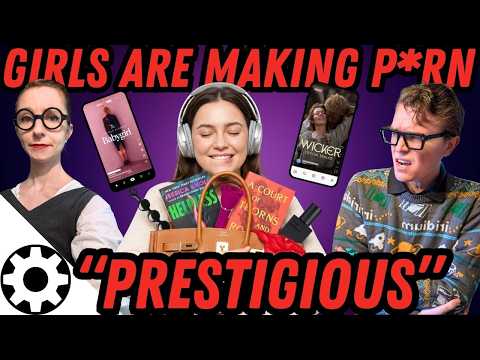
Women Make Their Debauchery High Status (Perversion = Prestige)
Based Camp with Simone & Malcolm Collins
Summary
Simone and Malcolm examine a New York Post article on 'prestige porn,' a growing trend where explicit audiobooks, A24 films, and upscale retail products are marketed to women over 40 as sophisticated self-care and therapy. Reading profiles of a 41-year-old doctor, sold-out vibrating theater screenings for the film Wicker, and a $108 arousal serum at Bloomingdale's that costs $45 online, they argue that high-status branding is being used to normalize hedonism. They also critique the $60 audio app Quinn and the disturbing, dysfunctional relationships depicted in Lena Dunham's writing for HBO's Industry.
Connecting these habits to a Michigan State University study of 38,467 songs showing rising anxiety and declining romance, Simone contends that public obsession with sexual indulgence reflects economic fatalism and personal unhappiness. Throughout the discussion, the hosts contrast commercialized female erotica with free Reddit audio communities and their own platform, Reality Fabricator, before planning a follow-up episode on women dating in their 80s.
How time-sensitive the topic is: Developing story
By the numbers
38,467 songs: Number of songs by 230 popular artists from 1947 to 2024 analyzed in a Michigan State University study on lyrical anxiety and romance. (Mentioned at 1:12)
41 years old: Age of Rachel, a Bergen County, New Jersey doctor profiled in the New York Post for using prestige porn as therapy. (Mentioned at 6:44)
75%: Malcolm's personal estimate of the share of men in the BDSM community playing dominant roles who are faking it just to have sex. (Mentioned at 9:41)
108 USD: Price charged by Bloomingdale's for an arousal stimulating serum sold alongside luxury purses, according to the New York Post. (Mentioned at 13:10)
45 USD: Online price Simone finds via Google for the same arousal serum sold at Bloomingdale's for $108. (Mentioned at 13:47)
60 USD: Cost of the audio erotica app Quinn, which features bedtime stories read by Emmy nominee Andrew Scott. (Mentioned at 18:06)
1,000,000 copies: Sales figure Malcolm cites for a dark Harry Potter fanfiction about Draco and Hermione. (Mentioned at 22:10)
55 USD: Price of Gwyneth Paltrow's 'sex oil' lubricant sold through her Goop wellness company. (Mentioned at 29:08)
Questions this video answers
What is 'prestige porn' and how is it marketed to women?
According to a New York Post article reviewed in the episode, prestige porn refers to explicit books, audiobooks, indie films, and upscale boutique products aimed at women over 40. Because it involves Oscar-winning actors, acclaimed novelists, and luxury retailers, consumers frame it as sophisticated self-care or therapy rather than pornography.
Simone, 5:44 to 9:00
From this keypoint: High-status erotica normalized as therapy
What did the Michigan State University study on song lyrics from 1947 to 2024 find?
The Michigan State University analysis of 38,467 songs by 230 popular artists found that song lyrics have grown more anxious over time while featuring fewer references to romance and social relationships. Simone cites this as evidence of a broader cultural rise in nihilism and social disconnection.
Simone, 0:52 to 4:18
From this keypoint: Simone connects rising anxiety to prestige porn
Why does Simone criticize Bloomingdale's for selling arousal serum?
While reading that Bloomingdale's sells an herbal arousal stimulating serum for $108 alongside Louis Vuitton bags, Simone looks up the product online and finds it listed for $45 elsewhere. She criticizes the more than 100% markup as a rip-off disguised as luxury.
Simone, 11:35 to 16:42
From this keypoint: Retailers markup sexual wellness as luxury
What free alternative does Simone suggest instead of the $60 Quinn erotica app?
Simone explains that the $60 audio erotica app Quinn built its model on the free Reddit community r/GoneWildAudio. She tells listeners they can visit that subreddit, filter by gender tags, and sort by top all-time posts to hear high-quality voice actors without paying.
Simone, 16:42 to 19:23
From this keypoint: Quinn's $60 audio app vs free Reddit audio
What is the movie Wicker with Olivia Colman and Alexander Skarsgard about?
Wicker is an absurdist romantic comedy starring Olivia Colman as a frustrated spinster and Alexander Skarsgard as a man made of straw who engages in explicit scenes with her. Advance screenings featuring vibrating motion seats sold out nationwide and attracted crowds of retired women in Florida.
Simone, 23:43 to 26:54
From this keypoint: Sold-out vibrating theater seats for Wicker
Why does Simone dislike the sex scenes in HBO's drama Industry?
Simone says the explicit scenes in Industry depict deeply sad, angry, and dysfunctional relationships among London finance workers that add nothing to the plot. She connects the disturbing nature of the scenes to writer Lena Dunham, who worked on the series after creating Girls.
Simone, 29:55 to 36:55
From this keypoint: Lena Dunham and toxic relationships in Industry
How do therapists and celebrity brands justify selling sexual wellness products in mainstream stores?
Licensed sex therapist BriannaRader Mosca argues that screen fatigue leaves people disconnected from their bodies, and luxury framing gives women permission to explore desire openly. Brands partnered with celebrities like Dakota Johnson, Naomi Watts, and Gwyneth Paltrow use elevated design so buying lubricants or vibrators at Ulta or Sephora feels as routine as buying face cream.
Simone, 26:54 to 29:55
From this keypoint: Therapists and celebrity brands normalize hedonism
How can users generate higher-quality AI comics on Reality Fabricator?
Malcolm advises running Reality Fabricator's comic generation feature through its API connected to an automated coding agent rather than manually on the site. The coding agent can review and spot-check individual panels on its own to fix errors and improve overall comic quality.
Malcolm, 46:52 to 49:11
From this keypoint: Coding agent upgrades for AI comic creation
Credible AI™ signals
Confidence: Opinion-Driven Media Review. Simone and Malcolm ground their discussion in a real New York Post feature and a Michigan State University lyric study, quoting specific names, prices, and titles. However, they blend these sourced examples with sweeping evolutionary assertions and unverified personal theories about gender and sexuality.
Bias: Anti-Hedonist Traditionalism. The hosts explicitly frame the episode around female degeneracy, characterizing modern erotica, sexual wellness brands, and progressive television as symptoms of cultural nihilism. Simultaneously, they promote their own AI adult content and chatbot platform as a superior alternative for men.
Originality (72%): Idiosyncratic Cultural Critique. While reacting to a mainstream New York Post article, Simone and Malcolm bring an unconventional perspective by contrasting luxury female erotica with evolutionary psychology models, Lena Dunham's television writing, and their own AI-generated comic and chatbot business.
Depth (55%): Anecdotal Pop-Culture Analysis. The hosts connect retail markups, indie films, and prestige television to broader cultural shifts toward nihilism and loneliness. Still, much of the runtime relies on tangential banter, personal distaste, and informal speculation rather than rigorous sociological analysis.
Key points (12)
Short (15 min): key points 1, 2, 8 and 10
Medium (30 min): key points 1, 2, 4, 7, 8, 9 and 10
Relaxed (46 min): all 12 key points
1. Simone connects rising anxiety to prestige porn
Timestamp: 00:00:52 to 00:04:18 (3 min)
Speaker: Simone
Simone introduces two articles examining modern womanhood, citing a Michigan State University study of 38,467 songs from 1947 to 2024 showing lyrics have grown more anxious and less romantic. She connects this cultural shift to a New York Post piece on married doctor mothers calling explicit audiobooks therapy, illustrated by a viral skit about Bluetooth car speakers.
Impact: Medium. Why it matters: Framing explicit media consumption alongside multi-decade music data positions the trend as a symptom of broader social disconnection rather than harmless entertainment.
“The articles titled prestige porn married doctor moms are listening to xx audiobooks in the family SUV and calling it therapy.”
In the video: Simone, at 1:57
For: Malcolm
2. High-status erotica normalized as therapy
Timestamp: 00:05:44 to 00:09:00 (3 min)
Speaker: Simone
Reading from the New York Post, Simone profiles Rachel, a 41-year-old New Jersey physician who listens to explicit audiobooks like Helpless and A Court of Thorns and Roses while driving and trades smut recommendations in mom group chats. Malcolm argues this shows women seek high-status framing to justify explicit content.
Impact: High. Why it matters: Rebranding explicit material through award-winning creators and professional peer groups removes social stigma, allowing mainstream consumers to treat erotica as self-care.
“Specifically, the kind of highbrow erotica with the same explicit content as a softcore video, but made by award-winning filmmakers and novelists and starring Oscar-winning actors instead of only fans girls”
In the video: Simone, at 6:58
For: Malcolm
3. Malcolm's theory on BDSM and dual sexualities
Timestamp: 00:09:01 to 00:11:35 (3 min)
Speaker: Malcolm
Malcolm argues that men are wrongly blamed for BDSM culture, estimating that 75% of male dominants fake the role just to have sex. He outlines a dual-sexuality model where ancestral men evolved either a caring partner instinct or an aggressive raider instinct, which conflicts with the female fantasy of being a cherished submissive.
Impact: Medium. Why it matters: This evolutionary framework challenges conventional assumptions about who drives demand for dominance tropes in modern erotic media.
“I swear I think like 75% of the men in like the BSM community who play as doms are faking it for sex.”
In the video: Malcolm, at 9:40
For: Simone
4. Retailers markup sexual wellness as luxury
Timestamp: 00:11:35 to 00:16:42 (5 min)
Speaker: Simone
Reading further from the New York Post, Simone notes that Oscar winners like Nicole Kidman and Olivia Colman now perform graphic scenes for studios like A24, while Bloomingdale's sells a $108 arousal serum alongside Louis Vuitton purses. Looking up the herbal serum online, she finds it costs $45 elsewhere, condemning the department store markup while Malcolm argues older people should not be having sex.
Impact: High. Why it matters: Exposing a more than 100% price difference between standard online retail and Bloomingdale's illustrates how luxury branding inflates the cost of intimate products.
“Anyway, the the real story here is that Bloomingdales is robbing people blind. That is more than a a 100% markup.”
In the video: Simone, at 16:25
For: Malcolm
5. Quinn's $60 audio app vs free Reddit audio
Timestamp: 00:16:42 to 00:19:23 (3 min)
Speaker: Simone
After clarifying that Isabel Marant is a boot brand mentioned alongside anal beads at Revolve, Simone examines the $60 erotica app Quinn, which features Emmy nominee Andrew Scott. She argues Quinn simply monetizes a concept already available for free on Reddit's GoneWildAudio community, advising listeners how to filter the free subreddit instead of paying.
Impact: Medium. Why it matters: Pointing consumers to free user-generated audio directly undercuts the business model of celebrity-backed erotica subscriptions.
“So, I'm just gonna make a Gone Wild audio app and I'm gonna charge people for it and I'm going to have award-winning Emmy-winning actresses and actors read the the thing.”
In the video: Simone, at 18:40
Neutral: Malcolm
6. Malcolm pitches free tools on Reality Fabricator
Timestamp: 00:19:24 to 00:23:32 (4 min)
Speaker: Malcolm
Malcolm contrasts paid erotica with Reality Fabricator, explaining that their website offers a free meta-search across non-human adult image and video databases, one-click zip downloads, and an image auto-resizer. They also discuss how aggressive sponsorships for Quinn and sex toys on educational podcasts led a listener's wife to buy a dark Harry Potter fanfiction audiobook.
Impact: Low. Why it matters: Providing free aggregation and comic tools positions their platform as a disruptive alternative to commercialized adult paywalls, while highlighting how pervasive erotica ads have become.
“One of the services that we offer if you go to the group search service. without zero search every not for work image database that doesn't have real humans in it”
In the video: Malcolm, at 19:34
For: Simone
7. Sold-out vibrating theater seats for Wicker
Timestamp: 00:23:43 to 00:26:54 (3 min)
Speaker: Simone
After a brief digression on adult toys, Simone reads from the New York Post about Wicker, an absurdist romantic comedy starring Olivia Colman and Alexander Skarsgard as a man made of straw. Advance screenings with vibrating motion seats sold out nationwide and drew crowds of female retirees in Florida, which Simone compares to the lowbrow immersive theaters in Brave New World.
Impact: High. Why it matters: Selling out vibrating theater seats to retirees demonstrates how explicit indie cinema is being packaged as mainstream communal entertainment for older demographics.
“The movie opens nationwide on October 30th, but advanced screenings for the show, including several with vibrating and motion seats, sold out across the country.”
In the video: Simone, at 25:27
For: Malcolm
8. Therapists and celebrity brands normalize hedonism
Timestamp: 00:26:54 to 00:29:55 (3 min)
Speaker: Simone
Simone quotes sex therapist BriannaRader Mosca from the New York Post, who claims screen fatigue makes prestige porn a luxurious way to reconnect with the body, alongside celebrity wellness lines from Dakota Johnson, Naomi Watts, and Gwyneth Paltrow's $55 Goop sex oil. Rejecting the therapy framing, Simone argues that replacing productive hobbies with public sexual indulgence reflects economic despair and cultural nihilism.
Impact: High. Why it matters: By contrasting therapeutic marketing copy with economic fatalism, Simone argues that luxury branding is used to make self-indulgent escapism socially respectable.
“No, I don't think it's about status. I think that it's it's a sign that people think it's okay to celebrate self-indulgence and nihilism and that that they want they're okay with making their personalities about it”
In the video: Simone, at 27:37
For: Malcolm
9. Lena Dunham and toxic relationships in Industry
Timestamp: 00:29:55 to 00:36:55 (7 min)
Speaker: Simone
Simone highlights how prestige porn avoids the label of porn, noting that actors call Wicker a romance and HBO bills Industry as a finance drama despite explicit scenes. Having watched Industry, she attributes its disturbing, nihilistic sex scenes and deeply toxic character relationships to writer Lena Dunham, arguing that Dunham reenacts her own unhappy sexual experiences on screen.
Impact: High. Why it matters: Packaging dysfunctional, abusive dynamics as prestige television normalizes unhealthy relationships for viewers who mistake high production value for sophistication.
“Anyway, industry is it has like a sort of interesting plot, but everyone in it has the world's most toxic relationships. Everyone is detestable.”
In the video: Simone, at 32:24
For: Malcolm
10. Human thriving vs pervasive sexual degeneracy
Timestamp: 00:37:00 to 00:41:50 (5 min)
Speaker: Simone
After agreeing to save an article on older women dating for a separate episode, Simone distinguishes between harmless internet curiosity about bizarre Reddit trends and the sad, self-destructive sex depicted in prestige media, comparing the latter to drug addiction in a flophouse. Malcolm and Simone conclude that this destructive hedonism has spread from fringe figures into mainstream suburban life, praising asynchronous friendships as a better social model.
Impact: Medium. Why it matters: Equating mainstream prestige erotica with substance abuse underscores their core thesis that modern sexual liberation undermines human flourishing.
“I know what that is and it is really bad. It is it is it is humans not thriving. It is humans um it's like looking at someone like in a like a flop house like high on drugs”
In the video: Simone, at 39:17
For: Malcolm
11. AI dating bots, Renfaires, and libertarian women
Timestamp: 00:42:33 to 00:46:51 (4 min)
Speaker: Malcolm
Reflecting on their podcast as a structured date night, Malcolm recommends Reality Fabricator's AI dating platform to men who want to avoid modern women. When Simone suggests single men meet partners at Renaissance Faires, Malcolm counters that Renfaire attendees are highly promiscuous, and both agree based on research presented at Hereticon that libertarian women have exceptionally high partner counts.
Impact: Low. Why it matters: Contrasting real-world dating subcultures with AI companions illustrates how disillusionment with modern relationship norms drives demand for virtual partners.
“And so what I would suggest for guys watching this is if you don't want to date a normal woman or if you want to experience romance, we do have a a AI dating platform.”
In the video: Malcolm, at 43:29
For: Simone
12. Coding agent upgrades for AI comic creation
Timestamp: 00:46:52 to 00:49:11 (2 min)
Speaker: Malcolm
Malcolm explains that adult AI comics generate a significant portion of Reality Fabricator's revenue and details his recent upgrades to the comic creation API, which allows coding agents to review and spot-check panels automatically. Simone notes that AI adult comics still struggle with weak plots and dialogue because human-drawn adult training data rarely prioritizes storytelling.
Impact: Low. Why it matters: Integrating automated coding agents to self-check visual panels shows how AI developers are overcoming quality bottlenecks in generative media.
“That means you put it into your coding agent and you ask the coding agent to create things for you because it can review things on its own. It can do spot checks on panels on its own”
In the video: Malcolm, at 47:50
For: Simone
Conflicts of interest (1)
Promotion of Own AI Platform
Commercial conflict, Medium severity
Simone and Malcolm own and operate Reality Fabricator (rfab.ai), a commercial AI chatbot, adult search, and comic creation platform that they promote multiple times during the episode.
Sources: Simone, Malcolm, Reality Fabricator
Significance: Their financial stake in selling AI companions and adult comic tools incentivizes them to portray both human dating and competing paid erotica apps like Quinn as overpriced or inferior.
Key sources
Simone: Co-host and co-creator of Reality Fabricator
Malcolm: Co-host and co-creator of Reality Fabricator
Who's in this
New York Post
Michigan State University
Jessica Knoll
Sarah J. Maas
Nicole Kidman
Olivia Colman
A24
Bloomingdale's
Quinn
Reality Fabricator
Alexander Skarsgard
Gwyneth Paltrow
Lena Dunham
Dakota Johnson
Naomi Watts
Also mentioned
Rachel (First mentioned at 6:42)
Industry (First mentioned at 8:35)
Wicker (First mentioned at 25:01)
Draco Malfoy (First mentioned at 3:44)
Hermione Granger (First mentioned at 4:00)
Helpless (First mentioned at 7:34)
Reddit (First mentioned at 18:31)
Goop (First mentioned at 29:06)
TikTok (First mentioned at 2:16)
J.K. Rowling (First mentioned at 5:14)
A Court of Thorns and Roses (First mentioned at 7:36)
Babygirl (First mentioned at 8:33)
Revolve (First mentioned at 13:15)
South Park (First mentioned at 15:40)
Isabel Marant (First mentioned at 16:43)
Andrew Scott (First mentioned at 18:14)
Brave New World (First mentioned at 25:44)
BriannaRader Mosca (First mentioned at 27:01)
Sephora (First mentioned at 28:43)
Ulta Beauty (First mentioned at 28:47)
HBO (First mentioned at 30:28)
Emma Watson (First mentioned at 4:57)
Department of Education (First mentioned at 5:34)
Old Testament (First mentioned at 6:28)
Bergen County, New Jersey (First mentioned at 6:44)
OnlyFans (First mentioned at 7:08)
iPhone (First mentioned at 8:36)
Fifty Shades of Grey (First mentioned at 11:56)
Louis Vuitton (First mentioned at 13:15)
Google (First mentioned at 13:34)
E-Hentai (First mentioned at 20:13)
East Oakland (First mentioned at 23:22)
Palm Beach Gardens, Florida (First mentioned at 26:05)
This analysis was generated by skim (skim.plus), an AI-powered content analysis platform by Credible AI. Scores and classifications represent the platform's AI-generated assessment and should be considered alongside other sources.