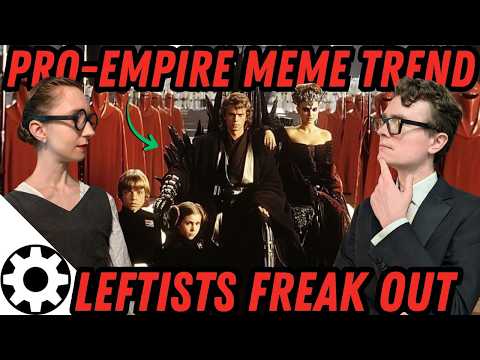
Simone and Malcolm explore a viral wave of Star Wars prequel memes where young men and Elon Musk portray Anakin Skywalker and the Galactic Empire as an aspirational ideal. Reading commentary from X alongside a 2005 MTV True Life segment, Simone argues that younger generations have long rejected baby boomer Rebel Alliance nostalgia and view the Jedi Council as a corrupt, stifling bureaucracy. The hosts contend that disaffected young men are rejecting democratic norms and even MAGA in favor of stellar humanism: a clean, orderly, futuristic vision for humanity.
Simone predicts that as shrinking tax bases cause legacy institutions to collapse, these agentic young men will build the replacement society. Channeling this right-wing futurism, Malcolm previews his upcoming Steam game Broodfall, showcasing a Technopuritan empire on Dyson Sphere 7 where schoolchildren fight lethal duels to prevent dysgenics and enter a digitized afterlife.
How time-sensitive the topic is: Developing story
By the numbers
10 years: Duration Anakin Skywalker loyally served under the Jedi Order before attempting to save his mother in Episode II, as cited by Adeptus Liberatus. (Mentioned at 6:01)
2005 year: Broadcast year of the MTV True Life episode featuring a son rebelling against his father's Rebel Alliance fandom by cosplaying as a Stormtrooper. (Mentioned at 10:20)
400 billion souls: Fictional population of Dyson Sphere 7 in the lore video for Malcolm's upcoming sci-fi game universe Broodfall. (Mentioned at 35:49)
10 kids a year: Approximate number of children Technopuritan families have per year using artificial wombs in Malcolm's fictional Broodfall universe. (Mentioned at 36:28)
24-hour marinated beef: Marination time Malcolm says AI recommended for their bulgogi dinner, compared to their previous 30-minute marination. (Mentioned at 49:22)
Questions this video answers
Why are Zoomer men posting Anakin Skywalker and Galactic Empire memes?
According to Simone and Malcolm, young men relate to Anakin Skywalker because they feel stifled by an ossified, rule-bound bureaucracy that fails to protect the people they care about. In their view, the Galactic Empire represents a strong, clean, and aspirational alternative to corrupt democratic institutions.
Simone, 0:00 to 3:00
From this keypoint: Simone examines viral pro-Empire Anakin memes
Why do online commentators argue that the Jedi Council was evil in the Star Wars prequels?
Commentators quoted by Simone argue that the Jedi Council rejected Anakin despite knowing he was the Chosen One, forbade him from reproducing, and allowed his mother to die in slavery. They view the Council as an inferior, geriatric bureaucracy lecturing a superior warrior using arbitrary titles.
Simone, 3:01 to 7:15
From this keypoint: Why Zoomers view the Jedi Council as corrupt
What is stellar humanism and how does it relate to the Star Wars Empire?
Malcolm describes stellar humanism, a concept credited to Leaflet, as the desire to admire a strong, orderly, clean, and futuristic vision for human civilization. He argues that within Star Wars, the Empire is the only faction that fulfills this aesthetic and organizational aspiration compared to the corrupt Republic and dirty Rebels.
Malcolm, 19:45 to 22:05
From this keypoint: Malcolm links Empire appeal to stellar humanism
How did Katherine Dee and Tom Fowdy explain the viral Anakin meme trend?
Internet historian Katherine Dee suggested the trend resulted from a demographic broadening of the online right and pre-midterm election astroturfing. In contrast, Tom Fowdy argued that the memes reflect frustrated young masculinity and a genuine rejection of both liberal democracy and MAGA in favor of an authoritarian system.
Simone, 14:45 to 19:45
From this keypoint: Why the meme trend rejects establishment politics
What happened in the 2005 MTV True Life episode about Star Wars fans?
The 2005 MTV True Life segment followed a young man named Charlie whose baby boomer father was obsessed with the Jedi and the Rebel Alliance. At a Star Wars convention, Charlie bonded with patriotic Empire cosplayers and dressed as a Stormtrooper, causing his father to visibly cry over his son choosing the 'wrong side.'
Simone, 10:05 to 14:44
From this keypoint: A 2005 MTV clip shows early pro-Empire rebellion
How does the visual design of the Galactic Empire differ from Warhammer 40k and Naboo?
Citing a Star Wars design book from his childhood, Malcolm explains that Imperial ships like TIE fighters and the Death Star were intentionally designed to look utilitarian and stripped of ornate iconography. He contrasts this clean, Protestant-like aesthetic with the gaudy ships of Naboo and the heavy orthodoxy of Warhammer 40k.
Malcolm, 26:57 to 31:09
From this keypoint: Utilitarian Empire design and colonizing Star Wars
Why do Malcolm and Simone think young men rally around Anakin Skywalker instead of Paul Atreides from Dune?
They argue that in a post-literate society, cultural memes rely on television and movie adaptations rather than books. Simone found the Dune books whiny and disliked the recent films starring Zendaya, while Malcolm contends that recent screen adaptations have butchered the Dune universe.
Simone, 31:10 to 35:36
From this keypoint: Why Dune fails to inspire like Star Wars
What is Malcolm Collins's upcoming video game Broodfall about?
Broodfall is an upcoming sci-fi game on Steam where players exterminate a planet using roguelike tower-defense mechanics inspired by Inscryption and a story inspired by Red Alert. It also features a dating-sim mechanic where players court a reproductive partner within a fascistic Technopuritan empire.
Malcolm, 41:07 to 48:57
From this keypoint: Broodfall mechanics versus Iain Banks's Culture
How does the school system work on Dyson Sphere 7 in the Broodfall lore?
In the background lore for the Broodfall universe, Technopuritan children compete in lethal combat at school to test fitness and prevent dysgenic decline without relying on a eugenics council. Students who are killed have their minds digitized into a pleasurable artificial afterlife so they do not drain state resources.
Malcolm, 35:37 to 41:06
From this keypoint: Malcolm's Dyson Sphere 7 lore and digitized death
Which sci-fi universe does Simone prefer over Malcolm's Technopuritan Empire?
Simone prefers the post-scarcity utopia of the Culture novels, where inhabitants rarely die, have no biological constraints, and can freely change their physical bodies. She contrasts the Culture's focus on happiness and intelligence with the grim, austere hierarchy of Malcolm's Broodfall setting.
Malcolm, 41:07 to 48:57
From this keypoint: Broodfall mechanics versus Iain Banks's Culture
Credible AI™ signals
Confidence: Opinion-Driven Commentary. Simone and Malcolm Collins cite real social media posts, a 2005 MTV True Life segment, and Star Wars design history to anchor their cultural commentary. However, the episode primarily offers subjective political interpretations, sweeping demographic predictions, and promotional lore for Malcolm's upcoming video game.
Bias: Technopuritan Right Futurism. The hosts openly embrace a right-wing, anti-egalitarian worldview, framing the Galactic Empire as an aspirational model of order and dismissing progressive critiques. They explicitly advocate for hierarchical, natalist, and post-democratic systems while promoting their own ideological sci-fi project.
Originality (78%): Idiosyncratic Lore & Takes. By connecting viral Star Wars memes to a 2005 MTV clip, demographic collapse theories, and an original sci-fi game universe featuring lethal school competitions and digitized afterlives, the hosts deliver an unconventional blend of pop-culture analysis and worldbuilding.
Depth (62%): Cultural & Aesthetic Synthesis. The discussion moves beyond surface-level meme recaps to examine generational alienation, institutional decay, and the utilitarian visual design of Star Wars factions. Still, much of the runtime shifts into casual family banter and unchallenged ideological assertions rather than rigorous analysis.
Key points (11)
Short (15 min): key points 1, 2, 6 and 10
Medium (29 min): key points 1, 2, 5, 6, 7, 8 and 10
Relaxed (49 min): all 11 key points
1. Simone examines viral pro-Empire Anakin memes
Timestamp: 00:00:00 to 00:03:00 (3 min)
Speaker: Simone
Young men online, including Elon Musk, are sharing Star Wars prequel memes that depict Anakin Skywalker and the Galactic Empire as an aspirational ideal. Simone explains that these posters relate to Anakin because they feel stifled by an ossified bureaucracy that fails to protect the people they care about. The trend also includes revisionist jokes arguing Padme Amidala should have supported Anakin in overthrowing both the Jedi and Palpatine.
Impact: Medium. Why it matters: Framing pop-culture villains as heroes signals a growing youth disillusionment with liberal democratic norms in favor of strongman aesthetics.
“It makes sense because basically the people who are posting this like Anakin find themselves shackled by an oified bureaucracy that stifles them and and fails to defend the people that they care about.”
In the video: Simone, at 0:41
For: Malcolm
2. Why Zoomers view the Jedi Council as corrupt
Timestamp: 00:03:01 to 00:07:15 (4 min)
Speaker: Simone
Reading posts from X users Modern Vitalist, Rich, and Adeptus Liberatus, Simone outlines the argument that the Jedi Council functioned as a geriatric, rule-bound bureaucracy that mistreated Anakin Skywalker. These commentators argue the Jedi forbade Anakin from having a family, ignored his mother's enslavement and death, and lectured a superior warrior using arbitrary titles. Consequently, young men view the Jedi as a corrupt boomer institution that destroyed Anakin's loyalty.
Impact: High. Why it matters: Reinterpreting the Jedi as a stifling gerontocracy turns a classic morality tale into an indictment of modern diversity initiatives and institutional gatekeeping.
“Yet he's locked out of pursuing a greater destiny by a geriatric bureaucracy with rules even it doesn't seem to understand why it enforces anymore.”
In the video: Simone, at 4:40
For: Malcolm
3. Anakin's war crimes and progressive pushback
Timestamp: 00:07:15 to 00:10:05 (3 min)
Speaker: Malcolm
Malcolm notes that while left-wing critics condemn Anakin for killing younglings, most of Anakin's war crimes in the Clone Wars occurred while working with the Jedi. After playing a clip about Anakin torturing prisoners for information, Simone reads pushback from progressive X users like Delton Puit, S Foster, and Project Liberal, who call right-wingers stupid and label Anakin a weak, manipulated man. Simone and Malcolm dismiss this pushback as myopic and uncreative.
Impact: Medium. Why it matters: Dismissing ethical critiques of political violence within fiction reflects how partisan audiences increasingly value ruthless effectiveness over procedural rules.
“The first thing that the leftist uh mob that hates anyone posting these is saying he killed the younglings. The Jedi the the Jedi most of the war crimes he did were at the order or while working with the Jedi.”
In the video: Malcolm, at 8:01
For: Simone
4. A 2005 MTV clip shows early pro-Empire rebellion
Timestamp: 00:10:05 to 00:14:44 (5 min)
Speaker: Simone
Simone presents a 2005 episode of MTV True Life to show that generational rejection of the Rebel Alliance is over 20 years old. In the clip, a young man named Charlie attends a Star Wars convention with his Rebel-obsessed father, finds the Empire cosplayers wholesome and patriotic, and chooses to dress as a Stormtrooper, moving his father to tears. Malcolm and Simone share that Simone herself used photos in film-grade Stormtrooper armor on OkCupid when they first met.
Impact: Medium. Why it matters: Tracing pro-Empire sentiment back to 2005 demonstrates that youth counter-cultural rebellion against baby boomer idealism predates current social media politics.
“But my point is that as long as there have been boomers, as long as there have been Star Wars, there has been a generation that's not having any of it”
In the video: Simone, at 14:28
For: Malcolm
5. Why the meme trend rejects establishment politics
Timestamp: 00:14:45 to 00:19:45 (5 min)
Speaker: Simone
After briefly debating how to custom-make Imperial-style family outfits, Simone contrasts two analyses of the Anakin meme wave. Internet historian Katherine Dee attributes the memes to a demographic broadening of the online right and pre-midterm political astroturfing, which Malcolm says misses the desire for a new world order.
Impact: High. Why it matters: Highlighting right-wing youth dissatisfaction with MAGA suggests emerging populist movements may demand systemic replacement rather than electoral reform.
“He also views MAGA as part of the establishment and just another ineffective institution. He doesn't argue for reform. He argues for a completely different system, saying quote, "We want fascism. We want space fascism. We want the empire."”
In the video: Simone, at 19:13
For: Malcolm
6. Malcolm links Empire appeal to stellar humanism
Timestamp: 00:19:45 to 00:22:05 (2 min)
Speaker: Malcolm
Malcolm argues that the explosion of pro-Empire memes stems from what Leaflet calls stellar humanism: a desire on the right to admire a strong, orderly, clean, and futuristic vision for humanity. In Star Wars, the Republic is corrupt and the Rebels are dirty and incompetent, leaving the Empire as the only aspirational government. He adds that the Empire's inclusion of alien leaders like Grand Admiral Thrawn mirrors modern right-wing race realism rather than simple racism.
Impact: High. Why it matters: Articulating 'stellar humanism' clarifies how authoritarian movements use clean, futuristic aesthetics to make illiberal hierarchy appealing to young audiences.
“is we want to be able to admire a strong and orderly and clean and futuristic vision for where humanity could go.”
In the video: Malcolm, at 20:29
For: Simone
7. Simone predicts young men will build the future
Timestamp: 00:22:05 to 00:26:56 (5 min)
Speaker: Simone
Malcolm announces that his video game Broodfall is approved for wishlisting on Steam, featuring a fascistic yet internally coherent technopuritan empire. Expanding on why the Anakin memes matter, Simone predicts that legacy institutions will collapse as tax bases shrink and resource takers outnumber contributors.
Impact: High. Why it matters: Tying demographic decline to a predicted takeover by disaffected young men frames internet meme culture as a preview of future governance.
“No, you are looking at the memes being posted by the class of humans that is going to build the future.”
In the video: Simone, at 25:04
For: Malcolm
8. Utilitarian Empire design and colonizing Star Wars
Timestamp: 00:26:57 to 00:31:09 (4 min)
Speaker: Malcolm
Malcolm compares Warhammer 40k's ornate aesthetic to the Star Wars Empire's stripped-down, Protestant-like utilitarianism, citing a childhood Star Wars design book that contrasted functional TIE fighters and the Death Star with gaudy Naboo ships. While Simone notes the right has embraced Warhammer 40k for years, Malcolm argues leftists are infiltrating that brand.
Impact: High. Why it matters: Claiming villainous factions in mainstream franchises allows right-wing subcultures to co-opt major intellectual property without ideological pushback from progressive fans.
“And when it comes to something like saying no, we own the empire, the leftists can't push back on that, right?”
In the video: Malcolm, at 29:49
For: Simone
9. Why Dune fails to inspire like Star Wars
Timestamp: 00:31:10 to 00:35:36 (4 min)
Speaker: Simone
Addressing why young men rally around Anakin rather than Dune's Paul Atreides, Malcolm blames recent screen adaptations while Simone criticizes the Dune books as whiny and overly focused on 'Space Muslims,' noting she disliked the recent films starring Zendaya.
Impact: Low. Why it matters: Rejecting Dune adaptations while building arranged-marriage networks illustrates how the hosts blend media critique with radical lifestyle experiments.
“And Paul trades would be great if you didn't have an HBO show butchering it right now.”
In the video: Malcolm, at 31:24
For: Malcolm
10. Malcolm's Dyson Sphere 7 lore and digitized death
Timestamp: 00:35:37 to 00:41:06 (5 min)
Speaker: Malcolm
Malcolm plays an AI-generated video showcasing Dyson Sphere 7, a swarm habitat of 400 billion souls in his Broodfall universe where Technopuritan families have about 10 children a year in artificial wombs. To prevent the dysgenic collapse caused by 21st-century comfort, schoolchildren fight lethal duels rather than letting a eugenics council select genes.
Impact: Medium. Why it matters: Constructing a fictional society around lethal school selection and digitized afterlives pushes natalist and anti-dysgenic anxieties to a dystopian extreme.
“In school, children compete as a test of honestly signaled fitness and to prevent the disenic catastrophe of the 21st century.”
In the video: Malcolm, at 37:18
Against: Simone
11. Broodfall mechanics versus Iain Banks's Culture
Timestamp: 00:41:07 to 00:48:57 (8 min)
Speaker: Malcolm
Malcolm details additional lore and mechanics for Broodfall, which combines Inscryption-style roguelike tower defense and Red Alert storytelling with a reproductive dating sim. He explains the world's rules on genetically engineered catgirls (Neko girls), a deceased character uploaded as an AI companion after resisting genetic conversion from same-sex attraction, and a rival Jewish faction called the Sadducees.
Impact: Medium. Why it matters: Contrasting Malcolm's rigid Technopuritan dystopia with Simone's preference for the post-scarcity Culture highlights a core philosophical divide within futurist thought.
“exterminating a planet in the game is your your goal with tower defense rogike mechanics inspired by inscription and a story and plot inspired by red alert.”
In the video: Malcolm, at 44:59
Against: Simone
Conflicts of interest (2)
Self-Promotion of Upcoming Game Broodfall
Commercial conflict, Medium severity
Co-host Malcolm is the creator and developer of Broodfall, a commercial video game on Steam that he and Simone promote throughout the second half of the episode.
Sources: Simone, Malcolm
Significance: The hosts use the viral Star Wars Empire meme trend as a thematic springboard to market Broodfall's authoritarian sci-fi lore and urge viewers to wishlist the game.
Promotion of the Index Arranged-Marriage Network
Personal conflict, Low severity
Simone and Malcolm are founders and participants in the Index, an inter-family dating network for arranged marriages that they mention during the broadcast.
Sources: Simone, Malcolm
Significance: Their discussion of Dune's Bene Gesserit and dynastic family building serves to normalize and publicize their own private matchmaking initiative to their audience.
Key sources
Simone: Co-host
Malcolm: Co-host and Developer of Broodfall
Who's in this
Anakin Skywalker
Elon Musk
Padme Amidala
Palpatine
Broodfall
MTV
Steam
rfab.ai
Also mentioned
Galactic Empire (First mentioned at 0:35)
Star Wars (First mentioned at 10:48)
Jedi Council (First mentioned at 2:07)
X (First mentioned at 0:17)
Luke Skywalker (First mentioned at 0:29)
MTV True Life (First mentioned at 10:15)
Rebel Alliance (First mentioned at 10:54)
Tom Fowdy (First mentioned at 17:37)
Warhammer 40k (First mentioned at 20:22)
Dune (First mentioned at 31:28)
Dyson Sphere 7 (First mentioned at 35:45)
The Culture (First mentioned at 46:46)
Leia (First mentioned at 0:25)
Obi-Wan (First mentioned at 1:30)
Modern Vitalist (First mentioned at 3:20)
Rich (First mentioned at 4:04)
Mace Windu (First mentioned at 4:49)
Adeptus Liberatus (First mentioned at 5:22)
Yoda (First mentioned at 5:44)
Charlie (First mentioned at 13:20)
OkCupid (First mentioned at 13:59)
Katherine Dee (First mentioned at 16:20)
Leaflet (First mentioned at 19:59)
Thrawn (First mentioned at 21:37)
Titan (First mentioned at 25:25)
Torsten (First mentioned at 25:56)
Octavian (First mentioned at 30:52)
Paul Atreides (First mentioned at 31:19)
Zendaya (First mentioned at 32:04)
Industry Americus (First mentioned at 32:45)
Fire Emblem: Three Houses (First mentioned at 38:39)
Inscryption (First mentioned at 45:03)
Jar Jar Binks (First mentioned at 1:49)
Count Dooku (First mentioned at 4:23)
Delton Puit (First mentioned at 8:41)
S Foster (First mentioned at 8:44)
Project Liberal (First mentioned at 8:49)
Ron DeSantis (First mentioned at 17:04)
Tex (First mentioned at 30:52)
Battle Royale (First mentioned at 35:15)
Ender's Game (First mentioned at 38:04)
This analysis was generated by skim (skim.plus), an AI-powered content analysis platform by Credible AI. Scores and classifications represent the platform's AI-generated assessment and should be considered alongside other sources.