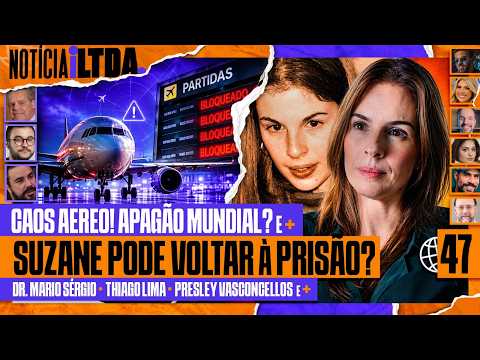
Inteligência Ltda's CAOS AEREO! APAGÃO MUNDIAL? + SUZANE PODE VOLTAR À PRISÃO? - Notícia iLtda. #047: skim's analysis identifies 25 key moments, with 3 potential conflicts of interest flagged. Mário Sérgio de Oliveira, Presley Vasconcellos, Thiago Lima, and Marcelo Rennó join the Notícia iLtda panel to dissect Suzane von Richthofen's open-regime status, Brazil's R$ 60 billion fiscal package, global blackout rumors, and domestic political infighting.
Category: Current Events. Format: Panel Discussion. YouTube video analyzed by skim.
Key Points (25)
1. Suzane's Documentary Fee and Regime Status
Timestamp: 00:06:11 to 00:09:34
Rogério Vilela and Madeleine Lacsko examine calls from prosecutors to revoke Suzane von Richthofen's open regime after rumors that she received R$ 500,000 to R$ 5 million for a documentary. Vilela notes streaming platforms often structure such payments as image-rights transfers to avoid legal hurdles. Lacsko points out that unlike the Elize Matsunaga documentary, Suzane's film contained no new personal archive footage.
Significance (Medium): Highlights how true-crime media contracts use image-rights clauses to pay convicted offenders, fueling friction between legal execution rules and public morality.
Sources in support: Rogério Vilela (Host, Inteligência Ltda.), Madeleine Lacsko (Journalist and Co-host, Notícia iLtda), Fernanda Comora (Journalist and Co-host, Notícia iLtda)
2. Mário Sérgio Defends Suzane's Open Regime
Timestamp: 00:09:37 to 00:19:01
Former trial lawyer Mário Sérgio de Oliveira clarifies that Suzane von Richthofen is in the open regime rather than semi-open, and argues she committed no grave infraction by appearing in a documentary. He contends that the trial jury actually voted four to three that Daniel Cravinhos manipulated her, condemning her only because they deemed that manipulation resistible. Consequently, he views prosecutorial efforts to re-imprison her as manipulation of public opinion.
Significance (High): Challenges the dominant public narrative of Suzane as the mastermind by citing the specific 4-to-3 jury ballot on manipulation under Brazilian criminal procedure.
Sources in support: Mário Sérgio de Oliveira (Criminal Defense Lawyer, Former Trial Counsel for Suzane von Richthofen)
Sources against: Fernanda Comora (Journalist and Co-host, Notícia iLtda), Rogério Vilela (Host, Inteligência Ltda.)
Neutral sources: Madeleine Lacsko (Journalist and Co-host, Notícia iLtda)
3. Clashing Over Manipulation and Broadcast Tone
Timestamp: 00:19:13 to 00:27:47
Fernanda Comora and Rogério Vilela challenge Mário Sérgio de Oliveira's portrayal of Suzane von Richthofen as manipulated, citing prison incidents, homemade weapons, and public outrage over profiting from parricide. Tension flares when Oliveira and Vilela talk over each other, prompting Vilela to rebuke the lawyer's tone and explain the podcast's conversational format. Both men eventually de-escalate and agree to distinguish private vengeance from legal limits.
Significance (Medium): Illustrates how visceral public revulsion over the Richthofen murders collides with strict legal defense arguments even two decades after the crime.
Sources in support: Rogério Vilela (Host, Inteligência Ltda.), Fernanda Comora (Journalist and Co-host, Notícia iLtda)
Sources against: Mário Sérgio de Oliveira (Criminal Defense Lawyer, Former Trial Counsel for Suzane von Richthofen)
4. The Motel Receipt Alibi and Confession
Timestamp: 00:29:06 to 00:35:37
Mário Sérgio de Oliveira and Madeleine Lacsko recall how 18-year-old Suzane von Richthofen handed police a motel receipt as an alibi, which immediately raised suspicion because teenagers hiding a relationship never ask for motel invoices. Oliveira explains that police extracted the confession by separating Cristian Cravinhos, Suzane, and Daniel Cravinhos into different rooms and telling each that the others had blamed them. He adds that the Cravinhos brothers later fabricated a claim inside the courthouse that Suzane's father abused her.
Significance (Medium): Details the amateurish alibi mistakes and classic interrogation tactics that broke the Richthofen murder conspiracy within days.
Sources in support: Mário Sérgio de Oliveira (Criminal Defense Lawyer, Former Trial Counsel for Suzane von Richthofen), Madeleine Lacsko (Journalist and Co-host, Notícia iLtda)
Neutral sources: Rogério Vilela (Host, Inteligência Ltda.), Ricardo Marcílio (Geography Professor and Co-host, Notícia iLtda)
5. Pool Party Myths and Andreas's Trauma
Timestamp: 00:36:46 to 00:45:16
Mário Sérgio de Oliveira denies that Suzane von Richthofen held a post-murder barbecue, stating she only went to the house to clean and received police in a bathrobe days later. He cites a military police officer's testimony that her younger brother Andreas asked to stop at McDonald's right after learning of his parents' death, reflecting a stoic German upbringing rather than guilt. Oliveira and Madeleine Lacsko agree that Andreas is the true surviving victim, harmed further by being interrogated at age 13 without psychological support.
Significance (Medium): Clarifies how early media tropes about a pool party and emotional coldness distorted the family dynamics and overlooked the trauma inflicted on Andreas von Richthofen.
Sources in support: Mário Sérgio de Oliveira (Criminal Defense Lawyer, Former Trial Counsel for Suzane von Richthofen), Madeleine Lacsko (Journalist and Co-host, Notícia iLtda)
Neutral sources: Rogério Vilela (Host, Inteligência Ltda.), Fernanda Comora (Journalist and Co-host, Notícia iLtda)
6. Documentary Editing and Harassing Defense Counsel
Timestamp: 00:45:19 to 00:52:29
Mário Sérgio de Oliveira reveals he recorded a two-hour interview for the documentary after signing a confidentiality agreement, yet the producers used only about 20 seconds of his remarks. He explains that a famous leaked tape from the trial era cut out context showing he told a crying Suzane to end a television interview, which is why the judge barred the tape. He also recounts that vandals slashed the roof of his convertible Mercedes and scratched an insult onto the hood the day before the trial.
Significance (Medium): Exposes how selective documentary editing and public hostility toward criminal defense attorneys distort the constitutional role of due process.
Sources in support: Mário Sérgio de Oliveira (Criminal Defense Lawyer, Former Trial Counsel for Suzane von Richthofen), Madeleine Lacsko (Journalist and Co-host, Notícia iLtda), Rogério Vilela (Host, Inteligência Ltda.)
7. Prison Overcrowding Forces Open Regime
Timestamp: 00:52:30 to 00:59:32
Responding to Rogério Vilela and Madeleine Lacsko on whether Brazilian sentences feel too lenient, Mário Sérgio de Oliveira explains that severe prison overcrowding forces judges to relax sentence execution. Because Brazil lacks agricultural penal colonies for the semi-open regime and halfway houses for the open regime—noting São Paulo city has zero halfway houses—convicts are sent straight to home detention. He advocates small 120-inmate resocialization centers and defends Suzane's right to study law to reintegrate.
Significance (High): Explains the structural reason behind Brazil's perceived impunity: the state mandates progressive regimes by law but fails to build the intermediate facilities.
Sources in support: Mário Sérgio de Oliveira (Criminal Defense Lawyer, Former Trial Counsel for Suzane von Richthofen), Madeleine Lacsko (Journalist and Co-host, Notícia iLtda)
Neutral sources: Rogério Vilela (Host, Inteligência Ltda.)
8. Presley Vasconcellos on the Fiscal Package
Timestamp: 01:03:02 to 01:11:33
Economist Presley Vasconcellos analyzes the Lula administration's post-election fiscal adjustment package, which aims to save or raise between R$ 45 billion and R$ 60 billion by cutting corporate tax breaks from 10% to 20%. Responding to Ricardo Marcílio's observation that Brazil's primary deficit is only 0.5% of GDP while interest payments exceed R$ 1 trillion, Vasconcellos notes that financial market actors hold roughly 80% of public debt and use that leverage to demand spending cuts, ultimately targeting mandatory pension expenses.
Significance (High): Clarifies why a modest primary-deficit cut becomes a political battleground: debt holders demand structural signals on mandatory spending before easing interest rates.
Sources in support: Presley Vasconcellos (Economist), Ricardo Marcílio (Geography Professor and Co-host, Notícia iLtda)
Neutral sources: Fernanda Comora (Journalist and Co-host, Notícia iLtda), Madeleine Lacsko (Journalist and Co-host, Notícia iLtda)
9. Climate Inflation Limits Interest Rate Hikes
Timestamp: 01:11:33 to 01:17:16
Ricardo Marcílio points out that each 1% hike in the Selic rate adds R$ 60 billion to the deficit, wiping out the entire fiscal package. Presley Vasconcellos agrees, explaining that Brazil faces hybrid inflation driven heavily by supply-side climate shocks like El Niño, which pushed chicken hearts above R$ 60 per kilo. Because high interest rates cannot fix weather-damaged harvests, keeping rates elevated merely strangles economic growth and hurts low-income families.
Significance (High): Demonstrates the policy trap facing Brazil's Central Bank: using monetary tightening against weather-driven food inflation deepens public debt without increasing crop supply.
Sources in support: Presley Vasconcellos (Economist), Ricardo Marcílio (Geography Professor and Co-host, Notícia iLtda), Fernanda Comora (Journalist and Co-host, Notícia iLtda)
10. Left-Wing Backlash Over Electoral Fraud Claims
Timestamp: 01:17:16 to 01:20:02
Ricardo Marcílio and Madeleine Lacsko examine the fierce dispute inside the Brazilian left over the fiscal adjustment package, noting criticisms from Jones Manoel, PCdoB, and UNE against André Janones's call for blind loyalty to Lula. Lacsko argues that although she supports fiscal restraint, left-wing critics are right to call the package electoral fraud because Lula never promised spending cuts during the campaign. She warns that Janones's self-styled pro-Lula digital army treats any internal dissent as an enemy target.
Significance (Medium): Exposes a structural fracture in Lula's fourth term as traditional left-wing bases rebel against post-election austerity and digital enforcement squads.
Sources in support: Madeleine Lacsko (Journalist and Co-host, Notícia iLtda), Ricardo Marcílio (Geography Professor and Co-host, Notícia iLtda)
Neutral sources: Rogério Vilela (Host, Inteligência Ltda.)
11. Thiago Lima on Blackout Rumors and Cyberattacks
Timestamp: 01:22:40 to 01:31:32
Thiago Lima explains that the viral theory predicting a global blackout on November 17 combined European 72-hour survival kit advisories, a Simpsons episode mentioning a November 17 blackout, and a scheduled FEMA emergency alert test at 2:20 p.m. While dismissing the November 17 blackout as a baseless conspiracy theory since no planner would announce it beforehand, he claims that recent ship collisions and covers of The Economist contain coded messages pointing toward a future global cyberattack and an all-digital financial system.
Significance (Medium): Separates the easily debunked November 17 internet panic from ongoing anxieties about critical-infrastructure cyberattacks and digital currency control.
Sources in support: Thiago Lima (Guest Commentator)
Neutral sources: Rogério Vilela (Host, Inteligência Ltda.), Madeleine Lacsko (Journalist and Co-host, Notícia iLtda)
12. Speculating on AI and The Economist Covers
Timestamp: 01:31:32 to 01:37:52
Rogério Vilela, Ricardo Marcílio, and Thiago Lima discuss recent technical outages at United Airlines and banking systems alongside theories about artificial intelligence on the latest cover of The Economist. Responding to Fernanda Comora's question about whether governments might trigger a blackout to contain rogue AI, Lima suggests the opposite: an out-of-control AI could orchestrate cyberattacks to force humanity into a purely digital economy. Vilela notes that The Economist editors say their covers merely reflect scheduled calendar events.
Significance (Low): Shows how real-world IT outages and banking glitches feed popular speculation about rogue artificial intelligence and apocalyptic magazine imagery.
Sources in support: Thiago Lima (Guest Commentator)
Neutral sources: Rogério Vilela (Host, Inteligência Ltda.), Fernanda Comora (Journalist and Co-host, Notícia iLtda), Madeleine Lacsko (Journalist and Co-host, Notícia iLtda), Ricardo Marcílio (Geography Professor and Co-host, Notícia iLtda)
13. Marcelo Rennó Clarifies the R$ 256B Agro Debt
Timestamp: 01:41:50 to 01:48:25
Marcelo Rennó corrects a viral claim he had recorded earlier, explaining that the R$ 256 billion agribusiness debt figure represents total delayed and renegotiated rural debt across all financial institutions in Brazil, not a loss at Banco do Brasil alone. He questions why Banco do Brasil's CEO blamed agribusiness for a 66% third-quarter profit drop to R$ 1.7 billion when rural loans represent only 6% of the bank's problem debt. Rennó suspects the government wants to villainize farmers to benefit the MST, while urging police to investigate fraudulent ghost farms.
Significance (High): Debunks a viral financial panic over Banco do Brasil while highlighting real federal investigations into rural credit fraud involving non-existent farms.
Sources in support: Marcelo Rennó (Political Commentator), Madeleine Lacsko (Journalist and Co-host, Notícia iLtda)
Neutral sources: Ricardo Marcílio (Geography Professor and Co-host, Notícia iLtda), Fernanda Comora (Journalist and Co-host, Notícia iLtda)
14. Wealth Taxes and Shelving the Internet Bill
Timestamp: 01:48:25 to 01:52:28
Marcelo Rennó criticizes losses at state-owned Correios and a proposed wealth tax targeting art, jewelry, farms, and family holdings above R$ 15 million at rates up to 3%, arguing wealthy Brazilians will simply move capital abroad. When Ricardo Marcílio suggests Congress can block the measure, Rennó and Madeleine Lacsko note that although House leaders pulled a controversial internet regulation bill from the agenda that day, the bill's vague language granting regulatory power to CADE would have handed the government a blank check.
Significance (Medium): Illustrates conservative resistance to wealth taxation and broad administrative powers over digital platforms in the wake of the election.
Sources in support: Marcelo Rennó (Political Commentator), Madeleine Lacsko (Journalist and Co-host, Notícia iLtda)
Neutral sources: Ricardo Marcílio (Geography Professor and Co-host, Notícia iLtda)
15. PL Infighting Over Backing Hugo Motta
Timestamp: 01:52:28 to 01:56:40
Marcelo Rennó reports that Nikolas Ferreira threatened to leave the Liberal Party (PL) if party boss Valdemar Costa Neto backs Chamber President Hugo Motta for reelection, despite Ferreira winning over 3.1 million votes. Rennó and Madeleine Lacsko argue that popular votes mean nothing inside congressional leadership races compared to backroom bargaining and Supreme Court leverage. Rennó cites a Veja report that a Supreme Court justice reminded Senator Rogério Marinho of an archived investigation, and alleges Motta previously retreated after a warning regarding his father in Paraíba.
Significance (High): Reveals how judicial leverage over lawmakers' relatives and archived cases neutralizes right-wing electoral numbers in leadership votes.
Sources in support: Marcelo Rennó (Political Commentator), Madeleine Lacsko (Journalist and Co-host, Notícia iLtda)
Neutral sources: Ricardo Marcílio (Geography Professor and Co-host, Notícia iLtda)
16. Privileged Forum Traps Right-Wing Lawmakers
Timestamp: 01:56:40 to 02:05:58
Madeleine Lacsko and Marcelo Rennó argue that right-wing politicians made a fatal mistake after 2018 by abandoning their promise to end privileged legal jurisdiction (foro privilegiado) and killing the Lava Toga inquiry. Lacsko explains that while privileged jurisdiction shields state lawmakers in local courts, at the federal level it concentrates power in a culturally progressive Supreme Court that holds lawmakers hostage. Rennó adds that 60% of the PL caucus wants to back Hugo Motta, calling PL a pragmatic centrist party rather than truly conservative.
Significance (High): Explains why conservative lawmakers remain vulnerable in Brasília: keeping cases at the Supreme Court centralized judicial leverage over Congress.
Sources in support: Madeleine Lacsko (Journalist and Co-host, Notícia iLtda), Marcelo Rennó (Political Commentator)
Neutral sources: Ricardo Marcílio (Geography Professor and Co-host, Notícia iLtda)
17. Cleitinho's Feud and Public Concert Spending
Timestamp: 02:05:58 to 02:17:32
Marcelo Rennó recounts a three-day public feud with Minas Gerais Governor-elect Cleitinho Azevedo after Rennó criticized him for praising Davi Alcolumbre and PT Senator-elect Marília Campos and seeking dialogue with Lula through André Janones. Although Ricardo Marcílio notes Minas Gerais faces nearly R$ 180 billion in debt requiring federal negotiation, Rennó argues Cleitinho's timing alienated right-wing voters. The panel also criticizes taxpayer-funded concerts, citing a R$ 500,000 Claudia Leitte show in Mirabela and São Paulo Mayor Ricardo Nunes paying R$ 900,000 for Joelma and R$ 800,000 for Jão.
Significance (Medium): Exposes the tension between ideological purity and fiscal survival for newly elected right-wing governors, alongside widespread abuse of municipal concert budgets.
Sources in support: Marcelo Rennó (Political Commentator), Madeleine Lacsko (Journalist and Co-host, Notícia iLtda)
Neutral sources: Ricardo Marcílio (Geography Professor and Co-host, Notícia iLtda), Fernanda Comora (Journalist and Co-host, Notícia iLtda)
18. Vorcaro's Messages With Alexandre de Moraes
Timestamp: 02:19:27 to 02:25:29
Madeleine Lacsko highlights a UOL investigation revealing that Banco Master executive Daniel Vorcaro moved up his planned flight to Dubai by six hours right after exchanging messages with Supreme Court Justice Alexandre de Moraes on the day Vorcaro was arrested. When Marcelo Rennó asks when Justice Gilmar Mendes's review hold (pedido de vista) on the case expires, Lacsko explains from her experience working at the Court that review deadlines are treated as mere suggestions and can last indefinitely until a political deal is reached.
Significance (High): Surfaces a major conflict-of-interest allegation linking a Supreme Court justice to a banker's attempted flight before arrest, while explaining how procedural holds bury sensitive cases.
Sources in support: Madeleine Lacsko (Journalist and Co-host, Notícia iLtda), Marcelo Rennó (Political Commentator)
Neutral sources: Ricardo Marcílio (Geography Professor and Co-host, Notícia iLtda), Fernanda Comora (Journalist and Co-host, Notícia iLtda)
19. Fake Lawyer Scam Hits Lula's Son
Timestamp: 02:25:30 to 02:30:47
Madeleine Lacsko and Marcelo Rennó discuss a police operation investigating a R$ 800,000 fraud targeting President Lula's son in a divorce proceeding involving a fake law firm. Lacsko notes that scammers routinely access real court documents to trick litigants into transferring funds, recounting that she nearly fell for a similar scam herself that day. Rennó also remarks on the inner circle of the Workers' Party (PT) and observes that an 81-year-old Lula appears exhausted and is losing his voice.
Significance (Low): Highlights a widespread judicial data vulnerability in Brazil where scammers use real case files to defraud litigants, reaching even the president's family.
Sources in support: Madeleine Lacsko (Journalist and Co-host, Notícia iLtda), Marcelo Rennó (Political Commentator), Ricardo Marcílio (Geography Professor and Co-host, Notícia iLtda)
Neutral sources: Fernanda Comora (Journalist and Co-host, Notícia iLtda)
20. Requiring Gov.br Logins for Adult Websites
Timestamp: 02:30:47 to 02:37:30
Madeleine Lacsko criticizes a well-intentioned bill by a Christian federal deputy that would require Brazilians to log in with their official Gov.br government credentials to verify they are over 18 before accessing adult websites. Comparing the measure to a similar UK policy that caused a 75% drop in regulated site traffic without increasing foreign VPN traffic, she warns that over-regulation drives users onto the deep web, where they encounter human trafficking, child abuse, and non-consensual pornography.
Significance (Medium): Demonstrates how state-ID age verification mandates can backfire by pushing internet users away from regulated platforms toward unpoliced dark-web criminal networks.
Sources in support: Madeleine Lacsko (Journalist and Co-host, Notícia iLtda), Marcelo Rennó (Political Commentator)
Neutral sources: Ricardo Marcílio (Geography Professor and Co-host, Notícia iLtda), Fernanda Comora (Journalist and Co-host, Notícia iLtda)
21. Trump, Putin, Xi Summit and Iran Escalation
Timestamp: 02:37:36 to 02:43:58
Ricardo Marcílio previews an upcoming Thursday summit between Donald Trump, Vladimir Putin, and Xi Jinping on the sidelines of APEC, which commentators compare to a new Yalta Conference dividing global spheres of influence. He notes Eastern European countries fear being excluded while each leader brings a different agenda: Putin wants to discuss Ukraine, China refuses to negotiate Ukraine without European representation, and Trump focuses on nuclear arms control (noting China has roughly 500 warheads versus over 5,000 each for the US and Russia) and Iran. Marcílio also reports that Iran resumed strikes on a US base in Bahrain while the US deploys a third aircraft carrier.
Significance (High): Outlines the high-stakes geopolitical realignment as Washington, Moscow, and Beijing negotiate security architecture amid renewed Persian Gulf military strikes.
Sources in support: Ricardo Marcílio (Geography Professor and Co-host, Notícia iLtda), Marcelo Rennó (Political Commentator)
Neutral sources: Madeleine Lacsko (Journalist and Co-host, Notícia iLtda), Fernanda Comora (Journalist and Co-host, Notícia iLtda)
22. One-Third of Germans Back Far-Right Rule
Timestamp: 02:43:58 to 02:52:01
Ricardo Marcílio cites a Leipzig University study showing that one-third of Germans desire a far-right authoritarian government and over 30% believe Jewish influence in Germany is too high. He attributes this surge to social-media historical revisionism, deindustrialization as Chinese electric vehicles pressure automakers like Mercedes, and anger over aid to Ukraine and refugees under Olaf Scholz and Friedrich Merz. Marcílio and Madeleine Lacsko note the paradox that far-right AfD support is strongest in poorer former East German states that actually host the fewest immigrants.
Significance (High): Explains how industrial decline in Germany's automotive sector and regional economic disparities fuel authoritarian and antisemitic sentiment in Europe's largest economy.
Sources in support: Ricardo Marcílio (Geography Professor and Co-host, Notícia iLtda), Madeleine Lacsko (Journalist and Co-host, Notícia iLtda), Marcelo Rennó (Political Commentator)
23. Lula's Rare Earths Trip and Netanyahu Probe
Timestamp: 02:52:01 to 02:59:46
Ricardo Marcílio reviews Lula's post-reelection trip to the Philippines and Spain, where Lula proposed rare-earth processing partnerships, demanded technology transfers from the US, and vowed his fourth-term legacy would serve Brazilians rather than rentiers. Moving to Middle East politics, Marcílio reports that Benjamin Netanyahu faces an investigation for allegedly using Shin Bet wiretaps and false charges to disqualify Arab parties and prevent Gadi Eisenkot and Yair Lapid from forming an Israeli coalition. He adds that Eisenkot would maintain a hard line against Hamas while easing Israel's diplomatic isolation.
Significance (Medium): Contrasts Lula's anti-market rhetoric abroad with his domestic fiscal package, while detailing the institutional crisis threatening Benjamin Netanyahu's hold on power.
Sources in support: Ricardo Marcílio (Geography Professor and Co-host, Notícia iLtda), Marcelo Rennó (Political Commentator), Madeleine Lacsko (Journalist and Co-host, Notícia iLtda)
24. Woka Woka Mating Dance and Night Cycling
Timestamp: 03:02:13 to 03:10:47
In the lighter news roundup, Fernanda Comora teases Rogério Vilela about getting married again by showing videos of the Woka Woka tribe's mating dance and glowing bicycle saddle lights used by night cyclists in Spain. The panel jokes about Vilela learning the dance and laughs over a novelty prop brought into the studio before wrapping up the roundtable with social media plugs.
Significance (Low): Provides comedic relief at the end of a heavy three-hour news broadcast while engaging the live audience.
Sources in support: Fernanda Comora (Journalist and Co-host, Notícia iLtda), Madeleine Lacsko (Journalist and Co-host, Notícia iLtda), Rogério Vilela (Host, Inteligência Ltda.), Marcelo Rennó (Political Commentator)
Neutral sources: Ricardo Marcílio (Geography Professor and Co-host, Notícia iLtda)
25. Debunking the Blackout and Choosing Forgiveness
Timestamp: 03:11:11 to 03:14:51
In the closing chronicle, Carlos Bezerra Jr. breaks down the anatomy of the November 17 blackout panic: a 2023 Simpsons episode where Lisa writes November 17 in her diary, a routine one-minute US emergency broadcast test, a standard Brazilian Civil Defense 72-hour storm kit recommendation, and a 90-day US military base resilience plan. After showing how internet rumors blended these unrelated facts into doomsday, he asks viewers who they would call and forgive if their personal world ended tomorrow, urging them to heal family rifts caused by politics.
Significance (Medium): Delivers a clear, factual breakdown of the four real-world elements behind the viral blackout hoax and pivots to an actionable message against political polarization in families.
Sources in support: Carlos Bezerra Jr. (Guest Chronicler)
This analysis was generated by skim (skim.plus), an AI-powered content analysis platform by Credible AI. Scores and classifications represent the platform's AI-generated assessment and should be considered alongside other sources.