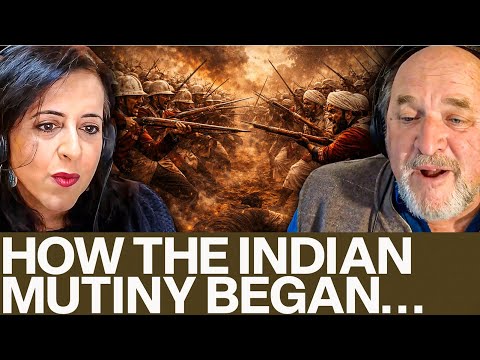
Empire • World History's Chapattis, Cartridges & Betrayal: How India’s Greatest Revolt Began (1857): skim's analysis identifies 11 key moments, with 1 potential conflict of interest flagged. William Dalrymple and Anita Anand trace the origins of the 1857 Indian Uprising from the cultural twilight of Mughal Delhi to the May 1857 outbreak at Meerut.
Category: Education. Format: Commentary. YouTube video analyzed by skim.
skim AI Analysis
Credibility assessment: Archival Historical Analysis. Historian William Dalrymple and co-host Anita Anand ground their account in primary sources, citing court diaries from the National Archives, Theo Metcalfe's papers in Cambridge, Urdu newspapers, Edward Campbell's letters, and Sita Ram Pande's memoirs.
Bias assessment: Sympathetic to Mughal Culture. The hosts openly admire early Anglo-Mughal cultural syncretism and Bahadur Shah Zafar's courtly arts, while sharply condemning 1850s British evangelical arrogance, Wahhabi puritanism, and the incompetence of British military commanders at Meerut.
Originality: 84% — Primary-Source Storytelling. Rather than treating 1857 solely through the lens of greased cartridges or Mangal Pandey, the discussion integrates Urdu literary rivalries, archival intelligence reports from Delhi, and the socioeconomic fallout of the 1856 annexation of Awadh.
Depth: 86% — Multi-Factor Causal Synthesis. The episode connects long-term structural shifts—Nader Shah's 1739 plunder, rising religious fundamentalism on both sides, falling sepoy pay after Awadh's annexation, and technical flaws in Enfield rifle lubrication—to the final Meerut mutiny.
Key Points (11)
1. Evangelicals end Delhi's Golden Calm
Timestamp: 00:00:39 to 00:04:17
After capturing Delhi in 1803, early British officials like David Ochterlony and William Fraser embraced Mughal culture, Urdu poetry, and Indian wives during a 20-to-30-year Golden Calm. By the 1830s, evangelical officials like Charles Trevelyan and readers of Macaulay replaced that harmony with racial arrogance and restricted Bahadur Shah Zafar's power to the Red Fort.
Significance (High): This shift from cultural integration to evangelical superiority alienated Delhi's elite and laid the ideological groundwork for the 1857 rupture.
Sources in support: William Dalrymple (Co-host and Historian), Anita Anand (Co-host and Author)
2. Nader Shah's plunder left Zafar broke
Timestamp: 00:04:17 to 00:08:35
William Dalrymple and Anita Anand explain that Bahadur Shah Zafar lacked the wealth of earlier Mughal builders because Persian invader Nader Shah crushed Muhammad Shah Rangila's forces at Karnal using armor-piercing swivel guns. Nader Shah carted off 380 wagons of jewels, including the Peacock Throne and Koh-i-Noor, leaving Zafar to patronize affordable writers like Zauq and Ghalib.
Significance (Medium): Financial exhaustion forced the late Mughal court to channel its prestige into Urdu poetry rather than military or architectural power.
Sources in support: William Dalrymple (Co-host and Historian), Anita Anand (Co-host and Author)
3. Zafar's court thrived on Urdu poetry
Timestamp: 00:08:36 to 00:12:27
Despite British rudeness and efforts after 1830 to push the Mughals out of the Red Fort toward Mehrauli, Bahadur Shah Zafar presided over a brilliant literary court featuring the rival poets Ghalib and Zauq. Dalrymple notes that Delhi's musical heritage survived the coming war only because a famous court musician impregnated one of Zafar's concubines and was exiled to Hyderabad.
Significance (Medium): Highlights how late Mughal Delhi experienced a golden age of Urdu verse and music right before the 1857 uprising destroyed the court.
Sources in support: William Dalrymple (Co-host and Historian), Anita Anand (Co-host and Author)
4. Dalrymple reads Ghalib's witty letters
Timestamp: 00:12:27 to 00:15:28
William Dalrymple portrays the aristocratic poet Ghalib as a hard-drinking, gambling rake who mocked the pious poet laureate Sahbai for never having tasted wine or seen the inside of a jail. Reading from a letter Ghalib wrote to a grieving friend, Dalrymple illustrates the playful, hedonistic court culture that existed just before the 1857 storm.
Significance (Low): Ghalib's irreverent wit captures the tolerant, sensual world of Mughal Delhi that both British evangelicals and Islamic puritans sought to erase.
Sources in support: William Dalrymple (Co-host and Historian), Anita Anand (Co-host and Author)
5. Puritanism and early Indian nationalism
Timestamp: 00:15:28 to 00:21:42
Anita Anand and William Dalrymple explain how Delhi's tolerant Sufi and Anglo-Mughal culture was squeezed between strict British officials like the Metcalfe family and hardline Wahhabi puritans seeking to purge Hindu customs from Indian Islam. Simultaneously, travelers like Azimullah Khan witnessed British military struggles in the Crimean War and returned with a newfound sense of Indian nationalism.
Significance (High): Religious polarization and knowledge of British vulnerability in Crimea transformed local grievances into a broader anti-colonial consciousness.
Sources in support: William Dalrymple (Co-host and Historian), Anita Anand (Co-host and Author)
6. Mysterious chapatis and fatwas spread
Timestamp: 00:21:54 to 00:24:58
Anita Anand details how early 1857 Urdu newspapers reported mysterious chapatis being passed by night watchmen from village to village toward Agra and Delhi, alongside fatwas in Madras calling for holy war against the British. Meanwhile, Delhi playboy and official Theo Metcalfe gathered bazaar intelligence warning that the public was openly discussing the sepoy army's lack of fidelity.
Significance (High): Shows that intelligence warnings, religious fatwas, and rural communication networks signaled a coordinated mood of revolt months before May 1857.
Sources in support: William Dalrymple (Co-host and Historian), Anita Anand (Co-host and Author)
7. Annexing Awadh slashed sepoy salaries
Timestamp: 00:24:58 to 00:27:31
In February 1856, the British abolished the court of Lucknow, annexed Awadh, and exiled Nawab Wajid Ali Shah to Calcutta. William Dalrymple explains that because most Bengal Army sepoys were recruited from Awadh, the annexation stripped them of their foreign-service supplement and reduced their pay by a third at a time when war loot had already dried up.
Significance (High): Annexing the sepoys' homeland while cutting their pay by a third turned the East India Company's primary recruiting ground against British rule.
Sources in support: William Dalrymple (Co-host and Historian), Anita Anand (Co-host and Author)
8. Enfield cartridges spark conversion panic
Timestamp: 00:27:31 to 00:33:46
Replacing the smoothbore Brown Bess musket in early 1857, the rifled Enfield required heavily lubricated cartridges manufactured at Dum Dum that soldiers had to bite open. Rumors that the thick grease came from cow and pig fat—combined with evangelical colonels reading the Bible on parade—convinced Hindu and Muslim sepoys of an organized plot to defile their caste and convert them to Christianity.
Significance (High): A manufacturing blunder at Dum Dum merged with evangelical proselytizing in the officer corps to unite Hindu and Muslim soldiers in shared existential dread.
Sources in support: William Dalrymple (Co-host and Historian), Anita Anand (Co-host and Author)
9. Anand cites Sita Ram Pande on alienation
Timestamp: 00:33:46 to 00:36:46
Even after the British changed the cartridge lubricant recipe to beeswax and ghee, sepoys no longer trusted their commanders. Reading from sepoy Sita Ram Pande's memoir, Anita Anand shows how older officers who spoke fluent Hindustani, attended nautch dances, and socialized with their men had been replaced by aloof officers swayed by chaplains, while orders to cross the sea to Burma further stoked caste fears.
Significance (High): The breakdown of personal trust between British officers and Indian soldiers meant administrative concessions on cartridge grease came too late to stop mutiny.
Sources in support: William Dalrymple (Co-host and Historian), Anita Anand (Co-host and Author)
10. 85 Meerut cavalrymen refuse the cartridge
Timestamp: 00:36:46 to 00:42:57
After Mangal Pandey broke the taboo by shooting at British officers in Barrackpore, the decisive crisis erupted at Meerut, 50 miles north of Delhi, under commanders Archdale Wilson and Bill Hewitt. On April 24, 1857, when Wilson forced 90 veteran troopers of the 3rd Light Cavalry to load the new cartridges on parade, 85 refused and were sentenced by a sepoy court of inquiry to 10 years with a plea for mercy.
Significance (High): Forcing a public test of the despised cartridges at the largest depot near Delhi turned passive resistance into an acute disciplinary crisis.
Sources in support: William Dalrymple (Co-host and Historian), Anita Anand (Co-host and Author)
11. Public shackling at Meerut triggers revolt
Timestamp: 00:42:57 to 00:46:36
Ignoring the recommendation for mercy, General Bill Hewitt paraded the Meerut cantonment on Saturday, May 9, 1857, to strip and shackle the 85 veteran troopers, who hurled their boots and curses at him as they were led to jail. That night, Meerut bazaar prostitutes refused to sleep with any soldier until the prisoners were freed, and Hewitt stuffed an intelligence warning about a Sunday church attack into his pocket unread, setting the stage for the May 10 mutiny.
Significance (High): Hewitt's public humiliation of decorated veterans and dismissal of intelligence warnings directly triggered the outbreak of the 1857 rebellion on May 10.
Sources in support: William Dalrymple (Co-host and Historian), Anita Anand (Co-host and Author)
This analysis was generated by skim (skim.plus), an AI-powered content analysis platform by Credible AI. Scores and classifications represent the platform's AI-generated assessment and should be considered alongside other sources.