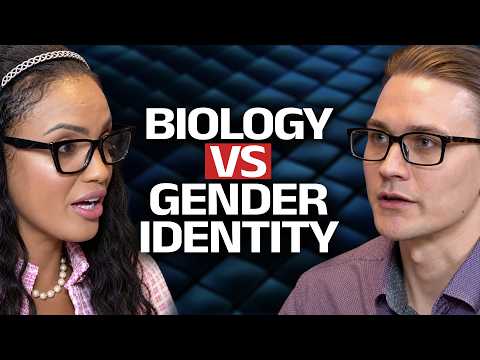
Ciera Foster vs Oskar Quentin: What REALLY Defines a Woman?
Digital Social Hour Podcast by Sean Kelly
Summary
On Digital Social Hour with guest moderator Justin Admiral Gibbs, political commentator and former NCAA basketball player Ciera Foster debates online political commentator Oskar Quentin on the definition of a woman and transgender participation in female sports. Foster cites September 2026 Executive Order 14168 to argue that a woman is an adult human female capable of reproduction, contending that chromosomes and male physical advantages cannot be erased by hormone therapy. Quentin counters that language is defined by social usage rather than government decrees and argues that hormone replacement therapy and puberty blockers reduce muscle mass and blood oxygen enough to allow fair competition outside of combat sports.
The exchange highlights a deep fracture among anti-Trump voters. Although both Foster and Quentin express support for transgender people's safety and opposition to Donald Trump, Foster states she left liberalism because of gender-identity policies, while Quentin argues the political right uses sports fairness as a wedge issue despite transgender athletes underperforming in elite competition.
How time-sensitive the topic is: Developing story
By the numbers
99%: Oskar Quentin estimates the adult human female definition of a woman works in about 99% of cases. (Mentioned at 2:23)
1%: Oskar Quentin states that about 1% of people in the world claim to be transgender. (Mentioned at 11:08)
20 years: Oskar Quentin claims Olympians have been allowed to compete as trans athletes for 20 years without winning a medal. (Mentioned at 12:20)
5 place: Oskar Quentin notes that swimmer Lia Thomas tied for fifth place in a race. (Mentioned at 12:37)
6'1" height: Ciera Foster states her own height as 6'1" and weight as 170 pounds (185 pounds in college). (Mentioned at 14:03)
6'8" height: Ciera Foster states that NBA player LeBron James is 6'8" tall. (Mentioned at 14:14)
200 days: Oskar Quentin says he has asked people for 200 days in a row for evidence that trans athletes with care are dangerous or unfair. (Mentioned at 37:01)
16 trans women: Oskar Quentin asks as an estimate whether there are something like 16 trans women in the WNBA. (Mentioned at 42:01)
Questions this video answers
How does Executive Order 14168 define a woman according to Ciera Foster?
Ciera Foster states that as of September 2026, federal Executive Order 14168 defines women as adult human females that can reproduce. Oskar Quentin rejects this definition, arguing that presidential executive orders do not determine the meaning of words.
Ciera Foster, 1:10 to 3:47
From this keypoint: Clashing over Executive Order 14168's definition
What is Oskar Quentin's position on transgender athletes in combat sports?
Oskar Quentin concedes that combat sports sit at the far end of the safety spectrum and require stricter standards than non-contact sports. He says he could imagine disqualifying transgender women from combat sports unless they went on puberty blockers or hormone replacement therapy prior to undergoing male puberty.
Oskar Quentin, 11:17 to 13:43
From this keypoint: Hormone therapy and combat sports eligibility
Why does Oskar Quentin argue that hormone therapy makes transgender women fair competitors in sports?
Quentin argues that sufficient gender-affirming hormone therapy causes muscle atrophy and reduces the amount of oxygen the lungs can deliver to the blood, erasing average biological advantages. He cites 20 years of Olympic eligibility with zero medals won by trans athletes and swimmer Lia Thomas tying for fifth place as evidence that trans women do not dominate.
Oskar Quentin, 11:17 to 13:43
From this keypoint: Hormone therapy and combat sports eligibility
How does Ciera Foster use her NCAA basketball experience to argue against trans women in female sports?
Foster recounts that at 6'1" and 185 pounds she had to move from center to power forward in the NCAA because 6'3" and 6'4" female players were so dominant, and she played against a 6'8" female athlete named Victoria Ba. She argues that even a 6'8" biological female could not safely contend with a 6'8" NBA player like LeBron James, regardless of hormone suppression.
Ciera Foster, 13:43 to 17:58
From this keypoint: Ciera Foster's LeBron James and NCAA size test
What is the difference between linguistic prescriptivism and descriptivism in the gender debate?
Oskar Quentin explains that a prescriptivist believes word definitions are dictated by authority or law, whereas a descriptivist observes how people actually use language in society. He argues that because society uses the word woman to include gender presentation, definitions should reflect that usage rather than strict reproductive rules.
Oskar Quentin, 3:47 to 6:34
From this keypoint: Oskar Quentin contrasts language and lived biology
Why did Ciera Foster stop identifying as a political liberal?
Although Foster states she strongly opposes Donald Trump and has led Pride protests to protect transgender people, she left liberalism over its inability to define a woman biologically. She views terms like 'cis woman' and 'baby carrier' as patriarchal and misogynistic attacks on biological women.
Ciera Foster, 17:58 to 21:00
From this keypoint: Why Foster left liberalism over gender contradictions
How do Ciera Foster and Oskar Quentin debate hysterectomies and birth defects in defining a woman?
Quentin points out that women who have had hysterectomies or congenital birth defects lack reproductive capacity, arguing this disproves a strictly reproductive definition of womanhood. Foster replies that her own mother had a hysterectomy after giving birth to her, and argues that calling a congenital condition a 'defect' confirms that reproductive anatomy is the female biological norm.
Oskar Quentin, 21:00 to 25:16
From this keypoint: Hysterectomies, birth defects, and the 1% exception
Why does the transgender sports debate focus on the WNBA and women's sports rather than trans men in the NBA?
Ciera Foster asks why there is never a push for biological females who transition (trans men) to play in the NBA. Oskar Quentin acknowledges that biological males have an average physical advantage over biological females, meaning the competitive gradient—and public concern over fairness—only runs in one direction.
Ciera Foster, 38:55 to 43:04
From this keypoint: Safety in female spaces and the NBA asymmetry
Should transgender youth on puberty blockers be allowed in K-12 girls' sports and sleepovers?
Oskar Quentin argues that K-12 athletics and sleepovers are meant for childhood socialization and development, contending there is zero evidence that a trans girl on puberty blockers poses any safety or fairness issue. Ciera Foster disagrees, stating as a teacher that no one should compete against the opposite chromosomal sex at any level.
Oskar Quentin, 34:57 to 38:55
From this keypoint: Quentin's case for K-12 sports and sleepovers
Credible AI™ signals
Confidence: Heated Unsourced Debate. Both Ciera Foster and Oskar Quentin rely heavily on personal anecdotes, broad generalizations, and unverified claims about medical research and sports rosters (such as Quentin estimating 16 trans women in the WNBA) without presenting primary documentation during the discussion.
Bias: Adversarial Two-Sided Clash. The format pits two fiercely opposed viewpoints against each other with minimal moderation: Ciera Foster argues from a biological essentialist and sex-segregated perspective, while Oskar Quentin advocates for gender self-identification and hormone-based athletic inclusion.
Originality (62%): Live Confrontational Format. While the core arguments around definitions of womanhood and transgender athletes follow familiar cultural talking points, Ciera Foster's perspective as a former NCAA basketball player and anti-Trump former liberal adds a distinct personal angle to the exchange.
Depth (45%): Repetitive Semantic Disputes. Substantive policy and physiological discussions are frequently derailed by crosstalk, personal slights, and circular arguments over linguistic prescriptivism and who has the authority to speak on women's issues.
Key points (12)
Short (12 min): key points 1, 4, 6 and 11
Medium (24 min): key points 1, 4, 5, 6, 8, 10 and 11
Relaxed (43 min): all 12 key points
1. Clashing over Executive Order 14168's definition
Timestamp: 00:01:10 to 00:03:47 (3 min)
Speaker: Ciera Foster
Ciera Foster challenges Oskar Quentin to define a woman and cites Executive Order 14168 as defining women as adult human females who can reproduce. Quentin rejects presidential orders as valid sources for language definitions and defines a woman through gender identity historically associated with two X chromosomes. The exchange establishes their core impasse over whether law and biology or social usage govern the word.
Impact: High. Why it matters: Frames the entire debate around whether legal and reproductive definitions of sex override socially constructed gender identity.
“as of September 2026 in the executive order 14168, a woman is defined or women are defined as adult human females that can reproduce. Do you disagree with that?”
In the video: Ciera Foster, at 1:54
Against: Oskar Quentin
2. Oskar Quentin contrasts language and lived biology
Timestamp: 00:03:47 to 00:06:34 (3 min)
Speaker: Oskar Quentin
Oskar Quentin accuses Ciera Foster of linguistic prescriptivism, arguing that word meanings come from how people use language rather than legal mandates. Foster counters that her lived biological experience of menstruation, having a uterus, and holding three bachelor's degrees outweigh semantic theory, and she rejects being called a cis woman or baby carrier. They remain deadlocked over whether a man without a uterus has standing to define womanhood.
Impact: Medium. Why it matters: Highlights how debates over transgender terminology often collide with women's objections to having their biological experiences relabeled.
“A prescriptivist is somebody who thinks that the definition of words are just decided by somebody, like an executive order, a law. This is what the word means, therefore that's what it means.”
In the video: Oskar Quentin, at 5:49
Against: Ciera Foster
3. Social gender norms versus chromosomal reality
Timestamp: 00:06:34 to 00:11:17 (5 min)
Speaker: Oskar Quentin
Oskar Quentin explains that while gender presentation aligns with biology for most people, cultural norms vary across history, and data convinces him that transgender individuals experience a real internal divergence that society should accommodate. Ciera Foster agrees that gender and sex are distinct constructs, but compares identifying as another sex to feeling like an elephant and argues that feelings do not override chromosomes.
Impact: High. Why it matters: Clarifies that both debaters separate gender from biological sex, yet draw opposite conclusions on whether society must reclassify sex-based categories.
“I've just seen enough evidence that the claim they're making about themselves is about something that is tangible and real within them and should be accommodated by society”
In the video: Oskar Quentin, at 8:06
Against: Ciera Foster
4. Hormone therapy and combat sports eligibility
Timestamp: 00:11:17 to 00:13:43 (2 min)
Speaker: Oskar Quentin
Oskar Quentin argues that sports governing bodies can set gender-affirming care requirements that erase biological advantages through muscle atrophy and reduced blood oxygenation, noting that trans athletes have competed in the Olympics for 20 years without winning a medal and Lia Thomas tied for fifth.
Impact: High. Why it matters: Demonstrates that proponents of trans athletic inclusion often concede that male puberty creates irreversible safety issues in combat sports.
“I could imagine a world in which trans athletes are disqualified from all combat sports if they didn't get on puberty blockers before they went through puberty”
In the video: Oskar Quentin, at 13:15
Neutral: Justin Admiral Gibbs
5. Ciera Foster's LeBron James and NCAA size test
Timestamp: 00:13:43 to 00:17:58 (4 min)
Speaker: Ciera Foster
Ciera Foster asks if she at 6'1" could compete against a 6'8" LeBron James even if he had taken puberty blockers, and shares how moving to NCAA basketball forced her to switch from center to power forward against 6'4" women. Oskar Quentin argues that biology makes all sports inherently unfair and proposes sorting athletes by physical metrics like height or bench press rather than chromosomes alone.
Impact: High. Why it matters: Uses first-hand NCAA basketball experience to challenge the theory that hormone suppression or height classes can equalize male and female athletics.
“Sorting men and women into two different categories doesn't necessarily fix the fact that sports are made up deeply unfair for everybody who participates in them because of biology.”
In the video: Oskar Quentin, at 14:24
Against: Oskar Quentin
6. Why Foster left liberalism over gender contradictions
Timestamp: 00:17:58 to 00:21:00 (3 min)
Speaker: Ciera Foster
Ciera Foster explains that although she and Oskar Quentin share disdain for Donald Trump, she stopped identifying as a liberal because of what she views as contradictions over biology and men calling women baby carriers. Quentin denies ever saying feelings override genetics, notes that gender dysphoria requires consistent, insistent, and persistent criteria, and points out that neither of them is a trans woman.
Impact: Medium. Why it matters: Illustrates how disputes over sex-segregated spaces and language have fractured political coalitions among anti-Trump voters.
Against: Oskar Quentin
Neutral: Justin Admiral Gibbs
7. Hysterectomies, birth defects, and the 1% exception
Timestamp: 00:21:00 to 00:25:16 (4 min)
Speaker: Oskar Quentin
Oskar Quentin challenges Ciera Foster's reproductive definition of women by citing women who have had hysterectomies or congenital birth defects affecting reproductive organs, arguing that trans women are similarly a 1% deviation from the norm. Foster replies that her mother had a hysterectomy after giving birth to her and that medical defects prove reproductive capacity is the biological norm for females.
Impact: Medium. Why it matters: Tests the boundary of reproductive definitions of sex against medical exceptions like hysterectomies and congenital conditions.
“My mother's had a hysterectomy and I absolutely because guess what? I came from her vagina and and a transgender woman can never do that.”
In the video: Ciera Foster, at 21:51
Against: Ciera Foster
Neutral: Justin Admiral Gibbs
8. Misogyny, TERF labels, and parent categories
Timestamp: 00:25:54 to 00:28:59 (3 min)
Speaker: Oskar Quentin
Responding to Justin Admiral Gibbs, Oskar Quentin argues that excluding trans women from feminist advocacy ignores how misogynistic men mistreat trans women for the same reasons they mistreat biological women, proposing 'women' as the parent category for cis and trans women. Ciera Foster strongly rejects the TERF label, acknowledges that trans women face severe harassment and fetishization, and insists she still refuses to be called a cis woman.
Impact: Medium. Why it matters: Examines whether shared exposure to misogynistic violence requires including transgender women within the category of women.
“misogynistic people mistreat them for a set of reasons that are similar to the reasons they treat people with two X chromosomes poorly.”
In the video: Oskar Quentin, at 26:55
Against: Ciera Foster
Neutral: Justin Admiral Gibbs
9. Clashing over phenotypes versus chromosomes at birth
Timestamp: 00:28:59 to 00:33:52 (5 min)
Speaker: Oskar Quentin
Oskar Quentin notes that doctors assign sex at birth by observing external genitalia—phenotypic expression—rather than running DNA chromosome tests, and social expectations follow from that observation. Ciera Foster accuses Quentin of contradicting himself because he admits phenotype depends on chromosomes, arguing that birth assignment still rests on chromosomal sex.
Impact: Low. Why it matters: Exposes the tension between how sex is practically observed at birth and the underlying genetic mechanisms that drive development.
“when the baby comes out, we don't check their chromosomes. We look at their genitals and we determine whether”
In the video: Oskar Quentin, at 29:05
Against: Ciera Foster
Neutral: Justin Admiral Gibbs
10. Quentin's case for K-12 sports and sleepovers
Timestamp: 00:34:57 to 00:38:55 (4 min)
Speaker: Oskar Quentin
Oskar Quentin presents a scenario of a transgender youth on puberty blockers who wants to attend a girls' middle school slumber party and play on the girls' soccer team, arguing that K-12 sports are for socialization and no evidence shows she poses a danger or unfairness. Ciera Foster responds as a teacher that no one should compete against the opposite chromosomal sex, and Oskar Quentin calls her position stubbornly unreasonable bigotry.
Impact: High. Why it matters: Shifts the debate from elite adult competition to K-12 youth socialization, where evidence of physical disparity in pre-pubescent or blocked youth is hotly contested.
“there is no none whatsoever evidence that suggests such a person is a danger at that slumber party or for that matter on the soccer team at that school.”
In the video: Oskar Quentin, at 36:12
Against: Ciera Foster
Neutral: Justin Admiral Gibbs
11. Safety in female spaces and the NBA asymmetry
Timestamp: 00:38:55 to 00:43:04 (4 min)
Speaker: Ciera Foster
Ciera Foster argues that white men do not have to worry about sharing spaces with individuals with penises or fear sexual assault, and asks why no one rallies for biological women who transition (trans men) to play in the NBA. Oskar Quentin suggests there may be 16 trans women in the WNBA and acknowledges that the debate only flows in one direction because biological males have an average athletic advantage over females.
Impact: High. Why it matters: Forces an acknowledgment that average male athletic advantages explain why eligibility debates center almost exclusively on women's leagues.
“It's because the gradient exists in one direction that people are concerned about it in one direction but not the other because it would be an advantage in one direction”
In the video: Oskar Quentin, at 42:43
Against: Oskar Quentin
Neutral: Justin Admiral Gibbs
12. Closing clashes on political division and safety
Timestamp: 00:43:04 to 00:46:16 (3 min)
Speaker: Oskar Quentin
In their final exchanges, Oskar Quentin argues that the political right uses the transgender sports issue to divide people who otherwise agree, reiterating that trans women underperform in sports and pose no documented danger. Ciera Foster counters that the left loses voters by denying simple biological reality and calls for both political parties to stop legally imposing personal ideologies that divide the country. Justin Admiral Gibbs wraps up the debate by thanking both participants.
Impact: Medium. Why it matters: Summarizes the broader political stakes: whether transgender inclusion is a manufactured wedge issue or a substantive electoral liability for the left.
“I think that the right has succeeded in making sure that people like you and me who agree about almost everything will not get to talk about anything important”
In the video: Oskar Quentin, at 43:20
Against: Ciera Foster
Neutral: Justin Admiral Gibbs
Key sources
Justin Admiral Gibbs: Guest Moderator, Digital Social Hour
Oskar Quentin: Online Political Debater
Ciera Foster: Political Commentator, History Teacher, and Former NCAA Athlete
Who's in this
Sean Kelly
Lia Thomas
Chuck Norris
LeBron James
NCAA
NBA
WNBA
Donald Trump
Phil Danaher
Also mentioned
Digital Social Hour (First mentioned at 0:43)
Executive Order 14168 (First mentioned at 1:57)
Victoria Ba (First mentioned at 17:40)
Texas (First mentioned at 37:54)
This analysis was generated by skim (skim.plus), an AI-powered content analysis platform by Credible AI. Scores and classifications represent the platform's AI-generated assessment and should be considered alongside other sources.