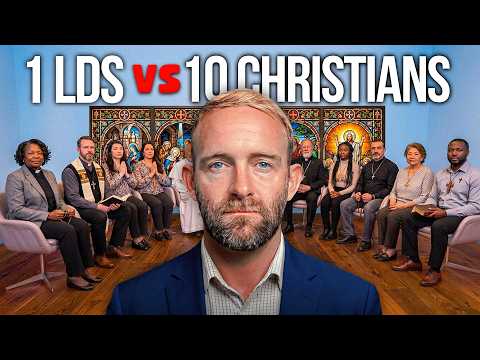
Jacob Hansen opens the first prompt by arguing that the Bible is reliable and authoritative, but not infallible. Using an analogy of two rooms receiving work instructions, he contends that if God, the greatest conceivable communicator, controlled every word, good-faith readers would not be divided into conflicting denominations. His challenger counters that God sovereignly worked through distinct human personalities while preserving infallible truth.
Defining the Great Apostasy and institutional loss
Introducing his second prompt, Jacob Hansen defines the Great Apostasy as the historical loss of centralized revelatory authority after the apostles died, quoting second-century historian Hegesippus. He distinguishes between the church as an institution and the church as a body of sincere believers. The second challenger reads from an official LDS website stating "the truth was lost once again" to argue that LDS doctrine claims the entire gospel disappeared.
Stephen's vision and the three-pen Godhead analogy
Reading Acts 7, Jacob Hansen argues that Stephen's vision of Jesus standing at the right hand of God describes a spatial relationship between two distinct beings. The challenger defends the Nicene homoousios distinction between one divine being and three persons, accusing Mormonism of its own apostasy over historical teachings like Adam-God and polygamy.
Does the Book of Mormon teach conditional grace?
Opening the third prompt, Jacob Hansen reads passages from the Book of Mormon title page, Omni, Ether 12, and 2 Nephi 25 to argue that the book brings readers closer to the New Testament Jesus. The fourth challenger counters that the Book of Mormon teaches a different gospel, quoting Moroni 10:32 to argue that making God's grace contingent on denying oneself of all ungodliness imposes an impossible works-based condition.
1830s meaning of "after all we can do" explained
Jacob Hansen quotes LDS Apostle Bruce R. McConkie stating that salvation comes by grace without works. In his closing, the challenger quotes Spencer W. Kimball's The Miracle of Forgiveness, Alma 11:37, and 2 Nephi 25:23 ("by grace that we are saved, after all we can do") to argue the onus remains on human effort.
Divine investiture, Yahweh's name, and 1 Corinthians 15
The Oneness Pentecostal challenger cites Colossians 2:9 and Acts baptismal formulas in the name of Jesus to argue that all of God is encapsulated in the single person of Jesus. Jacob Hansen responds with the ancient Near Eastern concept of divine investiture, citing Philippians 2 and John 5 and 17 to argue that the Father gave Jesus the name and title of Yahweh. In his closing, Hansen cites 1 Corinthians 15, where the Son subjects himself to the Father, proving they are two distinct persons.
Vocab Malone raises the 1835 Lectures on Faith
Opening his fourth prompt, Jacob Hansen argues that Joseph Smith's revelations about a plurality of gods and a Most High God align with the biblical divine council in Psalm 82, Job, and Deuteronomy 10, quoting Protestant scholar Michael Heiser. Challenger Vocab Malone counters by citing the 1835 Lectures on Faith, which described the Father as a "personage of spirit" and were bound in the Doctrine and Covenants until 1921, arguing Smith's early teachings contradicted his later theology.
Clashing over the King Follett Discourse's authority
Jacob Hansen responds that the Lectures on Faith were a theological treatise likely co-written with Sidney Rigdon and never claimed to be divine revelation. He similarly argues that in the 1844 King Follett Discourse, Joseph Smith offered his own ideas rather than canonized revelation. Vocab Malone reads directly from Teachings of the Prophet Joseph Smith, showing Smith stated he would speak "so far as I shall be inspired by the Holy Spirit" and declared "for God has told me so."
Isaiah 43-45 and Michael Heiser's scholarship
Vocab Malone reads Isaiah 43:10, 44:6-8, and 45:5 ("before me there was no God formed, neither shall there be after me") to argue that Yahweh rules out any pre-existing or future gods. Jacob Hansen quotes Protestant scholar Michael Heiser and Orthodox scholar Dr. Sijuwade to argue that such verses are ancient Near Eastern boasts of incomparability rather than denials that other divine beings exist.
Abraham 4's multiple Creators vs Genesis 1 grammar
A ninth challenger engages Jacob Hansen on the Book of Abraham chapter 4, which depicts "the Gods" organizing the earth in the plural. The challenger contrasts this with Genesis 1:26-27, explaining that while the Hebrew noun Elohim is morphologically plural, it is paired with a singular verb for "created," and with Isaiah 42:5 and 44:24, where Yahweh states He alone stretched out the heavens.
John 17 oneness and early Christian theosis
In the conclusion of the ninth round, the challenger argues that Old Testament prophets would reject the claim that three distinct beings bear the name Yahweh. Jacob Hansen cites Jesus's High Priestly Prayer in John 17, where Jesus prays that believers "may be one, even as we are one," arguing biblical oneness means relational harmony and love rather than ontological sameness. Hansen also quotes Athanasius and Irenaeus to show early Christians believed in theosis.
John 10:34, Psalm 82, and co-inheriting Christ's throne
In the final exchange, Jacob Hansen argues from Acts 17 (genos), John 10:34 (where Jesus quotes Psalm 82, "I have said, Ye are gods"), 2 Peter 1:4 (partakers of the divine nature), Romans 8 (co-heirs with Christ), and Revelation 3:21 (sitting on Christ's throne) to make a cumulative biblical case for human deification. The challenger argues that Psalm 82 refers to mortal judges of Israel and concludes that created, fallen humans remain fundamentally distinct from their eternal Creator.