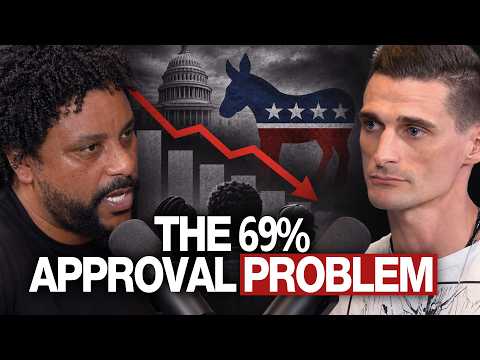
Did Democrats FAIL Black America? The Heated Debate Over California, Crime & Politics!...
Digital Social Hour Podcast by Sean Kelly
Summary
In this 36-minute debate segment, the host defends the prompt that the Democratic Party has failed Black Americans while a challenger tests the methodology and comparisons behind that claim. The prompt defender points to unfulfilled promises on reparations, a drop in Black approval for Democrats from 90% in 2020 to 69%, high California housing costs, the sub-1% rebuilding rate in the Pacific Palisades, NAFTA's impact on working-class jobs, and federal DEI mandates. The challenger counters that political failure requires comparing Democrats to the Republican alternative, noting that 19 states have restricted Black and DEI initiatives and that states like Florida offset zero income tax with high property taxes.
The exchange highlights a fundamental divide over whether economic disparities stem from systemic barriers and historical chattel slavery or from household financial literacy and government overregulation. A live moderator lookup during the debate also clarifies two disputed policy facts: Lyndon B. Johnson started the modern federal student loan system under the Higher Education Act of 1965 rather than Richard Nixon, and Joe Biden's 2021 executive orders mandated DEIA standards across federal agencies.
How time-sensitive the topic is: Evergreen
By the numbers
90%: Black American approval rating for the Democratic Party in 2020 with Joe Biden, as cited by Devory Darkins. (Mentioned at 2:26)
69%: Current Black American approval rating for the Democratic Party cited by Devory Darkins to argue support is falling. (Mentioned at 2:28)
300,000 dollars: Hypothetical home purchase price that Devory Darkins says could cost 900,000 dollars over the loan's lifetime due to interest rates. (Mentioned at 8:23)
1%: Devory Darkins claims less than 1% of burned structures in the Pacific Palisades have been rebuilt. (Mentioned at 10:38)
1965 year: Year of the Higher Education Act under President Lyndon B. Johnson that established the modern federal student loan system. (Mentioned at 21:38)
19 states: Number of states that Searkar says have restricted Black and DEI initiatives. (Mentioned at 24:25)
5%: Devory Darkins states the current unemployment rate is less than 5% when arguing Black Americans can find jobs. (Mentioned at 25:16)
14%: Share of the US population made up by Black Americans, cited by Searkar when discussing the racial wealth gap. (Mentioned at 26:05)
Questions this video answers
Which US president actually started the modern federal student loan system?
During the debate, Searkar claims Republican President Richard Nixon created the federal student loan system, but moderator Vem Miller checks the record and clarifies that Democratic President Lyndon B. Johnson established the modern federal student loan program under the Higher Education Act of 1965. This distinction matters because both speakers were attempting to assign partisan blame for modern student debt.
Vem Miller, 19:22 to 23:04
From this keypoint: Vem Miller checks who created federal student loans
What executive orders did Joe Biden sign regarding federal DEI standards?
Moderator Vem Miller notes that President Joe Biden signed Executive Order 13985 in January 2021 and Executive Order 14035 in June 2021 requiring federal agencies to implement diversity, equity, inclusion, and accessibility (DEIA) standards. While Devory Darkins views these mandates as government overreach, Searkar argues such frameworks are necessary to detect and prevent workplace discrimination.
Searkar, 31:55 to 35:58
From this keypoint: Disputing Joe Biden's DEIA executive orders
Why do the debaters disagree over rebuilding progress after the Pacific Palisades fire?
Devory Darkins cites that less than 1% of structures destroyed in the Pacific Palisades fire have been rebuilt, blaming state permitting, licensing, and insurance backlogs. Searkar counters that California Governor Gavin Newsom signed an executive order suspending permitting requirements to speed up debris removal and argues that severe fire damage to soil foundations naturally slows reconstruction.
Devory Darkins, 10:30 to 15:12
From this keypoint: Clash over Pacific Palisades fire rebuilding delays
How do the speakers compare taxation and housing costs between Texas, Florida, and California?
Devory Darkins praises Texas and Florida for having no state income tax and points to Austin's rapid homebuilding as proof that deregulation lowers rents, while blaming California's builder fees and environmental rules for high prices. Searkar argues that Florida offsets its lack of an income tax with steep property taxes and contends California's coastal geography and high buyer demand drive its prices.
Searkar, 5:16 to 8:31
From this keypoint: Searkar challenges red-state tax and housing claims
Why does Devory Darkins consider buying a home a liability rather than an investment?
Devory Darkins argues that taking out a mortgage puts buyers into heavy debt, noting that under high interest rates a 300,000 dollar home can cost 900,000 dollars over the life of the loan, outstripping annual returns. Searkar agrees current interest rates are unfavorable for buyers right now, though he maintains that Americans purchase homes to build wealth.
Searkar, 5:16 to 8:31
From this keypoint: Searkar challenges red-state tax and housing claims
What happens if student loan eligibility is tied to future career earnings?
Devory Darkins supports rules prohibiting universities from issuing student loans for degrees that do not lead to careers capable of repaying the debt, arguing this protects students from unpayable loans. Searkar argues that tying student loans strictly to career payouts creates an incentive that will push students out of fields like history and art and into business degrees.
Devory Darkins, 15:13 to 19:20
From this keypoint: Tying student loan eligibility to career earnings
How do the speakers explain the racial wealth gap in America?
Devory Darkins attributes the lack of generational wealth among Black Americans to internal cultural habits and a lack of household financial literacy rather than external racism. Searkar counters that financial literacy is transmitted through institutions like universities and argues that modern economic disparities cannot be separated from the generational impact of chattel slavery and systemic barriers.
Devory Darkins, 26:08 to 29:21
From this keypoint: Cultural financial literacy vs legacy of slavery
Credible AI™ signals
Confidence: Unverified Debate Claims. Both participants rely heavily on broad assertions, personal anecdotes, and contested interpretations of policy without immediate documentation. The moderator reads two brief lookups from a phone regarding the Higher Education Act of 1965 and Joe Biden's executive orders, which provide the only concrete reference points in the exchange.
Bias: Adversarial Two-Sided Clash. The format pits a critic of the Democratic Party directly against a challenger who defends targeted equity initiatives and systemic analysis. Neither viewpoint dominates unchallenged, as every partisan claim about taxation, housing regulations, student loans, and hiring practices meets immediate pushback from the across-the-table opponent.
Originality (65%): Unscripted Policy Sparring. While the broader topic of whether the Democratic Party serves Black Americans is a staple of political commentary, the specific detours into Pacific Palisades rebuilding permits, University of Arizona loan rules, and whether homeownership is a financial liability produce an unpredictable, unscripted exchange.
Depth (58%): Rapid Surface-Level Clash. The debaters touch on substantive questions of econometrics, supply-side housing constraints, and how to falsify political failure, but they rarely stay on one subject long enough to unpack the underlying data. Rapid topic shifts and disputes over basic definitions prevent a deeper policy examination.
Key points (11)
Short (8 min): key points 1, 8 and 10
Medium (20 min): key points 1, 5, 8, 9, 10 and 11
Relaxed (35 min): all 11 key points
1. Devory Darkins cites falling Black Democrat support
Timestamp: 00:00:20 to 00:03:08 (3 min)
Speaker: Devory Darkins
Devory Darkins defines political failure through measurable outcomes, arguing the Democratic Party repeatedly dangles reparations without delivering. He points to Black approval for Democrats dropping from 90% under Joe Biden in 2020 to 69% as proof that voters reject their working-class platform.
Impact: High. Why it matters: Framing political failure around measurable outcomes and approval shifts forces the debate onto empirical ground rather than partisan loyalty.
“if you go back to 2020 with Joe Biden, the approval rating from black Americans for the Democrat party was 90%. And today it's at 69%. Why? Because the Democrat party has not done a great job.”
In the video: Devory Darkins, at 2:20
Against: Searkar
2. Colorblind class policy vs race-based SBA loans
Timestamp: 00:03:11 to 00:05:16 (2 min)
Speaker: Devory Darkins
Advocating for economic class policies like eliminating taxes on tips and overtime, Devory Darkins opposes race-specific government programs. Searkar counters that Joe Biden's Small Business Administration helped disadvantaged Black businesses get loans before Donald Trump ended the program.
Impact: High. Why it matters: Exposes the core ideological divide between race-neutral working-class tax relief and targeted federal lending designed to correct historical disparities.
“It's a it's a flawed policy. I don't think you should because you shouldn't be making policies based on skin color.”
In the video: Devory Darkins, at 4:15
Against: Searkar
3. Searkar challenges red-state tax and housing claims
Timestamp: 00:05:16 to 00:08:31 (3 min)
Speaker: Searkar
When Devory Darkins praises Texas and Florida for having no state income tax and building housing supply in Austin, Searkar argues Florida offsets income tax with high property taxes. They then clash over whether buying a home is a wealth-building investment or a debt liability.
Impact: Medium. Why it matters: Challenges the narrative that low-tax Republican states automatically lower costs of living by highlighting how property taxes and high mortgage interest rates affect households.
“if you buy a home for 300,000, but over the lifetime you're going to pay 900,000, which supersedes what the return on investment would be every year, it's a liability.”
In the video: Devory Darkins, at 8:22
Against: Devory Darkins
4. Devory Darkins blames regulations for housing costs
Timestamp: 00:08:31 to 00:10:30 (2 min)
Speaker: Devory Darkins
Devory Darkins argues California's high housing prices stem from excessive builder fees, taxes, and environmental regulations rather than a shortage of buildable land. Searkar contends coastal Southern California lacks open land compared to Texas and faces much higher buyer demand.
Impact: Medium. Why it matters: Highlights the clash between supply-side deregulation arguments and geographic demand constraints in explaining California's housing affordability crisis.
“Well, it's expensive because in California there's too many reg regulations and there's too much tax and there's too much fees for builders.”
In the video: Devory Darkins, at 10:09
Against: Searkar
5. Clash over Pacific Palisades fire rebuilding delays
Timestamp: 00:10:30 to 00:15:12 (5 min)
Speaker: Devory Darkins
Citing that less than 1% of structures burned in the Pacific Palisades fire have been rebuilt, Devory Darkins blames permitting backlogs and state failure. Searkar counters that Governor Gavin Newsom suspended permitting via executive order and that fire damage ruins soil foundations.
Impact: High. Why it matters: Tests whether executive orders suspending regulations actually translate into completed reconstruction on the ground after a major disaster.
“you can sign all the executive orders you want, but if the results still show that less than 1% of the structures have been built, sounds like a failure to me.”
In the video: Devory Darkins, at 13:41
Against: Searkar
6. Tying student loan eligibility to career earnings
Timestamp: 00:15:13 to 00:19:20 (4 min)
Speaker: Devory Darkins
Devory Darkins supports policies restricting student loans to degrees tied to careers capable of paying back the debt, arguing unrestrained lending harmed millennials. Searkar argues tying loans strictly to job payouts distorts education and discourages students from studying history or art.
Impact: High. Why it matters: Questions the fundamental purpose of higher education funding: protecting borrowers from unpayable debt versus preserving access to non-commercial humanities degrees.
“The university is not allowed to issue student loans on degrees that are not tied to a career that could support the debt of that student loan.”
In the video: Devory Darkins, at 18:30
Against: Searkar
7. Vem Miller checks who created federal student loans
Timestamp: 00:19:22 to 00:23:04 (4 min)
Speaker: Vem Miller
Searkar claims Republican President Richard Nixon started the federal student loan program, while Devory Darkins argues later Democratic administrations expanded and abused it. Moderator Vem Miller intervenes with a lookup showing Democrat Lyndon B. Johnson began the modern system under the Higher Education Act of 1965.
Impact: Medium. Why it matters: Corrects a central historical claim in real time, shifting the debate from who invented federal student loans to which party bears responsibility for modern debt loads.
“So just to clarify, the modern federal student loan system began under President Lyndon B. Johnson, a Democrat. So right before uh and it's called the Higher Education Act of 1965.”
In the video: Vem Miller, at 21:27
For: Devory Darkins
Against: Searkar
8. Searkar warns of two-party bind and state DEI bans
Timestamp: 00:23:12 to 00:26:07 (3 min)
Speaker: Searkar
Conceding that Democrats have failed the Black community in many ways, Searkar questions why Black voters would turn to a Republican Party where 19 states have restricted Black and DEI initiatives. Devory Darkins argues both parties pose a conundrum but points to sub-5% unemployment in Southern states as proof Black workers find jobs.
Impact: High. Why it matters: Captures the electoral dilemma facing Black voters when weighing disappointing Democratic outcomes against active Republican rollbacks of diversity programs.
“We have one political party that's weaponized people's skin color. They make up policies they think that will help the black community. In fact, in the end, it actually does worse. And then we have a Republican party that doesn't really offer any alternative.”
In the video: Devory Darkins, at 24:08
Against: Devory Darkins
9. Cultural financial literacy vs legacy of slavery
Timestamp: 00:26:08 to 00:29:21 (3 min)
Speaker: Devory Darkins
Devory Darkins asserts that Black Americans fail to build generational wealth due to a cultural lack of financial literacy at home rather than racism. Searkar counters that financial literacy is institutionally taught and traces systemic disadvantages back to the economic and dehumanizing history of American chattel slavery.
Impact: High. Why it matters: Directly confronts the perennial debate over whether closing the racial wealth gap requires internal cultural change or institutional reform.
“Our culture does not prioritize financial literacy. Our culture does not prioritize generational wealth.”
In the video: Devory Darkins, at 26:16
Against: Searkar
10. NAFTA, STEM lags, and DEI cited in closing
Timestamp: 00:29:21 to 00:31:55 (3 min)
Speaker: Devory Darkins
In his closing statement, Devory Darkins outlines three reasons Democrats failed Black Americans: selling out working-class labor via NAFTA, failing to produce enough STEM graduates compared to China and India, and using divisive DEI and identity politics that place unqualified people in roles.
Impact: High. Why it matters: Synthesizes the conservative populist critique of the Democratic Party by linking trade policy, educational competitiveness, and affirmative action.
“Number one really isn't skin color, but black Americans are part of it, which is they have failed the working class. NAFTA clearly sold out the working class for cheap labor overseas.”
In the video: Devory Darkins, at 29:26
Against: Searkar
11. Disputing Joe Biden's DEIA executive orders
Timestamp: 00:31:55 to 00:35:58 (4 min)
Speaker: Searkar
Searkar argues diversity hiring occurs naturally in business to reach local markets, while Devory Darkins insists the Biden administration mandated DEI officers across government and corporations. Moderator Vem Miller cites Executive Orders 13985 and 14035, prompting a final clash over whether such standards prevent hidden firing discrimination or represent government overreach.
Impact: High. Why it matters: Clarifies the distinction between federal agency DEIA mandates and private corporate hiring while illustrating how difficult workplace discrimination is to prove.
“President Joe Biden signed key executive orders that required federal agencies to implement diversity, equity, inclusion, and accessibility DEIA standards. It's executive order 13985 signed January 2021.”
In the video: Vem Miller, at 34:00
Against: Devory Darkins
Neutral: Vem Miller
Key sources
Devory Darkins: Debate Host (named in video intro and description)
Searkar: Debate Challenger (named in video description)
Vem Miller: Moderator (named in video description)
YouTube: Digital Social Hour Podcast by Sean Kelly: Channel and Debate Platform
Who's in this
Democratic Party
Republican Party
Donald Trump
Joe Biden
Gavin Newsom
Richard Nixon
Lyndon B. Johnson
Barack Obama
University of Arizona
Small Business Administration
Harvard University
Walmart
Also mentioned
United States (First mentioned at 7:42)
California (First mentioned at 9:39)
Pacific Palisades (First mentioned at 10:35)
Florida (First mentioned at 5:56)
Texas (First mentioned at 6:06)
Los Angeles (First mentioned at 6:47)
Austin (First mentioned at 6:52)
US Constitution (First mentioned at 22:08)
Google Earth (First mentioned at 9:52)
Hawaii (First mentioned at 10:43)
Arizona (First mentioned at 16:08)
Higher Education Act of 1965 (First mentioned at 21:36)
Atlanta (First mentioned at 25:25)
James Madison (First mentioned at 28:31)
NAFTA (First mentioned at 29:31)
India (First mentioned at 30:09)
China (First mentioned at 30:09)
Utah (First mentioned at 32:06)
Executive Order 13985 (First mentioned at 34:09)
Executive Order 14035 (First mentioned at 34:13)
New York City (First mentioned at 6:49)
Palmdale (First mentioned at 9:44)
Lancaster (First mentioned at 9:46)
Victorville (First mentioned at 9:47)
Riverside (First mentioned at 9:50)
Orange County (First mentioned at 9:56)
Central Valley (First mentioned at 10:03)
Brian (First mentioned at 14:22)
Georgia (First mentioned at 25:26)
North Carolina (First mentioned at 25:29)
South Carolina (First mentioned at 25:29)
Louisiana (First mentioned at 25:31)
Starbucks (First mentioned at 25:47)
Declaration of Independence (First mentioned at 28:51)
Thomas Paine (First mentioned at 29:06)
Pentagon (First mentioned at 33:34)
Fox News (First mentioned at 34:24)
This analysis was generated by skim (skim.plus), an AI-powered content analysis platform by Credible AI. Scores and classifications represent the platform's AI-generated assessment and should be considered alongside other sources.