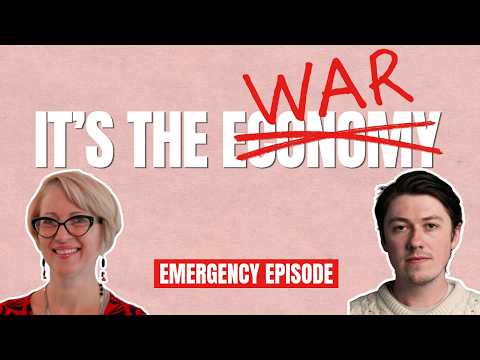
Quincy Institute for Responsible Statecraft's Did the Iran War Actually Decide the Midterms? ft. Kelley Vlahos & Connor Echols: skim's analysis identifies 10 key moments, with 1 potential conflict of interest flagged. Responsible Statecraft editors Kelley Vlahos and Connor Echols join hosts Courtney Rawlings and Alex Jordan to analyze how the Iran war and US policy toward Israel shaped the 2026 midterm elections.
Category: Politics. Format: Panel Discussion. YouTube video analyzed by skim.
skim AI Analysis
Credibility assessment: Attributed Policy Analysis. The panel grounds its post-election commentary in exit polling, campaign finance reports from Eli Clifton on AIPAC spending, and Bloomberg viewership metrics. While the discussion reflects an explicit non-interventionist perspective, the speakers distinguish their electoral interpretations from the underlying data.
Bias assessment: Anti-Interventionist Restraint. Produced by the Quincy Institute for Responsible Statecraft, the hosts and guests openly evaluate the 2026 midterm elections through the lens of military restraint. They criticize both Republican war policies and the Democratic foreign policy establishment while advocating for diplomatic resolutions.
Originality: 82% — Focused Foreign Policy Lens. Rather than treating the 2026 midterms solely as a domestic economic story, the panel connects Straight of Hormuz shipping disruptions, AIPAC primary losses, and alternative media viewership shifts into a cohesive argument about voter fatigue with US foreign interventions.
Depth: 84% — Granular Electoral Breakdown. Kelley Vlahos and Connor Echols move beyond headline election results to examine party faction dynamics, comparing the 8-month Iran war backlash to the 2006 Iraq war midterms and assessing how large congressional majorities paradoxically limit progressive leverage.
Key Points (10)
1. Iran War Fallout Drove the 2026 Midterm Wave
Timestamp: 00:02:40 to 00:05:05
Connor Echols argues that the 2026 Democratic midterm wave was driven by anger over the economic fallout of Donald Trump's Iran war and perceived administration corruption. Closing the Straight of Hormuz raised gas, diesel, and fertilizer prices, making foreign policy the defining issue.
Significance (High): Links domestic cost-of-living anger directly to military intervention, challenging pundits who separate economic voting from foreign policy.
Sources in support: Connor Echols (Managing Editor, Responsible Statecraft), Courtney Rawlings (Co-host, Always at War podcast at the Quincy Institute)
2. Economic Pain Accelerated Backlash, Says Vlahos
Timestamp: 00:05:05 to 00:09:14
Kelley Vlahos notes that while most Republican voters still back the war, higher Democratic turnout and disillusionment over broken promises like the Epstein files cracked Donald Trump's base. Direct pain at the gas pump triggered a backlash eight months into the Iran war, compared to three years for Iraq in 2006.
Significance (High): Explains why the 2026 electoral rebuke happened in eight months rather than the three years it took during the Iraq war.
Sources in support: Kelley Vlahos (Editor-in-Chief, Responsible Statecraft), Connor Echols (Managing Editor, Responsible Statecraft)
3. Voters React to Price Shocks Over Foreign Wars
Timestamp: 00:09:14 to 00:14:08
Alex Jordan argues that cost-of-living votes are foreign policy votes when wars and sanctions drive up prices, comparing the Iran war to summer 2022 when Ukraine war sanctions pushed US gas above $5. Kelley Vlahos and Connor Echols caution that voters tolerated actions like kidnapping Nicolas Maduro because they did not raise prices.
Significance (Medium): Highlights a core dilemma for anti-war advocates: American voters rarely punish foreign interventions unless those policies directly inflate domestic prices.
Sources in support: Alex Jordan (Co-host, Always at War podcast at the Quincy Institute and former Democratic staffer), Kelley Vlahos (Editor-in-Chief, Responsible Statecraft), Connor Echols (Managing Editor, Responsible Statecraft)
4. AIPAC Loses Two-Thirds of Midterm Spending
Timestamp: 00:14:08 to 00:18:34
Connor Echols reports that 13 new Democratic House members and two new Senators, Troy Jackson and Abdul El-Sayed, won on platforms backing an Israel arms embargo. Citing colleague Eli Clifton, Echols notes that AIPAC lost 66% of the roughly $55 million it spent across 84 called races.
Significance (High): Demonstrates measurable erosion in pro-Israel lobbying effectiveness and a growing congressional bloc willing to condition military aid.
Sources in support: Connor Echols (Managing Editor, Responsible Statecraft), Courtney Rawlings (Co-host, Always at War podcast at the Quincy Institute), Kelley Vlahos (Editor-in-Chief, Responsible Statecraft)
5. Vance and Rubio Split Ahead of 2028 GOP Primary
Timestamp: 00:18:34 to 00:25:23
Alex Jordan notes that Donald Trump suggested ending US aid to Israel on election morning, while Courtney Rawlings highlights JD Vance's post-election tweet citing pollsters who urged ending the war. Kelley Vlahos and Connor Echols argue Vance is in damage control while Marco Rubio avoided campaigning on the Iran war and is positioning for 2028.
Significance (High): Maps out an emerging 2028 Republican primary cleavage between JD Vance's populist anti-war messaging and Marco Rubio's establishment support.
Sources in support: Kelley Vlahos (Editor-in-Chief, Responsible Statecraft), Connor Echols (Managing Editor, Responsible Statecraft), Alex Jordan (Co-host, Always at War podcast at the Quincy Institute and former Democratic staffer), Courtney Rawlings (Co-host, Always at War podcast at the Quincy Institute)
6. Large Majorities Dilute Progressive Anti-War Power
Timestamp: 00:25:24 to 00:29:28
Responding to Alex Jordan on whether Democrats will use the December 11 government funding deadline to stop the Iran war, Connor Echols warns they may back down as in 2006. Because anti-war progressives make up only 5% to 10% of the caucus, a large 260-seat House majority leaves Chuck Schumer and Hakeem Jeffries less reliant on their votes.
Significance (High): Reveals the legislative paradox where a sweeping electoral blowout actually weakens the bargaining power of the anti-war caucus.
Sources in support: Connor Echols (Managing Editor, Responsible Statecraft), Kelley Vlahos (Editor-in-Chief, Responsible Statecraft)
Neutral sources: Alex Jordan (Co-host, Always at War podcast at the Quincy Institute and former Democratic staffer), Courtney Rawlings (Co-host, Always at War podcast at the Quincy Institute)
7. Democratic Establishment Resists Restraint on Ukraine
Timestamp: 00:29:29 to 00:36:34
Alex Jordan reads an Antony Blinken tweet claiming the midterms rebuke alienating allies and appeasing autocrats. Kelley Vlahos and Connor Echols argue that while Democrats oppose Donald Trump's Iran war, party leaders remain ideologically committed to arming Ukraine and maintaining military integration with Israel.
Significance (Medium): Shows that partisan opposition to a rival president's war does not automatically translate into broader foreign policy restraint.
Sources in support: Kelley Vlahos (Editor-in-Chief, Responsible Statecraft), Connor Echols (Managing Editor, Responsible Statecraft), Alex Jordan (Co-host, Always at War podcast at the Quincy Institute and former Democratic staffer), Courtney Rawlings (Co-host, Always at War podcast at the Quincy Institute)
8. Progressives Shift on Ukraine While Establishment Holds
Timestamp: 00:36:34 to 00:44:17
Alex Jordan questions whether Democrats will reckon with how Biden's refusal to re-enter the JCPOA and maximum pressure sanctions enabled Donald Trump's Iran policy. Connor Echols points to former Bernie Sanders adviser Matt Duss shifting toward diplomacy on Ukraine, though Kelley Vlahos warns the establishment often marginalizes progressives as under Obama in Afghanistan.
Significance (Medium): Contrasts emerging realism among progressive advisers with the entrenched hawkishness of Democratic leadership on China and Russia.
Sources in support: Connor Echols (Managing Editor, Responsible Statecraft), Kelley Vlahos (Editor-in-Chief, Responsible Statecraft), Alex Jordan (Co-host, Always at War podcast at the Quincy Institute and former Democratic staffer), Courtney Rawlings (Co-host, Always at War podcast at the Quincy Institute)
9. Election Night Viewership Swings to Populist Media
Timestamp: 00:44:17 to 00:55:07
Courtney Rawlings cites Bloomberg figures showing election night live streams fell for Daily Wire from over 3 million in 2024 to 14,000 on YouTube, and All-In from 450,000 to 72,000 on X and 11,000 on YouTube, while Hasan Piker drew 217,000 to 240,000 and The Bulwark drew 56,000. Connor Echols and Kelley Vlahos attribute this shift and Responsible Statecraft's growth to demand for populist, anti-establishment voices like Ana Kasparian on Tucker Carlson's show.
Significance (Medium): Quantifies a sharp collapse in pro-administration and legacy broadcast streams in favor of blunt, anti-establishment commentary.
Sources in support: Courtney Rawlings (Co-host, Always at War podcast at the Quincy Institute), Connor Echols (Managing Editor, Responsible Statecraft), Kelley Vlahos (Editor-in-Chief, Responsible Statecraft), Alex Jordan (Co-host, Always at War podcast at the Quincy Institute and former Democratic staffer)
10. Hosts Reflect on Realism and Voter Rebuke of War
Timestamp: 00:55:16 to 00:58:12
In their closing segment, Courtney Rawlings and Alex Jordan reflect on the emotional weight of analyzing US foreign policy from a realist perspective. They conclude that the midterm voters' rebuke of an illegal war offers an encouraging moment for the restraint movement.
Significance (Low): Wraps up the episode by framing the 2026 midterm results as validation for foreign policy realism.
Sources in support: Courtney Rawlings (Co-host, Always at War podcast at the Quincy Institute), Alex Jordan (Co-host, Always at War podcast at the Quincy Institute and former Democratic staffer)
This analysis was generated by skim (skim.plus), an AI-powered content analysis platform by Credible AI. Scores and classifications represent the platform's AI-generated assessment and should be considered alongside other sources.