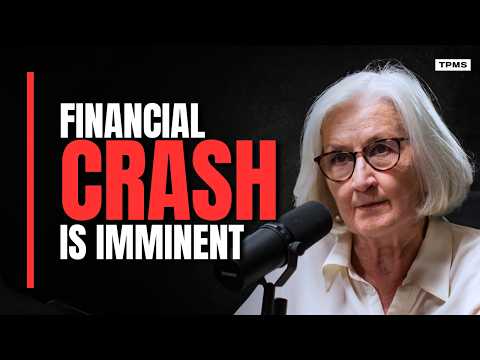
Economist Who Predicted 2008: "The Financial System Is About To Collapse" | Ann Pettifor
Peter McCormack
Summary
Political economist Ann Pettifor joins Peter McCormack to recount how her Jubilee 2000 campaign mobilized up to 100,000 protesters at the 1998 Birmingham G8 summit to force the cancellation of $100 billion in developing-world debt. Drawing on her 2006 prediction of the 2008 financial crash, Pettifor explains that commercial banks and the Federal Reserve create money digitally against collateral, meaning real physical capacity rather than cash constrains public investment. She traces modern economic instability to Richard Nixon's 1971 decision to sever the dollar from gold, which dismantled the 1945 Bretton Woods system and handed global economic governance to Wall Street.
Pettifor warns that a second financial crisis is imminent as elevated interest rates threaten $1 trillion to $3 trillion in opaque private credit and shadow banking exposure. She argues that central bank inflation mandates protect wealthy creditors while austerity and Margaret Thatcher's privatizations have hollowed out Britain's economy, fueling populist anger that benefits figures like Donald Trump and Marine Le Pen. To prevent further political extremism, she calls for reforming the Bank of England's mandate, nationalizing utilities like Thames Water, and investing in domestic housing retrofits.
How time-sensitive the topic is: Evergreen
By the numbers
100 billion dollars: Amount of developing-world sovereign debt cancelled following the Jubilee 2000 campaign. (Mentioned at 1:26)
100,000 people: Jubilee 2000's estimate of protesters forming a human chain at the 1998 Birmingham G8 summit (police estimated 70,000). (Mentioned at 8:36)
40 trillion dollars: Total United States sovereign debt cited by Peter McCormack, alongside $10 trillion rolling over this year. (Mentioned at 15:46)
3 trillion pounds: Total United Kingdom public debt cited by Peter McCormack. (Mentioned at 15:50)
11 billion dollars: Amount Ben Bernanke said the Federal Reserve entered into a computer to bail out AIG. (Mentioned at 17:48)
1 to 3 trillion dollars: Estimated lending volume of opaque private credit institutions operating outside regulatory oversight. (Mentioned at 33:50)
3.4 billion dollars: Amount the Wall Street Journal reported that roughly 1 million people lost investing in Donald Trump's meme coin. (Mentioned at 45:03)
30 million taxpayers: Number of UK taxpayers legally bound to pay taxes, backing the Treasury's credit power. (Mentioned at 52:28)
Questions this video answers
How did the Jubilee 2000 campaign get $100 billion in third-world debt cancelled?
Instead of just lobbying the IMF and World Bank in Washington, Ann Pettifor's team educated the public with concise one-page arguments and mobilized up to 100,000 people to form a human chain at the 1998 G8 summit in Birmingham. The public pressure embarrassed G8 leaders and forced Prime Minister Tony Blair and Chancellor Gordon Brown to begin writing off bilateral sovereign debts.
Ann Pettifor, 1:22 to 9:31
From this keypoint: How Pettifor Mobilized Millions to Cancel Debt
Why does economist Ann Pettifor think another global financial crisis is imminent?
Pettifor warns that rising bond yields and elevated central bank interest rates act like a dagger aimed at a massive global debt bubble. She points to $1 trillion to $3 trillion in unregulated private credit and shadow banking institutions like BlackRock lending pension savings without central bank oversight.
Ann Pettifor, 30:10 to 35:17
From this keypoint: Pettifor Warns a Second Debt Crisis Is Imminent
How do commercial banks and the Federal Reserve actually create money?
Banks do not lend out existing piles of cash; instead, they create new money digitally when a borrower signs a collateralized promise to repay with interest. Former Fed Chair Ben Bernanke confirmed this mechanism on television by explaining that the Fed typed $11 billion into a computer to bail out AIG.
Ann Pettifor, 15:36 to 19:24
From this keypoint: Money Creation and Sovereign Debt Myths, per Pettifor
What happened in 1971 with the Nixon Shock and the Bretton Woods financial system?
In 1971, President Richard Nixon unilaterally ended the link between the US dollar and gold that had anchored the 1945 Bretton Woods monetary architecture. Dismantling currency management ended the post-war golden age of stability, handing control of capital flows to Wall Street and enabling massive trade imbalances between nations like China and the US.
Ann Pettifor, 35:17 to 40:23
From this keypoint: How Nixon's 1971 Shock Handed Power to Wall Street
Why did Ann Pettifor predict the 2008 financial crisis when mainstream economists missed it?
While academic economists focused on narrow theoretical models, Pettifor's work on international sovereign debt gave her a macro view of US and UK balance sheets. She realized that skyrocketing private household and mortgage debt in Western economies could never be repaid, publishing her warning in September 2006.
Ann Pettifor, 26:02 to 30:10
From this keypoint: How Private Debt Triggered the 2008 Crash
Who benefits most from central bank inflation targeting according to Ann Pettifor?
Pettifor argues that the Bank of England's strict inflation mandate primarily protects wealthy creditors and bondholders rather than ordinary shoppers. Because rising prices and wages erode the real value of outstanding loans, creditors favor high interest rates and deflationary policies even when they suppress wages and investment.
Ann Pettifor, 55:41 to 1:02:20
From this keypoint: Inflation Targets Protect Creditors Over Debtors, Says Pettifor
How did UK export credit guarantees contribute to developing countries' sovereign debt?
The British government's Export Credit Guarantee Department used taxpayer funds to insure UK arms manufacturers selling weapons to Nigerian dictators. When those dictators defaulted, the British government claimed the debt at the Paris Club, turning private arms sales into sovereign debt owed by poor nations.
Ann Pettifor, 9:32 to 15:11
From this keypoint: Taxpayer Export Guarantees and Predatory Lending
Why does Ann Pettifor argue the UK can afford to nationalize Thames Water?
Pettifor rejects the claim that the government has no money, noting that the UK Treasury is backed by 30 million taxpayers legally required to pay taxes for decades to come. This guaranteed revenue stream makes the state a powerful creditor capable of issuing credit to reclaim privatized utilities and clean up rivers.
Ann Pettifor, 47:51 to 55:41
From this keypoint: Economic Despair and the Thatcher Privatization Legacy
What did John Maynard Keynes actually believe about government deficits?
According to Pettifor, Keynes opposed permanent deficits and high debt, viewing deficits as a symptom of a collapsed economy. He argued that governments should only step in with investment to fill economic craters during downturns and then balance the books once full employment returns.
Ann Pettifor, 40:23 to 45:30
From this keypoint: Keynesian Management vs Post-2008 Bank Bailouts
How did public state investment contribute to the invention of the Apple iPhone?
Citing economist Mariana Mazzucato, Pettifor explains that core technologies inside the iPhone, including the internet and GPS, were developed through taxpayer-backed US military and public sector research. This demonstrates that the state can act as an entrepreneurial investor rather than merely funding welfare.
Ann Pettifor, 1:02:20 to 1:09:13
From this keypoint: The Entrepreneurial State and Cross-Border Debt Risks
Credible AI™ signals
Confidence: Seasoned Policy Veteran. Ann Pettifor draws directly on her firsthand experience leading the Jubilee 2000 debt relief campaign and decades of macroeconomic research. While her historical accounts of the 1953 London Agreement and 1971 Nixon Shock are well-grounded, several macro predictions and political characterizations are broad and opinion-driven.
Bias: Keynesian Anti-Neoliberalism. Ann Pettifor strongly advocates for Keynesian state intervention, capital controls, and public utility nationalization while condemning Wall Street deregulation and austerity. Host Peter McCormack provides a polite conservative and free-market counterpoint, keeping the exchange conversational rather than one-sided.
Originality (80%): Insider Campaign History. Pettifor's firsthand stories of mobilizing 70,000 to 100,000 protesters at the 1998 Birmingham G8 summit and confronting UK Treasury officials offer rare insider perspective. Her connecting of 1971 financial deregulation to modern populist anger and private credit risk synthesizes history and current events effectively.
Depth (78%): Structural Macro Critique. The conversation moves beyond surface-level debt panic to examine commercial bank credit creation, international trade imbalances, and the institutional role of central banks. It simplifies some complex mechanisms, such as the Bretton Woods gold link and modern bond market constraints, for a general audience.
Key points (12)
Short (24 min): key points 1, 3, 6 and 10
Medium (42 min): key points 1, 3, 4, 6, 7, 10 and 11
Relaxed (1h 15min): all 12 key points
1. How Pettifor Mobilized Millions to Cancel Debt
Timestamp: 00:01:22 to 00:09:31 (8 min)
Speaker: Ann Pettifor
Ann Pettifor explains that NGOs initially wanted her to lobby the IMF, World Bank, and Paris Club in Washington, but she insisted on educating and mobilizing the public instead. By distilling complex sovereign debt mechanics into one-page legal-style briefs and leveraging Germany's 1953 London Agreement debt relief, Jubilee 2000 drew between 70,000 and 100,000 protesters to the 1998 Birmingham G8 summit. The public embarrassment forced Prime Minister Tony Blair to fly back to meet campaigners and begin canceling $100 billion in debt.
Impact: High. Why it matters: Demonstrates that demystifying sovereign finance for ordinary citizens can generate enough political pressure to override entrenched treasury and creditor resistance.
“I don't believe people act until they feel empowered, until they understand stuff.”
In the video: Ann Pettifor, at 2:48
Neutral: Peter McCormack
2. Taxpayer Export Guarantees and Predatory Lending
Timestamp: 00:09:32 to 00:15:11 (6 min)
Speaker: Ann Pettifor
The cancelled sovereign debts were largely bilateral loans where Western governments, via agencies like Britain's Export Credit Guarantee Department, used taxpayer funds to insure Newcastle arms dealers selling weapons to Nigerian dictators. Once Jubilee 2000 cleared developing nations' balance sheets, creditors and the World Bank immediately rushed back in to issue high-interest loans. Because no international bankruptcy law exists for sovereign states like Haiti, creditors repeatedly strip developing countries of their assets.
Impact: High. Why it matters: Exposes how sovereign debt relief without an international bankruptcy framework merely resets the clock for high-interest creditors to extract public wealth.
“the creditors love an empty balance sheet, right? They love it when there's just nothing on the balance sheet. So they all piled in.”
In the video: Ann Pettifor, at 13:42
For: Peter McCormack
3. Money Creation and Sovereign Debt Myths, per Pettifor
Timestamp: 00:15:36 to 00:19:24 (4 min)
Speaker: Ann Pettifor
Contesting Peter McCormack's worry over America's $40 trillion debt and Britain's £3 trillion debt, Ann Pettifor explains that commercial banks and the Federal Reserve create money simply by entering numbers into a computer against a borrower's collateralized promise to pay. She cites former Fed Chair Ben Bernanke's admission that the Fed created $11 billion digitally to bail out AIG and made a profit. Consequently, physical capacity and ecological limits constrain what a nation can build, not a shortage of money.
Impact: High. Why it matters: Reframes money as a social contract of credit rather than a scarce commodity, challenging the premise behind government austerity.
“He said, "We have something at the Federal Reserve that all offices have got which is called a computer. And we entered the number 11 billion dollars, there is a lot of zeros, into that and we made a transfer to AIG.”
In the video: Ann Pettifor, at 17:42
Neutral: Peter McCormack
4. Weak Economies Drive Deficits and Global Anger
Timestamp: 00:19:24 to 00:26:02 (7 min)
Speaker: Ann Pettifor
Sovereign deficits expand when governments underinvest and allow wages to stagnate, which starves the treasury of tax returns. Britain suffers from the lowest public and private investment in the OECD and falling real wages since 2010, whereas China uses capital controls and state-directed credit to fund local authorities and green infrastructure. This shared exposure to an unstable, deregulated global financial system explains why voters across Britain, France, the US, and India are simultaneously turning toward authoritarian leaders.
Impact: High. Why it matters: Connects domestic wage stagnation and rising authoritarianism directly to global capital mobility and state refusal to manage investment.
“So the debt is a function of the weakness of the American economy. When the American economy recovers and prospers, when there's full employment, when people have decent incomes, when companies make profits, boom, the debt goes down as night follows day.”
In the video: Ann Pettifor, at 21:22
Neutral: Peter McCormack
5. How Private Debt Triggered the 2008 Crash
Timestamp: 00:26:02 to 00:30:10 (4 min)
Speaker: Ann Pettifor
While mainstream economists at the London School of Economics failed to foresee the 2008 crash, Ann Pettifor predicted it in her September 2006 book by examining unsustainable US and UK private debt loads. Although the crisis began in August 2007 and culminated with Lehman Brothers in 2008, President Barack Obama and Larry Summers protected the secondary banking system rather than prosecuting bankers or helping foreclosed families.
Impact: Medium. Why it matters: Highlights how mainstream economics ignores private debt bubbles and how post-2008 bailouts shielded financial elites from legal accountability.
“the public debt invariably will get repaid because the economies are too big and United States is far too big and powerful ever to default on its debt actually unless they really screw it up. But um that's not the problem. The problem was the private debt.”
In the video: Ann Pettifor, at 27:28
For: Peter McCormack
6. Pettifor Warns a Second Debt Crisis Is Imminent
Timestamp: 00:30:10 to 00:35:17 (5 min)
Speaker: Ann Pettifor
Ann Pettifor warns that a second major financial crisis is imminent because rising bond yields and central bank interest rates act like a dagger pointed at a massive debt bubble. In a deregulated global casino, capitalists favor quick financial speculation over productive investments like wind farms, while opaque private credit and shadow banking institutions like BlackRock have lent out $1 trillion to $3 trillion using pension and savings cash without regulatory oversight.
Impact: High. Why it matters: Identifies the $1 trillion to $3 trillion unregulated private credit and shadow banking sector as the hidden fault line that high interest rates could rupture.
“the problem with year bond yields rising and rates rising is they become like a dagger pointed at a balloon, right? It's a bubble.”
In the video: Ann Pettifor, at 31:28
Neutral: Peter McCormack
7. How Nixon's 1971 Shock Handed Power to Wall Street
Timestamp: 00:35:17 to 00:40:23 (5 min)
Speaker: Ann Pettifor
The international financial system can be reformed because economists led by John Maynard Keynes successfully rebuilt it at Bretton Woods in 1945, excluding bankers, regulating capital movement, and linking currencies to gold to create a crisis-free golden age until 1971. In 1971, President Richard Nixon unilaterally ended the dollar's gold link without even informing Henry Kissinger, dismantling currency discipline and allowing Wall Street to govern the global economy while China builds massive surpluses and the US runs huge deficits.
Impact: High. Why it matters: Frames the post-1971 floating-rate regime not as a natural market evolution, but as a unilateral political decision that created modern trade imbalances.
“tonight on a Sunday night when the cowboy show is over, I'm going to announce the United States is destroying the international financial architecture. It's called the Nixon shock.”
In the video: Ann Pettifor, at 37:35
Neutral: Peter McCormack
8. Keynesian Management vs Post-2008 Bank Bailouts
Timestamp: 00:40:23 to 00:45:30 (5 min)
Speaker: Ann Pettifor
Responding to Peter McCormack's question on whether Keynesian money printing has been abused, Ann Pettifor clarifies that John Maynard Keynes opposed permanent deficits and only advocated state investment to fill economic craters during downturns before balancing the books. Instead of market discipline punishing reckless speculators after the 2007-2008 crash, taxpayers bailed them out and Gordon Brown invited bankers who expected prison into the Treasury, allowing the financial sector to consolidate.
Impact: Medium. Why it matters: Separates actual Keynesian counter-cyclical theory from the asymmetric bailout capitalism that socializes bank losses while privatizing speculative gains.
“I watched the bankers and the bankers were convinced they were going to go to jail. They knew they would due to due to go to jail.”
In the video: Ann Pettifor, at 43:35
For: Peter McCormack
9. Economic Despair and the Thatcher Privatization Legacy
Timestamp: 00:47:51 to 00:55:41 (8 min)
Speaker: Ann Pettifor
Just as the 1929 crash and Great Depression drove desperate citizens toward Adolf Hitler and World War II, today's economic insecurity is channeling voter frustration toward nationalist leaders like Donald Trump and Marine Le Pen. Pettifor argues that British politicians appear powerless because Margaret Thatcher privatized essential water and energy utilities, leaving the state hollowed out. Because the Treasury is backed by 30 million legally bound taxpayers, Pettifor says the government has the credit power to nationalize Thames Water immediately rather than hiding behind austerity.
Impact: High. Why it matters: Challenges the bipartisan consensus of fiscal helplessness by arguing that future tax revenues give the state permanent credit capacity to reclaim failing utilities.
“behind the Treasury, there are 30 million taxpayers. Are you a taxpayer, Peter?”
In the video: Ann Pettifor, at 52:28
Against: Peter McCormack
10. Inflation Targets Protect Creditors Over Debtors, Says Pettifor
Timestamp: 00:55:41 to 01:02:20 (7 min)
Speaker: Ann Pettifor
While Peter McCormack agrees water and Royal Mail privatization failed, he worries that high debt interest and stagnant productivity prevent state borrowing. Ann Pettifor counters that low productivity is caused by low investment and that the Bank of England's inflation mandate primarily protects wealthy creditors whose debt assets lose value when prices and wages rise. She proposes replacing the Bank of England's mandate to lower interest rates and funding a massive housing retrofit program that creates manual jobs and tax revenues.
Impact: High. Why it matters: Reveals the distributional conflict inside central bank inflation targeting, showing how price stability rules prioritize bondholders over working debtors.
“So, the creditors hate inflation. They would rather have a situation in which prices fall, incomes fall, investment falls and the value of the debt goes up.”
In the video: Ann Pettifor, at 57:39
Against: Peter McCormack
11. The Entrepreneurial State and Cross-Border Debt Risks
Timestamp: 01:02:20 to 01:09:13 (7 min)
Speaker: Ann Pettifor
Citing economist Mariana Mazzucato, Ann Pettifor notes that taxpayer-backed US military and state funding invented the internet, GPS, and core iPhone technologies, while privatization leaves the state solely with unprofitable social care and a degraded Royal Mail. Although Pettifor and McCormack agree the private sector has a vital role, Pettifor argues that marketizing money across borders is disastrous, citing Irish expats in Budapest ruined by Austrian currency swings during the Eurozone crisis.
Impact: Medium. Why it matters: Illustrates why cross-border lending in foreign currencies creates unmanageable exchange-rate risk for ordinary households and why state R&D underpins private tech.
“the biggest problem, Peter, is is is not the market in even the market in water. The biggest problem is the market in money.”
In the video: Ann Pettifor, at 1:06:51
Neutral: Peter McCormack
12. Domestic Economic Priority and Grassroots Hope
Timestamp: 01:09:13 to 01:19:09 (10 min)
Speaker: Ann Pettifor
Distinguishing civic pride from the racist Afrikaner nationalism she grew up under in South Africa, Ann Pettifor agrees with Peter McCormack that governments must manage borders and prioritize the domestic economy by taxing Amazon, halting speculative bank lending, and restoring national gas buffer stocks. While they debate whether a glacier collapse in Nepal is driven by fossil-fuel climate change or geology, both agree that extreme rhetoric alienates ordinary citizens and that giving young people jobs and purpose is essential to stopping political extremism.
Impact: Medium. Why it matters: Finds common ground between left-wing political economy and conservative economic nationalism around domestic production, strategic reserves, and youth employment.
“instead of us focusing on the global economy, we should be focusing on the domestic economy. We should be Our politicians should be saying the most important thing is we should grow here.”
In the video: Ann Pettifor, at 1:11:51
For: Peter McCormack
Conflicts of interest (2)
Expat Money Sponsorship on UK Tax Flight
Commercial conflict, Medium severity
Host Peter McCormack reads a paid sponsorship for Expat Money, a consultancy selling offshore investments and second residencies to Britons fleeing UK taxes and government policy.
Sources: Peter McCormack, Expat Money
Significance: The commercial relationship gives the host a financial incentive to emphasize UK fiscal decline, high taxation, and state incompetence during his economic discussion with Ann Pettifor.
Promotion of Author's Books and Substack
Commercial conflict, Low severity
Guest Ann Pettifor promotes her books and her paid Substack newsletter during the interview while discussing debt crises and financial speculation.
Sources: Ann Pettifor
Significance: Framing a new financial collapse as imminent directly raises commercial interest in her books on debt crises and her macroeconomic commentary.
Key sources
Ann Pettifor: Political economist, author of The Production of Money, former director of Jubilee 2000
Peter McCormack: Podcast host
Who's in this
Jubilee 2000
International Monetary Fund
World Bank
Gordon Brown
Tony Blair
Federal Reserve
Ben Bernanke
AIG
Bank of England
Donald Trump
BlackRock
Richard Nixon
John Maynard Keynes
Marine Le Pen
Margaret Thatcher
Thames Water
Mariana Mazzucato
Expat Money
Also mentioned
United States (First mentioned at 0:02)
Britain (First mentioned at 0:03)
Paris Club (First mentioned at 1:48)
Uganda (First mentioned at 5:41)
Birmingham (First mentioned at 6:15)
Germany (First mentioned at 6:52)
China (First mentioned at 22:03)
The Coming First World Debt Crisis (First mentioned at 28:56)
Christian Aid (First mentioned at 2:28)
Japan (First mentioned at 4:36)
Nigeria (First mentioned at 10:17)
Export Credit Guarantee Department (First mentioned at 10:29)
Amazon (First mentioned at 25:04)
London School of Economics (First mentioned at 26:12)
The Big Short (First mentioned at 27:45)
Barack Obama (First mentioned at 28:12)
Larry Summers (First mentioned at 28:22)
Lehman Brothers (First mentioned at 29:17)
Alan Greenspan (First mentioned at 31:49)
Northern Rock (First mentioned at 43:48)
Adolf Hitler (First mentioned at 49:54)
Royal Mail (First mentioned at 55:56)
Alistair Campbell (First mentioned at 9:10)
Haiti (First mentioned at 14:52)
Scott Pelley (First mentioned at 17:20)
Polymarket (First mentioned at 30:37)
Scott Bessent (First mentioned at 31:00)
The Creature from Jekyll Island (First mentioned at 35:36)
Henry Kissinger (First mentioned at 37:27)
Quo (First mentioned at 45:47)
This analysis was generated by skim (skim.plus), an AI-powered content analysis platform by Credible AI. Scores and classifications represent the platform's AI-generated assessment and should be considered alongside other sources.