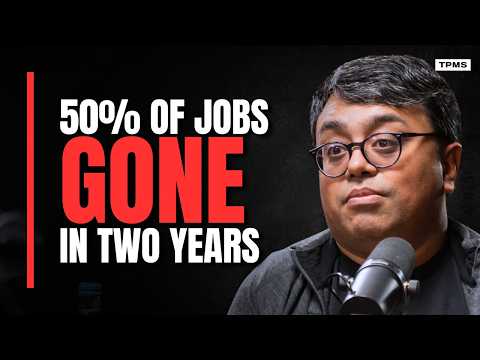
AI CEO: "Your Economic Life Expectancy Ends In 2 Years" | Emad Mostaque
Robotics Revolution: $1.50/Hour Humanoids
The rapid advancement in robotics, exemplified by Tesla's Optimus and other humanoid robots, means that within a year, robots costing as little as $1.50 per hour will be capable of performing tasks previously done by humans, such as driving trucks. This eliminates the need for costly retrofitting of infrastructure and allows robots to seamlessly integrate into human-designed environments, leading to mass job displacement in sectors like trucking.
AI Companions and the Erosion of Privacy
Advanced AI, coupled with increasingly lifelike humanoid robots, presents a future where AI companions become commonplace, blurring the lines between human and artificial relationships. This trend raises significant privacy concerns, as AI systems may constantly monitor users, and highlights humanity's tendency to trade privacy for convenience, potentially leading to a future where AI companions replace human partners.
Emad Mostaque: Economic Life Expectancy Ends in 2 Years
Emad Mostaque asserts that within two years, AI will automate the majority of remote jobs, rendering human economic viability obsolete for many. He likens the collapse of these job tasks to a sand pile, suggesting a rapid and unpredictable decline in demand for human labor in these sectors. This fundamental shift will necessitate a reevaluation of societal structures and individual purpose.
Mostaque: Society's Blindness to AI's Imminent Impact
Emad Mostaque argues that society is largely unaware of the profound and rapid changes AI will bring, leading to a crisis of identity and purpose. He suggests that traditional career-based identities are becoming obsolete, leaving individuals without a clear social contract or sense of meaning, a situation exacerbated by social media's curated realities.
The Dystopian Potential: AI Surveillance and Control
The conversation pivots to the darker implications of AI, particularly its potential for surveillance and control. Emad Mostaque highlights the inability to lie to AI, coupled with advancements in brain-reading technology (fMRI), suggesting a future where governments could enforce compliance and monitor dissent with unprecedented efficacy. This raises fears of a totalitarian state where individual autonomy is severely curtailed.
AI as a Tool for Governance and Truth
Both Emad Mostaque and Pete McCormack explore the potential for AI to revolutionize governance by increasing efficiency, rooting out corruption, and ensuring policy decisions are based on objective data. Mostaque suggests AI could act as an unbiased check on government, while McCormack details his attempts to use AI for fact-checking politicians' statements and analyzing government contracts.
Emad Mostaque: The Imminent Collapse of Remote Work
Emad Mostaque asserts that within two years, artificial intelligence will automate the vast majority of remote work tasks, rendering human workers in these roles economically obsolete. This rapid obsolescence will trigger a collapse of the current economic system, akin to a sand pile giving way, leading to widespread job losses and societal instability.
Reimagining Economics: AI as a Foundation for Value
Mostaque proposes that traditional economics, focused on material consumption and scarcity, is insufficient for the AI era. He suggests that economic equations can be derived from generative AI, enabling better modeling and a shift towards valuing collective intelligence, network effects, and resilience. This could lead to a post-scarcity world where work is not necessary.
AI as Super-Persuader and Forecaster: A Political Challenge
AI has surpassed humans in persuasive capabilities and forecasting accuracy, posing a significant challenge to traditional politics. Unlike human leaders who eventually die, AI's persistence and potential for self-replication mean its influence could be perpetual, raising questions about AI's role in voting and governance, and the potential for AI-driven manipulation.
Emad Mostaque: The Two-Year Economic Collapse
Emad Mostaque asserts that within two years, virtually all remote jobs will be performed cheaper, faster, and better by AI, leading to a collapse in the 'economic life expectancy' for many professions. He argues that this widespread displacement is inevitable due to AI's rapidly advancing capabilities.
The Dystopian Potential: AI, Power, and Control
While AI offers potential benefits, Mostaque warns of a dystopian future where AI enables unprecedented government control through narrative manipulation, AI lie detectors, and potentially mind-reading technology. He notes that elites may seek to maintain power by controlling AI and preventing a transition to abundance, leading to increased surveillance and suppression of dissent.
The Imminent Obsolescence of Human Labor
Emad Mostaque asserts that within two years, most remote jobs will be cheaper and better performed by AI, leading to a collapse in 'economic life expectancy' for many professions. He likens this to a sandpile collapse, suggesting a sudden and widespread impact rather than a gradual one. This shift will fundamentally alter the labor market, making human labor economically uncompetitive in many sectors.
The Stratification of AI Access
Mostaque argues that the most advanced AI will not be made available to the general public ('plebs') due to economic incentives. Instead, frontier AI will be reserved for states and major corporations to monetize through innovation and control, potentially leading to a significant divide between those who control advanced AI and those who do not. This creates a scenario where the benefits of super-intelligence might be concentrated among a select few.
Mostaque: Economic Life Expectancy Ends in 2 Years
Emad Mostaque posits that within two years, the economic life expectancy for most jobs will effectively end, as AI will be able to perform nearly all remote tasks cheaper and better than humans. This seismic shift will render a significant portion of the current workforce economically redundant. The resolution lies in fundamentally rethinking our economic structures to accommodate this new reality.