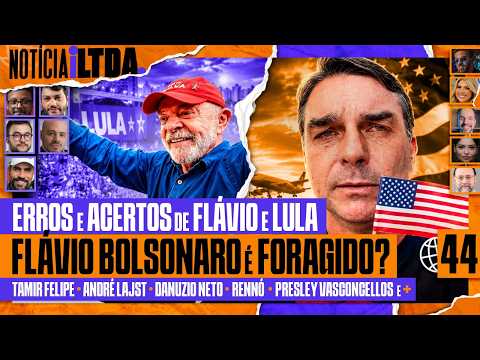
Inteligência Ltda's FLÁVIO É FORAGIDO? + INTEFERÊNCIA NAS ELEIÇÔES + ANÁLISE DAS CAMPANHAS - Notícia iLtda. #044: skim's analysis identifies 20 key moments, with 2 potential conflicts of interest flagged. Notícia iLtda hosts and guests examine the immediate fallout of Lula's 2026 presidential runoff victory over Flávio Bolsonaro, alongside live exit polls from Israel's parliamentary election.
Category: Politics. Format: Panel Discussion. YouTube video analyzed by skim.
Key Points (20)
1. André Lajst on Israel's Election Deadlock
Timestamp: 00:04:53 to 00:12:11
Reporting live from Israel, André Lajst states that the 2026 parliamentary election was clean and compares incumbent Benjamin Netanyahu with former army chief Gadi Eisenkot, who favors a national inquiry into October 7 and mandatory ultra-Orthodox conscription. Exit polls show Netanyahu's bloc dropping from 68 to roughly 50 or 51 seats while the opposition holds 52 to 54 seats, leaving both short of the 61 seats needed to govern.
Significance (High): A hung Knesset dependent on Arab parties forces Israeli leaders to negotiate domestic and diplomatic compromises to form a government.
Sources in support: André Lajst (Geopolitical Analyst reporting live from Israel)
Neutral sources: Ricardo Marcílio (Geography Professor and Co-host of Notícia iLtda)
2. Settlements, Netanyahu's Image, and the Courts
Timestamp: 00:12:46 to 00:22:36
André Lajst explains that West Bank settlements were barely debated during the campaign, which focused instead on healing the trauma of October 7 and national defense. He notes that after roughly 18.5 years in power, Benjamin Netanyahu's personal image is fused with Israel's wartime reputation, meaning a new prime minister could improve Israel's global standing just as Barack Obama improved the US image after George W. Bush.
Significance (Medium): Replacing a long-serving leader can reset a nation's international diplomatic standing even when core security policies remain unchanged.
Sources in support: André Lajst (Geopolitical Analyst reporting live from Israel)
Neutral sources: Madeleine Lacsko (Journalist, Co-host of Notícia iLtda, and political candidate), Ricardo Marcílio (Geography Professor and Co-host of Notícia iLtda)
3. Presley Vasconcellos Explains Post-Vote Sell-Off
Timestamp: 00:24:42 to 00:31:21
Economist Presley Vasconcellos explains that the Ibovespa drop and dollar spike following Lula's re-election occurred because investors had heavily priced in a Flávio Bolsonaro victory after he won the first round. For the first time in Brazilian history, the first-round winner lost the runoff, forcing traders who bet on Bolsonaro and poll projections to sell assets rapidly to cut losses.
Significance (High): Demonstrates how sudden electoral reversals trigger immediate portfolio repricing when markets bet heavily on pre-election polls.
Sources in support: Presley Vasconcellos (Economist)
Neutral sources: Fernanda Comora (Journalist and Co-host of Notícia iLtda)
4. High Interest Rates and Spending Drive Debt
Timestamp: 00:32:03 to 00:42:02
Responding to Ricardo Marcílio on whether government spending or interest rates drive Brazil's debt, Presley Vasconcellos argues that both factors combine: Brazil suffers from the world's highest real interest rate alongside massive structural obligations like social security.
Significance (Medium): Highlights the fiscal collision between unfunded campaign promises, an aging population's pension costs, and high interest rates.
Sources in support: Presley Vasconcellos (Economist)
Neutral sources: Fernanda Comora (Journalist and Co-host of Notícia iLtda), Madeleine Lacsko (Journalist, Co-host of Notícia iLtda, and political candidate), Ricardo Marcílio (Geography Professor and Co-host of Notícia iLtda)
5. Marcelo Rennó Details Flávio Bolsonaro's Escape
Timestamp: 00:45:29 to 00:53:05
Marcelo Rennó recounts reports that Flávio Bolsonaro fled Brazil around midnight in a planned operation to avoid surrendering his passport by 11:00 a.m., flying from Brasília to Foz do Iguaçu, crossing into Puerto Iguazú in Argentina, and routing through Santiago, Chile toward Miami to avoid Brazilian Air Force interception.
Significance (High): Seizing a defeated presidential candidate's passport minutes after the vote count raises severe domestic and international alarm over judicial overreach.
Sources in support: Madeleine Lacsko (Journalist, Co-host of Notícia iLtda, and political candidate), Marcelo Rennó (Political Commentator)
Neutral sources: Rogério Vilela (Host of Inteligência Ltda.)
6. PT Mobilization and Right-Wing Hubris
Timestamp: 00:53:05 to 01:00:35
Explaining how Lula overturned Flávio Bolsonaro's first-round lead, Marcelo Rennó credits intense Workers' Party street mobilization, André Janones's 10-million-member WhatsApp group, and gov.br messages telling families that voting counted as INSS proof of life for elderly retirees. Rennó rejects voting machine fraud claims, arguing instead that the right grew arrogant after polls like Quaest and Datafolha showed Flávio Bolsonaro two points ahead on the eve of the vote.
Significance (High): Exposes how candidate rejection and second-round complacency cost the Brazilian right an election that polls projected them to win.
Sources in support: Madeleine Lacsko (Journalist, Co-host of Notícia iLtda, and political candidate), Marcelo Rennó (Political Commentator)
Neutral sources: Ricardo Marcílio (Geography Professor and Co-host of Notícia iLtda)
7. Small-Town Flipping and the Ana Clara Factor
Timestamp: 01:00:36 to 01:08:02
Madeleine Lacsko and Marcelo Rennó detail how municipal mayors and public employees in conservative interior towns like Cotia mobilized voters at schools and health clinics to flip votes from Bolsonaro to Lula. While Ricardo Marcílio notes that moderate voters were alienated by Flávio Bolsonaro's scandals and aggressive right-wing rhetoric, Rennó argues that corruption scandals no longer move Brazilian voters given Lula's own controversies.
Significance (Medium): Shows how local municipal machinery and emotional campaign incidents outweigh traditional corruption allegations in swing municipalities.
Sources in support: Madeleine Lacsko (Journalist, Co-host of Notícia iLtda, and political candidate), Ricardo Marcílio (Geography Professor and Co-host of Notícia iLtda), Marcelo Rennó (Political Commentator)
8. Zanin's Voting Extension and Centrão Defections
Timestamp: 01:08:02 to 01:18:12
Madeleine Lacsko and Marcelo Rennó criticize Justice Cristiano Zanin—Lula's former personal lawyer—for ordering an unprecedented last-minute extension of voting hours at 5:02 p.m. after TSE President Kassio Nunes Marques declined to act and the Federal District had already begun releasing results showing Lula 10 points ahead. Although only 35,000 votes were cast after 5:00 p.m., Lacsko argues the rule-breaking severely damages electoral credibility abroad.
Significance (High): Last-minute procedural changes by a former presidential attorney fuel international skepticism even when the numerical vote impact is small.
Sources in support: Madeleine Lacsko (Journalist, Co-host of Notícia iLtda, and political candidate), Marcelo Rennó (Political Commentator)
Neutral sources: Ricardo Marcílio (Geography Professor and Co-host of Notícia iLtda), Rogério Vilela (Host of Inteligência Ltda.)
9. Danuzio Neto Critiques Lula's Speech Regulation
Timestamp: 01:19:57 to 01:26:22
Commenting on President Lula's victory remarks prioritizing social media regulation, Danuzio Neto argues that the government ignores urgent public security and economic crises to pursue selective political censorship. He points out that online crimes are already punished in Brazil, citing Danilo Gentili's conviction, while pro-government figures like André Janones go unpunished for spreading campaign falsehoods.
Significance (Medium): Frames the administration's immediate post-election focus on platform regulation as a tool for asymmetric political enforcement.
Sources in support: Danuzio Neto (Political Commentator)
Neutral sources: Fernanda Comora (Journalist and Co-host of Notícia iLtda)
10. TSE 72-Hour Blackout and Foreign Interference
Timestamp: 01:28:03 to 01:39:53
Madeleine Lacsko notes that TSE election rules cut candidates' organic reach to 2% and funneled millions in public party funds into paid social media ads. Danuzio Neto reports that under TSE orders, Meta automatically restricted dozens of his posts—and 22 factual posts by newspaper O Estado de S. Paulo—during the 72 hours before and 24 hours after the vote, while André Janones deleted 500 posts from his 10-million-member WhatsApp channel without penalty.
Significance (High): Details how automated pre-election content blocks restricted both independent commentators and major newspapers.
Sources in support: Fernanda Comora (Journalist and Co-host of Notícia iLtda), Madeleine Lacsko (Journalist, Co-host of Notícia iLtda, and political candidate), Danuzio Neto (Political Commentator)
Neutral sources: Ricardo Marcílio (Geography Professor and Co-host of Notícia iLtda)
11. Tamir Felipe on PT-Bolsonarismo Symbiosis
Timestamp: 01:41:18 to 01:47:02
Federal deputy candidate Tamir Felipe explains why he cast a null vote in the presidential runoff, arguing that Petismo and Bolsonarismo feed off each other in a staged polarization that crowds out substantive national development debates. He recalls José Dirceu stating in 2018 that a Bolsonaro victory would help the PT return stronger in 2022, and notes that right-wing candidate Pavanato refused three debate invitations with him to focus on culture-war topics.
Significance (Medium): Challenges the ideological divide by showing convergence between Lula and Flávio Bolsonaro on labor deregulation and oil privatization.
Sources in support: Tamir Felipe (Federal Deputy Candidate and Labor Political Commentator)
Neutral sources: Ricardo Marcílio (Geography Professor and Co-host of Notícia iLtda), Rogério Vilela (Host of Inteligência Ltda.)
12. Shadow Bans and R$ 378M in Public Ad Spending
Timestamp: 01:50:44 to 02:01:58
Madeleine Lacsko and Tamir Felipe detail how TSE campaign rules imposed severe shadow bans on registered candidates' social media accounts, dropping TikTok views from 50,000 to 20 and Instagram story views from 15,000 to 800. Because organic reach was throttled, campaigns had to buy visibility, resulting in R$ 378 million of public funds—93% from the Electoral Fund—being sent to foreign Big Tech companies in dollars.
Significance (High): Reveals how digital election rules entrenched party bosses and incumbents while transferring hundreds of millions in public tax money to foreign tech platforms.
Sources in support: Madeleine Lacsko (Journalist, Co-host of Notícia iLtda, and political candidate), Tamir Felipe (Federal Deputy Candidate and Labor Political Commentator)
13. Labor Movement Prospects and Industrial Policy
Timestamp: 02:01:58 to 02:05:04
Asked by Ricardo Marcílio whether Brazil's labor movement has a clear leader or room to grow amid polarization, Tamir Felipe admits that developmentalist and nationalist voices are heavily squeezed between the two dominant blocs. While declining to call himself a national leader, Felipe says he ran for office at his community's urging to keep industrial and employment proposals alive.
Significance (Low): Assess the space for a third-way developmentalist agenda in a political system dominated by cultural polarization.
Sources in support: Tamir Felipe (Federal Deputy Candidate and Labor Political Commentator)
Neutral sources: Ricardo Marcílio (Geography Professor and Co-host of Notícia iLtda)
14. Madeleine Lacsko on Brumadinho Election Probe
Timestamp: 02:06:08 to 02:10:52
Madeleine Lacsko clarifies that Justice Flávio Dino did not open a new inquiry into foreign election interference, but instead issued a ruling inside an existing Supreme Court action—ADPF 978 or 778—after the Workers' Party filed a petition citing material from Missão party president Renan Santos about Tallis Gomes and Pedro Sangenis.
Significance (High): Exposes bizarre judicial procedural piggybacking where an election interference claim is adjudicated inside a mining disaster lawsuit.
Sources in support: Madeleine Lacsko (Journalist, Co-host of Notícia iLtda, and political candidate)
Neutral sources: Fernanda Comora (Journalist and Co-host of Notícia iLtda), Ricardo Marcílio (Geography Professor and Co-host of Notícia iLtda), Rogério Vilela (Host of Inteligência Ltda.)
15. Italian Court Rejects Tagliaferro Extradition
Timestamp: 02:10:55 to 02:15:39
After noting internal Bolsonarista infighting blaming Nikolas Ferreira and Michelle Bolsonaro for the election loss, Madeleine Lacsko reports that the Court of Appeal of Catanzaro in Italy denied Brazil's extradition request for Eduardo Tagliaferro, a former advisor to Justice Alexandre de Moraes.
Significance (High): An European appellate court formally censuring Brazil's Supreme Court for due process violations deals a major blow to the tribunal's international legitimacy.
Sources in support: Madeleine Lacsko (Journalist, Co-host of Notícia iLtda, and political candidate)
Neutral sources: Rogério Vilela (Host of Inteligência Ltda.)
16. Southern Separatist Plebiscite and Extremism
Timestamp: 02:18:40 to 02:26:55
Madeleine Lacsko reports that newly elected Santa Catarina PL deputy Bruno Souza proposed a separatist plebiscite for Santa Catarina, Paraná, and Rio Grande do Sul, while Ricardo Marcílio notes that Paulo Bilynskyj made similar remarks about dividing red and blue states. Marcílio argues that separatist rhetoric violates the Brazilian Constitution's unamendable federalist clause and alienates moderate voters.
Significance (Medium): Highlights how unconstitutional separatist proposals and street belligerence alienate moderate and conservative voters alike.
Sources in support: Fernanda Comora (Journalist and Co-host of Notícia iLtda), Madeleine Lacsko (Journalist, Co-host of Notícia iLtda, and political candidate), Ricardo Marcílio (Geography Professor and Co-host of Notícia iLtda)
Neutral sources: Rogério Vilela (Host of Inteligência Ltda.)
17. US, Argentine, and BRICS Post-Election Stances
Timestamp: 02:27:00 to 02:31:52
Ricardo Marcílio reviews international reactions to Lula's victory, noting that while most Latin American leaders congratulated him, Argentine President Javier Milei merely 'took note' of the result, and Elon Musk and a Trump Media attorney questioned the vote count.
Significance (High): Separates fabricated AI clips of Donald Trump from actual diplomatic signals between Washington, Buenos Aires, and Brasília.
Sources in support: Madeleine Lacsko (Journalist, Co-host of Notícia iLtda, and political candidate), Ricardo Marcílio (Geography Professor and Co-host of Notícia iLtda)
Neutral sources: Rogério Vilela (Host of Inteligência Ltda.)
18. Bukele's Haiti Threat and Venezuela Realpolitik
Timestamp: 02:31:53 to 02:37:44
Ricardo Marcílio reports that after four non-combat Salvadoran soldiers serving in a 2,000-troop UN mission in Haiti were ambushed and disappeared—likely killed by gangs controlling Port-au-Prince—El Salvador's President Nayib Bukele threatened to eradicate Haitian gangs just as he did at home.
Significance (Medium): Illustrates how resource and commercial interests override democratic ideology in US foreign policy toward Venezuela and Ukraine.
Sources in support: Ricardo Marcílio (Geography Professor and Co-host of Notícia iLtda)
Neutral sources: Madeleine Lacsko (Journalist, Co-host of Notícia iLtda, and political candidate), Rogério Vilela (Host of Inteligência Ltda.)
19. Egypt Sends Troops to Saudi Arabia; EU Protests
Timestamp: 02:37:44 to 02:41:48
Ricardo Marcílio reports that Egypt is deploying troops to Saudi Arabia to help fight Iranian-backed Houthi rebels in Yemen, joining a recent Mecca defense pact alongside Turkey and Pakistan, while Donald Trump delays any strike on Iran until after the US midterm elections to avoid oil price spikes.
Significance (Medium): Connects Middle Eastern military alignments and European debt protests to broader shifts in global energy and security.
Sources in support: Ricardo Marcílio (Geography Professor and Co-host of Notícia iLtda)
Neutral sources: Madeleine Lacsko (Journalist, Co-host of Notícia iLtda, and political candidate), Rogério Vilela (Host of Inteligência Ltda.)
20. Carlos Bezerra Jr. Condemns Post-Vote Boycotts
Timestamp: 02:51:02 to 02:55:02
In a closing commentary, newly elected São Paulo federal deputy and pastor Carlos Bezerra Jr. condemns post-election statements by right-wing figures calling for southern secession, firing PT-voting employees, halting food basket donations, and cheering the stock market drop. Speaking as a Christian and the grandson of Northeasterners, he argues that conditioning charity or jobs on a person's vote turns political ideology into an idol and violates Jesus's command to love one's neighbor.
Significance (Medium): Provides a moral appeal from an evangelical lawmaker against retaliatory firings, regional prejudice, and charity boycotts after a divisive election.
Sources in support: Carlos Bezerra Jr. (Pastor and Elected Federal Deputy for São Paulo)
This analysis was generated by skim (skim.plus), an AI-powered content analysis platform by Credible AI. Scores and classifications represent the platform's AI-generated assessment and should be considered alongside other sources.