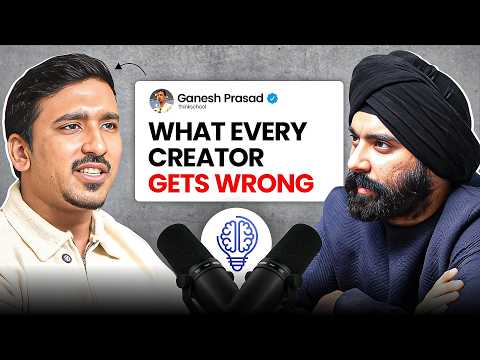
Indian Silicon Valley by Jivraj Singh Sachar's How @ThinkSchool Redefined Educational Content | The Ultimate Creator/Business Playbook: skim's analysis identifies 16 key moments, with 2 potential conflicts of interest flagged. Think School co-founder Ganesh Prasad joins host Jivraj Singh Sachar to deconstruct how he built a 4.
Category: Business. Format: Interview. YouTube video analyzed by skim.
skim AI Analysis
Credibility assessment: Direct Founder Insights. Ganesh Prasad provides transparent, firsthand operational accounts of building Think School, backed by concrete metrics and case study examples like Narayana Health. While macroeconomic claims regarding port infrastructure and highway costs rely on his memory of secondary reports, the core business lessons remain grounded in direct experience.
Bias assessment: Bootstrapped Capitalist. The conversation strongly favors bootstrapped entrepreneurship, operational frugality, and long-form educational content while openly criticizing Indian engineering colleges, short-form social media, and mainstream television news. Ganesh Prasad explicitly identifies as a capitalist focused on business efficiency.
Originality: 82% — Candid Creator Playbook. Rather than offering generic creator advice, Ganesh Prasad breaks down his specific four-step writing framework, his three-part storytelling structure, and his exact financial discipline. The synthesis of insights from Indian founders like Arokiaswamy Velumani and Dheeraj Gupta adds distinct practical value.
Depth: 84% — Structured Systems Thinking. The discussion goes beyond surface-level success stories to examine unit economics, floor efficiency, supply chain bottlenecks, and cognitive psychology in media consumption. Examples like Narayana Health's surgical assembly line and Dhirubhai Ambani's backward integration are unpacked with clear causal logic.
Key Points (16)
1. Ganesh Prasad's Vision for an Indian B-School
Timestamp: 00:02:53 to 00:10:57
Ganesh Prasad explains that he founded Think School to eventually build a world-class business school in India after experiencing an uninspiring civil engineering college. Starting in an 8,000-rupee rented room, he pivoted from offline classes to YouTube business case studies to build capital and reach. He concludes that after six years, Think School is about 20 percent of the way toward realizing that business school dream.
Significance (High): Frames Think School not as a mere creator channel, but as a long-term capital and distribution engine for physical higher education reform in India.
Sources in support: Ganesh Prasad (Co-founder, Think School)
Neutral sources: Jivraj Singh Sachar (Host, Indian Silicon Valley Podcast)
2. Merging Cinema with Educational Case Studies
Timestamp: 00:10:57 to 00:17:51
Knowledge without entertainment is boring, while entertainment without knowledge is pointless, so educational creators must treat videos like cinematic documentaries. Inspired by Jamsetji Tata's nation-building vision, he aims to make viewers feel mesmerized and screens every episode on an office projector. He concludes that building a lasting educational institution will be his defining contribution to India.
Significance (Medium): Demonstrates how applying cinematic standards to educational content breaks the trade-off between mass appeal and analytical depth.
Sources in support: Ganesh Prasad (Co-founder, Think School)
Neutral sources: Jivraj Singh Sachar (Host, Indian Silicon Valley Podcast)
3. Extreme Frugality Enables Startup Risk-Taking
Timestamp: 00:17:51 to 00:21:34
He took the leap into entrepreneurship because he lacked civil engineering skills and could survive on just 3,000 rupees a month eating street food. Citing Thyrocare founder Dr. Velumani's 25-year personal savings runway, he argues that low personal expenses allow founders to take bigger risks and reinvest profits into top employee salaries. He concludes that an inability to live frugally is why most aspiring founders fail to take risks.
Significance (High): Challenges the venture-backed startup norm by showing how extreme personal frugality extends a founder's runway and compounds business reinvestment.
Sources in support: Ganesh Prasad (Co-founder, Think School)
Neutral sources: Jivraj Singh Sachar (Host, Indian Silicon Valley Podcast)
4. Fixing Teaching Incentives and Indian Media
Timestamp: 00:21:34 to 00:28:46
Ganesh Prasad criticizes Indian colleges for hiring professors based on degrees rather than storytelling skills, and faults mainstream Indian news channels for chasing ratings because of heavy overhead costs and political advertisers. He points to Nitish Rajput and Think School's million-view podcasts as proof that Indian audiences crave deep, unbiased content. He concludes that India lacks genuine debate and hints at launching an Oxford Union-style debate format before 2029.
Significance (High): Identifies asset-heavy cost structures as the root cause of sensationalist television news, positioning lean digital creators to capture serious public discourse.
Sources in support: Ganesh Prasad (Co-founder, Think School)
Neutral sources: Jivraj Singh Sachar (Host, Indian Silicon Valley Podcast)
5. Sponsor Vetting and Think School's Revenue Model
Timestamp: 00:28:46 to 00:34:54
As Think School grew, the team instituted strict sponsor vetting, moving from adding 20-second risk disclaimers on crypto ads to rejecting grey-area sponsors entirely. He breaks down the company's two-wing business model: a media wing monetizing Hindi, English, and podcast channels via sponsorships and AdSense, and an ed-tech wing selling a Communication Masterclass. He concludes that poor communication carries a compounding career cost for engineers.
Significance (Medium): Illustrates how creator-led businesses can protect audience trust by declining grey-area ad money while monetizing through targeted skill courses.
Sources in support: Ganesh Prasad (Co-founder, Think School)
Neutral sources: Jivraj Singh Sachar (Host, Indian Silicon Valley Podcast)
6. Ganesh Prasad's Storytelling Framework
Timestamp: 00:34:54 to 00:42:14
Ganesh Prasad attributes his articulate delivery to writing over 300 episodes using a four-step process: data collection, structuring, articulation, and speaking. He defines the three essential components of a great story as purpose, context, and action, illustrating them through a Think School script on Dhirubhai Ambani's backward integration into polyester after the 1970s oil shocks. He concludes that establishing purpose first, setting context second, and delivering action third keeps audiences hooked.
Significance (High): Provides a replicable scriptwriting blueprint for turning dry corporate history into high-retention educational storytelling.
Sources in support: Ganesh Prasad (Co-founder, Think School), Jivraj Singh Sachar (Host, Indian Silicon Valley Podcast)
7. Three Core Lessons from 300 Case Studies
Timestamp: 00:42:14 to 00:51:18
Synthesizing his biggest business lessons, he shares Dr. Velumani's maxim that profits from customer pockets only sustain a firm, whereas profits from floor efficiency make millions. He illustrates this with Narayana Health, which uses an assembly-line model for senior cardiac surgeons to cut surgery costs to roughly 1 to 2 lakh rupees while earning around 400 crores in profit. He concludes by pairing floor efficiency with good frugality and deep customer empathy as the three pillars of entrepreneurship.
Significance (High): Distills hundreds of business case studies into three actionable operational principles centered on unit-cost reduction, smart capital allocation, and customer empathy.
Sources in support: Ganesh Prasad (Co-founder, Think School), Jivraj Singh Sachar (Host, Indian Silicon Valley Podcast)
8. Opportunities in Franchising and Cloud Kitchens
Timestamp: 00:51:18 to 00:57:57
Outlining major business opportunities in India, Ganesh Prasad highlights food franchising and cloud kitchens, citing insights from Jumbo King's Dheeraj Gupta and Biryani By Kilo's Vishal. He notes that most Indian franchises fail at scale because franchisors profit from selling equipment and raw materials rather than aligning incentives with franchisee profitability. He concludes that entrepreneurs who standardize inputs and processes can either build massive food brands or consult for struggling chains.
Significance (High): Pinpoints incentive misalignment and process standardization as the exact operational gaps entrepreneurs can monetize in India's food and beverage sector.
Sources in support: Ganesh Prasad (Co-founder, Think School)
Neutral sources: Jivraj Singh Sachar (Host, Indian Silicon Valley Podcast)
9. India's Manufacturing and Infrastructure Bottlenecks
Timestamp: 00:57:57 to 01:05:16
Electronics manufacturing is a massive opportunity in India because founders like Fittr's JC, Neel, and Boult's Varun currently rely on China due to domestic equipment and technical gaps. However, he warns that India's growth is held back by three structural bottlenecks: land acquisition delays that doubled Bharatmala highway costs from 5 lakh crore to 10 lakh crore rupees, bureaucratic red tape, and a lack of transshipment ports that forces goods trains to average 25 km/h. He concludes that solving land and departmental coordination is urgent for India's progress.
Significance (High): Connects startup supply-chain struggles directly to macroeconomic bottlenecks in land acquisition, regulatory approvals, and port infrastructure.
Sources in support: Ganesh Prasad (Co-founder, Think School)
Neutral sources: Jivraj Singh Sachar (Host, Indian Silicon Valley Podcast)
10. Why Founders Should Bootstrap Before Raising VC
Timestamp: 01:05:16 to 01:16:20
Advising founders not to raise venture capital to experiment, he argues that entrepreneurs should build proof of concept and proof of scale with their own money first. He contrasts VC-funded startups that burn lakhs on 18-person video crews with his own early setup using a broken phone, M-Seal on a tripod, and an 800-rupee microphone. Sharing his grandfather's view that a person's capacity to spend wisely matches what they have earned, he concludes that founders should only raise capital once they know exactly where to deploy it.
Significance (High): Offers a disciplined capital-allocation framework that warns founders against the wealth effect of unearned venture funding.
Sources in support: Ganesh Prasad (Co-founder, Think School), Jivraj Singh Sachar (Host, Indian Silicon Valley Podcast)
11. Ganesh Prasad on Staying Small and Debt-Free
Timestamp: 01:16:20 to 01:21:22
Pressed by Jivraj Singh Sachar on why Think School has not raised funding, Ganesh Prasad explains that their existing channels and courses are self-funded while their future business school lacks a proof of concept. He rejects chasing massive headcount, stating he is happy running a 22-person organization and would be content teaching just 30 students a year. He concludes that great outcomes come from baby steps rather than taking unvalidated venture bets.
Significance (Medium): Presents a deliberate counter-narrative to blitzscaling, prioritizing team profitability and educational quality over headcount growth.
Sources in support: Ganesh Prasad (Co-founder, Think School)
Neutral sources: Jivraj Singh Sachar (Host, Indian Silicon Valley Podcast)
12. What Defines a Great Educational Creator
Timestamp: 01:21:22 to 01:26:20
Evaluating the creator landscape, he praises MKBHD for authenticity, Johnny Harris for pushing production thresholds, Samay Raina for fearless originality, Bhuvan Bam for scaling to cinema, and Alakh Pandey for democratizing education. For Think School, he measures success by making 'noteworthy' rather than 'watchworthy' content, noting that viewers post 40-to-50-page podcast notes on LinkedIn and one note-taker was hired as their social media manager. He concludes that great educational creators tell audiences what they must hear rather than what they want to hear over many years.
Significance (Medium): Establishes 'noteworthy content' and multi-year longevity as the benchmark for serious educational creators.
Sources in support: Ganesh Prasad (Co-founder, Think School)
Neutral sources: Jivraj Singh Sachar (Host, Indian Silicon Valley Podcast)
13. System 1 Thinking and Creator Responsibility
Timestamp: 01:26:20 to 01:37:03
Responding to concerns about predatory creators and false claims, Ganesh Prasad uses Daniel Kahneman's System 1 and System 2 framework to argue that time-poor consumers scrolling reels after a nine-hour workday cannot be expected to do due diligence. He recounts how scammers impersonated him on Telegram to steal 5,000 rupees from gullible users, and how partisan viewers attack Think School's governance videos and Nirmala Sitharaman interview. He concludes that while gullible audiences will remain gullible, creators have a duty to verify facts and stay objective.
Significance (Medium): Applies behavioral economics to explain why short-form media fuels impulsive reactions and why the burden of accuracy rests on creators rather than exhausted viewers.
Sources in support: Ganesh Prasad (Co-founder, Think School)
Neutral sources: Jivraj Singh Sachar (Host, Indian Silicon Valley Podcast)
14. Constructive Criticism vs. Online Hate
Timestamp: 01:37:03 to 01:41:47
While dismissing unthinking hate comments because his team rigorously debates topics like capitalism versus socialism internally, he welcomes thoughtful criticism. He shares two examples where critical comments improved Think School: incorporating land acquisition challenges into all Indian development videos, and taking down an inaccurate Nvidia processing video while refunding the sponsor. He concludes that separating merit from emotion turns critical feedback into a competitive advantage.
Significance (Medium): Shows how willingness to retract flawed content and refund sponsors builds institutional credibility in digital media.
Sources in support: Ganesh Prasad (Co-founder, Think School), Jivraj Singh Sachar (Host, Indian Silicon Valley Podcast)
15. Turning Down 150 Crores to Protect the Art
Timestamp: 01:41:47 to 01:46:45
Asked whether he is an artist or a capitalist, Ganesh Prasad calls himself a capitalist who makes commercial art at the intersection of value and entertainment. He reveals that a venture capital firm once offered Think School 150 crore rupees, which fell apart when he told them he had no revenue targets and only cared about making his next YouTube video better. He concludes that the joy of seeing business schools play his videos and obsessing over audio quality matters far more than extra money.
Significance (High): Highlights the fundamental clash between venture capital growth mandates and craft-driven media companies.
Sources in support: Ganesh Prasad (Co-founder, Think School)
Neutral sources: Jivraj Singh Sachar (Host, Indian Silicon Valley Podcast)
16. Relationships, Systems, and Brutal Honesty
Timestamp: 01:47:04 to 01:58:59
Reflecting on his personal life, he contrasts a joyful 600-rupee college birthday with a lonely 2021 COVID lockdown birthday when he had 1.5 lakh rupees and 140,000 subscribers, proving that close friendships matter more than wealth. Asked for advice to his younger self, he emphasizes building scalable systems and delegating control once a product works. He concludes with a human lesson that brutal honesty with friends, mentors like Nikhil Kamath, and employees filters out fake relationships and drives great work.
Significance (Medium): Grounds entrepreneurial ambition in personal relationships, operational delegation, and radical candor.
Sources in support: Ganesh Prasad (Co-founder, Think School), Jivraj Singh Sachar (Host, Indian Silicon Valley Podcast)
This analysis was generated by skim (skim.plus), an AI-powered content analysis platform by Credible AI. Scores and classifications represent the platform's AI-generated assessment and should be considered alongside other sources.