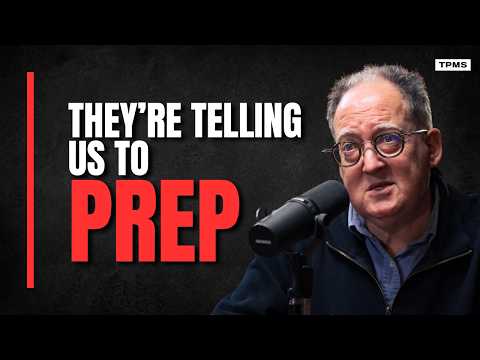
How World War 3 Could Start by Accident | Gideon Rachman
Peter McCormack
Summary
Financial Times columnist Gideon Rachman joins Peter McCormack to examine why the risk of a major conflict has risen despite rapid technological progress. Drawing on his book War Is Interested in You, Rachman argues that long-serving leaders like Vladimir Putin and Xi Jinping, alongside Donald Trump, prioritize territorial expansion and historical legacy over domestic welfare. While placing the probability of World War III below 50% due to nuclear deterrence, Rachman recounts how US intelligence assessed a 50-50 chance of Russian tactical nuclear use in October 2022 and warns that Russian hybrid sabotage against European supply chains could accidentally trigger a NATO clash.
The conversation also explores how regional conflicts are connecting and straining Western resources. Rachman argues that Trump launched the February 2026 attack on Iran expecting an easy regime-change victory after capturing Venezuela's Nicolás Maduro in January 2026, but instead sparked Iranian retaliation across the Gulf that has kept fuel prices high and depleted Western Patriot missile interceptors needed by Ukraine. With Congress briefed on potential post-midterm strikes against Iranian civilian infrastructure and Britain trapped by a 95% debt-to-GDP ratio and sluggish growth, Western states face mounting strategic and fiscal pressures.
How time-sensitive the topic is: Developing story
By the numbers
2 pounds per liter: Price Peter McCormack says he is paying for diesel to fill up his car. (Mentioned at 11:55)
1.5 million Russian casualties (killed or wounded): Western intelligence and British government estimate of Russian losses in the Ukraine war cited by Gideon Rachman. (Mentioned at 22:44)
5 years: Timeframe a leading Polish politician told Gideon Rachman it would take before Russia could mount a direct assault on NATO. (Mentioned at 29:19)
50%: Upper bound below which Gideon Rachman places the likelihood of a world war occurring. (Mentioned at 37:48)
50-50 chance: US intelligence assessment in October 2022 of the probability that Russia would use tactical nuclear weapons in Ukraine. (Mentioned at 42:46)
80% plus inflation rate: Inflation rate in Iran cited by Gideon Rachman while describing economic struggles under the Iranian regime. (Mentioned at 58:00)
27% of GDP lost: Economic contraction Greece suffered during its debt crisis before returning to a budget surplus and 3-4% annual growth. (Mentioned at 1:05:56)
95% debt-to-GDP ratio: Britain's approximate debt-to-GDP ratio cited by Gideon Rachman, compared with about 110% in France and 60% in Germany. (Mentioned at 1:06:47)
0.8 fertility rate: South Korea's fertility rate cited by Gideon Rachman alongside 1.2 in Japan and about 1 in China. (Mentioned at 1:09:12)
100 billion pounds: Amount Peter McCormack estimates Britain needs to cut from annual public spending to break even or begin paying down national debt. (Mentioned at 1:13:25)
Questions this video answers
How could World War III start by accident between Russia and NATO?
Gideon Rachman explains that while Russia lacks the capacity for a direct invasion of NATO for roughly five years, Moscow is conducting reckless hybrid warfare against Western supply chains to Ukraine, including placing bombs in DHL parcels, plotting against aircraft in Leipzig, and sinking ships in Romanian and Bulgarian waters. If one of these covert sabotage operations causes mass casualties on NATO soil, it could force a direct military confrontation.
Gideon Rachman, 26:50 to 31:39
From this keypoint: Accidental War via Russian Sabotage
How likely is World War III according to Gideon Rachman?
Gideon Rachman argues that a third world war is neither inevitable nor highly likely, placing the probability below 50%. He notes that unlike leaders in 1914 who expected a quick victory, modern leaders understand that direct conflict between nuclear-armed superpowers risks nuclear Armageddon.
Gideon Rachman, 37:02 to 41:39
From this keypoint: Nuclear Deterrence and Letters of Last Resort
How close did Russia come to using nuclear weapons in Ukraine in October 2022?
In October 2022, following Russian retreats in Kharkiv and Kherson, US intelligence assessed a 50-50 chance that Russia would use a tactical nuclear weapon if its forces collapsed. US Defense Secretary Lloyd Austin warned Russian Defense Minister Sergei Shoigu that America would respond with a massive conventional attack on Russian forces in Ukraine, and public opposition from China and India also helped deter Vladimir Putin.
Gideon Rachman, 41:39 to 46:38
From this keypoint: The October 2022 Tactical Nuclear Scare
Why did Donald Trump decide to attack Iran in February 2026?
Gideon Rachman suggests Donald Trump miscalculated that toppling the Iranian regime would be quick and easy after two prior successes: the July 2025 bombing of Iranian nuclear sites that drew no retaliation, and the January 2026 US military operation that captured Venezuelan leader Nicolás Maduro. Expecting a similar rapid regime change when Benjamin Netanyahu visited the White House, Trump launched the February attack but triggered an all-out regional retaliation instead.
Gideon Rachman, 50:20 to 55:55
From this keypoint: Trump's Iran War Miscalculation
Why won't Vladimir Putin agree to a peace deal in Ukraine right now?
Gideon Rachman argues that stopping the war now with only most of the Donbas gained would be politically dangerous for Vladimir Putin after suffering an estimated 1.5 million casualties and international isolation. Instead, Putin hopes that pummeling Ukraine's energy grid over the winter, blocking Black Sea grain exports, leveraging pressure from Donald Trump, and waiting for potential Western political shifts like a Marine Le Pen victory in France will put Russia in a stronger position in six to nine months.
Gideon Rachman, 20:45 to 26:50
From this keypoint: Putin's Motives and Stalled Peace Talks
What makes a conflict a 'World War' rather than a regional war?
Gideon Rachman defines a world war by two criteria: direct military confrontation between the world's major powers (such as the US and China or Europe and Russia) and the merging of separate regional conflicts into an interconnected global struggle. He points to North Korean troops in Russia, Iranian Shahed drones in Ukraine, and Russian satellite targeting assistance for Iranian strikes on US bases in the Gulf as early signs of regional wars touching.
Gideon Rachman, 31:39 to 37:02
From this keypoint: Merging Conflicts and 1914 Miscalculations
Why do European leaders keep warning the public about World War III?
According to Gideon Rachman, warnings from leaders like NATO Secretary General Mark Rutte serve two purposes: deterring adversaries through visible readiness and persuading reluctant European voters to accept higher defense spending. Without highlighting the security threat, voters prefer tax revenues to be spent on domestic priorities like healthcare and schools rather than closing defense shortfalls.
Gideon Rachman, 11:20 to 15:52
From this keypoint: World War III Warnings vs. Actual Risk
Why is the British government struggling to cut taxes or reduce welfare spending?
Gideon Rachman explains that sluggish economic growth, a debt-to-GDP ratio around 95%, and an aging population leave the British government with no fiscal headroom. Whenever leaders like Keir Starmer or his successors attempt even modest cuts to welfare or disability benefits, organized voter lobbies and party backbenchers revolt, forcing the government to raise taxes instead.
Gideon Rachman, 1:02:00 to 1:13:34
From this keypoint: Britain's Fiscal Trap and Generational Debt
What advice did Greek Prime Minister Kyriakos Mitsotakis give Britain on national debt?
Having emerged from a severe debt crisis that wiped out 27% of Greece's GDP to now run a budget surplus with lower borrowing costs than Britain or the US, Kyriakos Mitsotakis advised Britain not to let its fiscal problems get out of hand. He emphasized taking corrective action early rather than waiting for a full-blown sovereign debt crisis to force austerity.
Gideon Rachman, 1:02:00 to 1:13:34
From this keypoint: Britain's Fiscal Trap and Generational Debt
Credible AI™ signals
Confidence: Seasoned Foreign Reporting. Gideon Rachman draws on direct off-the-record and on-the-record conversations with defense officials, European heads of state, and policymakers like Lloyd Austin, Jake Sullivan, and Kyriakos Mitsotakis. Claims about secret briefings and casualty estimates are properly framed with their respective intelligence or congressional sources.
Bias: Liberal Internationalist Lens. The conversation favors a traditional Western liberal internationalist and fiscally conservative perspective. Gideon Rachman critiques nationalist strongmen like Vladimir Putin, Xi Jinping, and Donald Trump, while Peter McCormack advocates strongly for deep public spending cuts and reduced state intervention.
Originality (76%): Rich Diplomatic Anecdotes. While the broad geopolitical themes are widely discussed in foreign policy circles, Gideon Rachman enriches the analysis with firsthand reporting from his book and columns, including private accounts of Xi Jinping, direct questioning of Lloyd Austin over the 2022 nuclear scare, and candid remarks from European officials.
Depth (82%): Nuanced Strategic Synthesis. The discussion moves past alarmist headlines to examine the structural drivers of modern conflict, comparing 1914 and 1939 miscalculations to current hybrid warfare, nuclear deterrence theory, Patriot interceptor depletion across theaters, and the fiscal constraints of aging Western democracies.
Key points (12)
Short (22 min): key points 1, 6, 9 and 11
Medium (46 min): key points 1, 5, 6, 9, 10, 11 and 12
Relaxed (1h 9min): all 12 key points
1. Rachman on Strongmen and Imperial Egos
Timestamp: 00:00:40 to 00:07:16 (7 min)
Speaker: Gideon Rachman
Gideon Rachman argues that despite extraordinary scientific progress, global politics is dominated by strongman leaders driven by imperial history and territorial expansion. He points to Vladimir Putin emulating Russian czars, Xi Jinping abolishing term limits while eyeing Taiwan, and Donald Trump musing about Greenland and Canada. Staying in power for decades isolates these rulers and makes stepping down too dangerous to contemplate.
Impact: High. Why it matters: Frames modern geopolitical instability not as an inevitable systemic clash, but as the product of aging autocrats prioritizing personal monuments over citizen welfare.
“the longer you go on, the more dangerous it becomes to step down because you make enemies, you get people killed or arrested, purged.”
In the video: Gideon Rachman, at 4:44
For: Peter McCormack
2. Private Personas and Political Taboos
Timestamp: 00:07:16 to 00:11:20 (4 min)
Speaker: Gideon Rachman
Peter McCormack and Gideon Rachman observe that politicians like Nigel Farage are often thoughtful and engaging in private but adopt defensive or performative personas on camera. Rachman notes that because voters punish politicians for uncomfortable truths, standard leaders speak cautiously, which allowed Donald Trump to thrive by smashing taboos such as attacking John McCain's war record. This dynamic leaves the public alienated by routine political dishonesty.
Impact: Medium. Why it matters: Explains how the gap between private political candor and public cautiousness fuels voter cynicism and rewards taboo-breaking populists.
“in a funny way, I think part of Trump's appeal was precisely that he appeared more honest and authentic because he would violate taboos the whole time.”
In the video: Gideon Rachman, at 10:52
For: Peter McCormack
3. World War III Warnings vs. Actual Risk
Timestamp: 00:11:20 to 00:15:52 (5 min)
Speaker: Gideon Rachman
Responding to Peter McCormack's anxiety over government emergency prepper guidance and rising fuel costs, Gideon Rachman explains that world leaders like Donald Trump, Joe Biden, and NATO Secretary General Mark Rutte routinely invoke the risk of World War III. While Rachman does not believe a world war is inevitable or even highly likely, he notes that European leaders emphasize the threat both to deter Russia and to convince voters to fund major defense gaps.
Impact: High. Why it matters: Distinguishes between apocalyptic political rhetoric aimed at securing defense budgets and the actual probability of a global military confrontation.
“I actually don't think a world war is inevitable. In fact, I don't think it's even highly likely.”
In the video: Gideon Rachman, at 15:16
Neutral: Peter McCormack
4. Collective Security and NATO Deterrence
Timestamp: 00:16:17 to 00:20:45 (4 min)
Speaker: Gideon Rachman
Gideon Rachman explains that Western defense strategy relies on visible military preparation to deter adversaries, citing an Australian official who argued that building nuclear submarines is meant to prevent war with China. Addressing why Europe would fight if Russia attacked a NATO member, Rachman points to the 1930s lesson that unopposed aggressors keep expanding.
Impact: Medium. Why it matters: Clarifies the strategic logic of collective defense for skeptical audiences questioning why Western states risk wider war over eastern borders.
Neutral: Peter McCormack
5. Putin's Motives and Stalled Peace Talks
Timestamp: 00:20:45 to 00:26:50 (6 min)
Speaker: Gideon Rachman
Gideon Rachman argues that Vladimir Putin's invasion of Ukraine defies the true interests of Russian citizens, having cost an estimated 1.5 million Russian troops killed or wounded according to British government estimates. Beyond imperial nostalgia, Putin feared a democratic, EU-aligned Ukraine would offer Russians a dangerous counterexample to his authoritarian rule.
Impact: High. Why it matters: Shows why diplomatic efforts face steep odds: stopping now with only partial territorial gains would expose Putin to domestic backlash over massive casualties.
“I think a lot of people who are not intimately involved in the talks think just watching perhaps a little bit more objectively if you're not like actually in it think this guy has no interest in peace at the moment.”
In the video: Gideon Rachman, at 25:39
For: Peter McCormack
6. Accidental War via Russian Sabotage
Timestamp: 00:26:50 to 00:31:39 (5 min)
Speaker: Gideon Rachman
While a Polish politician told Gideon Rachman that Russia could not mount a direct military assault on NATO for five years, Rachman warns that hybrid warfare could trigger a war by accident much sooner. Because Ukraine strikes Russia with British and French missiles, Moscow views itself as under Western attack and retaliates through sabotage.
Impact: High. Why it matters: Identifies covert supply-chain sabotage, rather than a tank invasion, as the most immediate trigger for a direct Russia-NATO clash.
“there is this concern that one of these days they're they're going to kill somebody or kill a lot of people and then we'll be in a real security crisis.”
In the video: Gideon Rachman, at 30:56
Neutral: Peter McCormack
7. Merging Conflicts and 1914 Miscalculations
Timestamp: 00:31:39 to 00:37:02 (5 min)
Speaker: Gideon Rachman
Gideon Rachman defines a true world war as direct combat between major powers across multiple merged theaters, noting that North Korean troops in Russia, Iranian Shahed drones in Ukraine, and Russian satellite targeting help for Iranian strikes on US bases in Bahrain and Qatar show regional wars starting to connect.
Impact: High. Why it matters: Demonstrates how defense cooperation among Russia, Iran, and North Korea links separate regional wars into an interconnected strategic theater.
“the American base in Bahrain, the American base in Qatar have been attacked with Russian help uh by the Iranians. So these conflicts are beginning to touch each other.”
In the video: Gideon Rachman, at 34:03
For: Peter McCormack
8. Nuclear Deterrence and Letters of Last Resort
Timestamp: 00:37:02 to 00:41:39 (5 min)
Speaker: Gideon Rachman
Evaluating the likelihood of war reaching Britain, Gideon Rachman places the probability of a world war below 50% largely because nuclear weapons make leaders aware that direct conflict risks Armageddon, unlike the optimism of August 1914. Prompted by Peter McCormack's reflection on the film House of Dynamite, Rachman explains the paradox of second-strike deterrence, where nations maintain massive dispersed arsenals to prevent a first strike.
Impact: Medium. Why it matters: Highlights how nuclear weapons simultaneously restrain great-power war and force leaders into the paradoxical logic of preparing for total annihilation.
“we get ourselves in this situation where we would prepare for an you know a nuclear holocaust in an effort to prevent one.”
In the video: Gideon Rachman, at 40:49
For: Peter McCormack
9. The October 2022 Tactical Nuclear Scare
Timestamp: 00:41:39 to 00:46:38 (5 min)
Speaker: Gideon Rachman
Gideon Rachman recounts that in October 2022, US intelligence assessed a 50-50 chance that Russia would use a tactical nuclear weapon in Ukraine if Russian forces collapsed following retreats in Kharkiv and Kherson, especially after Moscow began making false-flag claims about a Ukrainian dirty bomb.
Impact: High. Why it matters: Reveals how close the Ukraine war came to crossing the nuclear threshold in 2022 and the crucial role played by both US conventional deterrence and Chinese diplomatic pressure.
“the Americans get some intelligence and and believe that there is as they put it a 50-50 chance that Russia will use nuclear weapons.”
In the video: Gideon Rachman, at 42:41
Neutral: Peter McCormack
10. Trump's Iran War Miscalculation
Timestamp: 00:50:20 to 00:55:55 (6 min)
Speaker: Gideon Rachman
Examining the logic of the war with Iran, Gideon Rachman suggests Donald Trump abandoned his anti-interventionist stance because he believed toppling the Iranian regime in February 2026 would be an easy triumph. According to Rachman, Trump was emboldened by the unopposed July 2025 bombing of Iranian nuclear sites and the January 2026 US operation that captured Venezuelan leader Nicolás Maduro and installed Delcy Rodríguez.
Impact: High. Why it matters: Explains how tactical successes in Venezuela and earlier strikes misled Washington into a prolonged Middle Eastern war that is driving up global energy prices.
“in January of this year, they have this uh technically brilliant military operation getting rid of the leader of Venezuela, Maduro. uh the Americans kidnap him all over etc etc. That is like five or six weeks before Trump decides to go for Iran.”
In the video: Gideon Rachman, at 52:12
Neutral: Peter McCormack
11. Post-Midterm Iran Strikes and Patriot Shortages
Timestamp: 00:55:55 to 01:02:00 (6 min)
Speaker: Gideon Rachman
Gideon Rachman expects the US to strike Iran harder after the upcoming midterms, noting a third aircraft carrier group has arrived and Senator Chris Murphy stated that a confidential congressional briefing outlined plans to hit Iranian civilian infrastructure. Because the February 2026 attack assassinated Iran's leadership, Tehran went all-out, blockading the Strait of Hormuz and striking US and Gulf targets in Bahrain, Qatar, and Saudi Arabia.
Impact: High. Why it matters: Connects the Middle East escalation directly to Ukraine's vulnerability by exposing how Iranian missile barrages exhaust shared Western air-defense stockpiles.
“One of the reasons Ukrainians are being pummeled is that the there aren't any patriots to send to them because they were saving them all up for uh possible war in the Middle East.”
In the video: Gideon Rachman, at 1:01:25
Neutral: Peter McCormack
12. Britain's Fiscal Trap and Generational Debt
Timestamp: 01:02:00 to 01:13:34 (12 min)
Speaker: Gideon Rachman
Turning to domestic economics, Gideon Rachman and Peter McCormack examine Britain's combination of low growth, rising taxes, and a 95% debt-to-GDP ratio. Rachman notes that politicians cannot easily cut welfare because every spending category is defended by organized voters, as seen when Labour revolted against Keir Starmer's small welfare cuts, while aging populations and falling global fertility drive healthcare and pension costs higher.
Impact: Medium. Why it matters: Illustrates how demographic aging and electoral resistance to welfare cuts lock Western democracies into high debt, limiting their fiscal capacity to handle geopolitical or AI disruptions.
“the overwhelming conclusion that he had reached was that there's just no money.”
In the video: Gideon Rachman, at 1:02:57
For: Peter McCormack
Conflicts of interest (2)
Gideon Rachman Book Promotion
Commercial conflict, Low severity
Gideon Rachman is on the podcast to promote his newly published book, War Is Interested in You.
Sources: Gideon Rachman
Significance: Promoting a book centered on the fear of World War III could incentivize framing current geopolitical tensions as uniquely perilous, though Gideon Rachman explicitly moderates his thesis by arguing a world war is below a 50% likelihood.
AI Sponsor Ties During AI Discussion
Commercial conflict, Medium severity
Peter McCormack is sponsored by AI infrastructure company IREN and privacy AI platform Venice AI while discussing the economic and societal impacts of artificial intelligence.
Sources: Peter McCormack, IREN, Venice AI
Significance: Financial backing from AI sponsors could incline the host toward a more optimistic framing of AI productivity and adoption when weighing its risks to employment.
Key sources
Peter McCormack: Podcast Host
Gideon Rachman: Financial Times Columnist and Author of War Is Interested in You
Who's in this
Vladimir Putin
Donald Trump
Xi Jinping
NATO
Mark Rutte
Nigel Farage
Lloyd Austin
Benjamin Netanyahu
Chris Murphy
Kyriakos Mitsotakis
IREN
Venice AI
Ledn
Also mentioned
Ukraine (First mentioned at 1:22)
Russia (First mentioned at 1:27)
United States (First mentioned at 2:07)
Iran (First mentioned at 11:41)
Britain (First mentioned at 16:23)
War Is Interested in You (First mentioned at 1:08)
China (First mentioned at 2:19)
Taiwan (First mentioned at 2:17)
Keir Starmer (First mentioned at 15:03)
Poland (First mentioned at 19:35)
Israel (First mentioned at 32:22)
Qatar (First mentioned at 34:05)
Germany (First mentioned at 36:31)
France (First mentioned at 36:43)
Venezuela (First mentioned at 52:19)
Nicolás Maduro (First mentioned at 52:21)
Saudi Arabia (First mentioned at 59:30)
Andy Burnham (First mentioned at 1:04:58)
Greece (First mentioned at 1:05:46)
Mao Zedong (First mentioned at 3:48)
Adolf Hitler (First mentioned at 19:26)
Marine Le Pen (First mentioned at 26:33)
North Korea (First mentioned at 33:14)
Bahrain (First mentioned at 34:05)
Strait of Hormuz (First mentioned at 55:07)
Patriot (First mentioned at 1:00:08)
Sergey Lavrov (First mentioned at 1:30)
David Cameron (First mentioned at 2:49)
John McCain (First mentioned at 10:24)
Leon Trotsky (First mentioned at 13:13)
Joe Biden (First mentioned at 14:22)
Dmytro Kuleba (First mentioned at 24:02)
Alexander Stubb (First mentioned at 25:15)
House of Dynamite (First mentioned at 38:36)
Jake Sullivan (First mentioned at 44:53)
Delcy Rodríguez (First mentioned at 53:22)
This analysis was generated by skim (skim.plus), an AI-powered content analysis platform by Credible AI. Scores and classifications represent the platform's AI-generated assessment and should be considered alongside other sources.