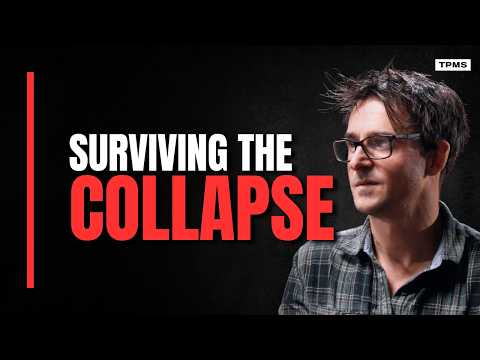
If Society Collapses, Cities Become Unliveable In 48 Hours | Prof Lewis Dartnell
Peter McCormack
Summary
Astrobiologist Lewis Dartnell breaks down the practical realities of restarting civilization after a global catastrophe. Emphasizing the immediate collapse of urban utilities, Dartnell demonstrates why survivors must relocate to rural areas with access to freshwater and timber. He reveals that a single supermarket provides over five decades of preserved nutrition, giving communities the time needed to establish food production. Sustaining technological recovery requires a minimum population of roughly 10,000 people to maintain specialized trade skills.
Dartnell showcases physical artifacts he fabricated from scratch, including a wood-burning gasifier stove that produces engine-ready combustible vapor, primitive silica glass made from beach sand, silver-emulsion photography, and a solar-powered e-reader holding thousands of technical guides. He argues that precision screw threads are the ultimate seed technology because they allow lathes to replicate other machine tools. Finally, he connects these recovery concepts to space exploration, outlining how in-situ resource utilization, regolith radiation shields, and cyanobacteria bio-fertilization could enable human survival on Mars.
How time-sensitive the topic is: Evergreen
By the numbers
55 years: Duration an average supermarket could keep one person alive on non-perishable food (Mentioned at 8:42)
63 years: Duration a supermarket sustains a person if canned dog and cat food are consumed (Mentioned at 8:50)
10000 people: Minimum viable community size suggested to maintain essential skills and division of labor (Mentioned at 9:52)
50 tools: Number of interconnected open-source tools within the Global Village Construction Set (Mentioned at 15:37)
1000000 vehicles: Estimated number of gasifier-powered vehicles running on wood gas in Europe during World War II (Mentioned at 38:42)
15 seconds: Exposure duration required for primitive silver photographic chemistry (Mentioned at 52:09)
10000 books: Volume of instructional titles loaded onto the solar-modified emergency e-reader (Mentioned at 1:00:04)
2 meters: Thickness of Martian regolith recommended to shield surface habitats against cosmic rays (Mentioned at 1:12:56)
Questions this video answers
How long can a single supermarket keep someone alive after society collapses?
An average supermarket contains enough canned and preserved calories to sustain an individual for roughly 55 years, or up to 63 years if canned pet food is utilized. This vast caloric stockpile gives small groups of survivors a prolonged buffer before they are forced to master agricultural farming.
8:14 to 10:30
From this keypoint: Supermarket Rations Provide a Multi-Decade Buffer
Why is a screw thread considered the most critical tool for restarting industry?
A precision screw thread provides the uniform pitch control required for building lathes, milling machines, and other shop equipment. Because machine tools replicate other machines, possessing a standardized screw thread bypasses centuries of trial-and-error hand filing.
23:14 to 27:29
From this keypoint: Screw Threads Act as Anchors for Machine Rebirth
Can ordinary cars run on alternative fuel without refined petroleum?
Vehicles can operate on combustible synthetic gases generated by the pyrolysis of timber inside wood gasification units. This technique saw widespread real-world adoption during fuel shortages in World War II, keeping more than one million European vehicles moving.
34:42 to 39:42
From this keypoint: Wood Gasification Keeps Transport Running Without Oil
How can human settlers survive cosmic radiation on Mars?
Mars lacks Earth's protective magnetic field and thick atmosphere, exposing surface structures to dangerous cosmic rays. Settlers can mitigate this hazard by heaping one to two meters of local Martian dirt and regolith directly over their habitats.
1:10:26 to 1:14:56
From this keypoint: Bootstrapping Human Habitats on Martian Regolith
Credible AI™ signals
Confidence: Rigorous Scientific Expertise. Lewis Dartnell grounds his analysis in practical chemistry, engineering history, and astrobiological research, demonstrating real-world replicas. Peter McCormack provides an engaged interview framework.
Bias: Pragmatic Technocentrism. The discussion adopts an empirical, problem-solving perspective centered on technological acceleration, material science, and survival pragmatism without overt political or ideological slant.
Originality (85%): Constructive Post-Apocalypse. Rather than lingering on catastrophic collapse tropes, the conversation focuses thoroughly on bootstrap manufacturing, scientific rediscovery, and foundational tools needed to rebuild civilization.
Depth (86%): Deep First-Principles Analysis. The dialogue unpacks complex manufacturing dependencies, tracing modern precision engineering, optical science, chemical synthesis, and off-world planetary colonization back to basic raw inputs.
Key points (12)
Short (22 min): key points 1, 3, 6, 8 and 12
Medium (38 min): key points 1, 2, 3, 4, 6, 8, 9, 10 and 12
Relaxed (50 min): all 12 key points
1. Escaping Cities to Establish Survival Baselines
Timestamp: 00:04:26 to 00:08:14 (4 min)
Modern urban centers are artificial habitats entirely reliant on automated municipal power, piped gas, and running water. In an apocalyptic breakdown, cities rapidly become unviable death traps due to infrastructure collapse and packs of feral animals. Moving to rural areas provides immediate access to arable soil, clean waterways, and wood supplies.
Impact: High. Why it matters: Reframes disaster preparedness from urban sheltering to rural self-sufficiency grounded in arable land and timber.
“You want to get out of the cities as quickly as possible because modern cities we all live in today are just bubbles of of artificiality.”
In the video: Lewis Dartnell, at 4:46
For: Lewis Dartnell, Peter McCormack
2. Supermarket Rations Provide a Multi-Decade Buffer
Timestamp: 00:08:14 to 00:10:30 (2 min)
An inventory assessment of standard grocery stores reveals vast reservoirs of non-perishable canned food. One supermarket contains enough shelf-stable nutrition to sustain a single survivor for 55 years, or 63 years if pet food is included. This surplus creates a valuable window to develop agricultural knowledge without immediate starvation.
Impact: Medium. Why it matters: Dispels the myth that societal collapse forces instantaneous farming on day one.
“The answer I came up with was an average supermarket could keep one person alive for 55 years or 63 years if you're happy to eat all the canned dog food”
In the video: Lewis Dartnell, at 8:41
For: Lewis Dartnell
Neutral: Peter McCormack
3. Rebuilding Demands a Critical Population Mass
Timestamp: 00:10:30 to 00:14:32 (4 min)
A population of at least 10,000 survivors is needed to maintain a resilient recovery rather than falling back into primitive hunter-gatherer existence. This demographic scale provides the occupational diversity needed for medical care, carpentry, metallurgy, and mechanical repair. Without specialized labor, a community loses the technical capacity to maintain complex machinery.
Impact: High. Why it matters: Identifies labor specialization as the non-negotiable minimum requirement for preserving civilizational knowledge.
For: Lewis Dartnell, Peter McCormack
4. Preserving Knowledge Across Fragile Social Structures
Timestamp: 00:14:32 to 00:19:02 (5 min)
Modern civilization is uniquely brittle because extreme technical specialization leaves ordinary citizens without fundamental survival competencies. Previous historical shocks like the Black Death allowed rapid recovery because populations maintained basic crafting and agrarian proficiencies. Modern continuity demands comprehensive reference compendiums, standardized toolsets, or interactive digital knowledge archives.
Impact: High. Why it matters: Exposes modern vulnerability where operational comfort conceals a complete absence of fundamental fabrication skills.
For: Lewis Dartnell, Peter McCormack
5. Dual-Use Dilemma of Foundational Technologies
Timestamp: 00:19:02 to 00:23:02 (4 min)
Any technological capability can be turned toward societal benefit or leveraged as a lethal weapon. Omitting destructive discoveries like chemical explosives from recovery archives would simultaneously cripple mining, civil quarrying, and land management. Preserving technical blueprints accelerates recovery across centuries, even if political and moral maturity cannot be easily fast-tracked.
Impact: Medium. Why it matters: Shows that scientific knowledge cannot be sanitized of dangerous applications without destroying industrial progress.
“technology. It gives you capability, allows you to do something which is useful and you could apply that to nefarious purposes or to, you know, wholesome beneficial purposes.”
In the video: Lewis Dartnell, at 19:30
For: Lewis Dartnell
Neutral: Peter McCormack
6. Screw Threads Act as Anchors for Machine Rebirth
Timestamp: 00:23:14 to 00:27:29 (4 min)
If forced to preserve only a single physical artifact to reboot technological industry, a standardized screw thread is the supreme choice. Precision lathes and workshop tools replicate themselves in an escalating cycle of mechanical capability, but generating that initial pitch from scratch requires painstaking refinement. A pristine screw thread allows immediate fabrication of lathes, milling apparatuses, and steam engines.
Impact: High. Why it matters: Pinpoints the mechanical root of precision manufacturing that underpins modern industrial engineering.
While small communal villages can operate through reputation and reciprocal bartering, advanced civil societies require money to price labor and specialized commodities. Standardized units of value eliminate friction and endless haggling across complex supply networks. Human progress is driven by a natural desire for labor-saving efficiency and economic incentive.
Impact: Medium. Why it matters: Validates medium-of-exchange mechanisms as an indispensable social technology for advanced civil coordination.
“money is just an incredibly useful app. Basically, a technology for putting a value on different people's labor, labor or produce, so you don't have to haggle each time.”
In the video: Lewis Dartnell, at 31:37
For: Lewis Dartnell, Peter McCormack
8. Wood Gasification Keeps Transport Running Without Oil
Timestamp: 00:34:42 to 00:39:42 (5 min)
Refined petroleum degrades rapidly after extraction infrastructure collapses, leaving internal combustion engines stranded without fuel. Gasification stoves and wood-gas generators convert solid timber through high-temperature pyrolysis into combustible synthetic gases like carbon monoxide and hydrogen. Over one million modified vehicles successfully ran across Europe on wood gas during wartime fuel shortages.
Impact: High. Why it matters: Demonstrates an accessible alternative fuel source capable of powering agricultural tractors and transit without petroleum.
“You can drive a car by burning wood rather than diesel or petrol.”
In the video: Lewis Dartnell, at 37:40
For: Lewis Dartnell
Neutral: Peter McCormack
9. Synthesizing Glass Enables the Scientific Method
Timestamp: 00:42:03 to 00:47:33 (6 min)
Scientific discovery stalls without physical glass because empirical observation requires inert, chemically non-reactive, and transparent laboratory apparatus. Sand, soda ash derived from seaweed or mineral flux, and limestone chalk can be smelted in high-heat kilns to fabricate rudimentary soda-lime glass. Shaping this material into optical lenses unlocks compound microscopes, which in turn proves germ theory and establishes sanitation standards.
Impact: High. Why it matters: Connects simple coastal mineral harvesting directly to microbiological discovery and massive reductions in mortality.
“Without glass, you can't build the basic tools for science to to observe and measure the world around you and then progress to a technologically advanced society.”
Movable type printing presses overcome the biological bottleneck of individual scribal copying, enabling the mass distribution of instructional knowledge. Fabricating handmade paper from fibrous pulp and mixing basic carbon ink allows the construction of a wooden press using cast metal letters. This self-replicating medium guarantees that recovered scientific manuals survive industrial collapse.
Impact: High. Why it matters: Establishes a mechanical mechanism to immunize technical learning against permanent loss.
“within the pages of this book it contains the instructions on how to make a book. So like the lathe this book the knowledge has got its own capability for reproduction”
In the video: Lewis Dartnell, at 54:31
For: Lewis Dartnell
Neutral: Peter McCormack
11. Solar Powered E-Readers Serve as Knowledge Compendiums
Timestamp: 00:58:27 to 01:02:27 (4 min)
While paper degrades over time through moisture and fire, solid-state electronic readers can compress tens of thousands of books into a portable hand-held format. Wiring scrap photovoltaic cells directly into an early generation e-reader creates a self-charging digital archive that functions off-grid. This device acts as an immediate instructional cache until physical printing presses are reassembled.
Impact: Medium. Why it matters: Offers a lightweight off-grid bridge connecting digital data storage with post-apocalyptic workshop manufacturing.
“I've loaded onto that a copy of my book, The Knowledge, and 9,999 other books which you might find useful. And if the battery ever gets flat, you'll notice on the outside of this cover, I've used some Scavenge solar panels”
In the video: Lewis Dartnell, at 1:00:00
For: Lewis Dartnell
Neutral: Peter McCormack
12. Bootstrapping Human Habitats on Martian Regolith
Timestamp: 01:10:26 to 01:14:56 (5 min)
Colonizing Mars requires in-situ resource utilization because hauling raw building materials out of Earth's gravity well is economically impossible. Surface settlers must excavate underground ice for drinking supplies and split water into breathable oxygen through electrolysis. Lethal cosmic radiation further dictates burying pressurized habitats under meters of Martian regolith to create radiation-shielded dwellings.
Impact: High. Why it matters: Translates terrestrial post-apocalyptic rebuilding principles directly to human survival on alien planets.
“you have your habitat and you basically just bury it with it with some kind of space JCB. You just pick up the regular from over here, pile on top of your habitat. So you've got a meter ideally near or 2 m of of stuff between you and the radiation”
In the video: Lewis Dartnell, at 1:12:45
For: Lewis Dartnell
Neutral: Peter McCormack
Conflicts of interest (2)
Dartnell Book Promotion
Commercial conflict, Low severity
Lewis Dartnell discusses and promotes his published books The Knowledge and Origins alongside his upcoming book Ingenious.
Sources: Lewis Dartnell
Significance: The conversation serves as an educational showcase that directly supports commercial interest in Dartnell's written works.
Commercial Episode Sponsorships
Commercial conflict, Low severity
Peter McCormack features paid promotions for IREN, Quo, and Arch Public during the broadcast.
Sources: Peter McCormack
Significance: Mid-roll commercial announcements provide operational revenue for the podcast production.
Key sources
Lewis Dartnell: Astrobiologist and Professor of Science Communication at the University of Westminster
Peter McCormack: Podcast Host
Who's in this
University of Westminster
Dave Gingery
Alexander Fleming
Sainsbury's
Kindle
Mars
Also mentioned
The Knowledge: How to Rebuild Our World from Scratch (First mentioned at 1:50)
Ingenious (First mentioned at 1:19:08)
This analysis was generated by skim (skim.plus), an AI-powered content analysis platform by Credible AI. Scores and classifications represent the platform's AI-generated assessment and should be considered alongside other sources.