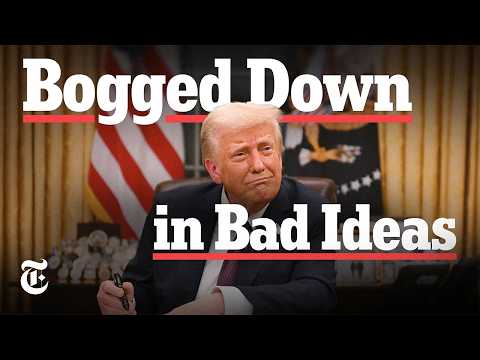
The Ezra Klein Show's Is Trump Running Out of Steam? | The Ezra Klein Show: skim's analysis identifies 11 key moments, with 1 potential conflict of interest flagged. New York Times correspondent Maggie Haberman joins Ezra Klein to examine the second year of Donald Trump's second term, drawing on her book Regime Change, co-authored with Jonathan Swan.
Category: Politics. Format: Interview. YouTube video analyzed by skim.
skim AI Analysis
Credibility assessment: Deeply Sourced Reporting. Maggie Haberman draws on extensive direct reporting, Oval Office interviews, and Situation Room accounts compiled for her book with Jonathan Swan. Claims about internal White House dynamics are carefully attributed, and she explicitly distinguishes her own interpretive judgments from documented events.
Bias assessment: Critical Institutionalist Lens. Both Ezra Klein and Maggie Haberman evaluate the administration through the lens of traditional governance norms, viewing unilateral executive actions, self-dealing, and the erosion of interagency processes with clear skepticism while still acknowledging where Trump's base feels satisfied.
Originality: 88% — Rich Insider Reporting. The conversation surfaces specific, granular scenes from Haberman and Jonathan Swan's book reporting, including a February 11 Situation Room meeting with Benjamin Netanyahu, internal clashes over Iran regime-change scenarios, and Trump's mid-meeting call to Emmanuel Macron about building an arch.
Depth: 86% — Nuanced Structural Analysis. Rather than treating the administration as a monolith, the discussion dissects the competing factions among aides, the mechanics of Trump's isolated information environment, and the structural reasons congressional oversight and media scrutiny no longer produce traditional political consequences.
Key Points (11)
1. Haberman on Unilateral Action vs. Fresh Chaos
Timestamp: 00:01:32 to 00:04:55
Ezra Klein suggests the Trump administration has lost steam in its second year, trapped by its own early decisions on trade and Iran. Maggie Haberman counters that while Elon Musk's DOGE effort failed to transform government, unilateral actions like shutting down USAID, firing inspectors general, and Stephen Miller's orders on DEI and the border satisfied core voters. However, launching a new trade war alongside combat in Iran exposes a fundamental lack of strategy.
Significance (High): Reframes the administration's second-year struggles not as simple exhaustion, but as the predictable collision of impulsive unilateral governance with complex geopolitical and economic realities.
Sources in support: Maggie Haberman (White House Correspondent, The New York Times; Co-author of Regime Change), Ezra Klein (Host, The Ezra Klein Show at The New York Times)
2. Assassination Plots and the Decision on Iran
Timestamp: 00:05:01 to 00:11:27
Trump's hostility toward Iran hardened during his four years out of power following the indictment of a Pakistani man in an alleged Iranian murder-for-hire plot, the Butler assassination attempt, and the hacking of Susie Wiles's emails. On February 11, Benjamin Netanyahu pitched regime change in the Situation Room, which CIA Director John Ratcliffe called farcical and Marco Rubio dismissed with an expletive.
Significance (High): Reveals that the war with Iran stemmed from a mix of personal grievance over threats to Trump's life and overconfidence from prior skirmishes, overriding explicit intelligence warnings from his own CIA director and Secretary of State.
Sources in support: Maggie Haberman (White House Correspondent, The New York Times; Co-author of Regime Change), Ezra Klein (Host, The Ezra Klein Show at The New York Times)
3. Epstein Files Expose Fissures in the MAGA Base
Timestamp: 00:11:27 to 00:16:15
Ezra Klein argues that there is no coherent Trumpism doctrine, only Trump's shifting impulses. Haberman agrees that pinning an ideology on him is futile, noting that MAGA is an uncomfortable coalition only he can unite, though fissures emerged when Trump resisted releasing the Jeffrey Epstein files.
Significance (Medium): Identifies the exact limit of Trump's ideological control over his movement: when he tried to bury the Epstein files after years of MAGA transparency promises, even loyalist lawmakers broke ranks.
Sources in support: Maggie Haberman (White House Correspondent, The New York Times; Co-author of Regime Change), Ezra Klein (Host, The Ezra Klein Show at The New York Times)
4. Haberman Details Trump's Information Bubble
Timestamp: 00:16:18 to 00:22:27
Second-term decision-making is restricted to roughly half a dozen aides in the room with Trump, sidelining the National Security Council interagency process. Trump relies heavily on Truth Social, uncritical Fox News coverage, and aide Natalie Harp, known as the human printer, who feeds him flattering clips and Google searches to counter official economic briefings from advisers like Howard Lutnick.
Significance (High): Shows how dismantling the traditional National Security Council and briefing structure leaves presidential decisions vulnerable to whoever walks into the Oval Office last with a printout.
Sources in support: Maggie Haberman (White House Correspondent, The New York Times; Co-author of Regime Change), Ezra Klein (Host, The Ezra Klein Show at The New York Times)
5. Unprecedented Self-Dealing and Moral Hazard
Timestamp: 00:22:27 to 00:28:07
Despite an unpopular trade war struck down by the Supreme Court, a collapsed DOGE effort, and no clear legislative agenda, Trump feels insulated from political fallout. He has accumulated more liquid wealth than ever from an industry he regulates through a company run by his sons and his special envoy's sons. Having survived near-bankruptcy in 1991, four indictments, and the Butler shooting, and armed with Supreme Court immunity and pardon powers, he believes everything always works out for him.
Significance (High): Explains why dismal polling and policy setbacks fail to alter Trump's behavior: personal enrichment, legal immunity, and a lifetime of escaping consequences insulate him from his party's electoral fate.
Sources in support: Maggie Haberman (White House Correspondent, The New York Times; Co-author of Regime Change), Ezra Klein (Host, The Ezra Klein Show at The New York Times)
6. Why Corruption Stories Slide Off Trump
Timestamp: 00:28:07 to 00:38:03
Republicans privately concede the administration's corruption is unprecedented, including plans to sell advance notice of market-moving Truth Social posts for roughly $100,000, yet scandals fail to stick. Haberman attributes this to partisan media silos, the firing of inspectors general, public fatigue from years of investigations, and a House GOP that treats Trump like a celebrity tossing Hershey bars on Air Force One.
Significance (High): Demonstrates how the collapse of congressional checks and independent watchdogs prevents investigative journalism from triggering the accountability mechanisms that toppled officials in past administrations.
Sources in support: Maggie Haberman (White House Correspondent, The New York Times; Co-author of Regime Change), Ezra Klein (Host, The Ezra Klein Show at The New York Times)
7. Governing by Executive Fiat Over Legislation
Timestamp: 00:38:03 to 00:42:08
Aside from passing the one big beautiful bill affecting Medicaid and food stamps, Congress acts as a supplicant under Speaker Mike Johnson with no real legislative agenda. Rather than pursuing durable statutory changes on tariffs, immigration, or civil service reform, Stephen Miller spent four years mapping how to stretch executive branch authority and fight in the courts. Meanwhile, internal factions led by Russ Vought, Elon Musk, and Miller often clashed in their methods.
Significance (Medium): Highlights the structural fragility of Trump's second-term domestic agenda: by bypassing Congress in favor of speed and court battles, most policies remain vulnerable to reversal by a future president.
Sources in support: Maggie Haberman (White House Correspondent, The New York Times; Co-author of Regime Change), Ezra Klein (Host, The Ezra Klein Show at The New York Times)
8. Haberman on Who Holds Power in the Cabinet
Timestamp: 00:42:08 to 00:47:07
Influence inside the administration shifts rapidly, with Marco Rubio largely staying clear of the Iran war while Susie Wiles and Stephen Miller remain deeply powerful. After the killings of Renee Goodale and Alex Preddy in Minnesota, ICE halted flashy helicopter raids in favor of traffic stops, and Miller lowered daily arrest targets from 3,000 to 2,000 while still aggressively pushing enforcement.
Significance (Medium): Clarifies the true hierarchy inside the White House, debunking reports that Stephen Miller lost influence after the Minnesota shootings and showing how Pete Hegseth maintains standing.
Sources in support: Maggie Haberman (White House Correspondent, The New York Times; Co-author of Regime Change)
Neutral sources: Ezra Klein (Host, The Ezra Klein Show at The New York Times)
9. Spectacle, Visuals, and the Mamdani Meetings
Timestamp: 00:47:07 to 00:52:35
The administration both makes decisions and communicates through visual spectacle, creating a self-reinforcing loop. Pete Hegseth sent boat strike videos to Trump, Stephen Miller used photos of an assaulted DOGE worker to spur deploying the National Guard to DC, and Steven Cheung sets strike videos to video game music or songs by protesting artists. In contrast to his aggressive public persona, Trump avoids one-on-one conflict and has charmed and been charmed by Mayor Mamdani in private meetings.
Significance (Medium): Illustrates how governing through visual spectacle replaces deliberative thought with instant emotional reaction, while exposing the sharp divide between Trump's online belligerence and his conciliatory private manner.
Sources in support: Maggie Haberman (White House Correspondent, The New York Times; Co-author of Regime Change), Ezra Klein (Host, The Ezra Klein Show at The New York Times)
10. Evaluating Trump's Age and Physical Health
Timestamp: 00:52:35 to 00:55:23
Asked whether age is slowing Trump down, Haberman notes that while his speech is slower and more repetitive than in 2016, she saw no signs of dementia during an hour-long Oval Office interview on March 16, finding him instead more purely focused on payback and renovations.
Significance (Medium): Separates partisan rumors of cognitive decline from documented physical health concerns and medical opacity surrounding an 80-year-old president.
Sources in support: Maggie Haberman (White House Correspondent, The New York Times; Co-author of Regime Change)
Neutral sources: Ezra Klein (Host, The Ezra Klein Show at The New York Times)
11. Why Renovations Consume 70% of Trump's Mindshare
Timestamp: 00:55:23 to 01:01:02
Haberman estimates that roughly 70% of Trump's mental energy goes toward White House renovations, including tearing into the East Wing, planning a ballroom, remodeling the Kennedy Center, and designing a triumphal arch. Rather than policy achievements, he views permanent physical monuments as a way to ensure he can never be erased or deplatformed, even interrupting a meeting to call French President Emmanuel Macron about the Arc de Triomphe.
Significance (High): Captures the core motivation of Trump's final term: abandoning traditional domestic policy-making in favor of physical monuments designed to cement him as a great man of history.
Sources in support: Maggie Haberman (White House Correspondent, The New York Times; Co-author of Regime Change), Ezra Klein (Host, The Ezra Klein Show at The New York Times)
This analysis was generated by skim (skim.plus), an AI-powered content analysis platform by Credible AI. Scores and classifications represent the platform's AI-generated assessment and should be considered alongside other sources.