The America That's Still Possible | The Ezra Klein Show
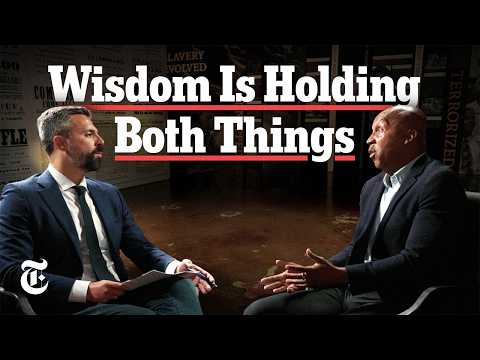
Stevenson: The Courage to Hold History's Totality
Bryan Stevenson reflects on his relationship with America, shaped by his work in Montgomery. He argues that true wisdom lies in the ability to hold the totality of life, including both horror and beauty, tragedy and triumph. This approach is crucial for creating a history that doesn't trap people in pain but also avoids an imagined glory, fostering solidarity rather than division.
Stevenson: Pride Through Progress, Not Denial
Stevenson argues that genuine pride in America comes not from ignoring its past but from achieving progress and overcoming challenges, citing college football in Alabama as an analogy. He contends that embracing the struggle for civil rights and integration, which led to shared triumphs, demonstrates how overcoming bigotry can unlock greater collective achievement and pride.
Stevenson: The Transatlantic Slave Trade's Human Cost
The Legacy Museum's exhibit on the transatlantic slave trade powerfully visualizes the immense human cost, highlighting the millions who died during the crossing and the profound loss of identity and culture. Stevenson shares a personal experience on a Lagos beach, realizing the ocean's role in separating him from his heritage, underscoring the unprecedented scale of this historical trauma.
Stevenson: The Narrative Justifying Enslavement
Stevenson explains that the horrific acts of enslavement were sustained by a 'false narrative' that dehumanized enslaved people, allowing enslavers to perceive themselves as moral. This narrative of racial difference, originating from the treatment of Indigenous peoples, was used to justify centuries of slavery and continues to echo in contemporary societal biases.
The Corrosive Effect of Injustice on Perpetrators
Enslaving another human being, participating in lynching, or enforcing segregation is not only harmful to the victim but also corrupts the heart and soul of the perpetrator, limiting their capacity for love and creating an unhealthy relationship with life. This suggests that liberation from injustice is a process that benefits everyone involved.
The Founding Fathers' Moral Compromise
Many Founding Fathers recognized slavery as a moral horror but did not abolish it or free their own slaves, creating a profound contradiction at the nation's inception. This failure to act on their knowledge, driven by the difficulty and cost of confronting the truth, serves as a warning that greatness without completeness is unhealthy and misleading.
Humanity Beyond Particulars
Understanding the harms of slavery, lynching, and segregation should lead to a universal intolerance for abuse of power and exploitation, rather than seeking personal exoneration. Recognizing the humanity of every person, regardless of their role in history, is key to moving past division and toward a more just society.
Bryan Stevenson: The Power of Enduring Love
The true narrative of slavery isn't just about the horrors endured, but about the profound resilience, strength, and capacity for love demonstrated by enslaved people. This perspective is crucial for understanding their humanity and celebrating their survival, offering a more complete picture than focusing solely on abolitionist heroes.
Klein: The Impact of Family Separation
The profound impact of slavery is vividly illustrated by the narratives of enslaved people's commitments to their families, even when facing separation. The stories of children trying to break chains or families being torn apart reveal the deep emotional toll and the systemic cruelty of the institution.
Stevenson: The True Heroes of Abolition
The primary heroes of the anti-slavery movement were not solely the abolitionists, but the millions of enslaved people who maintained their humanity, dignity, and hope over centuries of brutal oppression. Their endurance and resistance were the most powerful forces driving abolition.
Stevenson: Faith's Corruptibility and Power
Christianity, when wielded by those with power and privilege, can become corrupt and used to justify oppression, as seen in the defense of slavery and segregation. However, true faith, rooted in justice and mercy, empowers individuals to challenge injustice and work towards a better future, even when it's difficult.
Klein: Order vs. Justice in Social Movements
Social movements that seek to reorder oppressive systems are often labeled as 'agitators' by those who benefit from the status quo, who prioritize 'harmony' and 'order' over justice. This framing can obscure the true nature of the struggle for equality.
Stevenson: The Exhaustion of Injustice
The continuous navigation of racial prejudice, presumption of guilt, and systemic incompetence is profoundly exhausting, mirroring the weariness felt during the Civil Rights Movement. This exhaustion fuels the demand for immediate freedom and justice, necessitating fundamental societal change.
Stevenson: The Era of Truth and Repair
Achieving true justice requires a long-term commitment to an 'era of truth and repair,' extending beyond short-term actions. This involves systematically confronting historical injustices, acknowledging suffering, and actively working towards reconciliation and restoration.
The Superficiality of the 2020 Reckoning
Bryan Stevenson argues that the 2020 social justice movements, while significant, were too easily embraced by corporations and the public without requiring genuine, difficult work or acknowledgment of past harms. He suggests that the lack of deep commitment and the ease with which people could 'claim something' led to a backlash and an inability to sustain momentum, contrasting it with the brutal conditions faced by activists on the Edmund Pettus Bridge.
The Necessity of Truth and Reconciliation
Stevenson emphasizes that achieving a better future requires acknowledging difficult truths, such as the legacy of slavery and lynching violence. He likens this process to confession and repentance in a faith tradition, arguing that truth-telling is a sequential and essential step before repair and reconciliation can occur. Skipping this foundational step, he warns, leads to mistakes and prevents genuine redemption.
Stevenson: True Greatness is Love and Mercy
Bryan Stevenson redefines greatness not by military might, innovation, or wealth, but by humanity's capacity to love, show mercy, care for the vulnerable, and unlock opportunities for the burdened. He argues that societies built on power and intimidation are unsustainable, while those that prioritize human connection and justice endure.
Choosing America: A Responsibility, Not a Litmus Test
Stevenson reframes the question of 'loving America' as potentially inappropriate, likening it to asking a parent to choose a favorite child. As an American, he feels an obligation to all its people, especially those who fought for his right to be one. He highlights the perseverance of emancipated slaves as a prime example of true American spirit, demonstrating commitment despite threats and abuse.