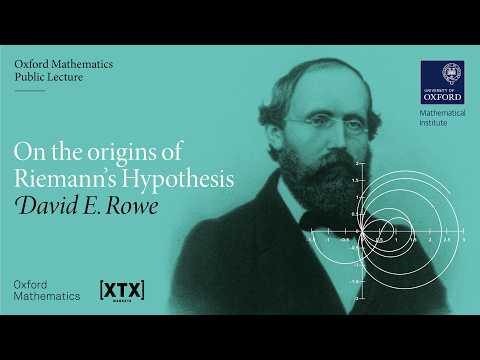
Oxford Mathematics's On the origins of Riemann’s Hypothesis - David E Rowe: skim's analysis identifies 9 key moments. Historian David E.
Category: Science. Format: Educational. YouTube video analyzed by skim.
skim AI Analysis
Credibility assessment: Primary Archival Scholarship. David E. Rowe builds his historical case on primary documents, including unpublished correspondence from Bernhard Riemann to Johann Franz Encke, library borrowing logs from Göttingen, Carl Friedrich Gauss's 1849 letter, and a 1927 manuscript by Carl Ludwig Siegel, while openly correcting an error in his own earlier book.
Bias assessment: Archival Historian Lens. The lecture favors historical context and documentary provenance over modern mathematical exposition, arguing that Peter Gustav Lejeune Dirichlet and Pafnuty Chebyshev rather than Carl Friedrich Gauss drove Bernhard Riemann's 1859 paper, while treating competing views fairly.
Originality: 90% — Unpublished Archival Finds. David E. Rowe presents newly uncovered archival material, notably Bernhard Riemann's unpublished October 19, 1859 letter to Johann Franz Encke and Carl Ludwig Siegel's 1927 handwritten birthday manuscript for Max Dehn, overturning a prior assumption in Rowe's own published work.
Depth: 88% — Detailed Documentary Forensics. By cross-referencing Göttingen library borrowing records from February 1856, undated notes in Bernhard Riemann's Nachlass, and dated correspondence with Berlin Academy secretary Johann Franz Encke, the lecture reconstructs the exact timeline and mathematical motivation behind the 1859 prime-counting paper.
Key Points (9)
1. Rowe outlines the reception of the 1859 paper
Timestamp: 00:01:51 to 00:06:09
David E. Rowe explains that while G. H. Hardy, John Edensor Littlewood, and David Hilbert made the Riemann hypothesis famous, Bernhard Riemann's 8-page November 1859 Berlin Academy paper is rarely read today. He notes that G. H. Hardy proved infinitely many zeros lie on the critical line, yet the original paper had broader aims.
Significance (Medium): Separating 20th-century reception history from Bernhard Riemann's 1859 text reframes the famous conjecture as a byproduct of a wider investigation.
Sources in support: David E. Rowe (Professor Emeritus for History of Mathematics and Natural Sciences, Johannes Gutenberg University in Mainz)
2. Why Dirichlet outranked Gauss in guiding Riemann
Timestamp: 00:06:09 to 00:09:24
Examining the opening of the 1859 paper, David E. Rowe highlights Bernhard Riemann's reference to Carl Friedrich Gauss and Peter Gustav Lejeune Dirichlet alongside Leonhard Euler and Carl Wolfgang Benjamin Goldschmidt. Rowe argues that Dirichlet, rather than nominal advisor Gauss, is the key figure behind Riemann's prime work.
Significance (High): Challenging the standard myth of direct mentorship from Carl Friedrich Gauss redirects credit toward Peter Gustav Lejeune Dirichlet's analytic methods.
Sources in support: David E. Rowe (Professor Emeritus for History of Mathematics and Natural Sciences, Johannes Gutenberg University in Mainz)
3. Riemann's schooling and early Göttingen physics
Timestamp: 00:09:24 to 00:15:15
Originally expected to follow his Lutheran pastor father into the clergy, Bernhard Riemann excelled in mathematics as a teenager while struggling with required language essays. At Göttingen, he learned little higher math from Carl Friedrich Gauss and instead gravitated toward physicist Wilhelm Weber's geomagnetism work before moving to Berlin.
Significance (Low): Tracing Bernhard Riemann's early attraction to Wilhelm Weber's physics and his move to Berlin explains why Göttingen's applied curriculum could not sustain his pure mathematics.
Sources in support: David E. Rowe (Professor Emeritus for History of Mathematics and Natural Sciences, Johannes Gutenberg University in Mainz)
4. Encke's 1849 letter prompts Gauss on primes
Timestamp: 00:15:15 to 00:19:21
In Berlin, Bernhard Riemann took courses with Peter Gustav Lejeune Dirichlet, Carl Gustav Jacob Jacobi, and astronomer Johann Franz Encke during the 1848 revolution. After hearing Dirichlet lecture on divisors, Encke wrote to Carl Friedrich Gauss in 1849 comparing Adrien-Marie Legendre's prime formula with his own calculations.
Significance (Medium): Johann Franz Encke's 1849 letter to Carl Friedrich Gauss catalyzed the written record of Gauss's empirical prime-counting work.
Sources in support: David E. Rowe (Professor Emeritus for History of Mathematics and Natural Sciences, Johannes Gutenberg University in Mainz)
5. Intellectual distance between Gauss and Riemann
Timestamp: 00:19:21 to 00:28:01
Carl Friedrich Gauss replied to Johann Franz Encke in December 1849 recalling his prime studies since 1792, a letter Bernhard Riemann later copied in October 1859 and helped publish in 1863. David E. Rowe shows through doctoral records and a letter to Riemann's brother that Gauss remained distant and never guided Riemann's dissertation.
Significance (High): Establishing that Carl Friedrich Gauss and Bernhard Riemann rarely discussed research proves Riemann could not have learned of the 1849 prime letter directly from Gauss.
Sources in support: David E. Rowe (Professor Emeritus for History of Mathematics and Natural Sciences, Johannes Gutenberg University in Mainz)
6. Rowe corrects his book on Gauss's prime tables
Timestamp: 00:28:01 to 00:34:50
In his December 1849 letter, Carl Friedrich Gauss described using Ladislaus Chernac's 1811 Cribrum factor tables and Carl Wolfgang Benjamin Goldschmidt's calculations up to 3 million to show the logarithmic integral overpredicts primes. David E. Rowe admits his own prior book was wrong to assume this table motivated Bernhard Riemann's refinement.
Significance (High): David E. Rowe's candid correction shows that Bernhard Riemann developed his prime-counting refinement independently of Carl Friedrich Gauss's 1849 numerical comparisons.
Sources in support: David E. Rowe (Professor Emeritus for History of Mathematics and Natural Sciences, Johannes Gutenberg University in Mainz)
7. Why Riemann set aside his own zeta conjecture
Timestamp: 00:34:50 to 00:40:49
Bernhard Riemann extended Leonhard Euler's zeta product formula to complex numbers via a functional equation and conjectured that all roots of his transformed function at real part 1/2 are real. He set a strict proof aside after fleeting attempts as dispensable for his main goal: refining the prime-counting formula using prime powers and zeta roots.
Significance (High): Reading Bernhard Riemann's exact words reveals that the Riemann hypothesis was an auxiliary observation inside an explicit formula for counting primes.
Sources in support: David E. Rowe (Professor Emeritus for History of Mathematics and Natural Sciences, Johannes Gutenberg University in Mainz)
8. 1856 library logs and the unpublished Encke letter
Timestamp: 00:40:49 to 00:46:01
David E. Rowe presents Göttingen library logs showing that in February 1856, after Peter Gustav Lejeune Dirichlet succeeded Carl Friedrich Gauss, Bernhard Riemann borrowed volumes 4 and 17 of Liouville's journal containing Dirichlet's and Pafnuty Chebyshev's prime papers. An unpublished October 19, 1859 letter to Johann Franz Encke confirms Riemann only just read Gauss's 1849 letter when submitting his paper.
Significance (High): Library borrowing records and the newly discovered 1859 letter to Johann Franz Encke anchor Bernhard Riemann's work in Peter Gustav Lejeune Dirichlet's and Pafnuty Chebyshev's research.
Sources in support: David E. Rowe (Professor Emeritus for History of Mathematics and Natural Sciences, Johannes Gutenberg University in Mainz)
9. Siegel's 1927 manuscript on Riemann's Nachlass
Timestamp: 00:46:01 to 00:51:08
An 1892 excerpt of Bernhard Riemann's letter to Karl Weierstrass revealed his theorems rested on an unsimplified series expansion. David E. Rowe shows an unpublished 10-page 1927 birthday manuscript by Carl Ludwig Siegel for Max Dehn reconstructing this formula from Riemann's Nachlass, five years before Siegel's 1932 publication.
Significance (Medium): Carl Ludwig Siegel's 1927 manuscript demonstrates how Bernhard Riemann's private scratch notes contained deep analytic methods decades ahead of his contemporaries.
Sources in support: David E. Rowe (Professor Emeritus for History of Mathematics and Natural Sciences, Johannes Gutenberg University in Mainz)
This analysis was generated by skim (skim.plus), an AI-powered content analysis platform by Credible AI. Scores and classifications represent the platform's AI-generated assessment and should be considered alongside other sources.