The lecture begins by summarizing the dynamics of systems of particles, highlighting that the rate of change of linear momentum (P) is equal to the sum of external forces, and introducing the concept of angular momentum (Lp) about an arbitrary point P.
Newton's Third Law and Force Cancellation
The lecture emphasizes how Newton's third law (Fij = -Fji) leads to the cancellation of internal forces when summing torques about a point, simplifying the expression for the rate of change of angular momentum.
Simplified Angular Momentum Equation
After accounting for internal force cancellations and defining the external torque (τp), the equation for the rate of change of angular momentum simplifies to Lp dot = -x dot cross P + τp_external, highlighting the influence of external torques and the motion of the reference point P.
Under a central force, specifically an inverse square law like gravity, a particle's trajectory is a conic section (ellipse, parabola, or hyperbola), determined by the conserved angular momentum and energy. This is derived by transforming the radial equation into a differential equation for u=1/r, which yields a solvable form.
Moulton: Systems of Particles and Center of Mass
For a system of N particles, the center of mass (G) moves according to Newton's second law as if it were a single particle with the total mass, acted upon only by the sum of external forces. Internal forces between particles cancel out due to Newton's third law, simplifying the analysis of complex systems.
Moulton: The Need for Rotational Dynamics
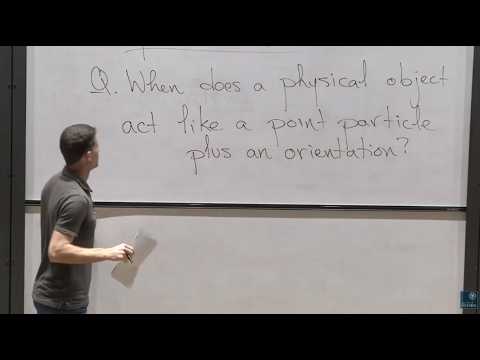
Describing the motion of rigid bodies requires more than just tracking the center of mass; their orientation and rotation must also be accounted for. This necessitates the introduction of concepts like angular momentum and the study of rotations, which go beyond simple translational dynamics.