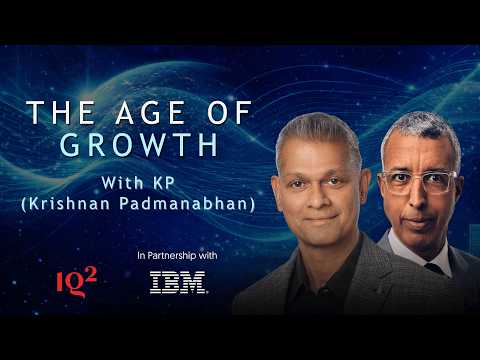
Intelligence Squared's Retail Banking in the Age of Intelligence: skim's analysis identifies 12 key moments, with 1 potential conflict of interest flagged. IBM executive Krishnan Padmanabhan and host Kamal Ahmed examine how artificial intelligence is transitioning from experimental proofs of concept to the core operating system of UK retail banking.
Category: Tech. Format: Interview. YouTube video analyzed by skim.
skim AI Analysis
Credibility assessment: Executive Industry Perspective. Krishnan Padmanabhan brings direct operational expertise from managing major UK bank accounts at IBM, offering concrete architectural explanations of banking AI layers and UK regulatory frameworks. However, the episode is co-produced by IBM and relies on single-source executive commentary without independent verification of client claims.
Bias assessment: Enterprise Tech Optimism. Sponsored by IBM and featuring an IBM executive, the discussion naturally favors enterprise AI adoption, framing challenges like job displacement, token costs, and regulatory risk as manageable hurdles on the path to an inevitable technological transformation.
Originality: 72% — Practical Banking Breakdown. While the broader themes of agentic AI and hyper-personalization are familiar across tech commentary, the specific breakdown of the three-layer banking AI cake, UK Data Use and Access Act implications, and refinement-induced friction offer grounded industry insight.
Depth: 75% — Architectural And Regulatory. The conversation moves beyond surface-level hype to dissect how machine learning, generative AI, and agentic systems divide labor in retail banking, while weighing UK Material Risk Taker accountability and data infrastructure bottlenecks.
Key Points (12)
1. Reasoning and English coding drive AI shift
Timestamp: 00:02:44 to 00:05:46
Krishnan Padmanabhan argues that enterprise AI represents a profound shift because computers have moved beyond record-keeping, deterministic automation, and customer self-service into reasoning. Combined with English becoming the new programming language and an exponential adoption curve three years in, barriers to building impactful systems have dropped. Consequently, far more people can participate in creating technology at a rapid pace.
Significance (High): Lowering programming barriers to plain English while adding machine reasoning accelerates how quickly banks can prototype and deploy enterprise software.
Sources in support: Krishnan Padmanabhan (Managing Client Partner for a major UK bank & UK/Ireland Financial Services Digital Transformation Lead, IBM)
Neutral sources: Kamal Ahmed (Host, The Age To Come & Executive Editor Director of Fortune in Europe)
2. AI spans front, mid, and back offices
Timestamp: 00:05:47 to 00:07:51
Unlike digital banking, which only changed customer interaction, or cloud computing, which altered infrastructure and accounting from CapEx to OpEx, AI cuts across every part of a bank. Padmanabhan observes a 2025 stampede of proofs of concept spanning front, mid, and back offices across technology and business teams. Furthermore, agentic systems bring depth by completing transactions almost autonomously.
Significance (Medium): Because AI touches every operational tier rather than just infrastructure or interfaces, banks must coordinate transformation across the entire enterprise.
Sources in support: Krishnan Padmanabhan (Managing Client Partner for a major UK bank & UK/Ireland Financial Services Digital Transformation Lead, IBM)
Neutral sources: Kamal Ahmed (Host, The Age To Come & Executive Editor Director of Fortune in Europe)
3. Unstructured data revives local branch context
Timestamp: 00:07:52 to 00:10:00
Hyper-personalization has long eluded retail banks because the personal context once held by local branch managers was lost during digitization. Padmanabhan explains that this context still exists inside unstructured call center transcripts and transaction records. Virtual agents equipped to harness unstructured data can reconstruct customer needs and restore intimate one-to-one service at scale.
Significance (High): Unlocking unstructured call and transaction data allows massive retail banks to replicate the contextual awareness of a traditional neighborhood branch manager.
Sources in support: Krishnan Padmanabhan (Managing Client Partner for a major UK bank & UK/Ireland Financial Services Digital Transformation Lead, IBM)
Neutral sources: Kamal Ahmed (Host, The Age To Come & Executive Editor Director of Fortune in Europe)
4. LLMs and agents fix clunky bank chatbots
Timestamp: 00:10:01 to 00:12:14
Krishnan Padmanabhan divides chatbots into an outward-facing intent recognition half and an inward-facing fulfillment half. Early chatbots frustrated users because syntactic natural language processing relied on keywords and mapped requests to 20 or 50 deterministic mobile APIs. Replacing syntactic NLP with semantic LLMs and pairing them with guarded agent swarms will eventually allow chatbots to understand conversations and fulfill tasks end-to-end.
Significance (High): Separating semantic intent recognition from guarded agentic fulfillment explains why customer-facing autonomous bank bots will deploy gradually rather than overnight.
Sources in support: Krishnan Padmanabhan (Managing Client Partner for a major UK bank & UK/Ireland Financial Services Digital Transformation Lead, IBM)
Neutral sources: Kamal Ahmed (Host, The Age To Come & Executive Editor Director of Fortune in Europe)
5. Three-layer AI cake spots financial stress
Timestamp: 00:13:07 to 00:15:55
Delivering proactive customer care requires a three-layer architecture rather than agentic AI alone. Traditional machine learning forms the top layer to trap event triggers cheaply and with low latency, generative AI forms the middle layer to analyze spending ratios and history, and agentic AI executes the action. Together, these layers can spot rising non-discretionary spend and empathetically offer a reliable customer a three-to-four-month mortgage payment holiday.
Significance (High): Combining cheap machine learning triggers with generative analysis gives banks a practical blueprint to intervene empathetically before a customer defaults.
Sources in support: Krishnan Padmanabhan (Managing Client Partner for a major UK bank & UK/Ireland Financial Services Digital Transformation Lead, IBM), Kamal Ahmed (Host, The Age To Come & Executive Editor Director of Fortune in Europe)
6. Material Risk Takers balance speed and safety
Timestamp: 00:15:57 to 00:19:01
As banks transition from 2024 proofs of concept to doubling down on resources in 2026, senior leaders face tension between competitive pace and regulatory safety. Padmanabhan notes that banking executives are designated Material Risk Takers (MRTs) who carry personal liability if deployments go wrong. Scaling safely requires business, technology, and risk teams to co-create central platforms with strict guardrails while allowing decentralized teams to build use cases.
Significance (High): Personal regulatory liability for senior bank executives ensures AI governance cannot be sidelined in the rush to deploy new tools.
Sources in support: Krishnan Padmanabhan (Managing Client Partner for a major UK bank & UK/Ireland Financial Services Digital Transformation Lead, IBM), Kamal Ahmed (Host, The Age To Come & Executive Editor Director of Fortune in Europe)
7. UK Data Act shifts burden of explanation to banks
Timestamp: 00:20:40 to 00:23:59
Following Brexit, the UK diverged from the EU's more prescriptive AI rules by passing the 2025 Data Use and Access Act, enforced in 2026. Padmanabhan explains that the law unlocks automated decision-making for banks while shifting the burden from customer discovery to bank explanation. Generative AI can fulfill this mandate at scale by translating algorithmic metrics like debt-to-income ratios and 92% credit card utilization into plain-language guidance on how to qualify for a rejected loan.
Significance (High): Using generative AI to translate mathematical credit rejections into actionable financial steps turns a regulatory mandate into a customer service upgrade.
Sources in support: Krishnan Padmanabhan (Managing Client Partner for a major UK bank & UK/Ireland Financial Services Digital Transformation Lead, IBM), Kamal Ahmed (Host, The Age To Come & Executive Editor Director of Fortune in Europe)
8. Clawbacks and customer choice govern human touch
Timestamp: 00:24:00 to 00:27:56
Under FCA and PRA rules, accountability for AI errors cannot be federated out; it remains concentrated with the bank and Material Risk Takers, who face compensation clawbacks if failures occur. Regarding when humans step into customer interactions, Padmanabhan argues banks must let customers choose their channel rather than imposing a one-size-fits-all model. Kamal Ahmed adds that research shows customers sometimes prefer discussing embarrassing debt problems with an AI rather than a human.
Significance (Medium): Preserving customer choice between human and AI channels accommodates both grieving relatives seeking empathy and indebted borrowers seeking judgment-free help.
Sources in support: Krishnan Padmanabhan (Managing Client Partner for a major UK bank & UK/Ireland Financial Services Digital Transformation Lead, IBM), Kamal Ahmed (Host, The Age To Come & Executive Editor Director of Fortune in Europe)
9. Data silos and token friction hamper AI scaling
Timestamp: 00:28:45 to 00:31:30
Padmanabhan identifies four factors governing how banks scale AI in 2026: evolving central guardrails, cleaning up neglected data silos from earlier digital transformations, establishing a prioritized roadmap, and managing cost. He highlights 'refinement-induced friction' (RIF), where layering necessary production guardrails onto token-hungry LLMs causes computing bills to balloon compared to simple proofs of concept.
Significance (High): Refinement-induced friction warns enterprise leaders that production AI costs escalate rapidly once safety guardrails multiply token consumption.
Sources in support: Krishnan Padmanabhan (Managing Client Partner for a major UK bank & UK/Ireland Financial Services Digital Transformation Lead, IBM)
Neutral sources: Kamal Ahmed (Host, The Age To Come & Executive Editor Director of Fortune in Europe)
10. Software development shows clear AI ROI today
Timestamp: 00:31:31 to 00:34:05
While banks will measure customer-facing AI using traditional metrics like headcount productivity, cross-selling, complaint rates, and Net Promoter Scores, Padmanabhan says the clearest measurable success today is internal software development. Generative AI and LLMs significantly aid every stage of the software development lifecycle, including writing requirements, low-level design, generating test scripts, converting visual prototypes to code, and modernizing legacy codebases.
Significance (High): Internal software engineering provides banks with immediate, provable return on AI investment while customer-facing returns are still maturing.
Sources in support: Krishnan Padmanabhan (Managing Client Partner for a major UK bank & UK/Ireland Financial Services Digital Transformation Lead, IBM), Kamal Ahmed (Host, The Age To Come & Executive Editor Director of Fortune in Europe)
11. Human-in-the-loop buffers near-term job cuts
Timestamp: 00:34:06 to 00:38:16
Addressing fears of mass banking layoffs, Padmanabhan notes that while workers who use AI may replace those who do not, no banking leaders he speaks with are actively planning large-scale redundancies in the short to medium term because humans must remain in the loop. Regarding physical branches, although over 90% of UK high street bank transactions are already self-serve, branches may persist as safe havens or for cash-handling small businesses.
Significance (Medium): Human-in-the-loop oversight requirements protect banking headcount in the near term even as routine self-service surpasses 90% of transactions.
Sources in support: Krishnan Padmanabhan (Managing Client Partner for a major UK bank & UK/Ireland Financial Services Digital Transformation Lead, IBM), Kamal Ahmed (Host, The Age To Come & Executive Editor Director of Fortune in Europe)
12. Customer and bank AI agents will negotiate on 6G
Timestamp: 00:39:36 to 00:43:44
Looking seven to ten years ahead through Amara's law, Padmanabhan expects AI to modernize legacy systems, guide customers empathetically through house purchases or bereavement, and defend against AI-equipped bad actors. Kamal Ahmed cites a Mobile World Congress discussion predicting that half of future 6G network capacity will carry agent-to-agent traffic, which Padmanabhan confirms is already beginning as organizations expose APIs as MCP tools for collaborating agent swarms.
Significance (High): Exposing bank APIs to personal customer AI agents shifts retail banking from a human-to-app interface to an automated agent-to-agent negotiation.
Sources in support: Kamal Ahmed (Host, The Age To Come & Executive Editor Director of Fortune in Europe), Krishnan Padmanabhan (Managing Client Partner for a major UK bank & UK/Ireland Financial Services Digital Transformation Lead, IBM)
This analysis was generated by skim (skim.plus), an AI-powered content analysis platform by Credible AI. Scores and classifications represent the platform's AI-generated assessment and should be considered alongside other sources.