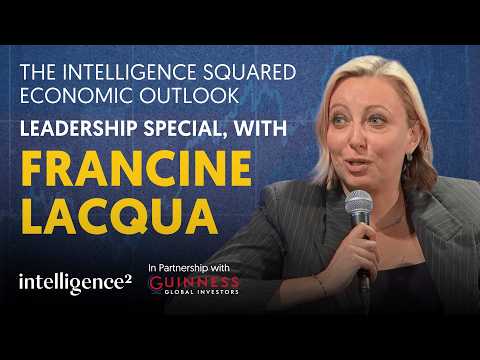
The Intelligence Squared Economic Outlook: Leadership Special, with Francine Lacqua
Crisis Interviews: A Double-Edged Sword
Interviews during times of crisis can be challenging. If a leader has 'messed up,' they are often defensive and unwilling to talk. However, if they feel wronged, they may take questions personally, leading to unpleasant exchanges. Lacqua notes that while earnings calls are difficult due to prepared statements, crisis interviews offer potential for apology or self-reflection, though they can also become highly confrontational, as seen in an interview with Rishi Sunak.
The Power Dynamics: Leaders vs. Events
In today's volatile world, leaders are largely driven by events rather than driving them. Multiple shocks like AI, geopolitical tensions, and economic instability demand reactive, flexible strategies. Lacqua observes that while major powers like the US and China might shape events, most leaders must focus on adapting their operational structures to withstand constant shocks, a stark contrast to the more predictable environment of the early 2000s.
AI's Ascendancy: A Private Power Grab?
The development and control of Artificial Intelligence are overwhelmingly in the hands of a few private companies, such as OpenAI and DeepMind, rather than nation-states. Lacqua argues that unless governments effectively regulate or absorb this technology, these hyperscalers will dictate how AI is consumed, fundamentally altering the social contract between governments and individuals and potentially leaving Europe and the UK behind in this technological race dominated by the US and China.
West Streeting's Cautious Campaign
West Streeting, a potential leadership candidate, is strategically holding back on detailed policy announcements to avoid premature campaigning and accountability, a tactic that can be frustrating for interviewers seeking concrete answers.
Nigel Farage's Unconventional Popularity
Nigel Farage's significant polling lead, despite lacking traditional political office, underscores a public desire for an 'outsider' figure who speaks directly to voter frustrations, challenging established political norms.
Leadership Communication in the Digital Age
The advent of social media has fundamentally altered leadership communication, compelling politicians and CEOs to engage directly with the public, often through personal narratives, to ensure understanding and connection.
The Uncharted Territory of AI Regulation
Regulating AI is a contentious issue, with businesses often viewing it as a barrier to innovation, while policymakers grapple with its potential impact on sovereignty and societal structures, creating a complex landscape for future governance.
Europe's AI Sovereignty Challenge
Europe risks being left behind in the AI race, creating a significant sovereignty challenge. While US companies lead with advanced systems, and China pursues its own path, Europe lacks a strong equivalent, prompting calls from executives for a European AI solution to ensure support and ease of integration. This technological disparity could leave Europe in a precarious middle ground.
The AI Race and Ethical Dilemmas
The intense race for AI advancement, driven by billions in potential profit, overshadows crucial ethical and regulatory considerations. Figures like Demis Hassabis acknowledge the race's focus on technological progress and profit, suggesting that deeper questions about regulation and the future of humanity are sidelined. This dynamic makes it difficult for leaders to prioritize morality over commercial imperatives.
The Social Contract and Leader's Role
Leaders are expected to uphold a social contract, providing security and welfare, which varies across cultures but fundamentally involves taking care of the populace. When people feel this contract is broken or unfulfilled, they become lost and seek change. This underscores the importance of leaders demonstrating a tangible commitment to their citizens' well-being, beyond mere charisma.
Public-Private Partnerships for Innovation
While public-private partnerships (PPPs) are vital for innovation, as seen with NASA/SpaceX and the Elizabeth Line, they must be structured to benefit the state. Professor Mariana Mazzucato emphasizes that state funding for innovation should yield returns, preventing public money from solely benefiting private entities or foreign markets. This requires carefully crafted contracts that ensure mutual benefit and innovation retention.
Middle Powers and Shifting Alliances
Middle powers like Canada, championed by figures like Mark Carney, are seeking to form new alliances in a fragmented world, but this is a slow process. While decoupling from the US is difficult due to its strong economy and innovation, countries are re-evaluating trading blocks based on alliances. This shift is gradual, with significant organization happening behind closed doors rather than through immediate public declarations.
Navigating the Trump Factor in Global Politics
Despite political rhetoric, global leaders and businesses find it difficult to stand up to Donald Trump due to his delivery of deregulation and economic growth, which aligns with their interests. While some international pushback occurred, particularly from Europe, the lack of widespread retaliation on trade policy was remarkable. This suggests a pragmatic approach where leaders prioritize economic benefits over direct confrontation, fearing potential trade wars.
The Dual Mandate of Modern Leadership
Modern leaders, like Emmanuel Macron, are burdened with two vastly different and demanding jobs: navigating complex foreign policy shifts and managing domestic populations undergoing massive societal and economic changes, often exacerbated by forces like AI. This necessitates a co-management approach, potentially dividing focus between domestic and international affairs.
AI's Double-Edged Sword for Small Businesses and Youth
The cost of ignoring AI is too high for small businesses, yet the expense of advanced models is prohibitive. While some businesses are experimenting, there's a significant debate about whether to invest in AI or hire graduates, with no clear data yet on the long-term impact on youth unemployment or career trajectories. The uncertainty extends to education, with experts divided on whether to focus on humanities or AI-specific skills.
Trump's Unconventional Approach to Advice
Donald Trump operates largely independently, with his aides often unsure of his direction, especially when he deviates from prepared remarks. His policy stances can appear fluid, possibly influenced by recent conversations rather than formal briefings, suggesting he is his own agent and follows his own counsel.