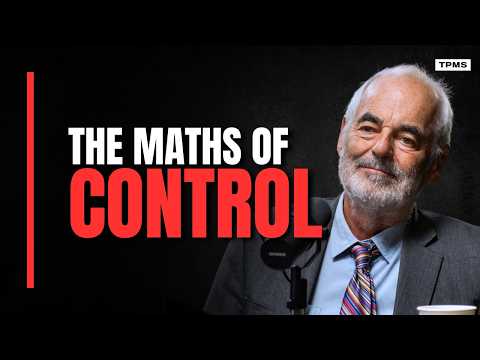
Risk Expert - ”The Math Behind Government Fear” | Sir David Spiegelhalter
Peter McCormack
Summary
Cambridge statistician Sir David Spiegelhalter joins host Peter McCormack to examine how numbers are used to inform or manipulate the public. Drawing on his leadership of statistical teams for the Bristol Royal Infirmary and Harold Shipman inquiries, Spiegelhalter explains how automated monitoring detects excess hospital mortality and how framing the same figure as relative rather than absolute risk turns minor hazards into frightening headlines. He critiques pandemic fear-mongering around youth risk, shows that COVID-19 mortality doubled every eight years of age, and cites a 1,000-person randomized trial proving that simplistic World Health Organization 'safe and effective' vaccine slogans erode trust among skeptics.
The conversation also explores how the Office for National Statistics corrected productivity errors, why Google DeepMind's weather models and McCormack's football attendance AI remain opaque black boxes compared to transparent clinical tools like the Predict cancer model, and why adaptable 'foxes' outperform ideological 'hedgehogs' in forecasting.
How time-sensitive the topic is: Evergreen
By the numbers
35 excess baby deaths: Excess mortality of children with congenital heart disease at Bristol Royal Infirmary identified by Spiegelhalter's statistical team. (Mentioned at 2:37)
250 murdered patients: Minimum number of patients murdered by Harold Shipman over 20 years, whereas statistical monitoring could have flagged him after about 40. (Mentioned at 2:55)
20%: Relative risk increase in bowel cancer from eating bacon daily, equivalent to absolute risk rising from 6 in 100 to 7 in 100 (or 5 to 6). (Mentioned at 7:10)
1,000 people: Sample size of a randomized study comparing standard 'vaccines are safe and effective' messaging against a nuanced, balanced message. (Mentioned at 20:56)
500,000 infections per day: Daily UK Omicron infections in December 2021 before voluntary cancellations of Christmas office parties curbed the projected spike. (Mentioned at 23:32)
14,000 lives: Modeled estimate cited by the COVID inquiry of lives that might have been saved had the UK locked down a week earlier in March 2020. (Mentioned at 25:16)
10,000 times risk: Approximate COVID-19 mortality risk multiplier for an 80-year-old compared to an 8-year-old, as risk doubled every 8 years of age. (Mentioned at 31:44)
1 in 12,000 8-year-olds per year: Annual mortality rate for 8-year-olds in the UK, making them the safest demographic in human history. (Mentioned at 34:16)
576 attendees: Actual crowd at Real Bedford's recent football match, compared to 457 predicted by Peter McCormack's AI attendance model. (Mentioned at 42:18)
10,000 cases: Database size underlying the Predict statistical model used globally to forecast breast and prostate cancer survival probabilities. (Mentioned at 57:09)
Questions this video answers
How do media headlines use relative vs. absolute risk to make statistics sound terrifying?
Communicators can report that eating a bacon sandwich every day increases bowel cancer risk by 20% (relative risk), which sounds alarming. Presenting the exact same figure as an absolute risk increase from roughly 6 in 100 to 7 in 100 over a lifetime makes the hazard sound minor, showing how framing dictates emotional reaction.
Sir David Spiegelhalter, 6:45 to 9:51
From this keypoint: Framing Tricks Make Identical Risks Terrifying
Why does the slogan 'vaccines are safe and effective' reduce trust among vaccine skeptics?
No medical intervention is 100% safe or 100% effective, so repeating an unqualified slogan feels patronizing and dishonest to people who already have doubts. In a 1,000-person randomized trial conducted by Spiegelhalter's team, vaccine-skeptical participants trusted a balanced message that acknowledged rare risks and limitations significantly more than the standard WHO slogan.
Sir David Spiegelhalter, 17:42 to 22:01
From this keypoint: Why 'Safe and Effective' Erodes Vaccine Trust
Could statistical monitoring have caught serial killer Harold Shipman earlier?
Yes; statistical analysis for the Shipman inquiry showed that automated excess-mortality monitoring would have flagged an anomaly after he had murdered roughly 40 patients rather than at least 250. While statistics cannot explain why excess deaths occur, similar automated systems now monitor pediatric intensive care and maternity units to trigger human investigations.
Sir David Spiegelhalter, 2:00 to 5:45
From this keypoint: Statistical Monitoring Could Have Flagged Shipman
How much did age affect COVID-19 mortality risk compared to other factors?
Age was overwhelmingly the dominant risk factor: the risk of dying from COVID-19 doubled roughly every eight years of age, making an 80-year-old about 10,000 times more vulnerable than an eight-year-old. Catching COVID-19 closely mirrored normal actuarial mortality, equating to roughly one normal year's worth of death risk compressed into three weeks.
Sir David Spiegelhalter, 31:02 to 35:06
From this keypoint: Spiegelhalter Condemns Government Fear-Mongering
Were UK COVID-19 infections already falling before the first compulsory lockdown in March 2020?
Spiegelhalter notes that UK infections were already dropping following voluntary restrictions and behavior changes around March 16, before the compulsory lockdown took effect on March 23. He also points out that the COVID inquiry's headline claim that locking down earlier would have saved 14,000 lives was based on a model that required moving voluntary restrictions back to March 9.
Sir David Spiegelhalter, 22:28 to 30:50
From this keypoint: Voluntary Behavior Shifted Before Formal Lockdowns
Why did the UK Office for National Statistics miscalculate national productivity figures?
In labor force surveys, people who did not respond were treated simply as missing data rather than accounting for the elevated likelihood that non-respondents were away on holiday. This oversight caused the ONS to overcount total hours worked and undercount UK productivity for years until the agency publicly owned up to and corrected the error.
Sir David Spiegelhalter, 35:28 to 41:21
From this keypoint: ONS Owns Up to Productivity Survey Errors
What is the difference between AI black-box models and traditional statistical models?
Machine learning and AI models—such as Google DeepMind's weather forecaster or AI-built business tools—predict outcomes from historical patterns without explaining how each input is weighted or providing uncertainty bands. Traditional statistical models are transparent and explainable, allowing doctors or analysts to see exact feature weights and confidence intervals.
Sir David Spiegelhalter, 41:21 to 47:09
From this keypoint: Black-Box AI vs Explainable Statistical Models
How is the Predict model used in breast and prostate cancer treatment?
Built on a database of 10,000 cancer registry cases, the Predict system calculates transparent 5- and 10-year survival curves and shows how treatments shift those odds. Multidisciplinary medical teams use it as an unbiased baseline during patient reviews, while factoring in unrecorded clinical details like physical fitness.
Sir David Spiegelhalter, 56:46 to 1:08:14
From this keypoint: Cancer Survival Models and Closed vs Open AI
What does Sir David Spiegelhalter think of Elon Musk's 20% probability that AI will destroy humanity?
Spiegelhalter views Musk's 20% figure—and similar 10% figures from Jeff Hinton and Sam Altman—as subjective personal judgments pulled from people's heads rather than data-driven probabilities. He compares them to early worst-case pandemic projections that assumed society would take zero preventative action as a threat unfolded.
Sir David Spiegelhalter, 48:19 to 56:45
From this keypoint: Subjective AI Doom Odds and Neural Scaling
Why do 'foxes' make better super-forecasters than 'hedgehogs'?
Drawing on Isaiah Berlin's essay and super-forecasting research, 'hedgehogs' interpret the entire world through a single fixed ideology, making them persuasive leaders but poor predictors. 'Foxes' think probabilistically, hold no preset agenda, work in teams, and rapidly update their beliefs when confronted with new evidence and feedback.
Sir David Spiegelhalter, 1:12:06 to 1:24:03
From this keypoint: Why Foxes Outperform Ideological Hedgehogs
What percentage of people actually want to know the exact day they will die?
Across Spiegelhalter's public lectures, only about 5% of audience members—typically dedicated planners—raise their hands saying they want to know when they will die, closely matching an 8% 'yes' rate in a small test poll on an app built by McCormack's son. The vast majority refuse to know because uncertainty is a defining, relished part of the human condition.
Sir David Spiegelhalter, 56:46 to 1:08:14
From this keypoint: Cancer Survival Models and Closed vs Open AI
Credible AI™ signals
Confidence: Rigorous & Self-Critical. Sir David Spiegelhalter grounds his arguments in decades of direct experience on UK public inquiries, randomized communication trials, and his six-year tenure on the UK Statistics Authority board. He consistently distinguishes modeled projections from empirical data and highlights uncertainty and institutional errors.
Bias: Anti-Paternalistic Empiricism. Spiegelhalter explicitly favors neutral, non-advocacy data presentation and criticizes both government fear-mongering and simplistic public health messaging. Host Peter McCormack openly states his conservative, libertarian-leaning preferences while seeking ways to check his own ideological blind spots.
Originality (82%): First-Hand Inquiry Insights. The conversation pairs high-level statistical methodology with concrete, first-hand examples from the Shipman and Bristol inquiries, randomized trials on vaccine messaging, and practical contrasts between transparent statistical models and black-box AI systems.
Depth (88%): Methodological & Nuanced. Rather than debating surface-level politics, the discussion dissects how relative versus absolute risk framing alters perception, why age-stratified actuarial mortality matters for pandemic policy, and how value judgments shape economic optimization models.
Key points (12)
Short (27 min): key points 1, 2, 5, 7 and 12
Medium (53 min): key points 1, 2, 5, 6, 7, 9, 11 and 12
Relaxed (1h 15min): all 12 key points
1. Statistical Monitoring Could Have Flagged Shipman
Timestamp: 00:02:00 to 00:05:45 (4 min)
Speaker: Sir David Spiegelhalter
Sir David Spiegelhalter explains how leading the statistical team for the Bristol Royal Infirmary inquiry revealed roughly 35 excess infant heart-surgery deaths, which led to his work on the Harold Shipman inquiry. His team showed that automated mortality monitoring could have flagged Shipman after about 40 murders rather than at least 250.
Impact: High. Why it matters: Automated statistical thresholds transform healthcare oversight from reactive scandal inquiries into early-warning systems, though institutional delays in maternity adoption cost crucial years.
“Because the statistics never tells you why the problem is there, it just says there is a problem. And we developed monitoring systems that would have shown had they been in place”
In the video: Sir David Spiegelhalter, at 3:13
For: Peter McCormack
2. Framing Tricks Make Identical Risks Terrifying
Timestamp: 00:06:45 to 00:09:51 (3 min)
Speaker: Sir David Spiegelhalter
Spiegelhalter argues that anyone can make the exact same number look frightening or reassuring simply by choosing between relative and absolute risk framing. Reporting that daily bacon consumption raises bowel cancer risk by 20% creates alarming headlines, whereas explaining that lifetime risk rises from six in 100 to seven in 100 sounds unremarkable. Consequently, he immediately distrusts any number in the news and first asks who is sharing it and how they are trying to manipulate the audience.
Impact: High. Why it matters: Separating raw numbers from the claims attached to them gives citizens a practical defense against media manipulation and emotional agenda-setting.
“I always say I can make any number look big, small, frightening or reassuring. The same number. By the way I tell the story. By the comparators I make.”
In the video: Sir David Spiegelhalter, at 6:52
For: Peter McCormack
3. Overcoming Confirmation Bias via Slow Thinking
Timestamp: 00:09:52 to 00:14:28 (5 min)
Speaker: Sir David Spiegelhalter
Peter McCormack notes that people readily accept statistics that flatter their political tribe while scrutinizing opposing data. Spiegelhalter agrees that confirmation bias and unexamined worldviews drive fast, gut-instinct reactions, which statisticians must counter through slow thinking and strict non-advocacy. While evidence never dictates policy or values, society cannot have productive debates if citizens cannot even agree on the baseline evidence.
Impact: Medium. Why it matters: Distinguishing value disagreements from empirical disputes clarifies why political debates stall when partisans reject shared baseline data.
“Now, the evidence doesn't tell you what to do, and it doesn't tell you what to think, but it's good to identify if there's real arguments about what even what the evidence is”
In the video: Sir David Spiegelhalter, at 13:49
For: Peter McCormack
4. Six COVID Death Definitions Fueled Polarized Spin
Timestamp: 00:14:30 to 00:17:16 (3 min)
Speaker: Sir David Spiegelhalter
During the pandemic, Spiegelhalter and libertarian commentator Chris Snowden found themselves in the middle ground, attacked by both zero-COVID advocates and pandemic minimizers. Spiegelhalter explains that the daily 4:00 PM UK dashboard provided an unprecedented volume of transparent public data, so disputes rarely centered on fabricated numbers. Instead, conflict arose over interpretation, as at least six different definitions of a COVID death circulated simultaneously.
Impact: Medium. Why it matters: Shows how abundant open data can still generate polarized narratives when multiple valid statistical definitions exist side by side.
“when you think of deaths from COVID, well, there were at least six different definitions going around at one time.”
In the video: Sir David Spiegelhalter, at 16:59
Neutral: Peter McCormack
5. Why 'Safe and Effective' Erodes Vaccine Trust
Timestamp: 00:17:42 to 00:22:01 (4 min)
Speaker: Sir David Spiegelhalter
Spiegelhalter identifies the public belief that COVID-19 vaccines prevented infection and transmission as a major misunderstanding caused by officials failing to state what trial data did not show. He criticizes the World Health Organization's headline slogan that 'vaccines are safe and effective' as patronizing because no vaccine is completely safe or 100% effective.
Impact: High. Why it matters: Provides experimental proof that over-simplified public health slogans backfire among the exact skeptical audiences officials want to reach.
“when uh health communicates as like the WHO say vaccines are safe and effective you are decreasing trust in the group you're trying to reach, the people who are skeptical. You're making it worse.”
In the video: Sir David Spiegelhalter, at 21:41
For: Peter McCormack
6. Voluntary Behavior Shifted Before Formal Lockdowns
Timestamp: 00:22:28 to 00:30:50 (8 min)
Speaker: Sir David Spiegelhalter
Spiegelhalter contrasts patronizing political rhetoric with Chief Medical Officer Chris Whitty's trusted December 2021 Omicron briefing, where citizens voluntarily canceled office parties and averted projected death spikes without a new lockdown.
Impact: High. Why it matters: Challenges the narrative that only compulsory state mandates curbed infections, highlighting the power of voluntary behavior change and the cost of ignoring child welfare.
“The other thing the COVID inquiry didn't, you know, make clear is that infections were dropping before the lockdown, before the formal lockdown.”
In the video: Sir David Spiegelhalter, at 25:48
For: Peter McCormack
7. Spiegelhalter Condemns Government Fear-Mongering
Timestamp: 00:31:02 to 00:35:06 (4 min)
Speaker: Sir David Spiegelhalter
Spiegelhalter says he cannot forgive the UK government for fear-mongering advertisements that implied young people faced the same COVID-19 mortality risk as the elderly. In reality, COVID lethality doubled roughly every eight years of age, meaning an 80-year-old faced about 10,000 times the risk of an eight-year-old, closely mirroring normal actuarial mortality where catching COVID equaled roughly one normal year of death risk crammed into three weeks.
Impact: High. Why it matters: Puts pandemic mortality into clear actuarial perspective, showing why universal fear campaigns distorted an overwhelmingly age-dependent risk.
“the risk of COVID doubled every 8 years you're older. Which is overwhelmingly important factor of risk factor, far more important than anything else.”
In the video: Sir David Spiegelhalter, at 31:27
For: Peter McCormack
8. ONS Owns Up to Productivity Survey Errors
Timestamp: 00:35:28 to 00:41:21 (6 min)
Speaker: Sir David Spiegelhalter
Reflecting on his six years on the UK Statistics Authority board, Spiegelhalter praises the Office for National Statistics for building trustworthiness by publicly owning up to errors in its labor force survey and productivity figures. He explains that UK productivity had been undercounted for years because survey non-respondents were treated as missing data rather than as people more likely to be on holiday, which caused analysts to overcount hours worked.
Impact: Medium. Why it matters: Demonstrates how institutional candor about methodological mistakes and explicit warnings against misinterpretation rebuild public credibility.
“if people weren't responding to the survey, they were taken as as sort of they were just missing data rather than that increasing the chance that they were actually on holiday.”
In the video: Sir David Spiegelhalter, at 37:49
For: Peter McCormack
9. Black-Box AI vs Explainable Statistical Models
Timestamp: 00:41:21 to 00:47:09 (6 min)
Speaker: Sir David Spiegelhalter
Peter McCormack shares how he used AI to build a ticket and catering forecast model for his seventh-tier club, Real Bedford, which predicted 457 fans for a match that drew 576 and helps prepare for the 75% of burger sales occurring right before kickoff and at halftime. Spiegelhalter commends the practical utility and compares it to Google DeepMind's weather forecasting model, which rivals physics-based equations using pure historical data.
Impact: High. Why it matters: Illustrates the central trade-off in modern data science between the predictive power of black-box AI and the transparency and uncertainty bounds of classical statistics.
“I mean AI is wonderful, but if I was building a statistical model, I would mine would be explainable. It'd be transparent and explainable and you'd know exactly how much each feature was contributing to that number.”
In the video: Sir David Spiegelhalter, at 42:55
For: Peter McCormack
10. Subjective AI Doom Odds and Neural Scaling
Timestamp: 00:48:19 to 00:56:45 (8 min)
Speaker: Sir David Spiegelhalter
Spiegelhalter argues that AI will not replace radiologists or statisticians, though professionals who refuse to use AI risk being left behind. When asked about Elon Musk's 20% estimate and Jeff Hinton's and Sam Altman's 10% estimates that AI could destroy humanity, Spiegelhalter says such figures are subjective judgments rather than empirical models, comparable to early unmitigated COVID projections of 500,000 deaths that assumed zero human intervention.
Impact: Medium. Why it matters: Demystifies headline AI doom probabilities by separating subjective warning numbers from data-driven probabilities.
“These numbers they come out of people's heads. These are just judgments made of this is expressing some number on, well, there is a sort of possibility, and there's a train of events that could lead to this”
In the video: Sir David Spiegelhalter, at 52:36
For: Peter McCormack
11. Cancer Survival Models and Closed vs Open AI
Timestamp: 00:56:46 to 01:08:14 (11 min)
Speaker: Sir David Spiegelhalter
Spiegelhalter discusses the Predict system, a transparent statistical model built on 10,000 cases that estimates breast and prostate cancer survival curves, noting he has prostate cancer himself and that clinicians must still weigh unrecorded factors like patient fitness. He also notes that only about 5% of his lecture audiences—and 8% in a small test poll on an app built by McCormack's son—actually want to know the date of their death because humans relish uncertainty.
Impact: High. Why it matters: Clarifies why AI can revolutionize protein folding and pure mathematics while still struggling with unstructured clinical reality.
“You've got a set of inputs you've got a set of outputs as a closed issue. You know, like math problems and things like that and AI is just machine learning methods are just genius at that”
In the video: Sir David Spiegelhalter, at 1:04:04
For: Peter McCormack
12. Why Foxes Outperform Ideological Hedgehogs
Timestamp: 01:12:06 to 01:24:03 (12 min)
Speaker: Sir David Spiegelhalter
When McCormack asks how to model the optimal tax and welfare balance for UK living standards, Spiegelhalter points out that choosing an objective function—such as median wealth versus the bottom 20%—is a political value judgment, not a purely technical problem. To become a more trustworthy communicator, McCormack must adopt an open, neutral approach rather than fitting evidence to preset conservative views.
Impact: High. Why it matters: Synthesizes the episode's core philosophy: accurate forecasting and public trustworthiness require trading rigid ideological vision for probabilistic humility and continuous feedback.
“Whereas good forecasters foxes have no ideology, no preset opinions, no preset expectations. They don't want any particular thing to happen. They just want to understand how the world works”
In the video: Sir David Spiegelhalter, at 1:16:35
For: Peter McCormack
Conflicts of interest (3)
Host-Read Sponsor Promotions for IREN and Quo
Commercial conflict, Medium severity
Peter McCormack delivers paid sponsor reads for AI cloud infrastructure provider IREN and AI-enabled business phone system Quo during an episode that discusses artificial intelligence.
Sources: Peter McCormack
Significance: Commercial ties to AI infrastructure and software sponsors create a financial incentive for the show to frame practical business adoption of AI favorably.
Spiegelhalter's UK Statistics Authority Tenure
Professional conflict, Low severity
Sir David Spiegelhalter served for six years on the board of the UK Statistics Authority, which oversees the Office for National Statistics, and only recently stepped down.
Sources: Sir David Spiegelhalter
Significance: His recent governance role gives him a reputational stake in praising the Office for National Statistics's Code of Practice and framing its survey errors as a positive cultural turnaround.
Promotion of Spiegelhalter's Book
Commercial conflict, Low severity
Sir David Spiegelhalter promotes his book The Art of Uncertainty at the conclusion of the interview and draws directly on its examples throughout the conversation.
Sources: Sir David Spiegelhalter
Significance: The interview serves in part as a promotional platform to drive audience interest and sales for his published work.
Key sources
Sir David Spiegelhalter: Chair of the Winton Centre for Risk and Evidence Communication at Cambridge University
Peter McCormack: Podcast Host and Owner of Real Bedford Football Club
Who's in this
Harold Shipman
World Health Organization
Lucy Letby
Chris Whitty
Office for National Statistics
Google DeepMind
Jeff Hinton
Elon Musk
Claude
Real Bedford
IREN
Quo
Also mentioned
United Kingdom (First mentioned at 16:25)
Bristol Royal Infirmary (First mentioned at 2:26)
UK Statistics Authority (First mentioned at 37:03)
Code of Practice for Statistics (First mentioned at 39:00)
Predict (First mentioned at 57:31)
The Art of Uncertainty (First mentioned at 1:23:55)
Healthcare Commission (First mentioned at 3:58)
MAWS (First mentioned at 4:36)
Chris Snowden (First mentioned at 15:08)
Twitter (First mentioned at 16:40)
Sweden (First mentioned at 26:48)
Bedford (First mentioned at 41:24)
Met Office (First mentioned at 46:01)
Cambridge (First mentioned at 55:30)
One Question (First mentioned at 57:54)
AlphaFold (First mentioned at 1:03:39)
Isaiah Berlin (First mentioned at 1:15:44)
Michael Burry (First mentioned at 1:21:10)
Dale Vince (First mentioned at 7:15)
Montgomery Toms (First mentioned at 11:22)
Charlie Kirk (First mentioned at 11:24)
Institute of Economic Affairs (First mentioned at 15:14)
Independent SAGE (First mentioned at 15:39)
Jonathan Van-Tam (First mentioned at 23:05)
France (First mentioned at 27:20)
Spain (First mentioned at 27:20)
Italy (First mentioned at 27:22)
Plato (First mentioned at 36:10)
Sam Altman (First mentioned at 52:10)
Applied Psychology Unit (First mentioned at 55:27)
ChatGPT (First mentioned at 56:30)
OpenAI (First mentioned at 1:03:21)
Leo Tolstoy (First mentioned at 1:15:47)
Manchester City (First mentioned at 1:18:35)
Liverpool (First mentioned at 1:18:35)
The Big Short (First mentioned at 1:21:15)
Donald Rumsfeld (First mentioned at 1:24:40)
This analysis was generated by skim (skim.plus), an AI-powered content analysis platform by Credible AI. Scores and classifications represent the platform's AI-generated assessment and should be considered alongside other sources.