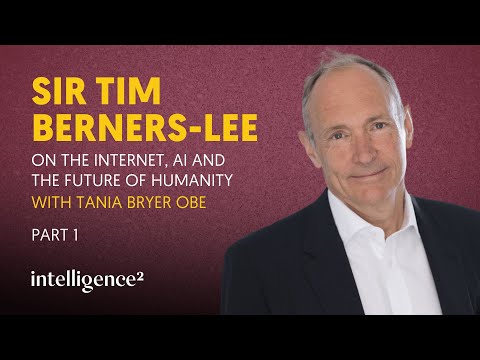
Intelligence Squared's Sir Tim Berners-Lee on the Internet, AI and the Future of Humanity (Part 1): skim's analysis identifies 9 key moments, with 1 potential conflict of interest flagged. Sir Tim Berners-Lee reflects on inventing the World Wide Web and publishing his memoir, This is For Everyone.
Category: Tech. Format: Interview. YouTube video analyzed by skim.
skim AI Analysis
Credibility assessment: Primary Inventor Testimony. Sir Tim Berners-Lee provides a firsthand, primary-source account of inventing the World Wide Web at CERN, grounded in his personal experience and documented historical milestones from 1989 to 1993.
Bias assessment: Open-Web Idealism. The conversation naturally favors open-source, decentralized, and non-monopolistic models of technology, reflecting Sir Tim Berners-Lee's career-long advocacy for universal standards and free access.
Originality: 82% — Candid Inventor Reflections. While the broad history of the web is known, Sir Tim Berners-Lee shares personal anecdotes from his memoir, including childhood influences, Oxford pranks, and near-misses with Steve Jobs.
Depth: 70% — Historical & Tech Retrospect. The discussion pairs biographical storytelling with clear structural insights into why universal interoperability succeeded at CERN while proprietary alternatives like Gopher failed.
Key Points (9)
1. Sir Tim Berners-Lee on writing his memoir
Timestamp: 00:01:21 to 00:04:12
Sir Tim Berners-Lee explains that he wrote his memoir, This is For Everyone, to put his personal and professional history in order and chart a better future for the web. He notes that even in the early days at CERN, three years of exponential growth showed that seven more years would make the web huge.
Significance (Medium): Frames the memoir not merely as nostalgia, but as an effort to steer the modern web toward a healthier future.
Sources in support: Sir Tim Berners-Lee (Inventor of the World Wide Web, CTO and Co-founder of Inrupt)
Neutral sources: YouTube: Intelligence Squared (Event Host and Interviewer)
2. From static pages to an uncollaborative AI race
Timestamp: 00:04:15 to 00:06:05
Tracing the shift from static Web 1.0 pages and dynamic Web 2.0 tools like Google Maps to centralized platforms like Facebook, Sir Tim Berners-Lee notes people no longer build their own websites. Comparing this to artificial intelligence, he observes that AI lacks a consortium like the W3C, with companies racing to win first rather than collaborating.
Significance (High): Highlights a structural risk in artificial intelligence development: intense commercial competition is outpacing shared governance and interoperability standards.
Sources in support: Sir Tim Berners-Lee (Inventor of the World Wide Web, CTO and Co-founder of Inrupt)
Neutral sources: YouTube: Intelligence Squared (Event Host and Interviewer)
3. Mathematician parents and a 19th-century book
Timestamp: 00:06:05 to 00:09:16
Raised by mathematicians Mary Lee and Conway Berners-Lee, who met building the early Ferranti computer when Alan Turing was defining computing, young Tim absorbed their excitement for math. In their television-free home, a Victorian household encyclopedia titled Enquire Within Upon Everything inspired the name of an early software program that preceded the web.
Significance (Medium): Reveals the direct intellectual lineage connecting first-generation British computing and a Victorian reference book to the architecture of the World Wide Web.
Sources in support: Sir Tim Berners-Lee (Inventor of the World Wide Web, CTO and Co-founder of Inrupt)
Neutral sources: YouTube: Intelligence Squared (Event Host and Interviewer)
4. Why the 1955 birth cohort shaped computing
Timestamp: 00:09:18 to 00:11:12
Sir Tim Berners-Lee argues that people born in 1955, including Steve Jobs, Bill Gates, and himself, grew up at the exact moment electronics transitioned from vacuum tubes and nail electromagnets to transistors and integrated circuits. Earlier generations lacked transistors, while later generations received finished phones and computers without building them from scratch.
Significance (Medium): Explains why a single demographic cohort dominated the personal computer revolution: technology was simple enough to solder by hand yet powerful enough to scale.
Sources in support: Sir Tim Berners-Lee (Inventor of the World Wide Web, CTO and Co-founder of Inrupt)
Neutral sources: YouTube: Intelligence Squared (Event Host and Interviewer)
5. Matching jackets and clock tower pranks at Oxford
Timestamp: 00:11:12 to 00:14:27
Recalling his nerves before his Queen's College, Oxford interview, Sir Tim Berners-Lee describes buying a brownish-green corduroy jacket, brown trousers, and a yellow-white shirt, only to find interviewer Professor John Moffatt wearing the exact same outfit. He fondly remembers punting at Oxford and celebrating graduation by hanging underwear on the college clock tower, which snagged the mechanism and required repair fees.
Significance (Low): Humanizes the inventor of the web through self-deprecating humor about his student days at Queen's College, Oxford.
Sources in support: Sir Tim Berners-Lee (Inventor of the World Wide Web, CTO and Co-founder of Inrupt)
Neutral sources: YouTube: Intelligence Squared (Event Host and Interviewer)
6. CERN's coffee area and incompatible systems
Timestamp: 00:14:29 to 00:19:27
Working at CERN in Geneva, Sir Tim Berners-Lee saw visiting physicists bring incompatible computers and isolated documentation systems while relying on hallway encounters by the coffee machine to figure out how equipment worked. Seeing speakers fail to convince colleagues to move all data onto an IBM system convinced him that the web had to be a universal space.
Significance (High): Pinpoints the core architectural insight of the World Wide Web: interoperability across heterogeneous systems rather than forced migration to a single platform.
Sources in support: Sir Tim Berners-Lee (Inventor of the World Wide Web, CTO and Co-founder of Inrupt)
Neutral sources: YouTube: Intelligence Squared (Event Host and Interviewer)
7. Vague but exciting: the 1989 CERN memo
Timestamp: 00:19:27 to 00:22:58
After drawing diagrams of the web in the snow with a ski pole for his friend Meryl, Sir Tim Berners-Lee submitted his hypertext proposal at CERN in March 1989 and resubmitted it in May 1990. His boss's boss, Mike Sendall, penciled 'vague, but exciting' on the corner and let him buy a NeXT computer to test the operating system by developing his hypertext project.
Significance (High): Shows how institutional flexibility and a sympathetic manager allowed an unofficial side project at a physics lab to become the World Wide Web.
Sources in support: Sir Tim Berners-Lee (Inventor of the World Wide Web, CTO and Co-founder of Inrupt)
Neutral sources: YouTube: Intelligence Squared (Event Host and Interviewer)
8. CERN's phone book and naming the WWW
Timestamp: 00:23:00 to 00:25:33
To get people using the web at CERN, a simple line-mode browser was deployed so staff on Unix, VAX/VMS, and HP machines could look up the CERN phone book without logging into the IBM mainframe, creating the second web server. After rejecting names like The Mesh, The Information Mine (TIM), and Mine of Information (MOI) as too egotistical, he chose WWW because the letter W was rare in project names.
Significance (Medium): Demonstrates that solving a mundane utility problem—accessing an employee phone directory across different machines—drove the first practical adoption of the web.
Sources in support: Sir Tim Berners-Lee (Inventor of the World Wide Web, CTO and Co-founder of Inrupt)
Neutral sources: YouTube: Intelligence Squared (Event Host and Interviewer)
9. Why monopolies hurt innovation and royalty-free IP
Timestamp: 00:25:33 to 00:29:50
After recounting how Steve Jobs was called away moments before seeing a World Wide Web demo on a NeXT machine in France, Sir Tim Berners-Lee warns that monopolies like Apple in phones or historic AT&T in telephony stifle innovation. He concludes by explaining how he and Robert Cailliau lobbied CERN to waive royalties in 1993, ensuring the web thrived while the University of Minnesota's Gopher protocol collapsed after threatening future fees.
Significance (High): Establishes that CERN's 1993 royalty-free pledge was the decisive turning point that enabled global adoption over competing protocols.
Sources in support: Sir Tim Berners-Lee (Inventor of the World Wide Web, CTO and Co-founder of Inrupt)
Neutral sources: YouTube: Intelligence Squared (Event Host and Interviewer)
This analysis was generated by skim (skim.plus), an AI-powered content analysis platform by Credible AI. Scores and classifications represent the platform's AI-generated assessment and should be considered alongside other sources.