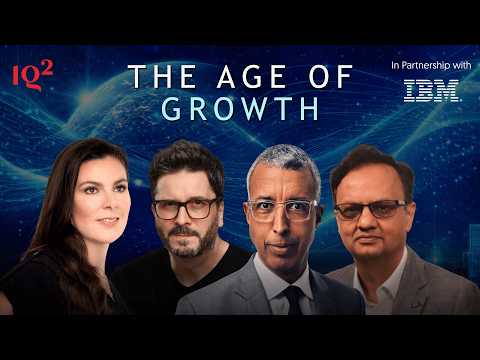
Intelligence Squared's The Age of Growth: skim's analysis identifies 12 key moments, with 2 potential conflicts of interest flagged. Kamal Ahmed hosts former Downing Street AI director Laura Gilbert, Royal London CDO Lee Ellis, and IBM Consulting partner Prashant Jojodia to examine how Britain can convert artificial intelligence into sustainable economic growth.
Category: Tech. Format: Panel Discussion. YouTube video analyzed by skim.
skim AI Analysis
Credibility assessment: Seasoned Practitioner Insights. The panel brings firsthand executive and government experience from 10 Downing Street, Royal London, and IBM Consulting. While the event is co-produced by IBM and features promotional framing for its consulting work, Laura Gilbert provides candid, unvarnished critiques of public sector delivery and political incentives.
Bias assessment: Pro-Enterprise Tech Optimism. Produced in partnership with IBM, the discussion naturally favors enterprise AI adoption and consulting-led digital transformation. However, Laura Gilbert balances the corporate optimism by highlighting government delivery failures, public distrust, and the human incentives driving politicians.
Originality: 76% — Candid Insider Perspectives. Rather than repeating standard AI hype, the speakers share concrete operational examples, such as GP resistance to automated scheduling, Royal London's shift to generative engine optimization, and a firsthand account of briefing a UK minister after speaking with Geoffrey Hinton.
Depth: 75% — Practical Systems Analysis. The panel moves beyond surface-level productivity talk to examine second-order systems effects, value chain disruption in financial advice, cultural homogenization from foreign language models, and the behavioral realities of policy implementation.
Key Points (12)
1. Creating a Pro-Business Environment for UK Growth
Timestamp: 00:11:50 to 00:15:22
Following an audience poll on UK AI priorities, Prashant Jojodia says IBM helps clients build transformation cases, guardrails, and talent. Laura Gilbert argues that infrastructure, public services, and talent are interdependent, but the vital missing element is an environment where tech entrepreneurs can build businesses. She concludes that politicians focus heavily on growth yet struggle because they lack backgrounds in delivery and economics.
Significance (Medium): Highlights a core structural gap in UK tech policy: attracting talent and capital requires a business-friendly environment and practical delivery skills that career politicians rarely possess.
Sources in support: Laura Gilbert (Senior Director of AI at Tony Blair Institute; former Founding Director of 10DS), Prashant Jojodia (Managing Partner for Financial Services UK & Ireland at IBM Consulting)
Neutral sources: Kamal Ahmed (Executive Editorial Director for Fortune Europe)
2. Prashant Jojodia Cites NHS Scheduling Savings
Timestamp: 00:16:53 to 00:18:59
Addressing public skepticism toward health data usage, Prashant Jojodia reports that IBM worked with University Hospital in Coventry to mine appointment data and deploy an AI notification engine. He states this system saved 7,000 hours a week from missed appointments by letting patients easily reschedule. He concludes that demonstrating everyday convenience is the most effective way to win public support for AI in public services.
Significance (Medium): Illustrates how targeted administrative automation in public healthcare can recover substantial clinical capacity while building patient goodwill through convenience.
Sources in support: Prashant Jojodia (Managing Partner for Financial Services UK & Ireland at IBM Consulting)
Neutral sources: Kamal Ahmed (Executive Editorial Director for Fortune Europe)
3. Systemic Realities and Public Trust in Health AI
Timestamp: 00:18:59 to 00:23:18
Laura Gilbert notes that when her team proposed an appointment scheduler to GPs, doctors objected because missed appointments were the only time they had to complete paperwork. She also describes building an assistive AI pharmacist tool to address bad prescription profiles that she says kill about 22,000 UK patients and cost the NHS £1 billion annually. She concludes that governments shouldn't demand blind trust in AI, but must prove competence and good intent by leading with the human problem.
Significance (High): Exposes why isolated tech fixes fail in complex public systems and establishes a clear dual standard for public data trust: proven operational competence and benevolent intent.
Sources in support: Laura Gilbert (Senior Director of AI at Tony Blair Institute; former Founding Director of 10DS)
4. Lee Ellis on Royal London's Copilot Adoption
Timestamp: 00:23:34 to 00:26:49
Lee Ellis outlines Royal London's scale as a mutual insurer with 10 million policyholders, £200 billion in assets, and 5,000 employees, returning £199 million to members this year. He reports that rolling out Microsoft Copilot across the workforce generated sustained active usage that outpaced tech companies. However, he notes that competing for top-tier AI engineering talent requires partnering with firms like IBM to augment internal capabilities.
Significance (Medium): Demonstrates that non-tech financial institutions can achieve high everyday workforce engagement with generative AI while relying on external partners for deep engineering.
Sources in support: Lee Ellis (Chief Digital Officer for Royal London)
Neutral sources: Kamal Ahmed (Executive Editorial Director for Fortune Europe)
5. Agentic AI Disrupting Financial Advice Chains
Timestamp: 00:28:52 to 00:33:22
Lee Ellis categorizes enterprise AI into personal productivity, internal process efficiency via an IBM-supported center of enablement running 30 use cases, and value chain disruption. Because 91% of the UK population cannot afford or access an independent financial adviser and a Lloyds study showed 28 million adults would take advice from digital assistants, he expects consumers to turn to AI for financial guidance. He predicts that within six months, agentic AI taking action on users' behalf will disrupt how Royal London distributes products.
Significance (High): Identifies a major commercial shift: as AI evolves from answering prompts to executing financial transactions, B2B2C insurers must prepare for disintermediation of human advisers.
Sources in support: Lee Ellis (Chief Digital Officer for Royal London)
Neutral sources: Kamal Ahmed (Executive Editorial Director for Fortune Europe)
6. CXO Revenue Expectations vs IBM's Cost Savings
Timestamp: 00:33:30 to 00:37:34
Prashant Jojodia explains that agentic AI elevates large language models by combining them with action to reimagine workflows. Citing an IBM Institute for Business Value survey of 3,000 CXOs, he notes that while 79% expect AI to generate significant revenue, only 29% know where that revenue will come from. Consequently, firms start with internal productivity; he reports that IBM exceeded CEO Arvind Krishna's $3 billion savings target by saving $4.5 billion, which it is now reinvesting for growth.
Significance (High): Quantifies the executive gap between AI revenue optimism and strategic clarity, showing why enterprises use internal cost reduction to fund longer-term growth bets.
Sources in support: Prashant Jojodia (Managing Partner for Financial Services UK & Ireland at IBM Consulting)
Neutral sources: Kamal Ahmed (Executive Editorial Director for Fortune Europe)
7. Exponential AI Growth and Cost-to-Serve Savings
Timestamp: 00:37:34 to 00:40:49
Lee Ellis admits that AI's immediate financial impact begins with reducing cost to serve in transactional processing while preserving human contact for complex pension and protection decisions. Looking ahead, he warns that humans struggle to grasp exponential capability doubling, comparing current AI progress to the final row of the chessboard penny-doubling game. He concludes that entering this final row of exponential power is simultaneously amazing and scary for society.
Significance (Medium): Frames the strategic danger of evaluating AI solely on current model capabilities rather than preparing for rapid, compounding leaps in performance.
Sources in support: Lee Ellis (Chief Digital Officer for Royal London)
Neutral sources: Kamal Ahmed (Executive Editorial Director for Fortune Europe)
8. Laura Gilbert on Engineering-Led Policy Delivery
Timestamp: 00:41:28 to 00:50:20
Laura Gilbert argues that government policymakers are often impractical and overly reliant on strategy documents rather than delivery mechanisms. Reflecting on her time in Downing Street, she notes that presenting raw data to prove a minister wrong simply gets you excluded from future meetings, whereas diverse teams have an 87% higher chance of making good business decisions. She explains that she builds AI tools not to make decisions for politicians, but to prompt them with questions about stakeholder knock-on effects so they improve their own thinking.
Significance (High): Offers a blueprint for public sector reform: replace static strategy papers and confrontational data briefings with interactive engineering prototypes that expose second-order policy consequences.
Sources in support: Laura Gilbert (Senior Director of AI at Tony Blair Institute; former Founding Director of 10DS)
Neutral sources: Kamal Ahmed (Executive Editorial Director for Fortune Europe)
9. Vertical AI Focus, GEO, and MCP Architecture
Timestamp: 00:53:29 to 01:00:00
Addressing potential AI market volatility, Prashant Jojodia recommends that Britain differentiate by applying AI vertically in strong domestic sectors like financial services, fintech, and healthcare. Lee Ellis explains that Royal London hedges against uncertainty by refusing to write strategies beyond 18 months and building architectural flexibility. Prompted by board chair Isabel Hudson's curiosity, Royal London shifted from search engine optimization to generative engine optimization and is implementing a Model Context Protocol layer so external AI agents can directly open policies.
Significance (High): Provides concrete technical actions for enterprises adapting to AI search and agents: refactoring content for LLM visibility and exposing services through Model Context Protocol layers.
Sources in support: Lee Ellis (Chief Digital Officer for Royal London), Prashant Jojodia (Managing Partner for Financial Services UK & Ireland at IBM Consulting)
Neutral sources: Kamal Ahmed (Executive Editorial Director for Fortune Europe)
10. Digital Sovereignty via Open-Source Coalitions
Timestamp: 01:00:00 to 01:07:41
Laura Gilbert argues that Britain should not waste scarce public funds trying to build its own frontier large language model, but warns that relying solely on US or Chinese models imports foreign cultural norms and erodes local nuances. Because the UK lacks standalone superpower purchasing clout, she proposes teaming up with blocs like the EU and the Commonwealth to set joint procurement standards and co-invest in open-source models and public solutions. Prashant Jojodia adds that realizing this potential requires multi-year capital commitment rather than treating AI as off-the-shelf software.
Significance (High): Reframes digital sovereignty away from expensive nationalistic LLM projects toward collective bargaining power and shared open-source infrastructure among mid-sized nations.
Sources in support: Laura Gilbert (Senior Director of AI at Tony Blair Institute; former Founding Director of 10DS), Prashant Jojodia (Managing Partner for Financial Services UK & Ireland at IBM Consulting)
Neutral sources: Kamal Ahmed (Executive Editorial Director for Fortune Europe)
11. Public Pressure, Politicians, and Longevity Risk
Timestamp: 01:12:50 to 01:21:42
Responding to concerns about a K-shaped digital divide and a lack of political focus on wealth distribution, Laura Gilbert notes that nobody predicted ChatGPT or DeepSeek, so citizens and businesses must actively demand the society they want. She observes that ministers facing electoral defeat often avoid offending tech firms where they hope to land post-government jobs, meaning only public pressure forces political action. Lee Ellis adds that Royal London is building proactive mobile pension guidance, while warning that if AI-driven medical breakthroughs extend lifespans past 100, fragile pension systems will face severe strain.
Significance (Medium): Connects political inaction on AI inequality to the personal career incentives of outgoing ministers, while highlighting how AI-driven longevity could destabilize retirement finance.
Sources in support: Laura Gilbert (Senior Director of AI at Tony Blair Institute; former Founding Director of 10DS), Lee Ellis (Chief Digital Officer for Royal London), Prashant Jojodia (Managing Partner for Financial Services UK & Ireland at IBM Consulting)
Neutral sources: Kamal Ahmed (Executive Editorial Director for Fortune Europe)
12. Geoffrey Hinton's Warning and Future Skills
Timestamp: 01:21:47 to 01:33:33
Challenged on whether Britain prioritized AI safety over growth, Laura Gilbert recalls a terrifying call with Geoffrey Hinton right after ChatGPT launched, where he warned that superintelligent AI on social media could manipulate human behavior rather than act like Skynet. She defends pairing the AI Safety Institute with the Downing Street AI incubator and recent government funding as a balanced approach to growth. On future education, she argues that learning to code is now pointless compared to critical thinking, Lee Ellis highlights reskilling Royal London's 2,000 phone staff, and Prashant Jojodia emphasizes continuous learning, noting IBM employees spend 400 to 500 hours learning.
Significance (High): Reveals the behind-the-scenes catalyst for the UK's AI safety push and shows consensus that coding rote skills are giving way to critical reasoning and continuous workforce reskilling.
Sources in support: Laura Gilbert (Senior Director of AI at Tony Blair Institute; former Founding Director of 10DS), Lee Ellis (Chief Digital Officer for Royal London), Prashant Jojodia (Managing Partner for Financial Services UK & Ireland at IBM Consulting)
Neutral sources: Kamal Ahmed (Executive Editorial Director for Fortune Europe), YouTube: Intelligence Squared (Host Channel and Event Organizer)
This analysis was generated by skim (skim.plus), an AI-powered content analysis platform by Credible AI. Scores and classifications represent the platform's AI-generated assessment and should be considered alongside other sources.