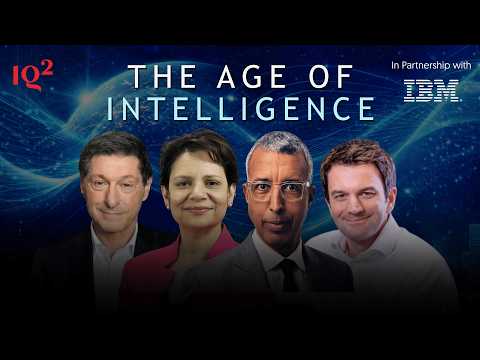
Intelligence Squared's The Age of Intelligence: skim's analysis identifies 13 key moments, with 1 potential conflict of interest flagged. Cybersecurity leaders Matt Rowe and Dimple Ahluwalia join journalists Kamal Ahmed and Jon Sopel to examine how artificial intelligence and quantum computing are reshaping cyber resilience, corporate governance, and global conflict.
Category: Tech. Format: Panel Discussion. YouTube video analyzed by skim.
skim AI Analysis
Credibility assessment: Seasoned Practitioner Insight. The panel brings together a major bank's Chief Security Officer, a senior IBM security leader, and veteran journalists. They cite concrete figures from IBM's annual data breach report and real-world incidents like Jaguar Land Rover and Marks & Spencer, though IBM's sponsorship introduces a commercial lens on autonomous defense.
Bias assessment: Enterprise Defender Optimism. Co-hosted with IBM, the panel naturally leans toward enterprise technology solutions and strategic optimism for cyber defenders. While Jon Sopel and the audience highlight public fear and geopolitical dangers, Dimple Ahluwalia and Matt Rowe consistently frame AI and quantum tools as manageable business enablers.
Originality: 72% — Cross-Sector Synthesis. Pairing enterprise security chiefs with political journalists bridges technical cyber resilience, media blind spots, and geopolitical warfare. Concepts like the 3 a.m. human vulnerability test and inverting corporate IT policies to combat shadow AI offer fresh, practical framing for a broad audience.
Depth: 75% — Strategic & Operational. The discussion moves past surface-level alarmism to examine why breaches persist: legacy IT spaghetti, asymmetric attacker incentives, regulatory friction against threat sharing, and harvest-now-decrypt-later quantum risks. Time constraints limit deep technical dives into emerging areas like neurotechnology.
Key Points (13)
1. Matt Rowe says security must design out human error
Timestamp: 00:06:27 to 00:14:38
Prompted by Kamal Ahmed's 3 a.m. crisis test, Dimple Ahluwalia and Jon Sopel share moments of exhaustion where they nearly clicked a phishing link or misdirected a sensitive email. Matt Rowe argues that any security model relying on humans to always make the right choice under stress will fail. He concludes that security leaders must engineer controls that remove human fallibility from the loop.
Significance (High): Shifting responsibility from employee vigilance to resilient system design challenges corporate reliance on phishing training alone.
Sources in support: Kamal Ahmed (Host, Executive Editorial Director for Fortune Europe), Jon Sopel (Co-host of The News Agents, former BBC North America Editor), Dimple Ahluwalia (Global Offering Leader for IBM Cyber Defend, IBM Consulting), Matt Rowe (Chief Security Officer (CSO) at Lloyds Banking Group)
2. Kamal Ahmed cites $4.44M average breach cost
Timestamp: 00:14:46 to 00:17:48
Drawing on IBM's annual Cost of a Data Breach Report, Kamal Ahmed highlights that data breaches cost businesses an average of $4.44 million globally and $10.22 million in the United States, with healthcare suffering the highest expenses. He notes that breaches go uncontained for an average of 279 days and that ungoverned shadow AI can add up to $1 million per breach. These figures frame a severe financial and operational toll before the panel evaluates who holds the upper hand.
Significance (High): Quantifying breach costs and 279-day containment lags underscores why reactive security threatens corporate survival.
Sources in support: Kamal Ahmed (Host, Executive Editorial Director for Fortune Europe)
3. Defenders hold the strategic edge, says Ahluwalia
Timestamp: 00:18:44 to 00:25:47
While an audience poll reveals 84% believe attackers hold the advantage, Dimple Ahluwalia distinguishes between tactical publicity and strategic capability. She and Matt Rowe argue that AI and machine learning give defenders a long-term strategic edge because cybersecurity is a big-data problem where defenders hold homefield knowledge of their own environments. Jon Sopel counters that high-profile breaches like Jaguar Land Rover and a children's nursery make public fear completely understandable.
Significance (High): Reframing AI as a homefield defender tool challenges the prevailing consensus that automation only helps hackers.
Sources in support: Dimple Ahluwalia (Global Offering Leader for IBM Cyber Defend, IBM Consulting), Matt Rowe (Chief Security Officer (CSO) at Lloyds Banking Group)
Neutral sources: Kamal Ahmed (Host, Executive Editorial Director for Fortune Europe), Jon Sopel (Co-host of The News Agents, former BBC North America Editor)
4. Jon Sopel admits media ignores AI for political froth
Timestamp: 00:25:51 to 00:32:15
Jon Sopel confesses that political journalism and his own podcast, The News Agents, disproportionately cover daily Westminster leadership gossip and Donald Trump posts because those episodes draw higher immediate ratings than AI coverage. Yet he warns that AI is upending graduate jobs, public policy, and supply chains, citing a statistic that 60% of uninsured SMEs go under after a cyber attack. Matt Rowe agrees that protecting major institutions like Lloyds Banking Group is directly tied to safeguarding the wider UK economy and SME ecosystem.
Significance (Medium): Exposes a dangerous attention gap where media incentives starve the public of debate on structural technological risk.
Sources in support: Kamal Ahmed (Host, Executive Editorial Director for Fortune Europe), Jon Sopel (Co-host of The News Agents, former BBC North America Editor), Matt Rowe (Chief Security Officer (CSO) at Lloyds Banking Group)
5. Cybersecurity acts like seatbelts for business speed
Timestamp: 00:32:15 to 00:37:30
Dimple Ahluwalia likens built-in cybersecurity to the introduction of seatbelts in cars, arguing it enables enterprises to innovate and expand faster with confidence. She stresses that resilience requires assuming flaws will be exploited, practicing response plans repeatedly to build muscle memory, and verifying partner security across the supply chain. Matt Rowe adds that society must stop victim-shaming breached companies and instead focus on making the entire ecosystem safe by design.
Significance (Medium): Shifting from post-breach blame to ecosystem-wide safety and rehearsal encourages more honest threat preparation.
Sources in support: Dimple Ahluwalia (Global Offering Leader for IBM Cyber Defend, IBM Consulting), Matt Rowe (Chief Security Officer (CSO) at Lloyds Banking Group)
Neutral sources: Kamal Ahmed (Host, Executive Editorial Director for Fortune Europe)
6. Legacy IT and regulatory penalties hinder sharing
Timestamp: 00:37:30 to 00:43:12
Kamal Ahmed recalls former Royal Bank of Scotland CEO Stephen Hester describing legacy bank IT stacks as moldering spaghetti that cannot communicate across divisions. Dimple Ahluwalia explains that large enterprises also manage operational technology in water and transit systems that cannot be rapidly upgraded. She notes that while cross-industry learning is vital, fear of reputational damage and regulatory penalties often discourages companies from sharing breach intelligence.
Significance (Medium): Highlights how punitive regulations unintentionally silence breached firms, depriving peers of vital threat intelligence.
Sources in support: Kamal Ahmed (Host, Executive Editorial Director for Fortune Europe), Dimple Ahluwalia (Global Offering Leader for IBM Cyber Defend, IBM Consulting)
7. US economic nationalism and Anthropic's Mythos model
Timestamp: 00:43:12 to 00:53:00
Jon Sopel argues that US bans on Chinese telecom giant Huawei and foreign port ownership blended genuine national security concerns with economic protectionism for American firms. Turning to current frontier AI, he points to Anthropic's decision to withhold its powerful Mythos model from the public while granting major financial institutions access via Project Glasswing to hunt for deep software vulnerabilities. Dimple Ahluwalia praises Anthropic's marketing and explains that IBM is already deploying autonomous security across identity, threat, and cloud silos to match AI attack speeds.
Significance (High): Illustrates how frontier AI models are uncovering decades-old code flaws, forcing defenders to automate response silos.
Sources in support: Kamal Ahmed (Host, Executive Editorial Director for Fortune Europe), Jon Sopel (Co-host of The News Agents, former BBC North America Editor), Dimple Ahluwalia (Global Offering Leader for IBM Cyber Defend, IBM Consulting)
8. Rowe counters shadow AI by upgrading work tools
Timestamp: 00:53:39 to 00:57:31
Addressing the risk of employees connecting unapproved consumer AI agents to corporate calendars and emails, Matt Rowe argues that acting as a 'ministry of no' only pushes staff toward shadow AI. Instead, Lloyds Banking Group provides superior, safe AI tools on corporate devices and even permits employees to use work technology for personal tasks. He stresses that because current frontier models are the least powerful they will ever be, advanced defensive capabilities must be democratized across the business ecosystem.
Significance (High): Inverting restrictive IT policies to offer superior in-house AI gives enterprises a practical way to curb shadow AI.
Sources in support: Matt Rowe (Chief Security Officer (CSO) at Lloyds Banking Group)
Neutral sources: Kamal Ahmed (Host, Executive Editorial Director for Fortune Europe)
9. US, Europe, and UK diverge on AI regulation
Timestamp: 00:57:31 to 01:00:37
Jon Sopel observes that while legislation lags behind technology, the United States is waking up to AI's societal impact beyond tech-founder rivalries. He contrasts America's lighter regulatory touch with Europe's heavier compliance rules, which risk leaving European firms behind, placing Britain somewhere between the two approaches. Citing a former GCHQ head, Sopel warns that state-backed false claims campaigns pose an epic threat to democratic politics.
Significance (Medium): Highlights the regulatory dilemma between stifling domestic AI innovation and leaving democracies exposed to foreign interference.
Sources in support: Jon Sopel (Co-host of The News Agents, former BBC North America Editor)
Neutral sources: Kamal Ahmed (Host, Executive Editorial Director for Fortune Europe)
10. Ahluwalia warns of harvest-now-decrypt-later quantum risk
Timestamp: 01:00:37 to 01:07:59
While boards often dismiss quantum computing as a distant five-year concern, Dimple Ahluwalia warns that adversaries are already executing 'harvest now, decrypt later' strategies. Stolen encrypted data with a shelf life exceeding 10 years, such as national identity and healthcare records, will be decrypted once quantum computers mature on Q-Day. She advises enterprises to inventory their cryptography now and build crypto-agility into routine server and software upgrades, while reassuring consumers that telecoms, banks, and browsers are handling the heavy lifting.
Significance (High): Demonstrates why post-quantum cryptography is an immediate data-governance problem for long-lived records, not a future one.
Sources in support: Dimple Ahluwalia (Global Offering Leader for IBM Cyber Defend, IBM Consulting), Matt Rowe (Chief Security Officer (CSO) at Lloyds Banking Group)
Neutral sources: Kamal Ahmed (Host, Executive Editorial Director for Fortune Europe)
11. Augmenting human creativity with intentional AI
Timestamp: 01:08:59 to 01:15:02
Responding to an audience question about how humans stay relevant, Matt Rowe cautions that AI will displace labor unless organizations intentionally design it to eliminate repetitive busywork so staff can move up the value chain. Dimple Ahluwalia frames the technology as augmented intelligence that frees workers to apply institutional knowledge and creativity. Jon Sopel illustrates the tangible upside with examples of an AI scribe saving his GP 15 minutes per appointment and ChatGPT accurately flagging a child's severe eye condition.
Significance (Medium): Distinguishes between passive labor replacement and deliberate workflow design that elevates human judgment and medical care.
Sources in support: Jon Sopel (Co-host of The News Agents, former BBC North America Editor), Dimple Ahluwalia (Global Offering Leader for IBM Cyber Defend, IBM Consulting), Matt Rowe (Chief Security Officer (CSO) at Lloyds Banking Group)
Neutral sources: Kamal Ahmed (Host, Executive Editorial Director for Fortune Europe)
12. Balancing breach recovery with shortened AI kill chains
Timestamp: 01:18:07 to 01:24:52
Tackling audience questions on breach recovery, budgeting, and geopolitics, Matt Rowe and Dimple Ahluwalia explain that security teams must treat patching as baseline hygiene while constantly rehearsing recovery plans to minimize business disruption. Turning to military geopolitics, Kamal Ahmed cites Professor Kate Crawford's warning that agentic AI has shortened the military kill chain in the Iran conflict. Jon Sopel adds that hypersonic missiles and cheap drone swarms leave no time for human chains of command, pushing militaries toward automated retaliation and lethal targeting errors like those seen in Gaza.
Significance (High): Connects corporate assume-breach resilience with the sobering reality of autonomous life-and-death decisions in modern warfare.
Sources in support: Kamal Ahmed (Host, Executive Editorial Director for Fortune Europe), Jon Sopel (Co-host of The News Agents, former BBC North America Editor), Dimple Ahluwalia (Global Offering Leader for IBM Cyber Defend, IBM Consulting), Matt Rowe (Chief Security Officer (CSO) at Lloyds Banking Group)
13. Containing AI agents and closing the talent gap
Timestamp: 01:27:28 to 01:35:44
In the final Q&A round, Matt Rowe distinguishes between AI agents acting on a user's behalf and fully autonomous agents, advising executives to restrict autonomous agents with fine-grained, ephemeral permissions in non-production sandboxes. Dimple Ahluwalia addresses offensive cyber by explaining how ethical hackers pressure-test defenses before deployment. Closing the evening, Ahluwalia notes that with millions of unfilled cybersecurity jobs globally, autonomous security can empower a three-person team to operate like a 30-person team.
Significance (High): Offers concrete governance guardrails for enterprise AI agents while showing how automation relieves the cyber talent shortage.
Sources in support: Jon Sopel (Co-host of The News Agents, former BBC North America Editor), Dimple Ahluwalia (Global Offering Leader for IBM Cyber Defend, IBM Consulting), Matt Rowe (Chief Security Officer (CSO) at Lloyds Banking Group)
Neutral sources: Kamal Ahmed (Host, Executive Editorial Director for Fortune Europe)
This analysis was generated by skim (skim.plus), an AI-powered content analysis platform by Credible AI. Scores and classifications represent the platform's AI-generated assessment and should be considered alongside other sources.