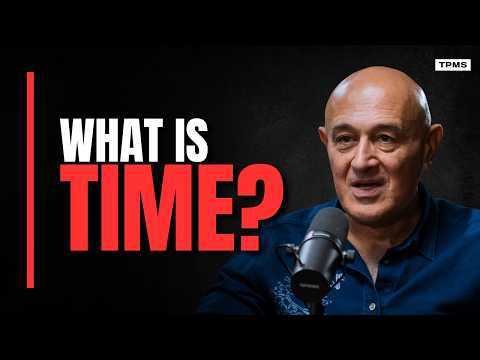
The Mind-Bending Understanding of Time | Prof. Jim Al-Khalil
Peter McCormack
Summary
Theoretical physicist Jim Al-Khalili joins host Peter McCormack to explore the divide between human perception and the fundamental laws of nature. While our minds experience a continuous flow of manifest time, Albert Einstein's general relativity treats all moments as equally real across four-dimensional spacetime, curving under gravity in ways that make smartphone GPS possible and produce black hole singularities. At subatomic scales, however, smooth spacetime geometry clashes with probabilistic quantum mechanics. Al-Khalili explains how laboratory tests of John Bell's inequality by John Clauser and Alain Aspect proved that entangled particles communicate non-locally, and why he favors quantum realism and pilot-wave theory over Niels Bohr's Copenhagen view.
The conversation also examines how modern tools and observations shape cosmology's biggest open questions. Reviewing recent reports of AI systems formalizing Fermat's Last Theorem in 11 days, Al-Khalili notes that while AI cannot yet invent fundamental physics theories, it is well suited to analyzing vast satellite telescope datasets to investigate dark matter and the accelerating cosmic expansion driven by dark energy. Finally, he explains why the universe has no physical edge beyond our 40-plus billion light-year observational horizon, expressing his personal preference for a finite, closed cosmos.
How time-sensitive the topic is: Evergreen
By the numbers
47 years old: Host Peter McCormack's stated age while reflecting on how much time he has left. (Mentioned at 1:20)
8 minutes: Time it takes for light and gravitational field changes from the sun to reach Earth. (Mentioned at 22:15)
6 universities: Three UK and three US universities involved in Jim Al-Khalili's physics and philosophy research project. (Mentioned at 40:48)
1637 year: Year Pierre de Fermat first proposed Fermat's Last Theorem. (Mentioned at 43:17)
1994 year: Year British mathematician Andrew Wiles proved Fermat's Last Theorem. (Mentioned at 43:47)
11 days: Reported time taken in September 2026 to complete the first computer-checked formalization of Fermat's Last Theorem using AI. (Mentioned at 44:30)
58 million dollars: Seed funding raised by Cambridge-based Physical Superintelligence led by Breakthrough Energy. (Mentioned at 49:49)
100,000 years: Time required for light to travel from one end of our galaxy to the other as measured on Earth. (Mentioned at 53:01)
1998 year: Year astronomers discovered that the expansion of the universe is accelerating, leading to the concept of dark energy. (Mentioned at 1:04:28)
13.8 billion years: Age of the universe and the duration light from the edge of the visible universe has been traveling. (Mentioned at 1:07:58)
Questions this video answers
What is the difference between psychological time and time in the laws of physics?
Psychological or manifest time is our subjective experience of a present moment flowing continuously from the past into the future. In the equations of physics and general relativity, there is no flow of time or special present moment; all times exist equally along the fourth dimension of spacetime, which can be warped by gravity.
Jim Al-Khalili, 1:33 to 7:43
From this keypoint: Manifest Time vs Physics, According to Al-Khalili
Why does phone GPS navigation prove Einstein's theory of general relativity?
According to general relativity, gravity curves spacetime and causes clocks to tick at different rates depending on the strength of the gravitational field. Because GPS satellites orbit high above Earth's stronger surface gravity, their onboard clocks experience gravitational time dilation that must be accounted for to pinpoint locations accurately on Google Maps.
Jim Al-Khalili, 1:33 to 7:43
From this keypoint: Manifest Time vs Physics, According to Al-Khalili
Why is it so difficult to unify general relativity and quantum mechanics?
General relativity describes gravity on cosmic scales as the smooth, continuous geometry of four-dimensional spacetime, whereas quantum mechanics describes the subatomic world using discrete particles, waves, and probabilities. Physicists do not yet know how to merge these two fundamentally different mathematical frameworks to describe extreme environments like black hole singularities.
Jim Al-Khalili, 16:19 to 19:13
From this keypoint: Jim Al-Khalili on Unifying Gravity and Quantum Law
How did Bell's inequality experiments prove Einstein wrong about quantum entanglement?
Albert Einstein argued that entangled particles could not influence each other instantaneously across space because nothing can travel faster than light. Following John Bell's 1960s mathematical test, Nobel-winning laser polarization experiments by John Clauser and Alain Aspect demonstrated that measuring one entangled particle instantaneously affects its partner nonlocally.
Jim Al-Khalili, 22:58 to 27:55
From this keypoint: Bell's Inequality Proved Quantum Nonlocality
What is the difference between the Copenhagen interpretation and quantum realism?
Niels Bohr's Copenhagen view states that quantum properties do not exist prior to measurement and physicists should only care about experimental probabilities. Quantum realists like Jim Al-Khalili argue an objective physical reality exists even when unobserved, offering competing models such as the Many-Worlds multiverse, spontaneous collapse, and de Broglie-Bohm pilot waves.
Jim Al-Khalili, 27:56 to 36:12
From this keypoint: Al-Khalili Favors Pilot Waves Over Copenhagen
How did Carl Sagan's novel Contact lead Kip Thorne to develop wormhole physics?
While writing Contact in the 1980s, Carl Sagan asked physicist Kip Thorne for a scientifically plausible way to travel across the galaxy quickly. Thorne solved Einstein's equations to propose a wormhole shortcut through space, realizing in the process that because space and time are unified, a spatial wormhole also acts as a time machine.
Jim Al-Khalili, 7:47 to 10:47
From this keypoint: Higher Dimensions and Kip Thorne's Wormholes
Could the Big Bang have been a white hole on the other side of a black hole?
A spinning black hole mathematically contains a ring singularity rather than a zero-size point, which led physicists to wonder if falling through could lead to a time-reversed white hole resembling the Big Bang. However, mathematical analyses indicate white holes are highly unstable because ejected matter quickly falls back in and collapses the structure into a black hole.
Jim Al-Khalili, 11:03 to 16:18
From this keypoint: Black Hole Singularities and White Hole Limits
What would happen to Earth's orbit if the sun suddenly disappeared?
Contrary to Isaac Newton's theory of instantaneous gravitational attraction, general relativity shows that gravity propagates through spacetime at the speed of light. If the sun disappeared, it would take just over eight minutes for both the last sunlight and the gravitational ripple to reach Earth.
Jim Al-Khalili, 19:14 to 22:55
From this keypoint: Warped Spacetime and the 8-Minute Gravity Delay
What evidence proves dark matter is real rather than just a flaw in gravity equations?
Dark matter is observed gravitationally in three ways: it keeps outer stars in spinning galaxies from flying away, bends background light via gravitational lensing, and clumped early after the Big Bang because it does not exchange photons. Alternative modified gravity theories like MOND struggle to explain all of these independent cosmological observations simultaneously.
Jim Al-Khalili, 57:03 to 1:06:08
From this keypoint: Why Al-Khalili Calls Dark Matter Invisible Matter
Why did astronomers invent the concept of dark energy in 1998?
In 1998, astronomers measuring light from distant galaxies realized those galaxies were receding more slowly in the distant past than expected, meaning cosmic expansion is accelerating today rather than slowing down under gravity. Dark energy was coined as a placeholder name for whatever unknown repulsive effect is driving that acceleration.
Jim Al-Khalili, 57:03 to 1:06:08
From this keypoint: Why Al-Khalili Calls Dark Matter Invisible Matter
What is exotic matter and why is it needed for wormhole space travel?
To keep a traversable wormhole from collapsing, physics requires exotic matter with negative energy and negative mass, a concept linked to Heisenberg's time-energy uncertainty principle where the vacuum briefly borrows energy. Creating permanent macroscopic quantities of negative mass is a technological problem that may take a thousand years or be ruled out by quantum gravity.
Jim Al-Khalili, 52:35 to 57:02
From this keypoint: Relativistic Travel Limits and Negative-Mass Matter
How can the universe be finite without having an edge?
Just as the two-dimensional surface of the Earth has a finite area but no edge you can fall off, three-dimensional space can be curved and closed in on itself so traveling in a straight line eventually brings you back to your starting point. The 40-billion-light-year boundary we observe is only our visible horizon based on how far light has traveled since the Big Bang.
Jim Al-Khalili, 1:06:10 to 1:09:59
From this keypoint: A Finite Closed Universe Without an Edge
Credible AI™ signals
Confidence: Academic Physics Grounding. Jim Al-Khalili is a professor of theoretical physics at the University of Surrey who clearly distinguishes established experimental physics from mathematical speculation and competing quantum interpretations. The host reads out unverified online summaries of AI math breakthroughs during one segment.
Bias: Quantum Realist Lean. The conversation is overwhelmingly educational and transparent about scientific consensus. When discussing unsettled areas, Jim Al-Khalili openly identifies his preference for quantum realism and pilot-wave theory over the Copenhagen interpretation, while fairly explaining rival views.
Originality (74%): Accessible Deep Synthesis. While the foundational concepts of general relativity, quantum entanglement, and cosmology are well-covered in popular science, the interview connects them freshly to contemporary AI mathematical formalization and the growing collaboration between physicists and philosophers of physics.
Depth (79%): Clear Conceptual Rigor. Designed as a layperson-friendly conversation, the dialogue avoids heavy equations but unpacks the conceptual mechanics behind gravitational time dilation, Bell's inequality, vacuum energy debt, and early-universe dark matter clumping without oversimplifying the underlying paradoxes.
Key points (12)
Short (26 min): key points 1, 4, 7 and 11
Medium (45 min): key points 1, 4, 6, 7, 9, 11 and 12
Relaxed (1h 7min): all 12 key points
1. Manifest Time vs Physics, According to Al-Khalili
Timestamp: 00:01:33 to 00:07:43 (6 min)
Speaker: Jim Al-Khalili
Humans experience psychological or manifest time as a relentless flow from past to future, measured by invented units like seconds and hours. In the equations of physics, however, time does not flow at all; all moments exist equally along the spacetime axis, and gravity physically stretches or squeezes time depending on field strength. Gravitational time dilation is so real that GPS satellites must correct for it to keep phone navigation working.
Impact: High. Why it matters: Separating psychological time from relativistic spacetime explains why physics treats past, present, and future as equally real while everyday human intuition insists only the fleeting present exists.
“what I find fascinating is this difference between what I call manifest time, which is our psychological experience of time, which seems so common sense, and then there's time in physics, in the laws of physics.”
In the video: Jim Al-Khalili, at 2:02
For: Peter McCormack
2. Higher Dimensions and Kip Thorne's Wormholes
Timestamp: 00:07:47 to 00:10:47 (3 min)
Speaker: Jim Al-Khalili
Curving four-dimensional spacetime mathematically implies a higher fifth dimension, which underpins the bookcase sequence in Interstellar. Producer and Nobel laureate Kip Thorne ensured the film's relativity was accurate, having earlier developed the mathematical concept of traversable wormholes in the 1980s when Carl Sagan asked for a realistic galactic shortcut for his novel Contact. Because space and time are unified, any wormhole shortcut through space mathematically functions as a two-way time machine.
Impact: Medium. Why it matters: Shows how a science fiction query from Carl Sagan prompted Kip Thorne to formalize wormhole spacetime shortcuts and time travel within peer-reviewed relativity mathematics.
“So he invents wormholes for Carl Sean and that becomes the book Contact and the movie Contact and and and in the process of doing that he also realizes that if you're going to have a shortcut through space it will also be a shortcut through time”
In the video: Jim Al-Khalili, at 10:06
Neutral: Peter McCormack
3. Black Hole Singularities and White Hole Limits
Timestamp: 00:11:03 to 00:16:18 (5 min)
Speaker: Jim Al-Khalili
Karl Schwarzschild first solved Einstein's field equations for a gravitationally collapsed star, defining the Schwarzschild radius and a central singularity where physics breaks down. Real stars spin, however, so a rotating black hole forms a ring singularity rather than a zero-size point, raising mathematical questions about passing through to a white hole. Following the sponsor break, Jim Al-Khalili concludes that although some compare the Big Bang to a white hole, mathematical models show white holes are unstable and quickly collapse back into black holes.
Impact: Medium. Why it matters: Clarifies that while general relativity equations permit exotic ring singularities and white holes on paper, physical instability prevents white holes from sustaining themselves in reality.
“a spinning black hole doesn't have a point singularity in the middle. It has a ring singularity and that leads to this idea of what might be on the other side”
In the video: Jim Al-Khalili, at 13:54
Neutral: Peter McCormack
4. Jim Al-Khalili on Unifying Gravity and Quantum Law
Timestamp: 00:16:19 to 00:19:13 (3 min)
Speaker: Jim Al-Khalili
Describing a subatomic black hole singularity requires combining general relativity with quantum mechanics, a challenge that has resisted physicists for half a century. General relativity uses continuous geometry to describe warped spacetime at cosmic scales, whereas quantum mechanics uses discrete particles, waves, and probabilities to govern three of the four fundamental forces. Candidate frameworks like string theory remain purely mathematical because nobody yet knows whether spacetime geometry emerges from quantum mechanics or vice versa.
Impact: High. Why it matters: Pinpoints the exact mathematical incompatibility at the heart of modern physics: smooth four-dimensional geometry cannot easily merge with probabilistic quantum fields.
“Einstein's general relativity is a theory about shapes, about geometry, the shape of spaceime. Whereas quantum mechanics isn't about geometry. It's about particles and waves and probabilities.”
In the video: Jim Al-Khalili, at 17:20
Neutral: Peter McCormack
5. Warped Spacetime and the 8-Minute Gravity Delay
Timestamp: 00:19:14 to 00:22:55 (4 min)
Speaker: Jim Al-Khalili
Unlike Isaac Newton's model of gravity as an instantaneous invisible force pulling masses together, Albert Einstein redefined gravity as the geometric warping of four-dimensional spacetime. Popular rubber-sheet illustrations reduce four dimensions to a two-dimensional surface and fail to capture true four-dimensional curvature. Crucially, gravitational changes propagate at the speed of light rather than instantaneously, meaning Earth would continue orbiting for just over eight minutes if the sun suddenly vanished.
Impact: Medium. Why it matters: Replaces the classroom notion of an instantaneous gravitational tether with a relativistic field whose ripples travel strictly at the speed of light.
“if the sun were to suddenly disappear, we wouldn't know about it for just over 8 minutes because it takes 8 minutes for light to reach us, but it'll also take 8 minutes for the absence of gravity”
In the video: Jim Al-Khalili, at 22:09
Neutral: Peter McCormack
6. Bell's Inequality Proved Quantum Nonlocality
Timestamp: 00:22:58 to 00:27:55 (5 min)
Speaker: Jim Al-Khalili
Albert Einstein rejected quantum entanglement as spooky action at a distance because he believed no influence could exceed the speed of light. In the mid-1960s, Irish physicist John Bell designed a testable inequality to settle the dispute, which John Clauser, Alain Aspect, and an Austrian team later tested in laboratory polarization experiments to win the Nobel Prize. Jim Al-Khalili argues that these experiments proved entangled particles communicate nonlocally in conflict with Einstein, calling attempts to dismiss the effect just because humans cannot send faster-than-light signals a cop-out.
Impact: High. Why it matters: Highlights how laboratory tests of Bell's inequality settled a foundational 20th-century debate against Einstein, establishing nonlocality as an experimentally observed feature of nature.
“Basically what they showed was Einstein was wrong. He couldn't con restrict communication below the speed of light. They're re these entangled particles really are communicating non-locally.”
In the video: Jim Al-Khalili, at 25:41
Neutral: Peter McCormack
7. Al-Khalili Favors Pilot Waves Over Copenhagen
Timestamp: 00:27:56 to 00:36:12 (8 min)
Speaker: Jim Al-Khalili
Physicists remain divided between Niels Bohr's Copenhagen interpretation, which holds that quantum properties do not exist until measured, and the quantum realist camp, which insists objective reality exists when unobserved. Within realism, competing models include the Many-Worlds multiverse, spontaneous collapse, and de Broglie-Bohm pilot-wave theory, which Jim Al-Khalili personally favors for keeping a single universe guided by a nonlocal quantum potential. Because all interpretations make identical experimental predictions in tests like the double-slit experiment, experiments cannot yet separate them, and Al-Khalili warns against conflating quantum mysteries with human consciousness.
Impact: High. Why it matters: Maps the ideological divide in modern quantum foundations, explaining why identical mathematical predictions keep rival models of reality deadlocked.
“There's another interpretation called de bruy bone pilot waves which actually is the one that I have a soft spot for. Okay. It says there's only one universe”
In the video: Jim Al-Khalili, at 30:02
Neutral: Peter McCormack
8. Bridging Physics and Philosophy of Physics
Timestamp: 00:36:37 to 00:42:03 (5 min)
Speaker: Jim Al-Khalili
Asked by Peter McCormack what mystery he most wants solved before he dies, Jim Al-Khalili ranks finding the true interpretation of quantum mechanics above even the origin of time at the Big Bang. While questioning quantum meaning was dismissed as mere philosophy when Al-Khalili was a PhD student in the 1980s, foundational questions are now respectable within physics. He recently led a six-university research collaboration across the UK and US uniting theoretical physicists, mathematicians, and philosophers of physics to translate abstract concepts and equations into a shared framework.
Impact: Low. Why it matters: Demonstrates a cultural shift in academia away from 'shut up and calculate' orthodoxy toward interdisciplinary work between physicists and philosophers.
“probably my number one on my bucket list of wanting to know is what is the correct interpretation of quantum mechanics.”
In the video: Jim Al-Khalili, at 36:39
For: Peter McCormack
9. AI Formalizing Math vs Discovering New Physics
Timestamp: 00:42:23 to 00:52:22 (10 min)
Speaker: Jim Al-Khalili
Looking up recent 2026 breakthroughs during the conversation, Peter McCormack and Jim Al-Khalili examine reports of Anthropic's AI completing a computer-checked formalization of Andrew Wiles's proof of Fermat's Last Theorem in 11 days, alongside OpenAI models tackling an 80-year-old Erdős problem and the Jacobian conjecture. While Al-Khalili views AI as a powerful tool for sifting massive astronomical datasets on dark matter and dark energy, he is skeptical of vague startup claims from Matthew Pines's $58 million company Physical Superintelligence about industrializing new physics. Real new physics, like magic-angle twisted bilayer graphene awarded at the Kavli Prize in Oslo, requires concrete material or experimental breakthroughs rather than buzzwords.
Impact: High. Why it matters: Separates genuine AI utility in mathematical verification and astronomical data processing from venture-backed hype claiming AI can autonomously invent new laws of physics.
“Certainly on the mathematical side on the more the the logical problem solving it's not yet to the point where it can tackle problems in physics”
In the video: Jim Al-Khalili, at 47:29
For: Peter McCormack
10. Relativistic Travel Limits and Negative-Mass Matter
Timestamp: 00:52:35 to 00:57:02 (4 min)
Speaker: Jim Al-Khalili
Crossing the Milky Way takes light 100,000 years, and while relativistic time dilation would let a near-light-speed astronaut make the trip in a single day of ship time, 100,000 years would still pass on Earth. Bypassing this limit via a traversable wormhole requires holding the tunnel open with exotic matter possessing negative energy and negative mass, derived from Heisenberg's time-energy uncertainty principle where the quantum vacuum temporarily goes into energy debt. Sustaining macroscopic negative mass is at least a thousand-year technological hurdle, and a future theory of quantum gravity may rule out traversable wormholes and closed timelike curves altogether.
Impact: Medium. Why it matters: Explains why deep-space human travel faces brutal relativistic and quantum barriers that neither near-light propulsion nor theoretical wormholes can practically overcome.
“The the the the fun thing is that you could travel below the speed of light and get there in a day. But that's a day according to your time because your time has slowed down. on Earth, it's taking a 100 thousand years”
In the video: Jim Al-Khalili, at 53:03
Neutral: Peter McCormack
11. Why Al-Khalili Calls Dark Matter Invisible Matter
Timestamp: 00:57:03 to 01:06:08 (9 min)
Speaker: Jim Al-Khalili
First proposed by Fritz Zwicky in the 1930s, dark matter is better described as invisible or transparent matter because it lacks electromagnetic interactions but reveals itself through gravity. It prevents outer stars in spinning spiral galaxies from flying off, bends distant light via gravitational lensing, and cooled faster than photon-exchanging normal matter after the Big Bang to seed the cosmic web. By contrast, dark energy was an unexpected 1998 discovery when astronomers found distant galaxies were receding more slowly in the past, proving cosmic expansion is accelerating.
Impact: High. Why it matters: Distinguishes the robust multi-channel observational evidence for dark matter from the complete mystery of dark energy driving cosmic acceleration.
“Dark matter should not be called dark matter. It should be called invisible matter or or or transparent matter because we know it's out there. It has gravity. It's holding galaxies together.”
In the video: Jim Al-Khalili, at 57:44
Neutral: Peter McCormack
12. A Finite Closed Universe Without an Edge
Timestamp: 01:06:10 to 01:09:59 (4 min)
Speaker: Jim Al-Khalili
Addressing Peter McCormack's confusion over how the universe lacks a physical boundary, Jim Al-Khalili compares three-dimensional space to the two-dimensional curved surface of a sphere, which is finite yet has no edge. The observable universe has a horizon over 40 billion light-years away because space expanded while light traveled for 13.8 billion years, but galaxies beyond that horizon simply see their own surrounding sphere. Because an infinite universe would have had to be infinite even at the Big Bang, Al-Khalili prefers the idea that the universe is finite and closed in on itself.
Impact: Medium. Why it matters: Resolves the common paradox of a boundary-free universe by separating the 40-billion-light-year observable horizon from the global geometry of closed spacetime.
“So I would prefer just so it help me sleep at night that the universe is finite and potentially that it's closed in on itself like a higher dimensional version of the earth's surface”
In the video: Jim Al-Khalili, at 1:09:40
Neutral: Peter McCormack
Conflicts of interest (2)
IREN AI Cloud Sponsorship
Commercial conflict, Medium severity
Host Peter McCormack reads a paid lead-sponsor advertisement for IREN, an AI cloud and GPU data center operator, during an episode that later discusses AI data centers and AI-driven scientific computing.
Sources: Peter McCormack, IREN
Significance: Commercial backing from an AI infrastructure provider gives the host an incentive to frame AI compute expansion and data center applications enthusiastically.
Author Promotion of On Time and Sunfall
Commercial conflict, Low severity
Guest Jim Al-Khalili promotes his newly released popular science book On Time and his science fiction novel Sunfall at the conclusion of the interview.
Sources: Jim Al-Khalili
Significance: The interview's central focus on psychological versus physical time directly mirrors the thesis of the guest's commercial book release.
Key sources
Jim Al-Khalili: Theoretical Physicist, Professor at the University of Surrey, and Author
Peter McCormack: Podcast Host
Who's in this
Albert Einstein
Isaac Newton
Kip Thorne
Carl Sagan
Karl Schwarzschild
Stephen Hawking
John Bell
John Clauser
Alain Aspect
Niels Bohr
Werner Heisenberg
Erwin Schrödinger
Andrew Wiles
Matthew Pines
Physical Superintelligence
Fritz Zwicky
IREN
Ledn
Also mentioned
Earth (First mentioned at 1:53)
Interstellar (First mentioned at 7:25)
Contact (First mentioned at 9:33)
Pierre de Fermat (First mentioned at 42:39)
Anthropic (First mentioned at 44:22)
OpenAI (First mentioned at 45:47)
Milky Way (First mentioned at 58:14)
On Time (First mentioned at 1:10:27)
Sunfall (First mentioned at 1:11:10)
Mindscape (First mentioned at 1:26)
Google Maps (First mentioned at 7:01)
Jodie Foster (First mentioned at 9:36)
Focus (First mentioned at 10:51)
New Scientist (First mentioned at 10:56)
Eric Weinstein (First mentioned at 18:27)
Paris (First mentioned at 25:28)
Austria (First mentioned at 25:33)
Denmark (First mentioned at 28:07)
Everything Everywhere All at Once (First mentioned at 29:47)
Bitcoin (First mentioned at 32:25)
Tether Gold (First mentioned at 32:36)
Karl Popper (First mentioned at 39:11)
Oxford (First mentioned at 40:57)
Bristol (First mentioned at 40:59)
California (First mentioned at 40:59)
Arithmetica (First mentioned at 43:41)
Pythagoras (First mentioned at 44:00)
Tim Gowers (First mentioned at 45:51)
GPT-5.4 Pro (First mentioned at 46:00)
Breakthrough Energy Ventures (First mentioned at 49:51)
Oslo (First mentioned at 50:42)
This analysis was generated by skim (skim.plus), an AI-powered content analysis platform by Credible AI. Scores and classifications represent the platform's AI-generated assessment and should be considered alongside other sources.