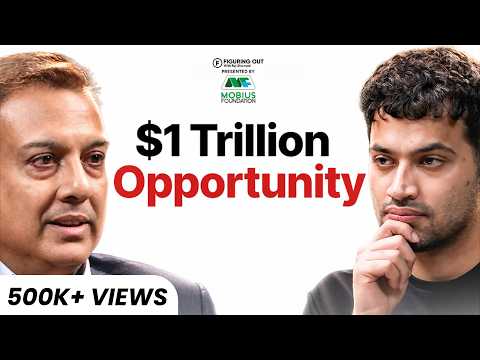
Raj Shamani's The Next Big Energy Opportunity: Solar, Wind, Batteries & Hydrogen | Sumant Sinha |FO568 Raj Shamani: skim's analysis identifies 14 key moments, with 2 potential conflicts of interest flagged. ReNew CEO Sumant Sinha breaks down the global energy transition, explaining why electricity represents only 20% of total energy consumption and how China captured the clean-tech supply chain.
Category: Business. Format: Interview. YouTube video analyzed by skim.
skim AI Analysis
Credibility assessment: Seasoned Industry Insider. Sumant Sinha speaks from 17-18 years of direct executive experience at Suzlon and ReNew, anchoring his macro analysis in specific capacity figures, supply chain mechanics, and policy structures. Claims are well-attributed to his perspective, though policy recommendations naturally align with his commercial interests.
Bias assessment: Domestic Clean-Tech Protection. The discussion strongly favors Indian renewable energy expansion and domestic manufacturing protectionism against Chinese imports. While Sinha candidly admits corporate India's R&D shortcomings and coal's 50-year persistence, his policy prescriptions directly benefit domestic clean-tech operators like ReNew.
Originality: 76% — Granular Sector Breakdown. Beyond standard energy transition talking points, the conversation delivers specific operational comparisons, such as contrasting India's single national grid with America's seven fragmented grids, and mapping out the four-stage solar manufacturing value chain from quartz to module.
Depth: 82% — Systems-Level Energy Analysis. Sinha connects climate physics, grid engineering, geopolitics, and capital market incentives into a cohesive framework. He distinguishes between the 20% electricity share and total energy consumption, and explains how capital asset lifespans in shipping and steel lock in fossil fuel demand.
Key Points (14)
1. Electricity Is Only 20% of Global Energy, Says Sinha
Timestamp: 00:03:16 to 00:12:39
Sumant Sinha explains that electricity makes up only 20% of total global energy consumption, while heating, cooling, transport, and industrial processes like steel and cement account for the rest. Energy consumption drives 75% to 80% of global carbon emissions, threatening India's monsoons, coastal cities, and Himalayan glaciers if warming exceeds 1.5 degrees Celsius. Although wind and solar currently provide only 15% to 16% of electricity, Prime Minister Modi's aggressive targets scaled the sector until renewables became cheaper than coal.
Significance (High): Framing renewables as 15% of a 20% slice exposes the massive scale of the remaining transition while showing how falling costs shifted the driver from climate charity to economic self-interest.
Sources in support: Sumant Sinha (Founder, Chairman and CEO of ReNew)
Neutral sources: Raj Shamani (Entrepreneur and Host of the Figuring Out Podcast)
2. India's Power Capacity Will Double by 2035
Timestamp: 00:13:39 to 00:19:23
Sinha details that India's 550 gigawatts of power capacity generates 1.8 trillion kilowatt-hours annually, growing at 6% per year even after 1.5% to 2% efficiency gains. Meeting this demand requires adding 60 to 70 gigawatts of renewable capacity annually, which will double India's total capacity to 1,100 gigawatts and consumption to 3.6 trillion units by 2035. While China leads at roughly 2,500 gigawatts and added 60% of global renewable capacity last year, India has surpassed the US to become the second-fastest-growing renewable market.
Significance (High): Quantifying India's trajectory to 750 gigawatts of renewables by 2035 underscores why new coal plants are stalling and establishes the baseline demand for domestic infrastructure.
Sources in support: Sumant Sinha (Founder, Chairman and CEO of ReNew)
Neutral sources: Raj Shamani (Entrepreneur and Host of the Figuring Out Podcast)
3. Falling Battery Costs and Grid Expansion
Timestamp: 00:19:23 to 00:24:51
Addressing how to harness solar power, Sinha notes that solar costs have fallen tenfold over 18 to 19 years, and declining battery costs are making solar-plus-storage cheaper than any alternative. Rapid renewable growth over the past two years created midday power surpluses and evening deficits, requiring an urgent buildout of a national lattice grid over the next two to three years. With India's top 10 conglomerates and private equity pouring capital into generation, Sinha expects India to face an oversupply of power rather than a shortage.
Significance (High): Near-parity for solar-plus-storage removes the intermittency barrier, shifting the primary bottleneck from power generation to transmission lines and grid balancing.
Sources in support: Sumant Sinha (Founder, Chairman and CEO of ReNew)
Neutral sources: Raj Shamani (Entrepreneur and Host of the Figuring Out Podcast)
4. Why America Faces an AI Grid Crisis
Timestamp: 00:24:51 to 00:28:22
Sinha explains that US AI founders are panicking over electricity because America is divided into seven separate grids that cannot easily transfer wind power from Texas or the Midwest to California or New York. After years of flat US demand, AI has triggered unexpected 2% to 3% electricity growth, forcing data centers to seek behind-the-meter nuclear, geothermal, or gas power. In contrast, India operates a single national grid and already handles 5% to 6% annual demand growth, making an extra 1% from AI manageable.
Significance (High): Contrasting America's fragmented transmission system with India's unified grid explains why US tech giants are buying up nuclear power while India can absorb AI data centers on its main grid.
Sources in support: Sumant Sinha (Founder, Chairman and CEO of ReNew)
Neutral sources: Raj Shamani (Entrepreneur and Host of the Figuring Out Podcast)
5. Sinha Maps China's 25-Year Clean-Tech Lock
Timestamp: 00:28:22 to 00:39:07
Sinha argues that 25 years ago, China realized it needed to escape oil import dependence and systematically localized the global clean-tech supply chain. After inviting Western manufacturers in and absorbing their technology, China captured downstream assembly, capital equipment manufacturing, next-generation R&D, and mineral refining from places like the Congo. Because India cannot safely trade a $150 billion to $200 billion annual fossil fuel import habit for single-country solar dependence on China, India is now blocking Chinese modules and cells to work backwards up the four-part solar value chain.
Significance (High): Exposing the four layers of China's dominance shows that simply assembling solar panels in India is insufficient without localizing wafers, polysilicon, machinery, and mineral refining.
Sources in support: Sumant Sinha (Founder, Chairman and CEO of ReNew), Raj Shamani (Entrepreneur and Host of the Figuring Out Podcast)
6. 89% of the World Lives in Fossil-Poor Nations
Timestamp: 00:39:07 to 00:43:17
Reflecting on why other countries missed China's early move, Sinha notes that India was historically too inward-looking, though it now possesses the market scale and leadership to transition quickly. Globally, 89% of the world's population lives in fossil-fuel-importing nations like India, China, and Europe, while only 11% live in fossil-fuel-exporting states. As energy supply chains are weaponized, importing nations face urgent pressure to transition from fossil fuel importers into self-reliant electro-states.
Significance (Medium): Dividing the world into the 11% fossil-rich exporters and 89% importers frames clean electrification as an inevitable geopolitical revolt by the global majority.
Sources in support: Sumant Sinha (Founder, Chairman and CEO of ReNew)
Neutral sources: Raj Shamani (Entrepreneur and Host of the Figuring Out Podcast)
7. US Fossil Exports vs. Europe's High-Cost Trap
Timestamp: 00:43:17 to 00:54:16
Sinha contrasts the US and Europe, pointing out that the US is now the world's largest fossil fuel exporter, surpassing Saudi Arabia, and has doubled down on oil and gas under its current administration while pulling out of COP agreements. Meanwhile, Europe outsourced manufacturing to China, relied on Russian gas until the Ukraine war, and now faces high energy costs, fragmented EU decision-making, and a 30% to 40% per capita income gap behind the US. Although Middle Eastern and Russian conflicts temporarily force India and Europe to buy US gas and LPG, Sinha argues this volatility accelerates the long-term push to electrify.
Significance (High): Highlighting America's role as the top fossil fuel exporter explains Washington's policy swings, while Europe's industrial squeeze serves as a cautionary tale against energy dependence.
Sources in support: Sumant Sinha (Founder, Chairman and CEO of ReNew), Raj Shamani (Entrepreneur and Host of the Figuring Out Podcast)
8. China Leads the Race Toward an Electric Future
Timestamp: 00:54:16 to 01:02:03
Comparing global powers over the next 20 years, Sinha places China at the top of the electric bucket with an insurmountable lead in minerals, rare earths, and clean-tech scale, while the US leads the fossil fuel bucket. Because technological ingenuity continually lowers electric costs whereas fossil fuels require extraction, Sinha predicts the global shift toward electricity will favor China within 10 to 15 years. To avoid trading fossil fuel dependence for Chinese supply chain dependence, India must simultaneously electrify and localize its domestic manufacturing over the next decade.
Significance (High): Framing energy as a contest between technology-driven electricity and extraction-driven fossil fuels explains why fossil fuel supply shocks will ultimately backfire on exporters.
Sources in support: Sumant Sinha (Founder, Chairman and CEO of ReNew)
Neutral sources: Raj Shamani (Entrepreneur and Host of the Figuring Out Podcast)
9. Sinha Critiques Corporate India's R&D Deficit
Timestamp: 01:02:03 to 01:10:28
When Raj Shamani presses him on why Indian conglomerates underinvest in research, Sinha admits that intense competition and quarterly capital market pressures keep Indian firms focused on immediate survival and execution. He contrasts a single New York state university receiving a $400 million US government battery research grant with the entirety of corporate India's R&D spending, noting weak collaboration between Indian academia and industry. As ReNew expands into solar cell manufacturing, it has begun funding perovskite research and established a center at IIT Delhi, while major conglomerates like Adani, NTPC, Reliance, and Tata crowd into the sector.
Significance (Medium): Sinha's candid admission that ReNew prioritized survival and 2-to-3 billion dollar annual capex over deep R&D highlights a critical vulnerability in India's ambition to match China.
Sources in support: Sumant Sinha (Founder, Chairman and CEO of ReNew), Raj Shamani (Entrepreneur and Host of the Figuring Out Podcast)
10. Three Policy Bets to Make India an Energy Leader
Timestamp: 01:10:28 to 01:18:11
Sinha explains that phasing out coal—which provides 65% of electricity—will take 50 years because existing coal plants, ships, and blast-furnace steel mills have 30-to-40-year lifespans. Advising the Prime Minister on how to make India an energy leader in 25 years, Sinha proposes three bets: protecting domestic clean-tech manufacturing via broad import barriers rather than flawed PLI bidding schemes, subsidizing downstream user industries like EVs and public transit, and rapidly accelerating grid and battery deployment. These three policy pillars form the foundation for fast national electrification.
Significance (High): Sinha's critique that aggressive PLI bidding and tight government conditions cause manufacturers to back off offers a rare, pointed industry assessment of flagship industrial policy.
Sources in support: Sumant Sinha (Founder, Chairman and CEO of ReNew), Raj Shamani (Entrepreneur and Host of the Figuring Out Podcast)
11. Why Everyday Citizens Need the Energy Transition
Timestamp: 01:18:11 to 01:23:48
Asked by Raj Shamani to explain why an ordinary citizen should care about the energy transition, Sinha highlights three practical drivers: cutting severe local air pollution from coal plants and winter vehicular smog in cities like Delhi, lowering household costs through rooftop solar subsidies and cheaper long-term EV operation, and protecting future generations from climate change. Both speakers agree that citizens must view clean energy adoption as a national mission so that foreign wars and oil price spikes stop impoverishing Indian households.
Significance (Medium): Translating macro energy policy into breathable winter air and household savings bridges the gap between national geopolitics and consumer behavior.
Sources in support: Sumant Sinha (Founder, Chairman and CEO of ReNew), Raj Shamani (Entrepreneur and Host of the Figuring Out Podcast)
12. Startup Opportunities in EPC and Grid Software, Says Sinha
Timestamp: 01:24:28 to 01:36:27
Evaluating where young entrepreneurs can build businesses, Sinha cautions that competing with subsidized Chinese manufacturers in components like junction boxes or inverters depends entirely on Indian government import protection. For founders without massive capital, he recommends ground-level services: building a credible, professionally managed Engineering, Procurement, and Construction (EPC) firm in a 100,000-crore market, developing battery and weather-forecasting software, enabling time-of-day pricing for utilities, and creating smart home energy management systems alongside clean power supply for data centers.
Significance (High): Pointing founders away from capital-heavy manufacturing toward a 100,000-crore unorganized EPC market and grid software provides an actionable roadmap for Indian clean-tech startups.
Sources in support: Sumant Sinha (Founder, Chairman and CEO of ReNew)
Neutral sources: Raj Shamani (Entrepreneur and Host of the Figuring Out Podcast)
13. Developing Talent In-House and Redefining Smartness
Timestamp: 01:36:28 to 01:45:19
Sharing personal and professional pain points, Sinha wishes automakers would put electric engines into regular cars with abundant fast chargers rather than over-complicating EV designs, and describes external executive hiring as a gamble that takes six to twelve months to evaluate. Having operated for over a decade, ReNew now prioritizes promoting internal talent who share its ethical culture. Citing Jensen Huang, Sinha argues that as AI replaces coding and routine analysis, true smartness is defined by judgment and seeing around corners, while organizations must blend Tata's ethics, Indian conglomerates' execution, and Western startups' agility.
Significance (Medium): Treating internal talent development like long-term R&D offers founders a practical defense against executive mis-hires in fast-scaling industries.
Sources in support: Sumant Sinha (Founder, Chairman and CEO of ReNew), Raj Shamani (Entrepreneur and Host of the Figuring Out Podcast)
14. Sinha on Entrepreneurship at 45 and Ambition at 61
Timestamp: 01:45:19 to 01:49:55
Reflecting on becoming an entrepreneur at age 45, Sinha states he feels joy rather than personal sacrifice, crediting his supportive wife Vaishali, strong shareholders, and board for sustaining him through inevitable business setbacks. He emphasizes that resilience—the ability to get knocked down and pick oneself back up despite not having a thick skin—is the most critical human trait for any founder. Now at age 61, Sinha says he is more ambitious than he was at 21 because experience and maturity allow him to clearly see the future and what is achievable.
Significance (Low): Sinha's reflection counters the startup myth of youthful burnout, showing how late-career founders leverage pattern recognition to expand their ambition.
Sources in support: Sumant Sinha (Founder, Chairman and CEO of ReNew), Raj Shamani (Entrepreneur and Host of the Figuring Out Podcast)
This analysis was generated by skim (skim.plus), an AI-powered content analysis platform by Credible AI. Scores and classifications represent the platform's AI-generated assessment and should be considered alongside other sources.