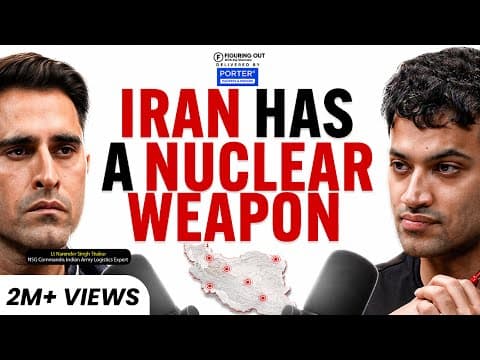
The Invisible Nuclear Bomb - Strait of Hormuz & Global Economy | Lt Col Narender | FO484 Raj Shamani
Cost Asymmetry in Modern Warfare
The cost of modern warfare creates a significant asymmetry. Iran's strategy involves making the conflict so expensive for the US and its allies that global pressure mounts for a resolution. The daily cost for the US, including carrier groups and missile defense, runs into billions, while Iran's low-cost drones are a fraction of the price of interceptors.
US Adoption of Adversary's Drone Technology
The US is reportedly using the 'Lukas' drone, a low-cost, re-engineered version of Iran's Shahed drone. This adoption highlights the effectiveness of Iran's drone design and the strategic shift where a technologically superior power resorts to using its adversary's own proven, cost-effective technology.
Understanding Air Defense Systems: The Iron Dome Example
Air defense systems like Israel's Iron Dome comprise four key components: radar for detection, control units for calculation, and interceptors to neutralize threats. The Iron Dome's fame stems from its layered defense, strong radar, and effective control units, though it's a system for intercepting projectiles, not a physical dome.
Iron Dome vs. India's S400/Sudarshan Chakra
While Israel's Iron Dome is a comprehensive system, comparing it directly with India's S400 and Akash (Sudarshan Chakra) is difficult without facing similar barrages. India's indigenous Akash system has shown excellent performance, and its layered approach is robust.
Iran's Missile Arsenal and Capabilities
Iran possesses a substantial arsenal of medium-range ballistic missiles (MRBMs), estimated between 2,000 to 3,000, developed domestically. These missiles are strategically dispersed in underground platforms, making them difficult to neutralize.
Black Rain: A Devastating Environmental Hazard
The 'Black Rain' phenomenon, resulting from the burning of oil refineries and depots, creates toxic clouds that can cause severe health issues, including cancer, and contaminate agricultural land for years. This environmental weaponization poses a long-term threat.
US as an Unreliable Partner
The US is increasingly perceived as an unreliable partner due to its indecisiveness in conflicts, its tendency to intervene, and its failure to fully protect allies. This erodes trust and complicates international relations.
India's Strategic Autonomy in Global Crises
India consistently acts as a reliable friend during global crises, offering support to various nations. This is exemplified by its stance on taking Russian oil, a decision driven by strategic autonomy and national interest, despite external pressures. The speaker emphasizes that India makes its own calculations and acts independently.
Russia's Economic Resilience Amidst Sanctions
Despite sanctions, Russia is technically winning the war economically due to rising oil prices. Every $10 increase in oil prices significantly boosts Russia's revenue, allowing it to offset losses and potentially avoid budget deficits. This economic resilience suggests Russia may not be eager to end the conflict.
Geopolitical Miscalculations and the Difficulty of War Termination
Wars are difficult to terminate, often prolonged by ego and the desire for more victory or the inability to accept defeat. India's swift termination of the 1971 war after achieving its objectives is contrasted with ongoing conflicts where termination proves elusive. This difficulty can lead to prolonged economic pressure and instability.
China's Weaponry Quality and Strategic Sales
Chinese weapons technology is often perceived as inferior to what China uses internally, with a deliberate strategy of selling less advanced systems to allies like Pakistan and Iran. This creates doubt about the reliability of Chinese defense systems, impacting their global standing and potentially benefiting adversaries.
The Shifting Landscape of Warfare: Drones and Asymmetric Tactics
The Ukraine war has demonstrated that low-cost drones can neutralize expensive tanks, signaling a paradigm shift in warfare. Traditional large-scale weapons and defense systems are becoming obsolete as asymmetric warfare, cyber capabilities, AI, and drone swarms gain prominence. This evolution prioritizes cost-effectiveness and minimizing human casualties.
The US's Geopolitical Doctrine and Global Influence
The US, protected by its geography, has historically prospered and projected power globally. Its Monroe Doctrine dictates a strong military response to any foreign influence in the Western Hemisphere. The US actively prevents other powers, like China, from achieving superpower status, maintaining its dominance through strategic bases and diplomatic pressure.
Lt Col Narender: India's Defense Capabilities vs. China
India possesses robust defense systems, including advanced missile technology like the Agni-VI, capable of reaching anywhere in China. This technological advancement ensures India can survive and retaliate effectively against any aggression from China, making a one-sided war impossible for China.
Lt Col Narender: Iran's Resilience and Strategic Shift Post-Conflict
Despite US and Israeli actions, Iran's internal situation has shifted. The conflict has united the Iranian populace and strengthened national pride, turning public sentiment against foreign intervention. This has inadvertently bolstered the regime, making regime change unlikely and potentially leading to accelerated nuclear development.
Lt Col Narender: India's Naval Assets and Strategic Deployment
India possesses two aircraft carriers, INS Vikrant and INS Vikramaditya, which are significant assets, though smaller than US carriers. These are strategically deployed in the Arabian Sea or Bay of Bengal, with potential deployment to the Strait of Hormuz if necessary, showcasing India's growing naval reach.
Lt Col Narender: The Economics of Global Military Power
Maintaining global military dominance, particularly through assets like aircraft carriers, is extraordinarily expensive, costing billions annually for operations and maintenance. This financial commitment is a key differentiator, enabling nations like the US to sustain a global presence, while others like China face limitations despite large fleets.
Lt Col Narender: India's Strategic Autonomy and Global Role
India pursues a policy of strategic autonomy, acting as a 'kingmaker' by maintaining relationships with all global powers and prioritizing its national interests. This approach allows India to navigate complex geopolitical landscapes, offset economic impacts, and position itself for future superpower status.