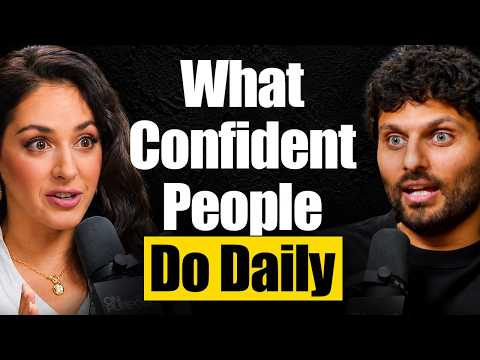
The Psychological Habit That Builds Self-Belief Fast | Dr. Shadé Zahrai
Jay Shetty Podcast
Summary
Dr. Shadé Zahrai tells Jay Shetty that self-doubt is driven by four measurable dimensions of self-image: acceptance, agency, autonomy, and adaptability. Drawing on psychological research including Robert Kleck's 1970s Dartmouth fake scar experiment and a study of 500 Nobel Prize-winning scientists, Zahrai explains how confirmation bias and the brain's desire to conserve metabolic energy keep people stuck in overthinking. She argues that up to 82% of people experience imposter phenomenon, and that 90% to 95% of people mistakenly wait to feel confident before acting, when confidence actually develops only after taking action through self-trust.
To overcome these four drivers, Zahrai and Shetty share practical behavioral tools for workplace and personal growth. Listeners learn to quiet the ego through service-oriented self-forgetting, adopt creative hobbies outside work, reframe pre-speech shaking hands as proof of caring, replace 'I should' with 'I could' to unlock divergent thinking, and use a three-second breathing and low-stakes speaking technique to contribute in meetings.
How time-sensitive the topic is: Evergreen
By the numbers
100 studies in meta-analyses: Meta-analyses of over 100 studies show the four self-image dimensions predict job performance and life satisfaction. (Mentioned at 4:41)
3 to 4 years of age: A person's foundational sense of self-acceptance initially develops during the first three to four years of life. (Mentioned at 7:56)
500 Nobel Prize-winning scientists: Sample size of a study examining the creative hobbies of Nobel laureates compared to regular scientists. (Mentioned at 12:32)
22 times more likely: Nobel Prize-winning scientists were 22 times more likely than regular scientists to have a performing arts hobby. (Mentioned at 12:40)
82% of people: Some studies find that up to 82% of people have felt like a fraud at some point in their lives. (Mentioned at 26:26)
5 to 8% of the population: Estimated share of the population with narcissism who may never experience self-doubt. (Mentioned at 29:22)
90% to 95% of people: Share of people Dr. Shadé Zahrai says identify confidence rather than self-trust as the opposite of self-doubt. (Mentioned at 31:12)
Questions this video answers
What is the real opposite of self-doubt if it is not confidence?
The opposite of self-doubt is self-trust, which is the belief that you can handle whatever outcome happens after you act. Psychological literature shows that confidence only develops after you take action and your brain observes proof of your competence, so waiting to feel confident first keeps you stuck in procrastination.
Dr. Shadé Zahrai, 30:49 to 33:34
From this keypoint: Self-Trust, Not Confidence, Opposes Self-Doubt
What happened in the Dartmouth fake scar psychology experiment?
In the 1970s, Dartmouth professor Robert Kleck drew an ugly facial scar on participants, let them see it in a mirror, and then secretly wiped it off with
Dr. Shadé Zahrai, 1:19 to 5:04
From this keypoint: The 1970s Dartmouth Fake Scar Study, per Zahrai
How can I stop panicking and speak up in work meetings?
Use the 3-second spiral stop: take a three-second breath, remind yourself there is no physical danger, and make a brief, low-stakes remark like validating a coworker's point or asking a clarifying question. Once your brain registers that safe proof point, you can share your longer perspective slowly while maintaining eye contact.
Dr. Shadé Zahrai, 40:30 to 42:59
From this keypoint: The 3-Second Fix for Speaking Up in Meetings
What is the difference between imposter syndrome and imposter phenomenon?
Clinical research uses the term 'imposter phenomenon' rather than 'syndrome' because feeling like a fraud is a common behavioral pattern experienced by up to 82% of people, not a medical pathology. It specifically applies when someone has a proven track record of achievement yet still feels undeserving, whereas beginners in a new role are simply experiencing a normal learning curve.
Dr. Shadé Zahrai, 24:06 to 28:01
From this keypoint: Why Imposter Syndrome Is Really a Phenomenon
How do creative hobbies help high achievers deal with failure?
Creative hobbies detach your identity from your job title so a workplace setback does not crush your self-worth. A study of 500 Nobel Prize-winning scientists found they were three times more likely to have a creative hobby and 22 times more likely to practice performing arts than regular scientists, helping them bounce back from failure.
Dr. Shadé Zahrai, 9:32 to 13:45
From this keypoint: Self-Forgetting and Creative Hobbies Build Worth
Why does replacing 'I should' with 'I could' reduce procrastination?
Telling yourself what you 'should' do triggers psychological reactance—an internal resistance to feeling forced—or makes you feel inadequate. Switching to an 'I could' list opens up divergent thinking and possibilities, from which you can circle three items to put on an actionable 'I will' list.
Dr. Shadé Zahrai, 33:40 to 40:29
From this keypoint: Autonomy and Replacing 'Should' With 'Could'
Why do intelligent people often struggle with overthinking and anxiety?
People who score higher on IQ measures tend to be more aware of complexity and potential risks, leading them to ruminate on everything that could go wrong. Furthermore, the brain magnifies worst-case scenarios to stop you from taking action so it can conserve metabolic energy.
Dr. Shadé Zahrai, 13:48 to 17:07
From this keypoint: Zahrai Links Catastrophizing to Energy Saving
How do you stop shaking hands and nerves before public speaking?
Instead of trying to eliminate physical nerves—which creates a 'meta-emotion' of feeling stressed about being stressed—reframe a racing heart and shaking hands as biological proof that you care about the audience. Accepting the physical response allows you to step onstage and perform well while nervous.
Jay Shetty, 17:08 to 19:12
From this keypoint: Jay Shetty Reframes Shaking Hands as Caring
Does using big, complex words at work make you sound smarter?
No, studies show that using unnecessarily complex vocabulary to sound competent actually backfires and undermines your perceived credibility. Simple, clear communication is far more effective for building workplace authority.
Dr. Shadé Zahrai, 19:30 to 24:05
From this keypoint: Hiding in a Law Firm Cubicle, According to Zahrai
Credible AI™ signals
Confidence: Research-Backed Psychology. Dr. Shadé Zahrai grounds her framework in named psychological studies like Robert Kleck's Dartmouth scar experiment, personality trait research on self-efficacy and locus of control, and her own doctoral work. Some statistics and coaching anecdotes are cited broadly without specific paper titles.
Bias: Self-Help Agency Focus. The conversation strongly favors individual cognitive reframing and personal responsibility over structural or environmental explanations for workplace anxiety, while also serving as a promotional vehicle for Dr. Shadé Zahrai's book and programs.
Originality (74%): Structured 4-A Framework. While the underlying concepts of self-esteem, self-efficacy, and locus of control are standard psychology, synthesizing them into the four A's of self-doubt (acceptance, agency, autonomy, adaptability) with practical tools offers a fresh, accessible structure.
Depth (76%): Applied Behavioral Science. The discussion goes beyond generic motivational advice by explaining neurological mechanisms like metabolic energy conservation, prefrontal cortex activation, and psychological reactance, pairing each concept with concrete behavioral interventions.
Key points (12)
Short (15 min): key points 1, 2, 7 and 9
Medium (27 min): key points 1, 2, 4, 7, 9, 10 and 11
Relaxed (44 min): all 12 key points
1. The 1970s Dartmouth Fake Scar Study, per Zahrai
Timestamp: 00:01:19 to 00:05:04 (4 min)
Speaker: Dr. Shadé Zahrai
Dr. Shadé Zahrai cites a 1970s Dartmouth experiment where researchers drew a scar on participants' faces, showed them a mirror, and secretly wiped it off before they spoke with strangers. Participants still felt tense and judged during the conversations. Our internal self-image dictates how we interpret others' behavior through confirmation bias.
Impact: High. Why it matters: Demonstrates that perceived social rejection is often a projection of internal insecurity rather than actual mistreatment by others.
For: Jay Shetty
2. Four Habits Showing Low Self-Acceptance
Timestamp: 00:05:06 to 00:09:31 (4 min)
Speaker: Dr. Shadé Zahrai
Lack of self-acceptance, the first driver of self-doubt, manifests in four habits: the pressure to prove, shrinking syndrome, the schadenfreude cycle of enjoying others' failures, and an endless need for approval. These patterns typically form in the first three to four years of life when children feel they must earn parental attention. Recognizing these ingrained patterns is the first step toward taking ownership rather than blaming caregivers.
Impact: High. Why it matters: Gives listeners a diagnostic checklist to spot hidden low self-esteem in behaviors like people-pleasing or secretly celebrating a peer's failure.
“Now, if you don't accept yourself, it shows up in four painfully familiar habits. The first one is what we call the pressure to prove.”
In the video: Dr. Shadé Zahrai, at 5:22
For: Jay Shetty
3. Self-Forgetting and Creative Hobbies Build Worth
Timestamp: 00:09:32 to 00:13:45 (4 min)
Speaker: Dr. Shadé Zahrai
To overcome low self-acceptance, people must separate their identity from their job titles and practice 'self-forgetting' by shifting focus from ego-driven worry to serving others. Zahrai notes a study of 500 Nobel Prize-winning scientists showing they were three times more likely to have a creative hobby and 22 times more likely to engage in performing arts than regular scientists. Pouring energy into creative hobbies outside work buffers self-esteem when professional setbacks occur.
Impact: High. Why it matters: Offers two concrete behavioral antidotes to ego anxiety: shifting attention toward serving the room and cultivating non-work creative identities.
“And research shows that this process of self-forgetting by becoming more serviceoriented helps to quieten that incessant voice of the ego.”
In the video: Dr. Shadé Zahrai, at 11:11
4. Zahrai Links Catastrophizing to Energy Saving
Timestamp: 00:13:48 to 00:17:07 (3 min)
Speaker: Dr. Shadé Zahrai
Dr. Shadé Zahrai explains that the brain's primary function is to conserve metabolic energy, causing an internal 'misguided protector' to magnify worst-case scenarios so we avoid risky actions. She adds that people with higher IQ scores often experience greater anxiety because they spot more complex risks. Using the 'spiral interrupt technique' to remind yourself you are safe re-engages the prefrontal cortex and calms the amygdala.
Impact: Medium. Why it matters: Reframes catastrophic overthinking not as personal weakness, but as a metabolic energy-saving mechanism and a byproduct of analytical intelligence.
“The primary function of the brain really is to make sure that the rest of the body is doing what it needs to do while using the least amount of metabolic energy.”
In the video: Dr. Shadé Zahrai, at 14:21
5. Jay Shetty Reframes Shaking Hands as Caring
Timestamp: 00:17:08 to 00:19:12 (2 min)
Speaker: Jay Shetty
Jay Shetty shares that despite years of public speaking training from age 11 to 18, moving into larger arenas caused his heart rate to spike and his hands to shake. Overthinking those physical symptoms created a spiral of stress about stress, which Dr. Shadé Zahrai labels a meta-emotion. Shetty broke the cycle by telling himself that physical nerves simply prove he cares about the audience.
Impact: Medium. Why it matters: Provides an immediate cognitive reframe for stage fright: treat physiological arousal as evidence of care rather than incompetence.
“And what I started to realize was, oh, when I care, I my body's going to do this and I can go and give an amazing talk anyway, but I care. That's all it's showing me.”
In the video: Jay Shetty, at 18:01
For: Dr. Shadé Zahrai
6. Hiding in a Law Firm Cubicle, According to Zahrai
Timestamp: 00:19:30 to 00:24:05 (5 min)
Speaker: Dr. Shadé Zahrai
Dr. Shadé Zahrai recounts how childhood family chants asking her to dance conditioned her to equate her worth with performing for others, even within a loving home. Working in commercial law and banking, she felt like a hiring mistake, hid behind her cubicle to avoid assignments, and used overly complex vocabulary that studies show actually undermines credibility. Changing industries did not cure her self-doubt until she addressed her underlying self-image.
Impact: Medium. Why it matters: Illustrates that even supportive upbringings can breed performance-based self-worth, and changing careers will not fix an internal self-image problem.
“Studies have been found that when you use unnecessarily complex language where you're trying to be perceived as more credible and competent, it does the opposite and it undermines your credibility and your competence.”
In the video: Dr. Shadé Zahrai, at 22:06
7. Why Imposter Syndrome Is Really a Phenomenon
Timestamp: 00:24:06 to 00:28:01 (4 min)
Speaker: Dr. Shadé Zahrai
Introducing the second pillar, agency, Zahrai clarifies that clinical literature uses the term 'imposter phenomenon' rather than 'syndrome,' which wrongly pathologizes a common experience felt by up to 82% of people. True imposter phenomenon requires both feeling like a fraud and possessing an actual track record of success, whereas beginners simply face a normal learning curve. Admitting inexperience aloud, as actor Jason Segel did when directing, shrinks the fear.
Impact: High. Why it matters: Stops newcomers from using 'imposter syndrome' as an excuse to withdraw, while showing high achievers how vocal vulnerability disarms fear.
“Imposttor syndrome actually doesn't exist in the literature and the research as the term imposter syndrome. It's called imposter phenomenon.”
In the video: Dr. Shadé Zahrai, at 24:45
For: Jay Shetty
8. Shetty Views Discomfort as Growth With Integrity
Timestamp: 00:28:02 to 00:30:48 (3 min)
Speaker: Jay Shetty
Jay Shetty notes that he still feels like an imposter whenever he launches a new venture or steps outside his comfort zone, viewing the discomfort as proof of expansion. Dr. Shadé Zahrai calls this 'growth with integrity,' noting that never feeling doubt indicates either blind delusion, lack of self-awareness, or narcissism, which affects roughly 5% to 8% of the population. Whether a task feels big or small depends entirely on one's personal agency.
Impact: Medium. Why it matters: Normalizes self-doubt during career transitions as healthy intellectual humility rather than a sign of inadequacy.
“So, I love the idea of feeling that way because it's proof to me that I'm pushing myself outside of my comfort zone. I'm trying something new.”
In the video: Jay Shetty, at 28:18
For: Dr. Shadé Zahrai
9. Self-Trust, Not Confidence, Opposes Self-Doubt
Timestamp: 00:30:49 to 00:33:34 (3 min)
Speaker: Dr. Shadé Zahrai
Although 90% to 95% of people believe confidence is the opposite of self-doubt, waiting to feel confident traps people in procrastination and over-planning. Research shows that confidence only arrives after taking action, once the brain observes proof of competence. Before acting, people actually need self-trust—rooted in the Latin 'confidere' meaning 'with trust'—which is the belief that you can handle whatever outcome occurs.
Impact: High. Why it matters: Dismantles the most common excuse for inaction by proving confidence is a lagging indicator of behavior, not a prerequisite.
“I you know that feeling of confidence that we wait for actually when we look at the literature it does not come before we take the action it comes after we take the action”
In the video: Dr. Shadé Zahrai, at 31:29
For: Jay Shetty
10. Autonomy and Replacing 'Should' With 'Could'
Timestamp: 00:33:40 to 00:40:29 (7 min)
Speaker: Dr. Shadé Zahrai
Through the story of a chronically complaining client named Bruno, Zahrai introduces the third pillar, autonomy, which reflects an internal versus external locus of control. Chronic complaining and reliving 'contamination stories' of past hurts signal low self-trust and an external locus that leaves people feeling powerless. Writing an 'I could' list instead of saying 'I should' avoids psychological reactance, activates divergent thinking, and leads into three concrete 'I will' actions.
Impact: High. Why it matters: Connects chronic complaining directly to low self-trust and provides a two-column writing exercise to shift from victimhood to action.
“Research has found that when you use the word could instead of should, it opens up divergent thinking.”
In the video: Dr. Shadé Zahrai, at 39:16
11. The 3-Second Fix for Speaking Up in Meetings
Timestamp: 00:40:30 to 00:42:59 (2 min)
Speaker: Dr. Shadé Zahrai
Addressing the fourth pillar, emotional adaptability, Dr. Shadé Zahrai outlines the '3-second spiral stop' for speaking up in meetings when afraid of messing up. First, take a three-second breath; second, remind yourself there is no physical danger; third, make a very brief, low-stakes comment—like validating a colleague or asking a clarifying question—to give your brain a safe proof point. Once calm, follow up with your full perspective while speaking slowly and maintaining eye contact.
Impact: High. Why it matters: Gives anxious professionals a step-by-step tactical script to break meeting silence without overwhelming their nervous system.
“So keep it really short. You might validate what someone else has said. That's a great idea, Jay. Or I'd like to build on what Simon said or Maria, can you repeat that one more time?”
In the video: Dr. Shadé Zahrai, at 42:09
For: Jay Shetty
12. Defining Purpose Around Caring and Healing
Timestamp: 00:43:00 to 00:45:42 (3 min)
Speaker: Dr. Shadé Zahrai
Asked by Jay Shetty to define her purpose, Dr. Shadé Zahrai says she wants to be remembered at her funeral simply as someone who cared about helping others overcome what holds them back. Shetty shares that his purpose is creating a happier, healthier, and continually 'healing' world, noting that healing invisible self-image scars is an ongoing process. Zahrai concludes that her one universal law would be to leave every person and place better than you found them.
Impact: Low. Why it matters: Ties the psychological framework back to personal values, framing self-development as a vehicle for serving and healing others.
“Someone once asked me, "What is the one word I want people to say about me at my funeral?" And without thinking, I said that she cared.”
In the video: Dr. Shadé Zahrai, at 43:02
For: Jay Shetty
Conflicts of interest (1)
Book and Program Promotion
Commercial conflict, Medium severity
Dr. Shadé Zahrai explicitly references her book and coaching programs throughout the interview while presenting her proprietary four-driver framework and 'state of big trust' methodology.
Sources: Dr. Shadé Zahrai
Significance: The interview functions partly as a marketing funnel for Zahrai's commercial offerings, incentivizing her to frame her proprietary four-pillar model as a comprehensive solution to workplace self-doubt.
Key sources
Dr. Shadé Zahrai: Guest, PhD Researcher and Author
Jay Shetty: Podcast Host
Who's in this
Robert Kleck
Dartmouth
Jason Segel
Bruno
Also mentioned
Nobel Prize (First mentioned at 12:29)
Dispatches from Elsewhere (First mentioned at 27:16)
How I Met Your Mother (First mentioned at 27:09)
This analysis was generated by skim (skim.plus), an AI-powered content analysis platform by Credible AI. Scores and classifications represent the platform's AI-generated assessment and should be considered alongside other sources.