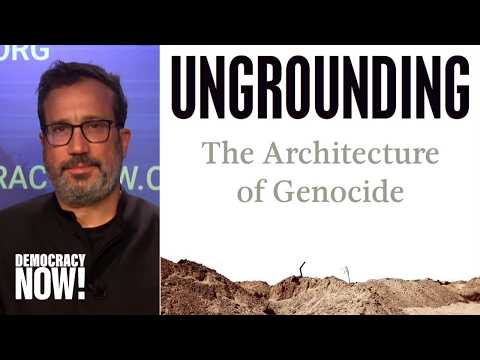
"Ungrounding": Eyal Weizman on Gaza Genocide & Israel's "Permanent Architecture of Control"
Democracy Now!
Summary
Forensic Architecture founder Eyal Weizman joins Amy Goodman and Juan Gonzalez to examine his book, Ungrounding: The Architecture of Genocide, alongside new UN and cartographic findings on Gaza. Weizman explains that since the October 2025 ceasefire, Israel has retained control of 54% of Gaza, built 34 military bases along the yellow line, and used US- and European-made bulldozers to compact bombed homes into a 40-kilometer earth berm along an encroaching orange line. He states this 'ungrounding' flips the soil to erase pre-war neighborhoods while disturbing roughly 10,000 unrecovered Palestinian bodies.
Weizman argues this environmental degradation operates as a slow genocide by attrition that renders Gaza's soil toxic for generations and destroys physical evidence against International Court of Justice orders. Combining 3D ballistic reconstructions like the killing of five-year-old Hind Rajab with broader patterns of famine and displacement, Forensic Architecture is supplying South Africa's ICJ legal team with evidence that isolated military acts form a unified campaign to force Palestinians out of Gaza.
How time-sensitive the topic is: Developing story
By the numbers
54 percent of Gaza: Depopulated area of Gaza that remained under Israeli control marked by the yellow line when the ceasefire took effect. (Mentioned at 2:09)
100 yellow concrete blocks: More than 100 boundary blocks mapped by Forensic Architecture, most placed beyond the agreed withdrawal line. (Mentioned at 2:32)
34 active military bases: Fortified Israeli military bases documented by Forensic Architecture spaced roughly every 1.8 kilometers along the yellow line. (Mentioned at 3:13)
250 Palestinian journalists and media workers: More than 250 media workers killed in Gaza since October 2023, reported by Amy Goodman. (Mentioned at 4:28)
20 Palestinians killed: At least 20 displaced Palestinians killed on September 16 when a damaged building they sheltered in collapsed. (Mentioned at 7:50)
40 kilometers: Length of the 6-meter-high earth berm Israel is building out of compacted rubble along the orange line. (Mentioned at 14:41)
10,000 missing Palestinians: Approximate number of missing Palestinians, many buried under bombed home rubble now being reshuffled by bulldozers. (Mentioned at 15:10)
85 percent of buildings: Approximate share of pre-October 7, 2023 buildings in Gaza destroyed, contrasted with an intact majority of tunnels. (Mentioned at 18:46)
13 to 23 meters: Calculated distance ring from which an Israeli Merkava tank fired roughly 30 bullets into Hind Rajab's family car. (Mentioned at 27:48)
25,000 tons of bombs: Explosive tonnage dropped on Gaza in the first weeks of the war alone, exceeding the Allied campaign on German cities. (Mentioned at 34:44)
Questions this video answers
What does Eyal Weizman mean by 'ungrounding' in Gaza?
Eyal Weizman defines 'ungrounding' as a form of total terrain erasure executed by bulldozers rather than aerial bombs. While air strikes leave recognizable piles of rubble where buildings stood, bulldozers stab their front loaders into the soil and flip the earth, erasing the ruins themselves so returning residents cannot identify their neighborhoods.
Eyal Weizman, 3:45 to 6:55
From this keypoint: Weizman Defines 'Ungrounding' by Bulldozers
How has Israel changed Gaza's borders and territory since the October 2025 ceasefire?
According to Forensic Architecture, Israel retained control of 54% of Gaza along the yellow withdrawal line and placed over 100 concrete blocks well beyond it. Israel also imposed an orange line encroaching over a kilometer further inward, built 34 fortified bases spaced every 1.8 kilometers, and constructed a 40-kilometer earth berm leaving just over 30% of Gaza for Palestinians.
Amy Goodman, 0:17 to 3:45
From this keypoint: UN Inquiry and Mapping Cite Ceasefire Violations
How is Israel's clearing of rubble in Gaza affecting International Court of Justice evidence?
Eyal Weizman states that roughly 10,000 Palestinians remain missing under bombed buildings, and Israeli-operated excavators are compacting that rubble—and human remains—into roads, military bases, and a 6-meter-high earth berm. He argues this reshuffling actively destroys physical evidence of genocide in violation of International Court of Justice orders.
Eyal Weizman, 12:51 to 15:55
From this keypoint: Rubble Berms Desecrate Remains and ICJ Evidence
What did Forensic Architecture find in its investigation of the killing of Hind Rajab?
Using acoustic analysis, satellite imagery, and 3D modeling of bullet entry and exit holes, Forensic Architecture determined that an Israeli Merkava tank fired a volley of about 30 bullets into the family's car from 13 to 23 meters away. Researcher Nicholas Masterton concluded that the tank's optical equipment made the occupants inside the car clearly visible to soldiers.
Nicholas Masterton, 25:31 to 28:52
From this keypoint: 3D Modeling Tracks the Killing of Hind Rajab
How does Forensic Architecture help South Africa's legal team at the International Court of Justice?
Forensic Architecture analyzes tens of thousands of videos to connect individual strikes into a single compounded pattern of harm. While Israel contends each strike was an isolated tactical action against Hamas, Weizman's team maps how hospital bombings, agricultural erasure, and attacks on aid convoys interact to generate famine and force Palestinians toward the Egyptian border.
Eyal Weizman, 28:52 to 33:43
From this keypoint: Synthesizing Isolated Acts into an ICJ Case
How much of Gaza's tunnel network has been destroyed compared to surface buildings?
Eyal Weizman states that while roughly 85% of all buildings standing in Gaza prior to October 7, 2023 have been destroyed, only the opposite proportion of tunnels has been destroyed, leaving the majority intact. He argues Israel portrays the tunnels as a single connected 'metro' to justify leveling every surface neighborhood.
Eyal Weizman, 15:55 to 20:25
From this keypoint: Subsoil Tunnels Withstand Surface Bombardment
What role have Caterpillar bulldozers played in the history of the Gaza Strip?
In August 1950, a single-blade plow pulled by a World War II-era Caterpillar tractor carved the ditch that first cut the Gaza Strip off from the rest of Palestine. Today, massive Caterpillar bulldozers and US- and European-made excavators operated by private contractors are used to flatten buildings and terraform the landscape.
Eyal Weizman, 10:45 to 12:51
From this keypoint: Caterpillar Tractors and the 1950 Gaza Boundary
How does the destruction of Gaza compare to the Allied bombing of Germany in World War II?
Eyal Weizman states that in the first weeks of the war alone, Israel dropped 25,000 tons of bombs on Gaza, surpassing the entire Allied aerial bombardment campaign against German cities. Because Germany is several thousand times larger than the Gaza Strip, the concentration of explosives and toxic contamination in Gaza's soil is far more total.
Eyal Weizman, 33:43 to 37:26
From this keypoint: Bomb Tonnage Exceeds World War II German Campaign
Credible AI™ signals
Confidence: Sourced Forensic Analysis. The broadcast relies on satellite mapping, acoustic modeling, and UN inquiry reports presented by Forensic Architecture's Eyal Weizman. While the evidence is methodically documented for international court proceedings, the segment presents a single-perspective legal argument with only brief mention of the Israeli mission's formal denial.
Bias: Human Rights Advocacy. Hosts Amy Goodman and Juan Gonzalez frame the segment entirely around the legal case that Israel is committing genocide in Gaza. Guest Eyal Weizman is an active contributor to South Africa's ICJ litigation against Israel, and the program offers no substantive airtime to Israeli military or legal counter-arguments.
Originality (84%): Original Spatial Research. Featuring Eyal Weizman discussing his new book and Forensic Architecture's proprietary cartographic and 3D modeling investigations provides distinct analytical value. The focus on 'ungrounding' via bulldozers and post-ceasefire boundary shifts moves beyond standard war reporting into original spatial forensics.
Depth (86%): Deep Structural Examination. Weizman connects immediate military actions in Gaza to a 100-year environmental history, international genocide law under Raphael Lemkin's framework, and forensic reconstructions of specific killings. The discussion examines how agricultural erasure, rubble compaction, and aid blockades interact as a compounded system.
Key points (10)
Short (11 min): key points 2, 5 and 9
Medium (22 min): key points 1, 2, 3, 5, 8 and 9
Relaxed (37 min): all 10 key points
1. UN Inquiry and Mapping Cite Ceasefire Violations
Timestamp: 00:00:17 to 00:03:45 (3 min)
Speaker: Amy Goodman
Amy Goodman reports that a UN Commission of Inquiry accused Israel of continuing genocidal acts during the ceasefire, while Israel's Geneva mission rejected the report as a campaign to destroy the Jewish state. Forensic Architecture maps 34 bases and over 100 blocks expanding past the yellow line.
Impact: High. Why it matters: Documenting military fortification beyond agreed withdrawal lines challenges the premise that the ceasefire halted territorial annexation.
“When the ceasefire came into effect, most of the area Israel had depopulated remained under its control. This constituted 54% of Gaza, marked by the yellow line.”
In the video: Forensic Architecture, at 2:02
For: Forensic Architecture
2. Weizman Defines 'Ungrounding' by Bulldozers
Timestamp: 00:03:45 to 00:06:55 (3 min)
Speaker: Eyal Weizman
Following the speaker's call for an ICC probe into 'mediacide' after over 250 Palestinian journalists were killed, Eyal Weizman defines 'ungrounding.' He explains that bulldozers flip the soil and erase even the ruins of bombed buildings, leaving an unrecognizable terrain.
Impact: High. Why it matters: Framing bulldozer clearing as a distinct phase of destruction highlights how physical landmarks and community memory are systematically erased.
“In fact, the bulldozer stab their front loader into the ground and flips the terrain, erasing also the traces of destruction. So, ungrounding is a kind of destruction that trace that erases the traces of destruction.”
A Forensic Architecture clip shows orchards cleared for tents and a damaged building collapse killing at least 20 Palestinians. Eyal Weizman connects this to Raphael Lemkin's concept of genocide by attrition, arguing that destroying Gaza's environment extinguishes life since October 2025.
Impact: High. Why it matters: Connecting environmental degradation to the Genocide Convention shows how lethal conditions persist even when mass bombings slow down.
“And I think that since the ceasefire, the so-called ceasefire began in October 2025, the destruction of the Palestinian people by the destruction and degrading of their environment is the most pronounced means of uh destroying Palestinian life”
In the video: Eyal Weizman, at 10:18
For: Forensic Architecture
4. Caterpillar Tractors and the 1950 Gaza Boundary
Timestamp: 00:10:45 to 00:12:51 (2 min)
Speaker: Eyal Weizman
Juan Gonzalez quotes Weizman's book on how a World War II-era Caterpillar tractor plowed the ditch that first cut off the Gaza Strip in August 1950. Weizman argues that while discussions focus on AI and surveillance, Caterpillar earth-moving machines actually execute the erasure on the ground.
Impact: Medium. Why it matters: Tracing Caterpillar machinery from the 1950 border carving to current demolitions links corporate heavy equipment directly to territorial partition.
“Total erasure, ungrounding, the transformation of the environment undertaken by those big monster of um technical equipment manufactured by Caterpillar here which produce in effect the architecture of genocide.”
In the video: Eyal Weizman, at 12:32
For: Juan Gonzalez
5. Rubble Berms Desecrate Remains and ICJ Evidence
Timestamp: 00:12:51 to 00:15:55 (3 min)
Speaker: Eyal Weizman
Weizman states that the ceasefire lowered insurance costs, allowing private firms with US and European excavators to accelerate terraforming. Israel is compacting bombed homes—where many of the roughly 10,000 missing Palestinians remain buried—into a 40-kilometer earth berm, destroying ICJ evidence.
Impact: High. Why it matters: Compacting bombed rubble containing human remains into military fortifications constitutes both a desecration of the dead and spoliation of forensic evidence.
“And when Israel is shuffling that rubble into all sort of shapes and BMS and military bases and roads, they are actually moving human remains.”
In the video: Eyal Weizman, at 15:15
6. Subsoil Tunnels Withstand Surface Bombardment
Timestamp: 00:15:55 to 00:20:25 (5 min)
Speaker: Eyal Weizman
Responding to Juan Gonzalez, Eyal Weizman traces Gaza's tunnels to indigenous farmers displaced in 1948 who used well-digging skills to reconnect trade along the ancient Via Maris to Egypt. While 85% of surface buildings are destroyed, most tunnels survive, though Israel uses them to justify total surface erasure.
Impact: Medium. Why it matters: Contrasting 85% surface destruction with an largely intact tunnel network exposes the gap between Israel's stated anti-tunnel rationale and its surface leveling.
“So while about 85% of all buildings that were standing in Gaza prior to October 7th, 2023 are destroyed, uh only the opposite number of tunnels have been destroyed.”
In the video: Eyal Weizman, at 18:45
For: Juan Gonzalez
7. Weizman Calls Trump 'Riviera' Plan Genocide
Timestamp: 00:20:25 to 00:25:31 (5 min)
Speaker: Eyal Weizman
In archival clips, Donald Trump proposes turning Gaza into the 'Riviera of the Middle East' and Jared Kushner suggests moving Palestinians out to clean up valuable waterfront property. Weizman calls such development plans a continuation of genocide by reconstruction designed to permanently bar Palestinian return.
Impact: High. Why it matters: Evaluating top-down redevelopment proposals through the history of Palestinian displacement reveals how reconstruction can be weaponized for permanent expulsion.
“in the crime of genocide, it could be actually undertaken by destruction as we have seen and genocide could be undertaken by reconstruction uh as a means of destroying a particular national life uh in that part.”
In the video: Eyal Weizman, at 23:52
Against: Donald Trump, Jared Kushner
Neutral: YouTube: Democracy Now!
8. 3D Modeling Tracks the Killing of Hind Rajab
Timestamp: 00:25:31 to 00:28:52 (3 min)
Speaker: Nicholas Masterton
Amy Goodman notes Representative Rashida Tlaib's call to arrest commander Sean Glass over the 2024 killing of five-year-old Hind Rajab, her family, and two paramedics. In a documentary clip, Forensic Architecture's Nicholas Masterton shows how acoustic and 3D modeling placed an Israeli Merkava tank 13 to 23 meters from the car with clear visibility.
Impact: High. Why it matters: Ballistic and optical modeling at a 13-to-23-meter range undermines claims of accidental fire and supports criminal accountability demands.
“So based on positioning the tank in hundreds of places within that ring of 13 to 23 m, we find that there's a position immediately to the south of the KIA, which appears to be the most likely position of the shooter for this recording.”
In the video: Nicholas Masterton, at 27:44
For: Amy Goodman, YouTube: Democracy Now!
9. Synthesizing Isolated Acts into an ICJ Case
Timestamp: 00:28:52 to 00:33:43 (5 min)
Speaker: Eyal Weizman
Weizman explains how Forensic Architecture assists South Africa's ICJ legal team by reviewing tens of thousands of Palestinian videos to link isolated attacks into a compounded pattern. While Israel argues each strike targeted Hamas fighters, Weizman shows how hospital attacks, farm destruction, and aid strikes combine to force Palestinians toward Egypt.
Impact: High. Why it matters: Demonstrating how separate military strikes compound into famine and forced concentration is essential to proving genocidal intent at the ICJ.
“how those different acts do not need to be considered each in itself but have a compounded harm that is larger than the sum of its parts.”
In the video: Eyal Weizman, at 32:28
10. Bomb Tonnage Exceeds World War II German Campaign
Timestamp: 00:33:43 to 00:37:26 (4 min)
Speaker: Eyal Weizman
Asked by Juan Gonzalez to compare Gaza to World War II and Vietnam, Weizman states that Israel used defoliants along the border since the 2010s and dropped 25,000 tons of bombs in the first weeks alone, exceeding the Allied campaign on German cities. He concludes that soil toxins and displacement onto desert dunes will leave Gaza's farmland uncultivable for generations.
Impact: High. Why it matters: Quantifying explosive tonnage against Gaza's small area and noting generational soil toxicity underscores the permanent ecological toll of the war.
“The amount of toxin uh that has been released into the soil uh in Gaza uh is going to make this that soil that very fertile rich agricultural soil uh uncultivatable for generations.”
In the video: Eyal Weizman, at 37:10
For: Juan Gonzalez
Conflicts of interest (2)
ICJ Legal Team Evidence Provider
Professional conflict, Medium severity
Eyal Weizman and Forensic Architecture actively produce evidentiary analysis for South Africa's legal team in its genocide case against Israel at the International Court of Justice.
Sources: Forensic Architecture, Eyal Weizman
Significance: Weizman's analysis is structured to build a cumulative legal argument establishing genocidal intent rather than evaluating Israeli military counter-claims neutrally.
Promotion of Newly Published Book
Commercial conflict, Low severity
Eyal Weizman appears on the program to promote his newly released book, Ungrounding: The Architecture of Genocide.
Sources: Eyal Weizman
Significance: The interview centers on the book's specific conceptual terminology and historical thesis to drive viewer interest in the publication.
Key sources
Amy Goodman: Host, Democracy Now!
Juan Gonzalez: Co-host, Democracy Now!
Eyal Weizman: Founder and Director of Forensic Architecture, Professor at Goldsmiths
Donald Trump: U.S. President
Jared Kushner: Former White House Adviser
Nicholas Masterton: Researcher, Forensic Architecture
Forensic Architecture: Interdisciplinary research group at Goldsmiths, University of London
YouTube: Democracy Now!
Who's in this
UN Independent International Commission of Inquiry on the Occupied Palestinian Territory
International Court of Justice
International Criminal Court
Raphael Lemkin
Caterpillar
Benjamin Netanyahu
Rashida Tlaib
Sean Glass
Hind Rajab
Palestine Red Crescent
Al-Shifa Medical Complex
Hamas
Also mentioned
Israel (First mentioned at 0:17)
Gaza (First mentioned at 0:19)
Ungrounding: The Architecture of Genocide (First mentioned at 4:54)
Palestine (First mentioned at 10:40)
Democracy Now! (First mentioned at 0:00)
A Cartography of Genocide (First mentioned at 1:57)
United States (First mentioned at 10:49)
Egypt (First mentioned at 17:45)
South Africa (First mentioned at 30:20)
Bani Suheila (First mentioned at 3:17)
Goldsmiths College, University of London (First mentioned at 5:01)
Khan Younis (First mentioned at 7:24)
Via Maris (First mentioned at 17:51)
White House (First mentioned at 20:27)
Department of Justice (First mentioned at 25:34)
The Night Won't End: Biden's War on Gaza (First mentioned at 26:14)
Merkava (First mentioned at 27:28)
New York (First mentioned at 0:05)
Chicago (First mentioned at 0:07)
West Bank (First mentioned at 0:39)
Geneva (First mentioned at 0:48)
Hollow Land: Israel's Architecture of Occupation (First mentioned at 5:06)
The Least of All Possible Evils: A Short History of Humanitarian Violence (First mentioned at 5:12)
Right Livelihood Award (First mentioned at 5:25)
Rome (First mentioned at 11:45)
Alexandria (First mentioned at 17:53)
CNN (First mentioned at 20:31)
Harvard Kennedy School (First mentioned at 22:08)
This analysis was generated by skim (skim.plus), an AI-powered content analysis platform by Credible AI. Scores and classifications represent the platform's AI-generated assessment and should be considered alongside other sources.