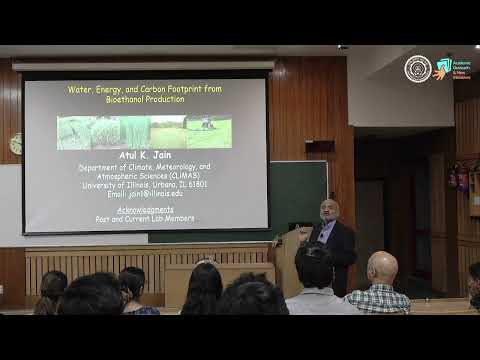
IIT Delhi's Water, Energy, and Carbon Footprint from Bioethanol Production by Prof. Atul Jain: skim's analysis identifies 11 key moments. Atul Jain examines the water, energy, and carbon trade-offs of cellulosic bioethanol production using his lab's ISAM modeling framework.
Category: Science. Format: Educational. YouTube video analyzed by skim.
skim AI Analysis
Credibility assessment: Data-Driven Academic Lecture. Atul Jain grounds his claims in peer-reviewed research from his University of Illinois lab, field observations from a 320-acre farm, and spatial modeling using the ISAM framework. He openly distinguishes published findings from unpublished carbon emissions results and notes where policy details fall outside his expertise.
Bias assessment: Ecological Trade-Off Realism. Rather than promoting bioethanol as a silver bullet, Atul Jain systematically weighs high biomass yields and carbon sequestration against severe regional water depletion and food-land competition. He explicitly warns against growing temperate energy grasses in water-stressed India.
Originality: 82% — Primary Spatial Modeling. The lecture presents original computational modeling from Atul Jain's research group, mapping bioenergy crop yields, evapotranspiration, nitrogen leaching, and carbon sequestration at 0.1-degree resolution across the United States and challenging the popular marginal-land assumption.
Depth: 85% — Multi-System Nexus Analysis. Atul Jain connects plant physiology, winter senescence, and hardiness zones to macro-level hydrological fluxes, nitrogen runoff, soil carbon sequestration, drought resilience, and national biofuel mandates in both the United States and India.
Key Points (11)
1. Fossil carbon emissions and biomass energy basics
Timestamp: 00:05:19 to 00:08:51
Atul Jain frames climate change around energy consumption, noting that burning coal, oil, and gas inevitably produces carbon dioxide as a byproduct. He introduces perennial energy grasses grown on his university's research farm as a way to capture solar energy into biomass and convert it into liquid biofuels like bioethanol and biodiesel. He concludes that ethanol can be derived not only from sugar and starch crops like sugarcane and corn, but also from plant cell wall polymers like cellulose.
Significance (Medium): Frames bioethanol not merely as an agricultural product, but as a structural intervention in the global carbon-energy nexus.
Sources in support: Atul Jain (Professor at University of Illinois Urbana-Champaign; Visiting Professor at IIT Delhi)
2. US ethanol mandates and the corn price spike
Timestamp: 00:09:14 to 00:15:13
Global ethanol production has grown six-fold since 1995 to roughly 31 billion gallons a year, led by the United States at 16 billion gallons from corn grain. Atul Jain explains that the 2007 US Energy Independence and Security Act targeted 36 billion gallons by 2022, capping corn ethanol at 15 billion gallons and mandating that 58% come from advanced cellulosic biofuels.
Significance (High): Demonstrates how aggressive first-generation biofuel mandates directly shock agricultural commodity prices, forcing a regulatory pivot toward non-food cellulosic feedstocks.
Sources in support: Atul Jain (Professor at University of Illinois Urbana-Champaign; Visiting Professor at IIT Delhi)
3. Atul Jain questions marginal land assumptions
Timestamp: 00:15:15 to 00:17:25
Literature reviews by Atul Jain's student revealed widespread claims that dedicated energy crops can be grown on low-yielding marginal land anywhere. However, closer examination shows that marginal land yields only a fraction of fertile land output and that biomass productivity and carbon benefits are heavily constrained by local climate, water availability, soil quality, and site management.
Significance (High): Challenges a foundational assumption in bioenergy policy that degraded or marginal lands can effortlessly supply industrial-scale cellulosic biofuel.
Sources in support: Atul Jain (Professor at University of Illinois Urbana-Champaign; Visiting Professor at IIT Delhi)
4. India hits its 2030 E20 ethanol target early
Timestamp: 00:17:26 to 00:19:49
India set a 20% bioethanol blending target (E20) requiring about 3.17 billion gallons annually by 2030, but by 2025 its production already reached roughly 5.25 billion gallons (1,900 crore liters), creating an oversupply. Atul Jain notes that India achieved this surge by allowing damaged food grains, broken rice, and corn to supply nearly half of its ethanol alongside sugarcane.
Significance (High): Highlights how state pricing incentives can rapidly accelerate biofuel blending targets while distorting traditional sugar and grain markets.
Sources in support: Atul Jain (Professor at University of Illinois Urbana-Champaign; Visiting Professor at IIT Delhi)
5. Physiology of perennial rhizomes and senescence
Timestamp: 00:19:50 to 00:26:10
Unlike annual row crops such as corn that must be planted from seed and fertilized every year, perennial grasses like Miscanthus and switchgrass grow from underground rhizomes with minimal annual inputs. During the growing season, nutrients and water move from roots to shoots, and during winter senescence, nutrients translocate back down into the rhizomes before the dry lignocellulosic shoots are harvested.
Significance (Medium): Explains the biological mechanism that makes perennial grasses economically and ecologically superior to both annual crops and timber for cellulosic ethanol.
Sources in support: Atul Jain (Professor at University of Illinois Urbana-Champaign; Visiting Professor at IIT Delhi)
6. Modeling energy grasses with the ISAM framework
Timestamp: 00:26:11 to 00:31:28
To evaluate where bioenergy crops can achieve high, stable yields and how they affect water and carbon fluxes, Atul Jain's team integrated dynamic crop growth modules for Miscanthus, Cave-in-Rock switchgrass, Alamo switchgrass, and corn into their ISAM Earth system model. They calibrated the model's dynamic root-shoot interactions, water stress responses, and nutrient fluxes using measurements from a 320-acre energy crop farm at the University of Illinois and other US field sites.
Significance (Low): Establishes the empirical and computational foundation behind the lecture's spatial maps of US bioethanol potential and hydrological trade-offs.
Sources in support: Atul Jain (Professor at University of Illinois Urbana-Champaign; Visiting Professor at IIT Delhi)
7. Climate hardiness limits US bioethanol geography
Timestamp: 00:31:29 to 00:37:43
Spatial modeling by Atul Jain shows that perennial energy grasses cannot grow in the arid western United States or across all temperature zones. Miscanthus roots die where winter temperatures drop below -28 degrees Celsius and fail in the warm south where winter senescence cannot occur, while Cave-in-Rock switchgrass tolerates -32 degrees Celsius in the north and Alamo switchgrass thrives in the south below the -23 degrees Celsius hardiness zone.
Significance (High): Proves that cellulosic bioethanol production must be regionally tailored by crop cultivar and winter temperature thresholds while avoiding existing Midwest corn cropland.
Sources in support: Atul Jain (Professor at University of Illinois Urbana-Champaign; Visiting Professor at IIT Delhi)
8. Grass crops cut nitrogen runoff but use more water
Timestamp: 00:37:44 to 00:40:27
Evaluating hydrological impacts, Atul Jain shows that while water use per liter of ethanol is most efficient in high-yielding regions, perennial energy grasses have much higher total evapotranspiration than corn. Consequently, large-scale adoption of Miscanthus and switchgrass reduces surface runoff and can deplete regional water availability for human use.
Significance (High): Exposes a sharp environmental trade-off: replacing corn with perennial energy grasses cleans up nitrogen water pollution at the cost of consuming significantly more regional water.
Sources in support: Atul Jain (Professor at University of Illinois Urbana-Champaign; Visiting Professor at IIT Delhi)
9. Soil carbon gains and drought resilience in grasses
Timestamp: 00:40:28 to 00:44:50
Sharing unpublished modeling results on soil carbon, Atul Jain reports that Miscanthus and Cave-in-Rock switchgrass sequester net carbon across almost all yield zones, whereas Alamo switchgrass increases net CO2 emissions to the atmosphere. Furthermore, during the severe 2012 US drought, corn-based ethanol yields tanked while Miscanthus and switchgrass yields remained largely stable.
Significance (High): Differentiates energy grass cultivars on carbon performance and shows that deep-rooted perennials buffer biofuel supply chains against extreme climate droughts.
Sources in support: Atul Jain (Professor at University of Illinois Urbana-Champaign; Visiting Professor at IIT Delhi)
10. Crop residue management and air quality in India
Timestamp: 00:45:08 to 00:49:54
Responding to a question from Wasim and a follow-up from the audience on air pollution, Atul Jain explains that biofuel crop impacts on air quality depend on agricultural waste management. In India, rapid multi-cropping rotations—shortened to roughly 15 days by new productive cultivars—push farmers to burn rice residue for economic reasons, driving severe air pollution into Delhi.
Significance (Medium): Connects Delhi's seasonal air pollution crisis to compressed multi-cropping timelines and contrasts it with nutrient-recycling residue practices in the United States.
Sources in support: Atul Jain (Professor at University of Illinois Urbana-Champaign; Visiting Professor at IIT Delhi)
Neutral sources: Wasim (Research Scholar, Department of Environmental Science)
11. Why Miscanthus fails in India's climate and water table
Timestamp: 00:49:56 to 00:55:36
Asked how the US enforces its 15-billion-gallon corn ethanol cap and how energy crops affect groundwater, Atul Jain notes that regional Environmental Protection Agency offices track industry ethanol volumes on the market. On water, he stresses that US perennial grasses are rain-fed in zones receiving 400 to 600 millimeters of precipitation, drawing heavily from existing water tables with deep roots.
Significance (High): Delivers a direct warning to Indian policymakers: importing temperate cellulosic crops like Miscanthus into warm, groundwater-depleted regions will repeat the Jatropha failure.
Sources in support: Atul Jain (Professor at University of Illinois Urbana-Champaign; Visiting Professor at IIT Delhi)
This analysis was generated by skim (skim.plus), an AI-powered content analysis platform by Credible AI. Scores and classifications represent the platform's AI-generated assessment and should be considered alongside other sources.