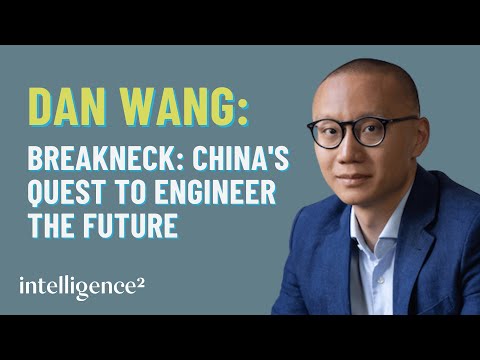
Intelligence Squared's What Does China's Seismic Economic Progress Mean for the USA? With Dan Wang: skim's analysis identifies 9 key moments, with 1 potential conflict of interest flagged. Technology analyst Dan Wang and professor Chris Miller contrast China's 'engineering state' with America's 'lawyerly society.
Category: Politics. Format: Interview. YouTube video analyzed by skim.
skim AI Analysis
Credibility assessment: Grounded Comparative Analysis. Dan Wang draws on six years of firsthand technology research in China alongside historical and infrastructural examples. While the 'engineering vs. lawyerly' framework is an interpretive lens rather than hard empirical science, both speakers ground their claims in concrete policy cases and verifiable economic realities.
Bias assessment: Pro-Build Institutionalist. The conversation favors physical construction, supply-side abundance, and industrial capacity while critiquing American regulatory proceduralism. However, Dan Wang balances this by harshly condemning the human rights abuses and authoritarian excesses of China's engineering state, such as the one-child policy and zero-COVID.
Originality: 88% — Fresh Conceptual Framework. Moving beyond stale 20th-century labels like neoliberal or socialist, Dan Wang's contrast between China's 'engineering state' and America's 'lawyerly society' offers an illuminating paradigm. Blending on-the-ground observations with historical parallels like Robert Moses yields high intellectual novelty.
Depth: 86% — Nuanced Structural Critique. The discussion unpacks historical, macroeconomic, and security drivers behind both governance models. Rather than declaring one system superior, the speakers examine the institutional trade-offs between physical construction speed, individual liberties, pluralistic reform, and defense readiness.
Key Points (9)
1. Dan Wang Contrasts Engineers and Lawyers
Timestamp: 00:01:00 to 00:03:21
Dan Wang frames China as an engineering state whose Soviet-style technocrats treat physical infrastructure and social management alike as construction and math exercises. Conversely, he characterizes the United States as a lawyerly society where legal professionals dominate government and block both harmful policies and vital infrastructure. This foundational dichotomy explains why China builds relentlessly while even well-connected American corridors struggle with dysfunctional trains and highways.
Significance (High): Provides a fresh institutional lens that explains both Chinese infrastructural speed and American regulatory paralysis without relying on dated ideological labels.
Sources in support: Dan Wang (Technology analyst and author of Breakneck: China's Quest to Engineer the Future), Chris Miller (Professor at the Fletcher School, author of Chip War, host of Intelligence Squared podcast)
2. China's Tech Shift and Zero-COVID Collapse
Timestamp: 00:04:12 to 00:07:25
Living in Hong Kong, Beijing, and Shanghai from 2017 to 2023, Dan Wang observed China evolve from an alleged intellectual property copycat into an indisputable leader in electric vehicles and consumer drones. During the same period, he witnessed the three-act trajectory of zero-COVID: initial 2020 uncertainty, apparent 2021 success that bred Communist Party hubris, and the 2022 Shanghai lockdown collapse. The ordeal ultimately smashed social relations and left citizens deeply upset over the state's extreme pandemic controls.
Significance (High): Illustrates how the same state capacity that propelled rapid clean-tech dominance also produced brittle, socially destructive pandemic overreach.
Sources in support: Dan Wang (Technology analyst and author of Breakneck: China's Quest to Engineer the Future)
Neutral sources: Chris Miller (Professor at the Fletcher School, author of Chip War, host of Intelligence Squared podcast)
3. Historical Roots of Both Governance Models
Timestamp: 00:08:32 to 00:11:44
America's lawyerly society dates back to its founding, with Thomas Jefferson's legalistic Declaration of Independence and 13 of the first 16 presidents having practiced law. China's engineering state draws on imperial traditions of conscripting labor for the Great Wall and Grand Canal, alongside Soviet influence and post-1993 macroeconomic construction drives. Together, authoritarianism, economic growth, and lack of legal checks allow Chinese leaders to regulate society like a series of pipes.
Significance (Medium): Demonstrates that modern American proceduralism and Chinese state-led construction are deeply rooted in centuries of political heritage rather than recent policy shifts.
Sources in support: Dan Wang (Technology analyst and author of Breakneck: China's Quest to Engineer the Future)
Neutral sources: Chris Miller (Professor at the Fletcher School, author of Chip War, host of Intelligence Squared podcast)
4. How American Legalism Blocks Housing and Protects Wealth
Timestamp: 00:12:11 to 00:14:40
Dan Wang argues that America's lawyerly system makes stopping projects via environmental, noise, or zoning laws far easier than building housing, mass transit, or clean energy grids. Furthermore, strong legal protections help create $4 trillion corporations like Nvidia and allow wealthy Manhattanites to build skinny high-rises, while leaving poor and middle-class citizens with severe housing shortages and weak transit. Consequently, the lawyerly society excels at protecting existing wealth rather than building broad material abundance.
Significance (High): Connects regulatory vetoes directly to American inequality, showing how procedural blocks hurt lower-income citizens while shielding corporate and elite assets.
Sources in support: Dan Wang (Technology analyst and author of Breakneck: China's Quest to Engineer the Future)
5. Lawyers Prevent Abuses Like the One-Child Policy
Timestamp: 00:14:40 to 00:16:20
Despite its material bottlenecks, the lawyerly society prevents authoritarian atrocities like China's 1980s one-child policy, which Dan Wang describes as a campaign of rural terror involving forced sterilizations and mass abortions. Additionally, American lawyers drove a worthwhile transition away from the 1950s US engineering and warfare state that caused environmental degradation, urban highway destruction, and land wars in Asia. Legal checks thus brought vital environmental and civil rights protections to American life.
Significance (High): Explains why the US originally empowered lawyers in the 1960s and highlights the indispensable role of legal rights in preventing state violence.
Sources in support: Dan Wang (Technology analyst and author of Breakneck: China's Quest to Engineer the Future)
6. Dan Wang Reassesses Urban Builder Robert Moses
Timestamp: 00:17:10 to 00:19:30
Responding to Chris Miller's question on turning back the dial toward builders, Dan Wang identifies as a slight Robert Moses revisionist who believes discourse shaped by Robert Caro's biography The Power Broker has become excessively negative. Unlike Midwestern cities such as Detroit and Cleveland that lost two-thirds of their population since 1950, New York City grew and remains America's most functional city. Today, New York suffers from underdeveloped rather than excessive infrastructure, meaning the US needs more Moses-style capacity to build clean tech and transit.
Significance (Medium): Challenges fifty years of urban planning orthodoxy by arguing that the refusal to build now harms American cities more than overbuilding.
Sources in support: Dan Wang (Technology analyst and author of Breakneck: China's Quest to Engineer the Future), Chris Miller (Professor at the Fletcher School, author of Chip War, host of Intelligence Squared podcast)
7. Abundance Politics and Better Democratic Models
Timestamp: 00:19:30 to 00:22:42
Chris Miller links the pro-building argument to Ezra Klein and Derek Thompson's book Abundance on the left and Elon Musk's anti-bureaucratic push on the right. Dan Wang notes that while China practices a form of supply-side abundance in solar, wind, and housing, it suppresses worker rights and subordinates companies to national strategy. Rather than copying authoritarian China, the United States can look to democratic peers like Japan, Spain, and France, which build subways, high-speed rail, and renewables far faster than America.
Significance (Medium): Refutes the false binary between American stagnation and Chinese authoritarianism by pointing to high-building democracies in Europe and East Asia.
Sources in support: Dan Wang (Technology analyst and author of Breakneck: China's Quest to Engineer the Future), Chris Miller (Professor at the Fletcher School, author of Chip War, host of Intelligence Squared podcast)
8. Why America Can Rebalance More Easily Than China
Timestamp: 00:23:32 to 00:26:44
China faces severe demographic and debt headwinds worsened by the one-child policy and heavy-handed crackdowns on internet platforms and real estate. Dan Wang is more optimistic about America's ability to rebalance because lawyers guarantee pluralism and robust debate for reform, and the US can draw on its own military-engineering heritage exemplified by George Washington and Dwight Eisenhower's federal highway system. China, by contrast, lacks a historical tradition of legal liberalism or individual rights protection to check sovereign power.
Significance (High): Delivers the book's central comparative verdict: reviving dormant American engineering traditions is structurally easier than building rule of law in China.
Sources in support: Dan Wang (Technology analyst and author of Breakneck: China's Quest to Engineer the Future), Chris Miller (Professor at the Fletcher School, author of Chip War, host of Intelligence Squared podcast)
9. Fortress China's Hardware vs. US AI in Conflict
Timestamp: 00:27:38 to 00:30:52
Shaped by Japanese invasion, civil war, and Soviet influence, the Chinese Communist Party under Xi Jinping aggressively pursues self-sufficiency in energy, desert grain farming, and semiconductors. Driving electric vehicle adoption to one in two cars allows China to run transport on domestic coal, solar, and wind rather than imported oil or gas. Meanwhile, America's defense industrial base has rusted in shipbuilding and munitions after supplying Ukraine, prompting Dan Wang to ask whether US artificial intelligence or Chinese drones and munitions would matter more in a real conflict.
Significance (High): Raises an urgent strategic warning that software and AI superiority may not compensate for a hollowed-out US defense manufacturing base.
Sources in support: Dan Wang (Technology analyst and author of Breakneck: China's Quest to Engineer the Future), Chris Miller (Professor at the Fletcher School, author of Chip War, host of Intelligence Squared podcast)
This analysis was generated by skim (skim.plus), an AI-powered content analysis platform by Credible AI. Scores and classifications represent the platform's AI-generated assessment and should be considered alongside other sources.