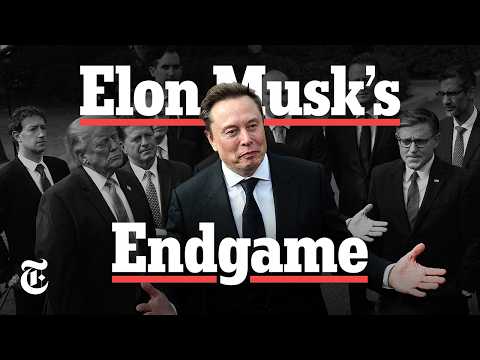
The Ezra Klein Show's What’s Driving Elon Musk? | The Ezra Klein Show: skim's analysis identifies 12 key moments, with 2 potential conflicts of interest flagged. Historian Quinn Slobodian and Ezra Klein examine how Elon Musk uses roughly $450 million in Republican campaign donations and his control over SpaceX, Starlink, Tesla, and X to entrench global dependency on his business empire.
Category: Politics. Format: Interview. YouTube video analyzed by skim.
skim AI Analysis
Credibility assessment: Scholarly Political Analysis. Boston University historian Quinn Slobodian and host Ezra Klein ground their political and economic critique in corporate filings, historical movements, and direct audio clips of Elon Musk. Several psychological and biographical claims about Apartheid South Africa and simulation theory remain interpretive rather than documented.
Bias assessment: Progressive Anti-Oligarch Lens. Both speakers examine Elon Musk from a center-left and progressive perspective that treats billionaire influence and far-right politics as systemic threats. However, Ezra Klein explicitly pushes back against left-wing critics who dismiss Musk as a mere grifter, crediting his genuine industrial achievements at SpaceX and Tesla.
Originality: 85% — Deep Ideological Synthesis. Rather than rehashing daily social media controversies, the conversation connects Elon Musk's corporate strategy to 1990s neoliberal race science, vertical supply-chain integration, Richard Dawkins's memetics, and pension-fund dependency.
Depth: 88% — Rigorous Structural Critique. The discussion systematically unpacks three distinct pillars of power across finance, physical infrastructure, and communications, tracing how corporate mergers, stock market structure, and posthuman AI ideology reinforce one another.
Key Points (12)
1. Slobodian on Musk's $450M Campaign Strategy
Timestamp: 00:02:03 to 00:07:04
Quinn Slobodian argues that Elon Musk's $450 million in Republican donations aims to entrench dependency across finance, physical infrastructure, and media messaging. Despite the risk of alienating future Democratic administrations, Slobodian concludes Musk uses hyperpolarization to secure favored status with right-wing movements in the U.S. and Europe.
Significance (High): Frames massive campaign spending not as simple lobbying, but as a high-risk bid to lock in state reliance across finance, orbit, and media before regulators can act.
Sources in support: Quinn Slobodian (Professor of International History at Boston University; Co-author of Muskism)
Neutral sources: Ezra Klein (Host, The Ezra Klein Show (The New York Times))
2. From AI Safety to Fighting Woke Models
Timestamp: 00:07:04 to 00:11:58
In an Economist clip, Elon Musk states that humans are unlikely to control superintelligent AI in 10 years, so AI must be maximally truth-seeking and curious. Quinn Slobodian traces how Musk shifted from founding OpenAI and Neuralink to counter digital superintelligence toward building Grok after November 2022 to fight what he views as woke language models.
Significance (High): Reveals how AI safety rhetoric in Silicon Valley pivoted from existential human survival to culture-war competition after ChatGPT proved generative AI's commercial value.
Sources in support: Quinn Slobodian (Professor of International History at Boston University; Co-author of Muskism), Elon Musk (CEO of SpaceX and Tesla; Owner of X and xAI (heard in audio clips))
Neutral sources: Ezra Klein (Host, The Ezra Klein Show (The New York Times))
3. Labor, COVID Rules, and the Meme Stock Surge
Timestamp: 00:11:59 to 00:15:34
Quinn Slobodian attributes Elon Musk's political shift from Obama-era green subsidy beneficiary to right-wing leader to pro-union Biden policies, workplace activism, and California's COVID lockdowns. Slobodian concludes that Musk discovered online polarization on Twitter acted as an accelerant that turned him into a human meme stock and the world's richest man.
Significance (Medium): Challenges the view that social media corrupted Elon Musk's judgment, showing instead that online provocation coincided with a massive surge in his stock valuation.
Sources in support: Quinn Slobodian (Professor of International History at Boston University; Co-author of Muskism), Ezra Klein (Host, The Ezra Klein Show (The New York Times))
4. Financial Fabulism Meets In-House Production
Timestamp: 00:15:34 to 00:20:00
Ezra Klein notes Elon Musk's wealth rose from an estimated $39 billion in 2020 to $1 trillion in six years and insists critics are wrong to dismiss his tangible achievements at SpaceX and Tesla. Quinn Slobodian explains that Musk combines financial fabulism about infinite future revenues with real in-house vertical manufacturing that cut orbital launch costs by over 90 percent.
Significance (High): Separates hype from industrial reality by showing how decoupled, in-house manufacturing allowed Tesla and SpaceX to weather global supply shocks and outpace legacy rivals.
Sources in support: Ezra Klein (Host, The Ezra Klein Show (The New York Times)), Quinn Slobodian (Professor of International History at Boston University; Co-author of Muskism)
5. Merging AI and Robotics Under SpaceX
Timestamp: 00:20:12 to 00:24:20
Elon Musk predicts a quasi-infinite economy driven by digital intelligence and humanoid robots shaping physical atoms. Quinn Slobodian notes that to unlock this vision, SpaceX absorbed xAI after xAI absorbed X.com, and Musk is calling for a Tesla-SpaceX merger even as the SpaceX prospectus lists national legislation as its top risk factor.
Significance (High): Highlights the tension between an empire consolidating digital AI and physical robotics under one roof and its underlying vulnerability to national government regulation.
Sources in support: Quinn Slobodian (Professor of International History at Boston University; Co-author of Muskism), Elon Musk (CEO of SpaceX and Tesla; Owner of X and xAI (heard in audio clips))
Neutral sources: Ezra Klein (Host, The Ezra Klein Show (The New York Times))
6. Dawkins, Asimov, and X as a Mind-Virus Engine
Timestamp: 00:24:21 to 00:30:50
Quinn Slobodian traces Elon Musk's concept of the woke mind virus to evolutionary biologist Richard Dawkins's 1990s writings on memetics and to Isaac Asimov's Foundation series. Slobodian argues Musk uses X and its account monetization to run a vertically integrated communicative space that amplifies right-wing memes and manages mass emotion toward a posthuman transition.
Significance (Medium): Explains why X prioritizes ideological amplification and creator payouts over traditional advertising, treating public discourse as a programmable cybernetic system.
Sources in support: Quinn Slobodian (Professor of International History at Boston University; Co-author of Muskism)
Neutral sources: Ezra Klein (Host, The Ezra Klein Show (The New York Times))
7. The Empathy Exploit, Apartheid, and Philanthropy
Timestamp: 00:30:50 to 00:38:52
In a clip with Joe Rogan, Elon Musk calls empathy a civilizational weakness exploited to undermine Western societies. Quinn Slobodian links this view to European far-right remigration demands, a two-tier mindset from late-Apartheid South Africa, and Musk's rejection of traditional billionaire social contracts, noting the Musk Foundation routinely misses its 5 percent payout rule.
Significance (Medium): Contrasts older industrialists like Henry Ford and Bill Gates, who used wages or philanthropy to buy public consent, with a model that rejects egalitarian obligations.
Sources in support: Quinn Slobodian (Professor of International History at Boston University; Co-author of Muskism), Ezra Klein (Host, The Ezra Klein Show (The New York Times))
8. Neoliberal Hierarchies and the 0.1% AI Elite
Timestamp: 00:38:53 to 00:45:24
Quinn Slobodian explains how post-Cold War neoliberals allied with cultural nationalists around the belief in natural racial and IQ hierarchies popularized by the 1994 book The Bell Curve. Slobodian argues that because generative AI is expected to automate away most knowledge-economy jobs, that 10 percent cognitive elite is shrinking into a tiny 0.1 percent super-aristocracy.
Significance (High): Shows how AI automation disrupts even conservative meritocratic arguments, shrinking the winners' circle from broad white-collar workers to a tiny ownership caste.
Sources in support: Quinn Slobodian (Professor of International History at Boston University; Co-author of Muskism), Ezra Klein (Host, The Ezra Klein Show (The New York Times))
9. Technocracy, Succession, and Ethnonationalism
Timestamp: 00:45:24 to 00:50:42
Ezra Klein argues that a belief in cognitive hierarchy unifies Elon Musk's seemingly contradictory positions on birth rates, foreign aid, immigration, and AI. Quinn Slobodian compares this to 1930s Technocracy Incorporated, notes Musk holds 85 percent of SpaceX voting shares with no succession plan, and says he uses ethnonationalist fear to win medium-term public consent.
Significance (Medium): Exposes the governance risk of an empire where one individual holds 85 percent of SpaceX voting shares without a succession plan while banking on rapid technological transition.
Sources in support: Ezra Klein (Host, The Ezra Klein Show (The New York Times)), Quinn Slobodian (Professor of International History at Boston University; Co-author of Muskism)
10. Klein on Masculine Will and the Starlink Showdown
Timestamp: 00:50:51 to 00:57:48
Ezra Klein argues that Elon Musk and Donald Trump appeal to male followers by projecting an unafraid, masculine conquering will, but warns that state dependence on Musk's companies creates an unstable equilibrium. Quinn Slobodian outlines Europe's three-part response of regulating, replacing, and reimagining technology, noting that local moratoria are already slowing AI data centers.
Significance (High): Provides concrete policy frameworks for democracies seeking to reduce single-vendor dependency on private satellite and AI infrastructure.
Sources in support: Ezra Klein (Host, The Ezra Klein Show (The New York Times)), Quinn Slobodian (Professor of International History at Boston University; Co-author of Muskism)
11. Nationalizing Starlink vs. Stock Market Leverage
Timestamp: 00:57:48 to 01:02:48
Quinn Slobodian notes that economist Paul Krugman recently discussed using the Defense Production Act to nationalize Starlink, though Ezra Klein cautions that reporting on Ukraine Starlink shutoffs remains contested. Slobodian counters that because SpaceX is a top-10 index company held by pension funds and universities, and Musk proposed giving every U.S. child one SpaceX share, punishing him risks hurting half of American households.
Significance (High): Demonstrates how passive index investing and institutional endowments shield dominant tech firms from aggressive state intervention or nationalization.
Sources in support: Quinn Slobodian (Professor of International History at Boston University; Co-author of Muskism), Ezra Klein (Host, The Ezra Klein Show (The New York Times))
12. Simulation Theory, Nihilism, and Tech Criticism
Timestamp: 01:03:08 to 01:09:50
In a clip with Walter Isaacson, Elon Musk jokes there is a 50 percent chance we live in a simulation because his own life making spaceships feels unreal. Ezra Klein and Quinn Slobodian argue that viewing other humans as non-player characters encourages a nihilistic abandonment of social responsibility, before Slobodian recommends three books on resource extraction, AI infrastructure, and tech labor organizing.
Significance (Medium): Connects billionaire fascination with simulation theory to the real-world dismissal of foreign aid and welfare programs as frivolous.
Sources in support: Ezra Klein (Host, The Ezra Klein Show (The New York Times)), Quinn Slobodian (Professor of International History at Boston University; Co-author of Muskism)
This analysis was generated by skim (skim.plus), an AI-powered content analysis platform by Credible AI. Scores and classifications represent the platform's AI-generated assessment and should be considered alongside other sources.