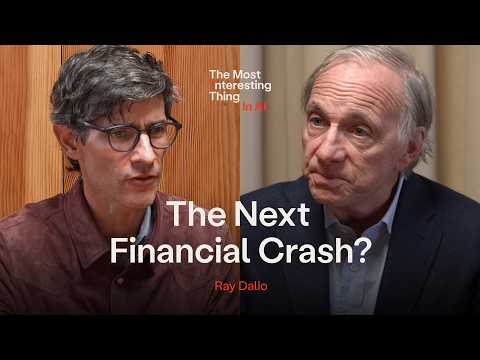
Nicholas Thompson's Why Ray Dalio is Worried About an AI Bubble: skim's analysis identifies 12 key moments. Investor Ray Dalio explains why current artificial intelligence investments exhibit the classic mechanics of a financial bubble.
Category: Business. Format: Interview. YouTube video analyzed by skim.
skim AI Analysis
Credibility assessment: Experienced Macro Insight. Ray Dalio articulates economic principles grounded in his decades running Bridgewater Associates. Arguments are structured around measurable balance-sheet metrics, though macroeconomic forecasting carries inherent unpredictability.
Bias assessment: Macro Cycle Determinism. Dalio evaluates emerging artificial intelligence strictly through historical economic cycles, sovereign debt mechanics, and capital supply-demand constraints rather than technological exceptionalism.
Originality: 84% — Systemic Historical Analogy. Contrasting the common tech-narrative focus on model compute, Dalio maps the artificial intelligence boom against historical financial bubbles and sovereign balance-sheet dynamics.
Depth: 88% — Rigorous Systems Mechanics. The discussion dissects specific supply-demand dynamics in Treasury auctions, capital structures, wealth-versus-money liquidity traps, and differences between Chinese and American industrial strategies.
Key Points (12)
1. Five Intertwined Forces Drive History
Timestamp: 00:02:07 to 00:07:12
Historical shifts occur via five interacting forces: debt money cycles, domestic political order, geopolitical relations, natural acts such as climate, and technological invention. Technology cannot be analyzed in isolation because capital flows and political conflict constrain its real-world implementation. Ultimately, mechanical cause-and-effect rules govern these historical developments.
Significance (High): Reorients technical discussions away from software metrics toward global macro pressures and debt cycles.
Sources in support: Ray Dalio (Founder, Bridgewater Associates)
Neutral sources: Nicholas Thompson (CEO of The Atlantic, Host)
2. Rules-Based Decision Systems Preceded Modern AI
Timestamp: 00:07:16 to 00:12:54
Bridgewater built its early quantitative systems around transparent, testable decision criteria rather than black-box algorithms. By measuring economic indicators like unemployment filings alongside commodity inflation, Dalio converted human reasoning into programmable logic. Systematic testing eliminated emotional bias and exposed analytical oversights over decades of operation.
Significance (Medium): Demonstrates how disciplined logical heuristics provide superior risk management during major economic shocks.
Sources in support: Ray Dalio (Founder, Bridgewater Associates)
Neutral sources: Nicholas Thompson (CEO of The Atlantic, Host)
3. Distinguishing Breakthrough Technology from Good Investments
Timestamp: 00:13:04 to 00:16:21
Every transformative technology from rural electrification to radio triggered massive investment manias as participants feared falling behind. Companies and investors routinely conflate useful engineering inventions with viable financial assets, overpaying at cycle peaks. A failure to separate fundamental innovation from sustainable valuation creates vulnerability.
Significance (High): Warns market participants that revolutionary utility does not insulate an asset class from devastating downturns.
Sources in support: Ray Dalio (Founder, Bridgewater Associates)
Neutral sources: Nicholas Thompson (CEO of The Atlantic, Host)
4. Surging Paper Wealth Collides with Cash Limits
Timestamp: 00:16:21 to 00:19:23
Unrealized equity valuations cannot substitute for spendable currency when debt obligations or tax bills come due. High paper valuations create a perceived wealth effect, yet turning that paper value into cash requires selling to a buyer with actual capital. When broad liquidations begin, illiquid valuations rapidly collapse across speculative holdings.
Significance (High): Highlights the precarious liquidity structure behind highly leveraged, privately held tech enterprises.
Sources in support: Ray Dalio (Founder, Bridgewater Associates)
Neutral sources: Nicholas Thompson (CEO of The Atlantic, Host)
5. Overconcentrated Market Bets Amplify Systemic Peril
Timestamp: 00:19:23 to 00:23:28
Market gauges reflect extreme concentration with major portions of GDP, equity indices, and capital expenditure tied directly to artificial intelligence. This single-sector exposure makes the entire economy vulnerable if key valuation or productivity assumptions slip. Diversification remains essential when leveraged sentiment reaches historical extremes.
Significance (Medium): Signals high correlation risk across portfolios heavily exposed to concentrated tech leadership.
Sources in support: Ray Dalio (Founder, Bridgewater Associates)
Neutral sources: Nicholas Thompson (CEO of The Atlantic, Host)
6. Mounting Debt Plaque Constrains US Spending
Timestamp: 00:23:29 to 00:26:47
The United States government spends approximately seven trillion dollars annually while collecting only five trillion in revenue. Debt service costs have escalated to roughly one trillion dollars a year, absorbing nearly half the federal deficit. This compounding interest acts like arterial plaque, reducing discretionary spending power across the broader economy.
Significance (High): Directly affects long-term interest rate projections and the fiscal capacity of the federal government.
Sources in support: Ray Dalio (Founder, Bridgewater Associates)
Neutral sources: Nicholas Thompson (CEO of The Atlantic, Host)
7. Declining Foreign Appetite for US Treasuries
Timestamp: 00:26:47 to 00:29:30
With ten trillion dollars in debt maturing alongside massive new deficits, the government requires dependable global capital. Foreign buyers such as China and Japan face structural and geopolitical reasons to curtail Treasury purchases, including sanctions risk. This mismatch between soaring Treasury supply and weakening demand poses severe refinancing hazards.
Significance (High): Threatens to force bond yields higher, directly inflating borrowing costs across the private sector.
Sources in support: Ray Dalio (Founder, Bridgewater Associates)
Neutral sources: Ray Dalio (Founder, Bridgewater Associates), Nicholas Thompson (CEO of The Atlantic, Host)
8. Productivity Gains Cannot Guarantee Timely Fiscal Solvency
Timestamp: 00:29:30 to 00:33:02
Technological optimists assume artificial intelligence will generate rapid productivity miracles that effortlessly resolve the debt crisis. However, economic history shows productivity often fuels deflationary price competition rather than direct taxable taxable personal income. Even with substantial output growth, political mechanisms may fail to distribute and tax that wealth in time to service mounting liabilities.
Significance (High): Challenges techno-optimist assumptions regarding automatic deficit resolution through automated economic growth.
Sources in support: Ray Dalio (Founder, Bridgewater Associates)
Neutral sources: Nicholas Thompson (CEO of The Atlantic, Host)
9. Strategic Rivalry Requires Coordinated State Direction
Timestamp: 00:33:05 to 00:37:32
Pure uncoordinated free market resource allocation falls short during periods of intense international competition. Critical technologies determining military supremacy and economic dominance require purposeful state guidance rather than consumer luxury optimization. Targeted sovereign intervention becomes necessary when systemic survival is at stake.
Significance (Medium): Shifts mainstream market dogma toward supporting coordinated industrial policy and strategic government capital stakes.
Sources in support: Ray Dalio (Founder, Bridgewater Associates)
Neutral sources: Nicholas Thompson (CEO of The Atlantic, Host)
10. Solving Fiscal Deficits with the Three Percent Target
Timestamp: 00:37:45 to 00:42:03
Stabilizing the debt spiral requires cutting federal deficits below three percent of GDP to halt exponential compounding. Achieving this goal mathematically demands a balanced combination of four to five percent spending cuts and four to five percent tax increases. Political leaders persistently reject these adjustments because electoral mandates depend on promising preserved entitlements and zero tax hikes.
Significance (High): Provides a definitive mathematical benchmark for assessing future legislative budget negotiations.
Sources in support: Ray Dalio (Founder, Bridgewater Associates)
Neutral sources: Nicholas Thompson (CEO of The Atlantic, Host)
11. China Treats Artificial Intelligence as Public Infrastructure
Timestamp: 00:42:05 to 00:46:08
American artificial intelligence development pursues venture capital profits and frontier software models, while Chinese leadership views AI as foundational public infrastructure. China prioritizes embedding practical, cost-effective automation into its dominant manufacturing sector, which accounts for nearly a third of global output. This structural difference steers automation toward industrial competitiveness rather than high-margin software services.
Significance (High): Frames international technological competition around tangible manufactured exports rather than enterprise cloud revenue alone.
Sources in support: Ray Dalio (Founder, Bridgewater Associates)
Neutral sources: Nicholas Thompson (CEO of The Atlantic, Host)
12. Principles and Reflection Form the Foundation for Success
Timestamp: 00:46:08 to 00:49:25
Long-term success requires aligning personal nature with daily work and deriving progress from painful missteps. Whether designing computer algorithms or managing a personal career, systematic reflection on mistakes produces durable wisdom. Dalio aims to democratize institutional investment knowledge by building accessible algorithmic platforms for broader public use.
Significance (Low): Encourages individuals to systematize career and financial decision processes using structured reflective feedback loops.
Sources in support: Ray Dalio (Founder, Bridgewater Associates)
Neutral sources: Nicholas Thompson (CEO of The Atlantic, Host)
This analysis was generated by skim (skim.plus), an AI-powered content analysis platform by Credible AI. Scores and classifications represent the platform's AI-generated assessment and should be considered alongside other sources.