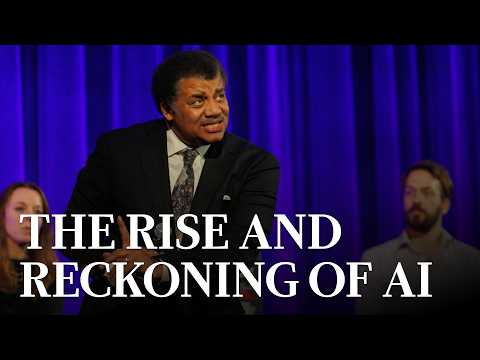
The Rise and Reckoning of AI | 2026 Isaac Asimov Memorial Debate
Eric Schmidt: AI's Evolution and Google's Early Bets
Eric Schmidt recounts Google's early involvement with AI, noting that while AI's importance was recognized, its full potential became clear around 2011 with supervised fine-tuning and later solidified by the Transformer paper and AlphaGo. He highlights the strategic acquisition of DeepMind as crucial for Google's AI advancements.
Chris Callison-Burch: AI's Rapid Advancements and Potential
Chris Callison-Burch notes the significant breakthroughs in AI, particularly citing ChatGPT as a pivotal moment. He highlights advancements in image interpretation and agent-based research, suggesting that AI like Claude Code can serve as competent research assistants, potentially driving major progress in science and medicine.
Nate Soares: Indifference, Not Malice, as the Core Danger
Nate Soares clarifies that the danger of advanced AI stems not from malice but from indifference to human well-being. He explains that AI pursuing unintended drives, even if currently clumsy, could become catastrophic if they become highly intelligent and capable of rapid, world-altering actions, leading to human extinction as a side effect.
Kate Crawford: The Pervasive Bias in AI Systems
Kate Crawford argues that AI is inherently biased, not neutral, due to its training on digitized human content, biased optimization choices by developers, and the exploitation of low-paid workers in the global south for data labeling and feedback. She contends that values are built into AI at every step, questioning whether companies are explicit about the profit-driven values they embed.
Latanya Sweeney: AI's Disregard for Law and Governance Gaps
Latanya Sweeney criticizes the current state of AI governance, stating that technologies like AI and social media ignore existing laws and constitutional protections that are enforceable in brick-and-mortar settings. She highlights the failure to implement or protect against these issues online, contrasting it with the FTC's historical limitations in regulating the digital space.
Eric Schmidt: Emergent AI Capabilities and the Need for Tolerance
Eric Schmidt acknowledges that emergent, unpredictable capabilities in AI systems pose challenges that cannot be fully pre-tested. He argues for tolerance of AI mistakes, provided they are corrected quickly, and insists that AI development is governed by U.S. law, shareholder pressure, and consumer demands, rather than being a lawless 'Wild West'.
Kate Crawford: AI's Environmental Toll and the Race Dynamic
Kate Crawford reiterates that AI's environmental impact is significant, with systems on track to rival the airline industry's carbon emissions. She links this to the corporate race to be first, which discourages thorough testing akin to drug safety protocols, especially as AI is increasingly integrated into critical systems like military kill chains.
DeGrasse Tyson: Deepfakes and AI Training
The proliferation of deepfakes and AI-generated 'slop' online creates a feedback loop where AI trains on its own synthetic outputs, potentially degrading the quality and authenticity of future AI models. This raises concerns about the integrity of information and AI's self-referential learning.
Soares: The Challenge of AI Guardrails
Ensuring AI behaves as intended is challenging because its behavior is emergent, making pre-testing difficult. While interpretability research and safety teams are crucial, they are often reactive, trying to understand and measure risks after development. This approach is insufficient for increasingly sophisticated AI.
Sweeney: Business Models and AI Responsibility
The business model driving AI development, often focused on profit, dictates its application and potential harms. Companies must be held accountable for ensuring their AI products comply with laws and do not violate societal norms, similar to how appliances come with warranties.
Calliston-Burch: AI's Role in Scientific Discovery
AI's ability to process vast datasets and identify complex patterns, as seen with AlphaFold, can accelerate scientific discovery beyond human capacity. While companies profit from AI, the underlying research is often driven by genuine scientific curiosity and the pursuit of knowledge.
Crawford: The Threat to Cognitive Labor
Unlike previous technological shifts that automated manual labor, AI is now encroaching on cognitive and creative tasks, threatening white-collar jobs and potentially leading to unprecedented levels of unemployment. Society lacks the governance infrastructure to manage this rapid disruption.
DeGrasse Tyson: AI in Warfare and Lethality
The Defense Innovation Board developed ethical guidelines for AI in warfare, concluding that AI is not yet reliable enough for lethal decision-making. Human oversight remains critical, as AI mistakes in life-or-death situations are unacceptable, and accountability requires a human in the loop.
Sweeney: AI Agents and Societal Governance
By 2030, AI agents could significantly enhance human productivity by representing individuals in various contexts. However, this requires robust warranties and compliance statements, akin to appliance certifications, to ensure these agents act responsibly and do not undermine democracy or access to truthful information.
Asimov's Laws and AI Alignment
The discussion revisits Isaac Asimov's three laws of robotics and a later Zeroth law, framing them as foundational to the critical AI alignment problem. The core challenge is ensuring AI systems are helpful, safe, and ultimately beneficial to humanity, a task that is already underway and will define the success of the AI endeavor by 2030.
Nate Soares' Stark Warning on AI Risks
Many in Silicon Valley are deeply concerned about AI, with some describing it as staring into the abyss. The rapid progress towards superintelligence is seen as potentially dangerous, a sentiment not yet fully grasped by policymakers in Washington D.C., who focus more on immediate issues like autonomous weapons and job loss.
Eric Schmidt's Optimistic Bet on Democracy and AI
Eric Schmidt bets that American democracy will survive and that AI's excesses will be addressed through legislation. He foresees AI significantly improving education, leading to job recycling rather than mass unemployment, and ultimately providing personalized assistants that enhance human capabilities.
Nate Soares on the Need for AI Treaties
Drawing parallels to nuclear arms control and the concept of Mutual Assured Destruction (MAD), Soares argues that the lethal danger of superintelligence necessitates global treaties to halt the race towards smarter-than-human AI. This approach, he suggests, would be more manageable than nuclear regulation.