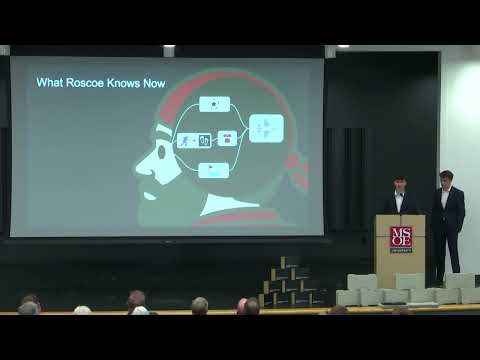
Changing the Game with AI | Soccer Video Analysis by Adrian Manchado & Tanner Cellio
Adrien Explains YOLO and SAM Integration
Adrien Manado details how Rosco AI uses YOLO for object detection and SAM 2 for tracking players over time. YOLO identifies players in each frame, and SAM 2 then tracks these players, assigning unique IDs to maintain continuity. This combination addresses the limitations of YOLO's lack of memory, enabling the system to understand player movements and interactions throughout the game. The integration of these models is crucial for generating meaningful insights.
Tanner: Kalman Filters Give Rosco Intuition
Tanner Cellio describes the use of Kalman filters to improve ball tracking, stating that these filters provide Rosco AI with "intuition." By predicting the ball's location in frames where it's not detected, the system compensates for imperfect vision. This predictive capability relies on features like velocity and trajectory, allowing Rosco to make educated guesses about the ball's position. This ensures more complete and accurate data for analysis.
Adrien: Homography Corrects Perspective
Adrien Manado explains how homography is used to correct for perspective distortions caused by camera movement. By mapping key points on the soccer field, the system can transform the image into a top-down view, allowing for accurate distance measurements. This technique addresses the challenge of varying dimensions in the video feed, ensuring that the AI can track players and the ball in a consistent 3D space. Homography is essential for obtaining reliable spatial data.
Tanner: Fatigue Tracking Reduces Injuries
Tanner Cellio argues that Rosco AI can help reduce injuries by tracking fatigue metrics like distance and sprints. He cites professional teams that have reduced injuries by one-third using similar analysis. By monitoring these metrics, the system can identify players at risk of overtraining, allowing coaches to make informed decisions about player rotation and training intensity. This proactive approach aims to improve player health and team performance. The potential to prevent six injuries could be the difference between winning and losing.
Adrien: Rosco AI Can Adapt to Basketball
Adrien Manado suggests that Rosco AI could be adapted for basketball analysis with minimal modifications. The primary change would involve retraining the key point detection model on a basketball dataset. This adaptability highlights the versatility of the system and its potential for use in other sports. By simply updating the training data, Rosco AI could provide similar insights for basketball teams, expanding its market and impact. This shows the scalability of the AI solution.
Tanner Explains YOLO and SAM 2 Synergies
Tanner Cellio clarifies why both YOLO and SAM 2 are used, explaining that YOLO provides the initial prompts for SAM 2. YOLO's speed allows it to quickly identify players in the first frame, providing bounding boxes that SAM 2 uses to track players continuously. This synergy leverages the strengths of both models, with YOLO providing the initial detection and SAM 2 ensuring accurate tracking over time. This combination is essential for the system's overall performance, enabling it to efficiently analyze player movements.
Adrien Acknowledges SAM 2 Limitations
Adrien Manado admits that SAM 2 has limitations, particularly with players leaving the frame or occlusions occurring. He explains that when a player leaves the frame, SAM 2 loses track of them, and occlusions can cause the system to assign the same ID to multiple players. To address these issues, they re-prompt SAM 2 with YOLO in frames where these errors occur. This iterative process ensures that the system maintains accurate tracking despite these challenges, demonstrating a robust approach to error correction.