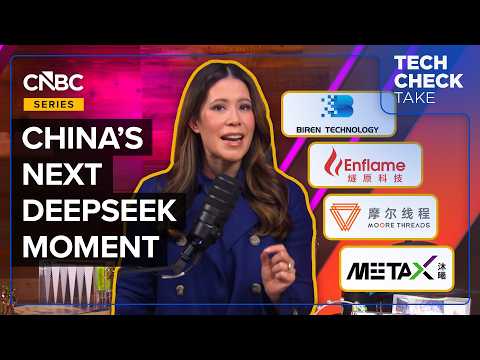
China’s Next AI Shock Is Hardware
Bosa: China Exports AI Stack
Deirdre Bosa points out that China is exporting a full AI stack, including open-source models and increasingly capable chips, to countries that want AI but lack the budget, talent, or power of the U.S. This strategy, described as a "Trojan horse," involves selling turnkey systems that integrate models, services, and chips into a single deployment. This approach allows China to gain mindshare and lock in long-term dependence, updated for AI. China's AI stack export strategy could reshape global AI adoption.
Rao Highlights Huawei's Progress
Naveen Rao acknowledges that Huawei has made significant progress in chip development, closing the gap with Nvidia. While Huawei's chips may not be at the same level as Nvidia's, they are getting closer with each generation, and Huawei is ramping up its chip production capabilities. This progress is notable because Huawei is now building its chips using SMIC, a Chinese manufacturer, due to U.S. sanctions, demonstrating China's increasing self-sufficiency in chip production. Huawei's advancements signal a growing competitive threat to Nvidia.
Rao: China's Brute Force Approach
China is using a "brute force" approach to chip manufacturing, compensating for the lack of advanced technology like EUV lithography by using multi-patterning techniques. This increases complexity, decreases yield, and increases cost, but allows them to achieve five-nanometer performance. This strategy extends to AI model training, where they string together thousands of less efficient chips to achieve comparable results. China's brute force approach highlights their determination to overcome technological limitations through sheer scale and resource allocation.
Rao: Deepseek's Impact
Naveen Rao reflects on the impact of Deepseek, noting that its success forced Chinese labs to be more efficient and creative due to chip limitations. This constraint-driven innovation led to the development of low-level, optimized software. The Deepseek moment served as a wake-up call, highlighting the potential for significant advancements even with limited resources. Deepseek's success demonstrates the power of constraint-driven innovation.
Rao: Energy as a Constraint
Naveen Rao emphasizes that energy is a significant constraint for China's AI ambitions, despite their rapid build-out of energy infrastructure. On a per-capita basis, China's energy production is still far behind the U.S., which could limit their ability to scale AI applications. However, China's central planning allows them to redirect energy resources to AI development, potentially mitigating this constraint. China's energy situation presents a complex challenge for its AI ambitions.
Rao: China's Model Mindshare
Naveen Rao notes that China has gained significant mindshare in the AI world, particularly outside the U.S., with many believing that Chinese models are the best. This perception is driven by the success of open-source models like Deepseek, which are widely used in Europe and other regions. This mindshare gives China a strategic advantage in shaping the global AI landscape. China's model mindshare positions them as a key player in global AI.
Rao: Unconventional Computing
Naveen Rao suggests that the next race in computing will be in unconventional computing, which involves rethinking the foundations of how computers are built for AI. China is actively researching unconventional computing techniques, driven by the need to do more with less due to their energy constraints. This research could lead to novel devices that are far more energy-efficient, giving China a significant advantage. Unconventional computing could be the key to unlocking the next level of AI efficiency.
Rao: Government's Role
Naveen Rao expresses concern about the government picking winners in the AI race, arguing that it could stifle innovation and lead to cronyism. He suggests that the U.S.'s strength lies in its individualistic approach, which fosters leading-edge innovation. Moving towards a more homogenous, state-based model could undermine this advantage. Government intervention could hinder the U.S.'s AI innovation.