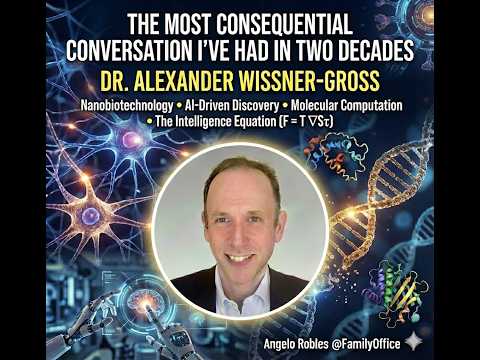
The Most Consequential Conversation I've Had in Two Decades
AI's Impact on Asset Classes
Wisner-Gross highlights the increasing role of AI in financial markets, including private and less liquid markets. He poses the question of where alpha remains once AI becomes pervasive in the economy. Consequently, investors must consider the impact of AI on traditional investment strategies.
Robas: Executives Must Embrace AI
Angelo Robas expresses concern about executives over 40 resisting AI adoption. He emphasizes the need for them to learn and work with AI to remain employable in a rapidly changing world. Therefore, continuous learning and adaptation are essential for professional survival.
Wisner-Gross on the Singularity's Nature
Wisner-Gross defines the singularity not as a single point in time, but as a converging set of technologies and scientific discoveries happening simultaneously. He uses the analogy of a mountain to illustrate that while the slope may appear vertical from a distance, it has foothills and a finite slope up close. Thus, the singularity is a process, not an event.
Wisner-Gross: Hyperdeflation vs. Hyperinflation
Wisner-Gross discusses the macroeconomic impact of the singularity, questioning whether it will lead to hyperdeflation or hyperinflation. He suggests that even if the cost of intelligence and labor goes to zero, central banks may print money to maintain a target inflation rate. Therefore, the long-term macroeconomic effects of the singularity are uncertain.
Wisner-Gross on Post-Scarcity Economics
Wisner-Gross explores the concept of post-scarcity economics, questioning whether capital accumulation will remain the primary motivator in a world where energy, intelligence, and labor are effectively free. He suggests that control and decision-making will become scarce resources. Thus, alternative systems of motivation may emerge in a post-capitalist future.
Wisner-Gross: Real Estate's Future
Wisner-Gross challenges the notion that coastal real estate will remain scarce, citing technological innovations like manufactured real estate and simulated environments. He argues that physical scarcity may become an artificial construct that most people don't care about. Therefore, traditional assumptions about the value of real estate may not hold in the future.
Wisner-Gross: The One-Person Unicorn
Wisner-Gross predicts the rise of trillion-dollar companies run by a handful of humans and a lot of AIs. He suggests that we may already be in the midst of a "zero-person unicorn," where an AI runs a billion-dollar business with a human figurehead. Thus, increasing productivity will lead to fewer people running larger operations.
Wisner-Gross: Knowledge Work is Cooked
Wisner-Gross asserts that knowledge work is "cooked" and will be automated in the next one to two years. He advises automating anything that can be automated, emphasizing the increasing autonomy and reliability of AI. Therefore, many existing roles are becoming obsolete.
Wisner-Gross: The Human-Machine Merger
Wisner-Gross argues that the human-machine merger is already underway, with wearables, brain-computer interfaces, and implantables becoming increasingly prevalent. He predicts that this merger will happen at scale within the next 10 years. Thus, humans will need to integrate with technology to remain competitive.
Wisner-Gross: Retirement is Obsolete
Wisner-Gross dismisses concerns about the obsolescence of retirement, arguing that it's a relatively recent concept and small potatoes compared to the changes we'll see in the future. He suggests that there will be so many interesting opportunities that worrying about retirement will seem laughable in retrospect. Therefore, individuals should focus on building ambitious things.
Wisner-Gross: The Earth-Centered Dyson Swarm
Wisner-Gross argues that we already have a baby Earth-centered Dyson swarm in the form of Starlink satellites. He suggests that solar synchronous orbit (SSO) is under-indexed and will become crowded as orbital AI computing kicks off. Therefore, the singularity will be visible in the sky as a ring around the Earth.
Wisner-Gross's AI Model Preferences
Wisner-Gross shares his favorite AI models, including Opus 4.6 for code generation, Nano Banana Pro for image generation, and Gemini 3 deep think for scientific reasoning. He emphasizes that each model has different strengths and weaknesses. Thus, choosing the right model depends on the specific task.
Wisner-Gross: The Easiest Onboarding Experience
Wisner-Gross recommends getting a Frontier model subscription, like Anthropic Claude, to easily build web-based apps. He suggests that this is the easiest onboarding experience for anyone to start experimenting with AI. Therefore, individuals should take advantage of these tools to learn and create.
Wisner-Gross on Chinese AI Dominance
Wisner-Gross explains why Chinese openweight models are stronger than US models, citing economic incentives and China's AI plus strategy. He suggests that China commoditizes its AI models to integrate AI throughout its industrial ecosystem. Therefore, the US may need to shift its economic focus to compete.
Wisner-Gross on Open Claw's Innovations
Wisner-Gross describes Open Claw as scaffolding on top of existing models that enabled AI agents to operate headlessly and autonomously 24/7, communicating via messaging apps. He argues that this unhobbling of capabilities is on par with that of chat GPT. Thus, Open Claw is a seminal moment in the evolution of AI agents.
Wisner-Gross: Skepticism of Simulation
Wisner-Gross expresses skepticism about the simulation hypothesis, arguing that it's biased to the moment because we have a lot of computers right now. He suggests that we should be suspicious of using the paradigm of the moment to explain the universe. Therefore, the simulation hypothesis may be too anthropic for his taste.