Molly Mielke's journey into venture capital, starting from film and design, challenges traditional VC archetypes. Her unique background allows her to connect with founders on a different level, focusing on storytelling and brand as critical early-stage differentiators. This unconventional path, while initially met with skepticism, has become a strength, attracting LPs who value differentiation.
Navigating the Fundraising Landscape
Successful fundraising requires a delicate balance between a deep, clear vision and strong relationships. Founders should invest in both their business fundamentals and their network before seeking capital. Mielke advises developing a well-written memo detailing short and long-term goals, understanding the problem's significance, and articulating why top talent would join.
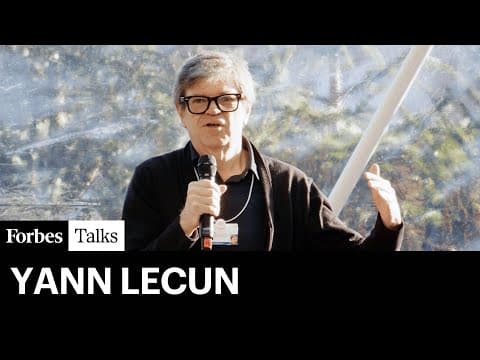
Yann LeCun argues that relying on Large Language Models (LLMs) for agentic systems is a flawed approach because these models lack the ability to predict the consequences of their actions. He emphasizes the necessity of 'world models' for intelligent behavior, enabling systems to anticipate outcomes and plan action sequences, which are currently absent in LLMs, thus hindering efficient learning and zero-shot task-solving.
Open AI is Crucial
LeCun emphasizes that the open nature of AI research has been the biggest factor in its progress, allowing for rapid contributions and advancements. He laments the increasing trend of industry research labs becoming more closed, particularly in the West, while open-source models from China are gaining prominence. He warns that this shift will slow down progress, especially in the US, and advocates for maintaining openness to foster innovation and collaboration, concluding that closed AI is a mistake.
AI as a Platform
LeCun argues that AI is becoming a platform and, like the internet, should be open source. He recalls the debates in the 90s about proprietary internet infrastructure and how it was eventually replaced by open-source solutions like Linux. He believes a similar phenomenon will occur with AI, advocating for countries outside the US and China to promote open-source AI to ensure diverse and culturally relevant AI systems, thus preventing control by a few companies.
LeCun on AI Alignment
LeCun argues that the focus on aligning LLMs to avoid offensive outputs is misguided because AI architectures will evolve significantly. He proposes 'objective-driven AI' systems that are given an objective and can only fulfill it, subject to guard rails at inference time. He contrasts this with coercing LLMs to behave properly, which he deems unreliable due to the limited training data, thus advocating for a different approach to AI safety and control.
LeCun's Vision for 2035
LeCun envisions that by 2035, AI systems will understand the physical world and reach human-like intelligence, assisting humans at all times, perhaps through smart glasses or wearable devices. He believes these systems will amplify human intelligence and enable more rational decisions. He states that increasing the total amount of intelligence on the planet is intrinsically good, and our relationship with super-intelligence will be like that of a leader with their staff, thus highlighting the potential for AI to augment human capabilities.