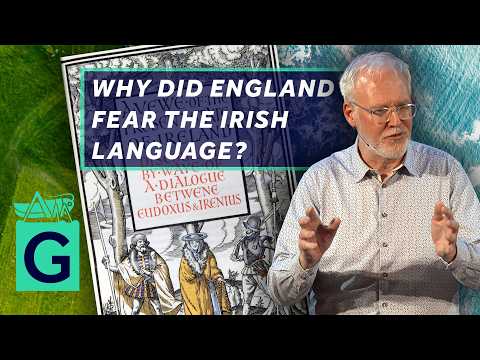
Language has always been a political tool, not just in terms of propaganda accompanying military conflict, but also in everyday human interaction. This phenomenon is universal and can be seen in contemporary events like the war in Ukraine, where the use of Ukrainian and Russian has been politicized. The lecture will explore the origins of negative stereotypes associated with the Irish language, aiming to partially absolve William Shakespeare of blame.
s1: The Decline of Celtic Languages
Multilingualism existed in the British Isles, with Germanic (English, Scots) and Celtic (Gaelic, Welsh, Cornish) language families. However, the proportion of Celtic language speakers dramatically decreased from approximately 50% around 1500 to about 10% by 1650, a decline linked to major political developments like the Union of Crowns. This shift occurred during Shakespeare's lifetime, a period when other languages were more prevalent than often recalled.
s1: English as an 'Unfamiliar' Tongue
Despite its later global dominance, English was considered 'unfamiliar' on the continent in the 16th century, as noted by John Florio. While spoken in the English Pale and parts of Scotland, its reach was not universal. This contrasts with the modern perception of English and highlights that its power and influence were still developing, influenced by political and social factors within the archipelago.
s1: Shakespeare's 'Henry V' and National Representation
Shakespeare's 'Henry V' famously features characters representing the four nations of Britain: Gower (English), McMorris (Irish), Jamie (Scottish), and Fluellen (Welsh). While intended to inspire unity, the play reveals linguistic complexities, such as Scotland's dual languages (Scots and Gaelic) and the Irish character McMorris's potential anglicized name derived from Anglo-Norman French. The play includes a line of Irish ('Kinolino') and a reference to howling in Irish, suggesting a complex, sometimes dismissive, view of non-English languages.
s1: McMorris's Identity and Anglo-Norman Roots
The Irish character McMorris in 'Henry V' is a fascinating figure whose name, 'Machm Murish,' is a Gaelicization of the Anglo-Norman French 'Fitz Morris.' This highlights the deep historical layers of linguistic and cultural influence in Ireland, stemming from the Anglo-Norman invasion. The character's passionate defense of his 'nation' against slurs underscores the complex and often contested nature of identity in this period.
Linguistic Hierarchy in Shakespeare
Shakespeare's plays, particularly 'Henry V', illustrate a hierarchy of languages, where English and French hold prestige, while Irish and Welsh are treated as politically subordinate, suggesting a potential commentary on the consequences of adhering to 'inferior' languages and the benefits of a unifying national tongue. This reflects broader European trends of linguistic standardization.
Caliban's Linguistic Grievance
In 'The Tempest', Prospero's castigation of Caliban for 'linguistic ingratitude' and Caliban's retort, 'You taught me language... and my profit in it is, I know how to curse,' powerfully represent the trauma of language loss and the complex, often painful, relationship between colonizer and colonized through language. This exchange underscores the idea that imposed language can be a tool of oppression, even as it grants new means of expression.
Medieval Roots of Irish Stereotypes
The negative portrayal of the Irish as wild, strange, and savage, often linked to their language and customs, did not originate with Shakespeare or the Tudors but has roots in 12th-century works like Gerald of Wales' 'Topographia Hibernica'. This discourse, influenced by classical Roman perceptions of barbarians, framed conquest as a moral imperative and laid the groundwork for enduring stereotypes.
The 16th Century 'War of Words' and Assimilation
The 16th century intensified the 'war of words' against the Irish language, with figures like Barnaby Rich and John Davies explicitly linking the Irish language and customs to barbarism and cannibalism. This rhetoric supported political aims, such as Henry VIII's 1537 Act for the English Order, Habit and Language, which sought to enforce linguistic and cultural conformity, marking a significant escalation in the drive for assimilation.
Plantation of Ulster and Linguistic Shift
The Plantation of Ulster in 1609, involving the London livery companies and the renaming of Derry to Londonderry, was a deliberate policy to reshape the region's demographics and culture. This initiative, alongside the broader political context of the Nine Years' War defeat and the Flight of the Earls, aimed to solidify English control and promote English language and culture, fundamentally altering the linguistic landscape.
Contrasting Attitudes: Ireland vs. America
In the late 16th and early 17th centuries, English attitudes towards Native Americans were often more positive and open to the possibility of reform than those towards the Irish. While Native Americans were sometimes seen as capable of civility, the Irish were frequently depicted as irredeemably savage, a contrast likely influenced by Ireland's perceived geopolitical threat compared to America's distance.
Irish Presence and Identity at Elizabeth's Court
Despite the prevailing anti-Irish sentiment, notable Irish figures like Hugh O'Neill and Donal O'Brien maintained a presence at Queen Elizabeth I's court, demonstrating complex bilingual identities. While some, like O'Neill, eventually led rebellions, others, like O'Brien, were lauded as 'truly English,' highlighting the fluid and often contradictory nature of identity and loyalty in this era.
The 'Age of Atrocity' and Lingering Complexities
While acknowledging the historical complexities and the 'Age of Atrocity' characterized by violence and animosity, the lecture concludes that identities and relations can exist beyond simplistic binaries. The enduring legacy of figures like Hugh O'Neill, described as 'too English for the Irish and too Irish for the English,' exemplifies the persistent challenge of navigating hybrid identities in the wake of linguistic and political conflict.
Ó Mainnín: Early Roots of Anti-Irish Language Sentiment
Concerns about the Irish language in England predate the 16th century, with evidence from the 14th century (Acts of Kilkenny). However, these earlier concerns were primarily directed at those of English descent in Ireland and did not gain significant traction. The 16th century marked a shift towards a broader, more concerted project against the Irish language as a whole, supported by figures like Spenser. This historical context is crucial for understanding the enduring negative stereotypes. The narrative of invasion is central to Irish mythology, influencing perceptions.
Geopolitical Fears Fueling 'Barbarian' Stereotypes
The English fear of Ireland, particularly its potential alliance with Spain, was a significant factor in the negative portrayal of the Irish language and people. Ireland's historical connection to Spain, including mythological origins and actual military support during rebellions like the Desmond Rebellions, made England perceive Ireland as a vulnerable flank susceptible to Spanish exploitation. This geopolitical anxiety directly contributed to the use of terms like 'barbarian' towards the Irish, a fear not present in their dealings with the Americas. The English consciousness was deeply affected by this perceived threat.
Ó Mainnín: The Shifting Identity of the Old English
By the 17th century, the 'Old English' in Ireland faced a crisis of identity, caught between loyalty to the crown and their Catholic faith, which was becoming a marker of division. Figures like Christopher Nent highlight this pressure, with Nent's writings reflecting the anxiety of descendants of the Old English who felt the changing political and religious landscape. The distinction between 'old' English (Catholic, long-settled) and 'new' English (Protestant, arriving in the 17th century) became significant, with the former facing different treatment due to their Catholicism and long history in Ireland. This period marks a crucial shift in their perceived identity and allegiance.
Ó Mainnín: The Double-Edged Sword of English Acquisition
In the 17th century, English became increasingly associated with privilege and power, making its acquisition a political and social necessity for the Irish seeking upward mobility. While many Irish people learned English, this trend was viewed with scorn by some, like Davio Brdair, who saw it as people 'getting above their station.' This reflects a complex ambivalence: English was a tool for survival and advancement, yet its adoption also represented a perceived loss of cultural identity and a departure from traditional values. Later figures like Daniel O'Connell would also grapple with the utilitarian benefits of English over Irish, reflecting a growing pragmatism.