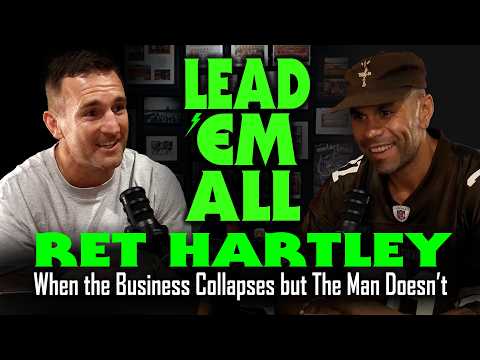
Episode 36 – Ret Hartley: When the Business Collapses but The Man Doesn’t
The Power of Environment and Culture
Hartley draws a parallel between personal growth and the success of sports teams like the Melbourne Storm, emphasizing that individuals become products of their environment. He aims to cultivate a similar 'winning culture' within 'Doghouse' by surrounding men with those committed to improvement and accountability.
Merchandise as a Motivator
Hartley plans to incorporate merchandise into 'Doghouse,' with some items being purchasable and others earned through commitment and progress. This gamified approach aims to provide tangible recognition for personal achievements within the program.
Lessons from S30's Administration
The collapse of his previous business, S30, into administration and liquidation was a significant learning curve for Hartley. He highlights the difficulty of navigating millions of dollars in financial complexities and the emotional toll of business failure, especially when it involves strained relationships with co-founders.
Transitioning from Sport to Fitness
After a rugby injury ended his professional aspirations, Hartley pursued a career in exercise science. He initially aimed to help people with bodybuilding but soon realized his passion lay in broader movement and fitness, leading him to personal training and entrepreneurship.
The 'Dump Truck' Training Method
Hartley recounts an old-school training method from his early career where he rapidly gained 20kg in three months by consuming large, high-calorie meals and undergoing intense, repetitive training. This included weighted vest treadmill sessions to prepare his nervous system for increased load.
The 'If You Build It, They Will Come' Mentality
Hartley reflects on the principle of 'if you build it, they will come,' noting how clients followed him from a gym to his own studio, willing to pay more. This validated his approach and the strong connection he had built with his clientele.
The Art of Client Connection
Hartley attributes his success as a trainer to genuinely caring about his clients as people, taking the time to understand their interests and lives. This approach fosters trust and makes clients feel valued beyond just their physical training.
Training as an Avoidant Behavior
Hartley admits to using the gym as an 'avoidant space' during times of personal frustration or difficulty. While the gym can be a safe haven, he acknowledges that over-reliance on it can be a way to escape rather than confront underlying issues.
Strategic Client Scheduling
Hartley learned to schedule draining clients earlier in the day to avoid projecting negative energy onto his partner. This shift also led him to attract more corporate clients and CEOs, refining his business model based on energy management and client profiling.
The 'Doghouse' Name Rationale
Hartley explains the name 'Doghouse' by subverting its negative connotation. Instead of being banished, men in the program are in a tough, challenging space together, finding strength and support in shared adversity.
The S30 Model: Community and Experience
S30 differentiated itself by focusing on community, custom music, unique programming (e.g., artist vs. artist workouts), and a strong emphasis on knowing members' names. This created a sense of belonging and loyalty, extending member lifespan beyond typical gym models.
Doghouse: Community and Accountability
Hartley envisions 'Doghouse' as a community where men hold each other accountable, rather than relying solely on him. This peer-to-peer support system is designed to foster belonging and drive collective progress.
The Bottleneck of Scaling
Hartley identifies rapid scaling as a potential bottleneck for businesses, citing F45's aggressive expansion. He believes that without proper systems and a clear strategy for growth, rapid expansion can lead to dilution of quality and operational challenges.
The Importance of Hiring the Right People
Hartley stresses the difficulty of hiring and managing people, particularly when positive attributes might mask fundamental unsuitability for a role. He advocates for a 'hire fast, fire fast' approach when necessary, prioritizing the business's needs over prolonged, unproductive relationships.
Navigating Business Partner Disagreements
Hartley shares the challenges of disagreements with business partners, particularly regarding strategic decisions like social media presence. He learned the importance of asserting his vision and communicating it clearly, rather than avoiding conflict.
Community and Shared Experience
Hartley highlights the value of community and shared experiences, drawing parallels to his past in sports teams. He believes that being around like-minded individuals who support each other's success is crucial for personal and collective thriving.
Targeting Men Aged 30-45
Hartley's 'Doghouse' program specifically targets men aged 30-45, a demographic often experiencing significant life shifts like starting families, breakups, or career changes. He aims to provide structure and support during these transitional periods.
The Value of a Morning Routine
Hartley emphasizes the critical role of a structured morning routine for mental clarity, emotional regulation, and productivity. He finds that quiet time for reflection, setting intentions, and physical activity significantly reduces stress and enhances his overall well-being.
The 'Just Start' Philosophy
Hartley champions the idea that one doesn't need to be perfect to begin; the crucial step is simply to start. This applies to personal development, business ventures, or any new endeavor, acknowledging that initial imperfection is part of the learning process.
The Impact of Cultural Identity
Hartley reflects on his Māori upbringing and the challenges of navigating a predominantly English-speaking education system. He believes this experience, while difficult, fostered a unique thought process and resilience, shaping his identity and drive.
Optimism as a Lost Art
The host praises Hartley's optimism, calling it a 'lost art' in a world quick to focus on negatives. Hartley believes in choosing to see the positives and move forward, rather than dwelling on setbacks or playing the victim.
The 'Doghouse' Reset Program
A four-week 'Doghouse' reset program is planned, focusing on character, clarity, and commitment, particularly for fathers. This initiative aims to provide a structured pathway for men to reconnect with themselves and build a supportive network.
Gratitude for Self vs. Others
Hartley distinguishes between gratitude for external factors and gratitude for oneself. He advocates for the latter, seeing self-gratitude as essential for filling one's own cup, which then allows for better contribution to others, such as being a present father.