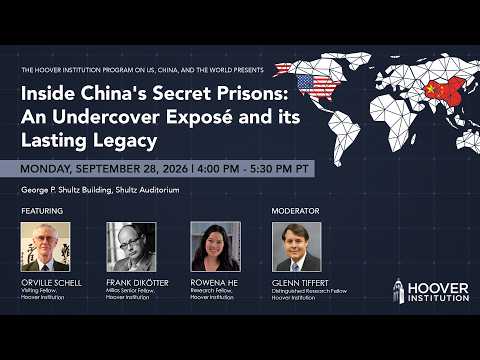
Orville Shell recounts the decades-long journey of his book, initially commissioned by 60 Minutes, which he initially deemed impossible to execute due to the inaccessibility of China's prisons. The project was revived years later, spurred by renewed global attention on human rights in China and Shell's own reduced career concerns.
Rowena Hua: The Pervasive Nature of Fear
Rowena Hua describes how fear, particularly for those with family in China, has become a pervasive and paralyzing force, impacting scholars and individuals. She notes that the 'red line' for acceptable discourse is not fixed but constantly shifting, creating an environment where self-censorship is a survival mechanism, leading to a profound personal cost.
Frank Data: Historical Roots of China's Penal System
Frank Data historicizes China's prison system, noting that while modern penal concepts were introduced before 1949, the Mao era saw a massive expansion of the Gulag system. This system, characterized by forced labor and ideological reform, has not fundamentally changed, even with modernization, and continues to operate at an enormous scale, comparable to or exceeding historical precedents.
Chinchung Prison: A Microcosm of Idealism and Repression
Chinchung Prison, which held political prisoners like Jiang Qing and Tiananmen student leaders, became a site where idealism clashed with repression. Students, despite their incarceration, engaged in intellectual pursuits and recited poetry, symbolizing a longing for freedom that persisted even in the bleakest conditions. This highlights the enduring human spirit against oppressive regimes.
The CCP's Narrative Control and Global Influence
The CCP actively controls narratives both inside and outside China, leveraging propaganda and institutions like Confucius Institutes to shape perceptions. They exploit Western guilt over historical imperialism and conflate the Party with Chinese culture and people, a tactic that influences scholars and journalists who may inadvertently amplify CCP-friendly stories for personal gain.
Thought Reform: Engineering the Human Soul
Mao Zedong's addition of 'thought reform' to the penal system, inspired by Stalin, aimed to engineer the human soul and create a 'new human being.' This involved not just labor but also intense self-criticism and confessions, forcing prisoners to internalize blame and accept the Party's ideology as the only path to potential release, profoundly impacting psychological well-being.
Generational Trauma and the Xi Jinping Example
The CCP's system fractures families, as seen with Xi Jinping's father's persecution, leading to profound generational trauma. Xi's own upbringing, marked by his father's 'counterrevolutionary' label and his sister's suicide, forced him to adopt extreme loyalty to the Party to overcome his 'spawn of a counterrevolutionary' status, illustrating how personal history shapes political ideology.
China's Political Levers: Critical Minerals and Global Chokeholds
China leverages its control over critical minerals and rare earth elements as a significant political tool, creating global chokeholds that influence even powerful nations like the United States. This economic leverage forces leaders, such as Donald Trump, to yield to CCP demands, mirroring the way individuals within China are compelled to submit to the Party's will.
The Lingering Scars of China's Carceral Regime
China's extensive penal system, characterized by extra-judicial detention and forced labor, inflicts deep and lasting trauma on individuals, families, and communities, leaving physical, psychological, and social scars that can persist for generations. This system has been a continuous feature since 1949, and under Xi Jinping, it has seen a resurgence with intensified fervor.
CCP's Survival: A Question of 'Truth-Telling'
The Chinese Communist Party's totalitarian system, built on a monopoly of power and information, cannot survive genuine 'truth-telling' about its actions. The system's foundation relies on suppressing dissent and controlling thought, a presumption that has deep historical roots and was reinforced by Leninism.
The False Assumption of Economic Reform Leading to Democracy
A long-held assumption that economic development in China would inevitably lead to political democratization has proven false. The CCP's model of authoritarianism and state capitalism, where the middle class depends on the regime, has not fostered independent political reform, and the party has never intended to move in that direction.
Exporting Surveillance and Control: China's Global Reach
China is actively exporting its surveillance and control technologies, honed in Xinjiang, to other countries. While few nations possess the state capacity and ideological drive of China, this export of repressive tools, amplified by COVID-19, poses a significant global threat, mirroring the export of its surveillance systems.
Human Rights as the Antidote to Authoritarianism
The core solution to many of China's problems lies in establishing human rights and equal rights for its citizens. This would prevent issues like unfair pricing and exploitation, fostering fair pay and a just system, thereby countering the CCP's push of its values onto democratic nations.
Transnational Repression and Silencing Dissent Abroad
The Chinese government actively engages in transnational repression, targeting dissidents and their families both within China and abroad. Examples include disappearances at airports, threats to family members, and preventing citizens, even US citizens, from leaving China, creating a climate of fear that extends beyond its borders.
The CCP's Fear of Narrative
The Chinese Communist Party (CCP) fears narratives and historical truths more than anything, as these are intrinsically linked to its legitimacy. Exposing past atrocities like the Tiananmen Square massacre, Cultural Revolution, and Great Famine could shift public opinion domestically and internationally, thereby threatening the CCP's grip on power. Therefore, preserving and telling these truths is crucial.