Israel crumbling, Bibi missing, American bases leveled. What they won't tell you on the news.
Host: Entering an Era of Empire in Decline
The speaker posits that the world is entering a new era characterized by the decline of empires, unlike anything previously observed. This decline is exacerbated by propaganda, censorship, and a lack of independent journalism, making it difficult to discern the truth about current global conflicts.
Host: Israel's Imminent Collapse
The host expresses a strong conviction that Israel is on the verge of collapse, having 'overplayed its last hand.' This sentiment is presented as a source of optimism amidst the chaos, suggesting that Israel's current actions will lead to its downfall.
Host: US Military Overextension and Vulnerability
The speaker argues that the US military presence in the Middle East is critically compromised, with bases evacuated and radar systems hit. This vulnerability, coupled with depleted missile stockpiles, suggests the US is overextended and may never return to these bases, signaling the potential end of the American Empire.
Host: Iran's Missile Arsenal and Asymmetric Warfare
Contrary to official narratives, the host asserts that Iran possesses a vast arsenal of missiles and drones, including extensive underground facilities. This capability allows Iran to wage effective asymmetric warfare, depleting US resources with cheap, mass-produced drones and advanced missiles, rendering expensive US defenses obsolete.
Host: US Military-Industrial Complex Greed
The speaker criticizes the US military's focus on building expensive, high-tech 'toys' for profit by the military-industrial complex, arguing these are ineffective in actual combat against asymmetrical threats like those posed by Iran. This pursuit of profit, driven by greed, has led to a military ill-equipped for modern warfare.
Host: Iran's Nuclear Ambitions and US Deception
The host suggests Iran is developing a nuclear weapon, partly due to the US killing a religious leader who opposed it. The speaker also accuses the White House of deceptively editing testimony to falsely imply Iran was building a nuke, highlighting a perceived manipulation of information regarding Iran's nuclear program.
Host: Iran's Decentralized Military Strategy
Iran's military was intentionally decentralized into 31 states to prevent decapitation strikes from crippling its command structure. This strategy allows individual units to operate autonomously on autopilot, ensuring continued resistance even if leadership is targeted, making Iran resilient to conventional military tactics.
Host: Iran Holds Cards via Gulf Infrastructure Threat
Iran's true leverage lies in its ability to cripple the global economy by targeting vital oil and water infrastructure in the Gulf states. The speaker argues that US inability to defend these assets, coupled with Iran's strategic strikes on military targets, leaves the US and its allies vulnerable and Iran in a position of power.
Host: US Censorship of Casualties and Damage
The speaker alleges that both the US and Israel are actively censoring information about casualties and the extent of damage sustained in the conflict. This censorship is seen as an attempt to hide the true severity of the situation and the ineffectiveness of their military actions.
US Bases Under Siege
Multiple US military bases across the Middle East, including those in Qatar, Jordan, Kuwait, Bahrain, Saudi Arabia, and the UAE, have reportedly sustained significant damage or outright destruction due to Iranian strikes. This includes critical radar systems like THAAD and Patriot, which are vital for missile defense. The presenter emphasizes that these attacks have rendered key infrastructure unusable and costly to repair, questioning the effectiveness of US defense systems.
The Billion-Dollar Radar Debacle
A specific AN/FPS-132 radar system, costing $1 billion and taking eight years to rebuild, located near Al Udeid Air Base, has been destroyed. This radar is one of only six globally and the only one in the Middle East, possessing the largest range of any US radar system. Its destruction, allegedly by a $50,000 drone, represents a massive cost-effectiveness disparity and a significant blow to US defense capabilities.
China's Strategic Advantage
As the US military's modern war plans and technological responses are observed in high definition through new satellite systems, China is gathering invaluable data. This intelligence allows China to understand American military capabilities, resource expenditure, and operational tactics, feeding into their AI models. The presenter suggests China is patiently waiting, poised to gain a significant future military advantage over the US.
Destruction of Middle Eastern Radar Networks
Beyond the primary $1 billion radar, smaller, less expensive THAAD radars (costing $300-500 million each) in Jordan, UAE, and Saudi Arabia have also been destroyed. Satellite imagery reportedly shows these sites, including Rui's base and Elsado base in UAE, Salty Air base in Jordan, and Prince Sultan Air Base in Saudi Arabia, as charred and obliterated. This leaves only one remaining radar in Israel, severely compromising regional early warning capabilities.
Strait of Hormuz Closure and Economic Fallout
Iran's declaration to fire on tankers has led insurance companies to stop covering passage through the Strait of Hormuz, effectively shutting down oil transit. This closure, coupled with Iran's demand for oil transactions in Yuan, directly challenges the US dollar's dominance in the petrodollar system. The presenter warns this could trigger a global recession and food shortage, as 20 million barrels of oil per day are at risk, far exceeding previous crisis levels.
Car Island Bombing and Global Impact
The bombing of Car Island, a key Iranian oil storage and export hub, by Trump is noted. While Trump claimed only military assets were hit, the presenter argues this action, combined with the Strait of Hormuz closure, exacerbates global economic instability. Destroying Car Island's oil infrastructure would further shock global oil markets, contributing to recession and food shortages, as oil and fertilizer reliant on petroleum products are disrupted.
The Case Against Israel
The presenter argues that Israel is the primary aggressor and a 'global terror state' that needs to be disarmed and neutralized. They contend that Israel's actions provoke wars, engage in blackmail and disinformation, and that its 'grip on the world' must be eliminated for world peace. The loss of Israel in this conflict, according to the presenter, could usher in a new, better age, whereas an Israeli victory would be catastrophic for the world.
US Military Deployment and Intimidation
The US is reportedly preparing 5,000 Marines for potential operations, possibly to seize Car Island or secure the Strait of Hormuz coastline, or as an intimidation tactic against Iran. However, the presenter believes Iran is not intimidated and is 'waiting for it,' suggesting the deployment is unlikely to deter them and may even be welcomed.
Host: Israel's crumbling defenses
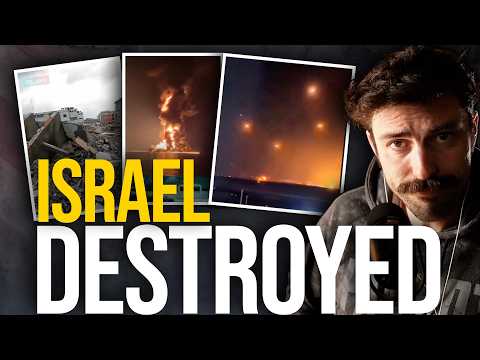
The host asserts that initial videos of Israel's air defense systems intercepting rockets have ceased, replaced by footage of cluster rockets raining down. This suggests a significant degradation in Israel's defensive capabilities, contrary to what is being reported.
Host: Authenticity of war footage
The host acknowledges the difficulty in verifying video authenticity but argues that even if some footage is fake, the underlying reality of Iranian cluster munitions breaking into multiple warheads and overwhelming defenses remains accurate. The failure of early warning and interceptor systems is presented as a factual consequence.
Host: Israel's strategic disadvantage
The host emphasizes that while the US can retreat, Israel, being a small nation, is a 'sitting duck' with no strategic retreat option. Their only recourse is to complain about war crimes, which the host finds ironically hypocritical given Israel's past actions.
Host: Iran's targeted strikes and intel
The host reports unverified claims that Iran is launching strikes on specific Israeli leaders and facilities, supported by detailed intelligence from China's advanced satellite and radar imagery. This suggests a sophisticated, intelligence-driven campaign.
Host: Netanyahu's potential AI-generated appearance
The host speculates that a recent video of Benjamin Netanyahu in a coffee shop might be AI-generated due to inconsistencies like a static coffee cup, unusual pocket artifacting, and a suspiciously perfect 60-second duration, raising questions about his well-being and public appearances.
Host: Strait of Hormuz vulnerability
The host details how the narrowness and depth of the Strait of Hormuz, combined with Iran's proximity and arsenal of drones, mines, and missiles, make it an easy target. Sinking even one oil tanker could shut down global trade, creating a significant economic crisis.
Host: Asymmetrical warfare and cost
The host argues that Iran can inflict massive economic damage with minimal cost through asymmetric warfare, while the US faces high costs and low tolerance for casualties. This imbalance means Iran can 'suffer more damage' and still achieve strategic objectives, making a prolonged conflict disadvantageous for the US.
Host: Geopolitical beneficiaries of conflict
The host suggests that Russia is profiting immensely from the conflict by lifting oil sanctions, and China is gaining military advantages and securing oil supplies, potentially using the distraction to advance on Taiwan. This implies the conflict serves broader geopolitical interests beyond the immediate belligerents.
Host: Iran's denial of US aggression
The host presents a statement from Iran's President Ali Larijani denying any intention to attack America and labeling any strike on US soil as an Israeli false flag operation. This is framed as Iran calling out the US and Israel's potential provocations.
Host: The inevitability of hard times
The host concludes that the world is entering a period of 'hard times' that will forge 'hard people,' likening the coming decade to a more challenging era than the 1990s. The hope is for Israel's demise and the end of its 'cabal of global influence.'
A Plea for Personal Virtues
The speaker concludes by urging viewers to practice kindness, express love to their families, and be good people. They also emphasize the importance of prayer for the world and for Tucker Carlson, framing it as a necessary action in uncertain times.
Defending Tucker Carlson
The speaker expresses strong support for Tucker Carlson, suggesting that if he faces arrest for his work, he should immediately announce a presidential run. This move is framed as a way to rally support and challenge perceived injustices against him.
Information as a Catalyst
The speaker posits that information is vital for societal change, suggesting that even a fraction of the available 'evidence' could be enough to dismantle the current paradigm and transform the planet. This implies a belief in the power of hidden truths to effect radical change.