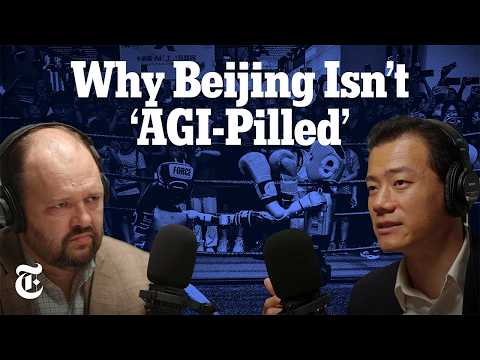
The U.S. and China Are Not In An A.I. Race | Interesting Times with Ross Douthat
Douthat: State vs. Industry in China
In contrast to the lightly regulated US tech environment, China's AI industry operates under the strict control of the Communist Party state, which sets rules, enforces content censorship, and requires pre-registration of models. This top-down guidance, however, is balanced with efforts to foster competition and innovation among Chinese AI labs and tech giants, avoiding the complete failure of previous rigid, top-down technological approaches.
Chan: China's Chip Constraints & Huawei's Role
US export controls on advanced semiconductors create a significant constraint for China's AI development, limiting access to cutting-edge chips like those from Nvidia. This forces Chinese companies, including giants like Huawei, to focus on efficiency and develop domestic alternatives, though these are not yet as powerful. The situation highlights China's dependence on a global supply chain involving Taiwan and the Netherlands, and their struggle to replicate advanced chip fabrication.
Chan: China's Energy Advantage
While the US faces energy bottlenecks for data centers, China possesses a significant advantage due to its rapid buildout of clean energy infrastructure (solar, wind, batteries). They strategically leverage this abundant energy, particularly in western provinces, to power their growing compute and AI development, addressing a key limitation faced by American AI companies. This positions China to potentially overcome compute limitations through energy resources.
Chan: China's Anxiety: Falling Behind
In contrast to US anxieties about AI's existential risks and job displacement, China's primary public and national anxiety revolves around falling behind technologically. This fear is amplified by a hyper-competitive labor market, especially for young graduates facing high unemployment, who worry that lacking AI proficiency will hinder their competitiveness. This mirrors national concerns, stemming from events like AlphaGo's victory, about not capitalizing on transformative technology.
Douthat: Welfare State Debate in China
While the US debates adapting its welfare state for AI-driven unemployment, China, historically lacking a robust safety net outside state-owned enterprises, is beginning to discuss potential policy responses to AI job displacement. This discussion is emerging as the traditional 'iron rice bowl' security erodes, prompting consideration of welfare and policy measures, though it remains in early stages.
Chan: AI Companions and Social Concerns
Chinese leaders are deeply concerned about AI's social effects, particularly AI companions potentially becoming time sinks for youth, diverting them from productive endeavors like innovation and entrepreneurship. This echoes past crackdowns on video games and private tutoring, viewed as wasteful activities. The government is actively regulating AI companions, reflecting a desire to channel youth energy into national development goals.
Chan: Robotics as a Solution to Labor Shortages
China's shrinking workforce and declining birth rates necessitate solutions for maintaining manufacturing competitiveness. AI and robotics, including humanoid robots, are seen as crucial tools to automate production, fill labor gaps, and enable the country to move up the value chain, producing higher-value goods despite workforce limitations. This positions robotics as a key strategy for future economic growth.
Espionage and Distillation: China's AI Catch-Up Tactics
While not outright IP theft, Chinese AI labs may be using unauthorized distillation of American AI models to improve their own capabilities, particularly in areas like coding. This practice, though not a direct secret-stealing operation, represents a form of competitive advantage.
US Policy: Stepping Back from the Reckless Race
The US should step back from an 'all-out race' mentality, as it drives recklessness and overlooks potential risks like cyber and biosecurity threats. Focusing solely on AGI competition might lead to neglecting essential safeguards and regulations.
Medium Risks: Cyber and Biosecurity Over AGI
While AGI risks are often overblown, cyber and biosecurity risks associated with AI are significant and potentially underestimated. These 'medium' risks warrant maintaining current export controls and a cautious approach to engagement.
Low Trust Hinders AI Arms Control
Meaningful AI arms control negotiations between the US and China are unlikely due to extremely low mutual trust and unwillingness to submit to invasive verification. Progress is more likely in areas of shared risk, like rogue AI or non-state actor threats.
Chan: Waiting for Disaster?
Kyle Chan worries that both the US and China might be waiting for a significant AI-related incident to occur before taking action or even initiating discussions on how to manage AI risks. This reactive approach could be perilous.