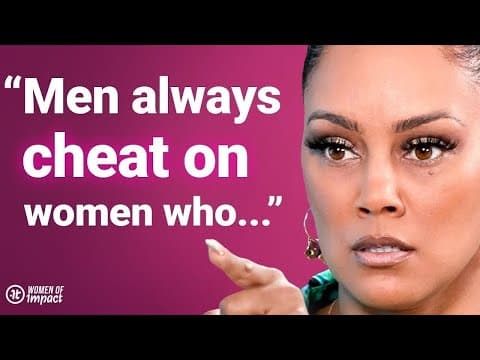
"I Coach Cheating Men" - 5 Signs He’s Absolutely Cheating & Why Women Always Miss It! | Dr. Bryant
Women's Tendency to Choose Potential Over Reality
Women often fall in love with the man they believe their partner could become, a 'fairy tale ideology,' rather than the man he is. This leads them to choose partners with a history of broken relationships, setting themselves up for heartbreak because past results are the only reliable predictor of future behavior.
Men's Accountability vs. Women's Excuses
Dr. Bryant observes that men in her practice often take accountability for cheating by saying 'It's not her, it's me,' whereas women tend to blame external factors like lack of affection. She notes that while some men are genuinely accountable, others use this phrase manipulatively to deflect blame.
The 'Dog Analogy' for Tolerating Bad Behavior
Comparing a cheater to a dog that barks, Dr. Bryant argues that women who stay with unfaithful partners learn to 'love the dog' and become its 'dog sitter,' sacrificing their own well-being. This normalization of bad behavior leads to self-starvation and a deficit in self-worth.
Fatherless Women and Dysfunctional Norms
Dr. Bryant suggests that women raised without a father figure may develop dysfunctional relationship norms, making them vulnerable to womanizers. Their 'blank canvas' for relationships can lead to choosing partners based on 'eeny, mini, miny, mo,' perpetuating cycles of dysfunction.
Self-Ownership as the Ultimate Power
Lisa Bilyeu emphasizes self-ownership as the key to empowerment, asserting that women must trust their intuition and discernment. Acting out of despair leads to missing red flags, while operating from a place of power makes one 'clairvoyant' to potential issues.
The Power of Standing in Your Truth
Standing in one's truth means identifying who you are and what you want, regardless of societal pressures. A woman in her power doesn't seek validation but commands respect, with the environment naturally aligning to her presence.
The 'Cheetah vs. Dog' Dilemma: Change vs. Nature
While behaviors can change, a person's core nature does not. Dr. Bryant uses the analogy of a dog still being a dog, even if it doesn't bark often. Similarly, a cheater may learn discipline but the appetite for infidelity can remain, making repeated offenses statistically probable.
The Deception of Infidelity is the Core Wound
Both Dr. Bryant and Lisa Bilyeu agree that the primary wound from infidelity for women is the deception and betrayal of trust, more so than the physical act itself. This deception can shatter a woman's sense of reality and self-worth.
Non-Negotiables as Self-Protection
Lisa Bilyeu explains her strict non-negotiables (like no hitting or cheating) as a form of self-protection, stemming from a fear of defaulting to her natural inclination for forgiveness. Setting these boundaries prevents her from compromising her well-being.
Choosing Partner Based on Results, Not Promises
Dr. Bryant advises women to evaluate potential partners based on their past results and actions, not their promises. If a man has a history of infidelity or broken commitments, it's a strong indicator of future behavior, and believing one can change him is a 'fairy tale ideology.'
Transparency vs. Honesty in Relationships
Dr. Bryant distinguishes between honesty (answering direct questions truthfully) and transparency (forthcoming with information). She argues that transparency builds trust, as it involves proactively sharing relevant details, whereas honesty alone can be misleading.
Password Access as a Commitment Indicator
Dr. Bryant suggests that offering full access to phones and computers early in a committed relationship is a way to gauge a partner's transparency and honesty. Refusal can be a red flag, indicating a potential lack of commitment or something to hide.
The Risk of 'Shrinking' Oneself in Relationships
Lisa Bilyeu warns against women 'shrinking' themselves by compromising their desires or non-negotiables to fit into a relationship, especially as they age. This often stems from fear or a desire to fill a perceived void, leading to dissatisfaction and regret.
Choosing the Person, Not the Season
Dr. Bryant advises choosing a partner based on who they are intrinsically ('you') rather than their current status or what they offer in a specific life phase ('the season'). This ensures commitment is to the individual, not their circumstances.
Creating vs. Waiting for What You Want
Dr. Bryant advocates for actively 'creating' one's desired reality rather than passively waiting for it. This involves putting oneself in aligned social situations and being transparent about intentions to manifest the desired partnership.
The Power of Creating Space vs. Shrinking
Dr. Bryant contrasts women who 'shrink' themselves to fit relationships with those who 'create space' by being filled with self-love and purpose. The latter attract partners from a place of power, not deficit, leading to healthier, interdependent connections.
Solitude as Preparation for Partnership
Embracing solitude is presented not as isolation, but as a crucial period for self-discovery and preparation. This self-knowledge builds a strong foundation, enabling women to become better, more interdependent partners rather than codependent ones.