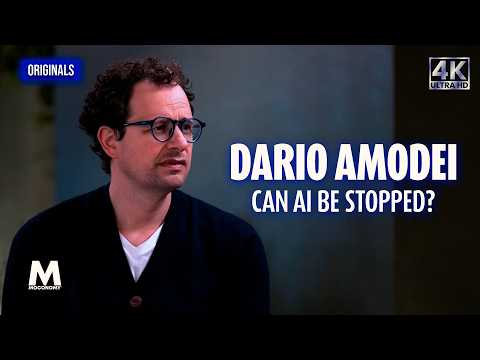
Inside the Mind of Anthropic CEO Dario Amodei | Full documentary | 4K
Amodei on Leaving OpenAI: Trust and Values
Dario Amodei left OpenAI not solely due to disagreements on safety protocols, but primarily because of a fundamental lack of trust and perceived dishonesty regarding values and behavior patterns. He emphasizes that while disagreements on safety are valid and common, a breakdown in trust makes continued collaboration untenable. The resolution, in such cases, is for parties to pursue their own paths and let market and public opinion determine success.
Anthropic's Enterprise Bet: Values Over Addiction
Anthropic deliberately chose an enterprise-focused business model over consumer apps to align with its core values and avoid the pitfalls of engagement-maximizing, addiction-inducing consumer platforms. This strategy focuses on making AI useful for critical applications like curing diseases, improving energy efficiency, and advancing education, which are inherently enterprise-driven. This approach fosters trust and long-term relationships, contrasting with the often gimmicky nature of consumer tech and ensuring the business model supports, rather than conflicts with, Anthropic's mission.
Amodei on AI's Impact on Software: Adaptation is Key
The rapid advancement of AI, exemplified by Claude Co-work, will significantly disrupt traditional software companies by eroding moats based on complex coding. While customer relationships, domain expertise, and unique know-how will remain valuable, companies that fail to adapt and embrace AI's capabilities risk obsolescence. Amodei predicts the overall software industry will likely grow due to AI's expansion, but substantial 'losers' will emerge among those who remain complacent.
Dario Amodei: Navigating Investor Agendas
Despite significant investments from major tech players like Amazon and Google, Dario Amodei asserts that Anthropic maintains its independence and voice. He points to his outspokenness on issues like export controls for AI chips to China, even when it conflicts with investor interests, as proof of their autonomy. Amodei believes that as long as Anthropic remains a valuable partner and delivers on its commitments, these relationships can coexist with strategic disagreements.
Amodei on Compute Demand: Planning for Explosive Growth
Anthropic's substantial compute deals are a rational buffer against the uncertainty of AI's rapid growth, which has exceeded even their aggressive 10x annual planning. The company experienced over a 3x quarterly revenue growth, projecting an annualized growth rate that could reach 80x, necessitating significant compute resources. While this explosive demand creates short-term strain, Amodei is confident in the market's ability to supply compute, albeit with potential delays, as demonstrated by recent deals with Google and Amazon.
Dario Amodei: Navigating Growth and Values
As Anthropic scales, maintaining its core values and 'will to win' commercially presents a dual challenge. Amodei emphasizes that the company's success in developing advanced models enables them to assert their values, but rapid hiring from Big Tech requires constant reinforcement of Anthropic's unique culture to prevent the dilution of its principles. Preserving this culture is a top priority for leadership.
AI and the Future of Work
Dario Amodei warns of significant job disruption from AI, potentially eliminating many entry-level white-collar jobs. While acknowledging the immediate productivity gains, he stresses the need for proactive policy responses, such as 'token taxes' and macroeconomic adjustments, to manage the transition and prevent widespread unemployment and inequality. He advocates for a positive, adaptive approach rather than succumbing to 'doom is coming' narratives.
Amodei Defends AI Job Loss Warnings
Dario Amodei strongly refutes claims that his warnings about AI-driven job loss are 'doom marketing' or mere 'cheap marketing.' He argues that such criticisms stem from laziness and a failure to engage with his detailed analyses, which include proposed solutions and distinctions between tasks and jobs. He insists on the necessity of a mature, serious conversation about AI's societal impact.
Anthropic's Military Contract Rationale
Dario Amodei explains Anthropic's contract with the Department of Defense by citing the need for the US to defend itself against aggressive authoritarian powers like Russia and China. He believes a stronger US military, augmented by AI, deters war. However, he insists on maintaining ethical red lines, such as against mass surveillance and fully autonomous weapons, arguing that democracy's victory is not worth compromising core values.
Amodei on AI in Warfare and Ethics
Regarding AI's role in military operations, Amodei supports the US's enhanced military capability as a deterrent but emphasizes that policy decisions on specific operations should rest with military leaders. He reiterates Anthropic's commitment to high-level ethical boundaries, ensuring AI use aligns with core values and doesn't undermine democracy, even if it means refusing certain contracts or collaborations.
Amodei on Mythos: A 'Super Weapon' Requiring Safeguards
Dario Amodei reveals that Anthropic's Mythos model demonstrated a significant leap in identifying and exploiting vulnerabilities, leading some early testers to label it a 'super weapon.' He stresses that Mythos is not yet ready for general release due to insufficient cyber safeguards, which can be 'jailbroken.' Anthropic is gradually opening access with strong cyber protections, aiming for a more secure internet ecosystem in the future.
Debunking Mythos Replication Claims
Dario Amodei vehemently refutes claims that Mythos's capabilities can be replicated by open-source models, calling such assertions 'incredibly false.' He clarifies that Mythos's strength lies in its ability to scan entire codebases for vulnerabilities, a feat current open-source models cannot match. He cites the discovery of 271 new vulnerabilities in Firefox as evidence of Mythos's unique and powerful capabilities.
Amodei: AI's Private Sector Origin is Unstable
Dario Amodei argues that AI is the first powerful technology primarily developed in the private sector, unlike historical precedents like nuclear weapons or the internet which originated with governments. He views this as an 'unstable situation' and advocates for robust checks and balances on both AI companies and government power, suggesting a need for regulation, pre-release testing, and auditing of AI models.
Amodei on China: Geopolitical Concerns and AI Dystopia
Dario Amodei expresses geopolitical concerns regarding China, citing the suppression of dissent and human rights issues like the treatment of Uyghurs. He fears that the combination of AI with an authoritarian high-tech state could lead to a '1984 or worse' dystopia, but believes AI also holds potential as a pro-democracy technology that can enhance freedom and justice if developed responsibly by companies and governments.
Dario Amodei: The Smooth Exponential of AI
Dario Amodei describes AI development not as a sudden moment of self-improvement, but as a continuous, accelerating exponential process. He warns against extreme reactions, like calls for nationalization or complete shutdowns, advocating instead for a measured approach where safety measures 'smoothly ratchet up' with the technology's power, emphasizing the need for gravitas and maturity in addressing AI's challenges.
Dario Amodei: The Unpredictability Dilemma
The inherent unpredictability of advanced AI models presents a constant dilemma, where efforts to mitigate risks are ongoing but never fully eliminate the possibility of unintended consequences. Amodei likens this to airline safety, where even a 10x safer airline is still not 100% crash-proof, but a 25% crash probability is unacceptable. The goal is to make the probability of AI-related harm as low as possible, acknowledging that zero risk is an unattainable ideal.